1257L Tax Code Guide: How to Calculate Take-Home Pay, Fix Emergency Codes, and Claim Refunds
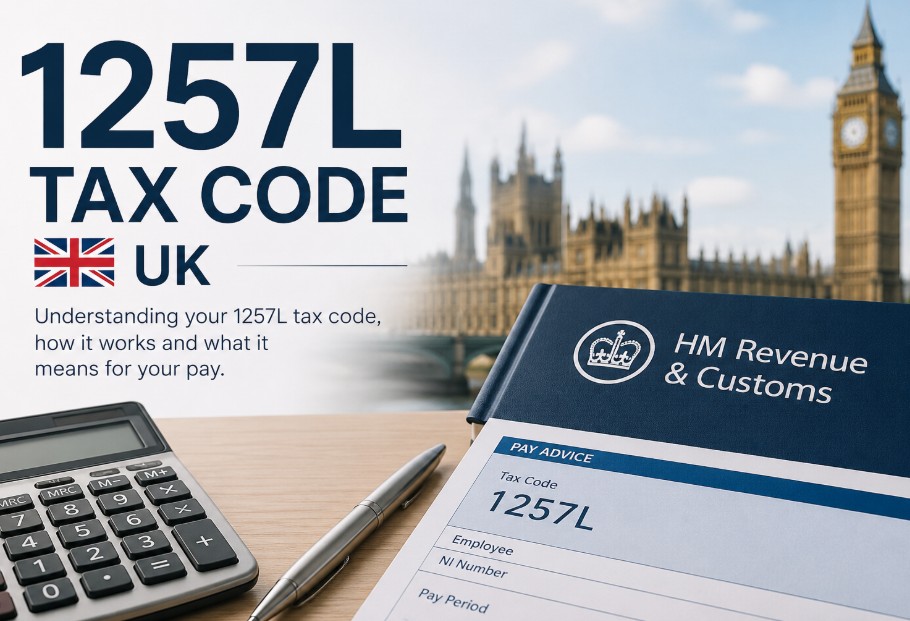
The 1257L tax code is the standard UK Pay As You Earn (PAYE) code set by HM Revenue & Customs (HMRC). It gives employees and pensioners a tax-free Personal Allowance of £12,570 per tax year. Any earnings over £1,047.50 a month or £241.73 a week are taxed at standard UK Income Tax rates.
Key Takeaways
- The 1257L tax code grants the UK baseline tax-free Personal Allowance of £12,570 allocated evenly across weekly or monthly pay periods.
- Monthly income up to £1,047.50 remains untaxed under cumulative 1257L calculations before standard tax bands are applied to remaining earnings.
- Suffixes W1 and M1 signal non-cumulative emergency tax tracking where each pay period is assessed independently without year-to-date balancing.
- Discrepancies in coding notices should be reported directly through the HMRC Personal Tax Account to correct overpayments and secure refunds.
What is a Tax Code?
A UK tax code is an alphanumeric identifier issued by HMRC to employers and pension providers. It dictates how much tax-free income an individual receives during a tax year and instructs payroll software on the exact amount of Income Tax to deduct automatically through the PAYE system.
A tax code combines numbers and letters to reflect your specific personal circumstances. It informs payroll software of your annual tax-free entitlement, highlights regional tax rules (such as Scottish or Welsh rates), and flags temporary emergency tax statuses.
If you are unsure what your pay breakdown means, using a tax code checker can help clarify your exact tax-free threshold.
What Does the 1257L Tax Code Mean on a UK Payslip?
Seeing the 1257L tax code on your payslip means you receive the full standard UK Personal Allowance of £12,570 tax-free each year.
The digits 1257 show your £12,570 threshold divided by 10, while the suffix letter L indicates you get the basic allowance without extra deductions or additions.
| Code Element | Value / Indicator | Operational Meaning |
| Number (1257) | £12,570 Allowance | Represents the annual tax-free allowance (£12,570 divided by 10). |
| Letter (L) | Standard Allowance | Indicates entitlement to the standard baseline Personal Allowance. |
| Prefix (S / C) | Scotland / Wales | Applies devolved Scottish (S) or Welsh (C) Income Tax rate bands. |
| Suffix (W1 / M1 / X) | Emergency Status | Assesses tax on an isolated pay period basis (non-cumulative). |
The numerical portion 1257 is derived directly from the annual Personal Allowance figure of £12,570 divided by 10.
The trailing letter L acts as a statutory category marker confirming that the taxpayer qualifies for the standard allowance without specific deductions or additions, such as state pension adjustments or marriage allowance transfers.
How Much is the Tax-Free Personal Allowance under Code 1257L?
The standard UK Personal Allowance under tax code 1257L is £12,570 per tax year. HMRC divides this allowance proportionally across your payment schedule, granting £1,047.50 per month or £241.73 per week tax-free, to prevent taxpayers from exhausting their tax-free threshold early in the tax year.
Proportional Allowance Breakdown Table
| Pay Frequency | Tax-Free Threshold | Taxable Threshold Begins |
| Annual | £12,570.00 | £12,570.01 |
| Monthly | £1,047.50 | £1,047.51 |
| Weekly | £241.73 | £241.74 |
How is Pay Calculated Using the 1257L Tax Code?
Income tax under code 1257L is calculated cumulatively across the tax year (6 April to 5 April). Your gross income to date is measured against your accumulated tax-free allowance to date, applying statutory tax bands sequentially to any earnings exceeding those thresholds.
UK Income Tax Bands and Rates (England, Wales & Northern Ireland)
| Income Tax Band | Taxable Income Threshold | Income Tax Rate |
| Personal Allowance | Up to £12,570 | 0% |
| Basic Rate | £12,571 to £50,270 | 20% |
| Higher Rate | £50,271 to £125,140 | 40% |
| Additional Rate | Over £125,140 | 45% |
Real-World Salary Calculation Examples
Gross monthly pay is £3,333.33. Subtracting the £1,047.50 monthly tax-free allowance leaves £2,285.83 subject to the 20% basic rate. The monthly Income Tax deduction is £457.17.
£50,000 vs. £55,000 Annual Salary
At £50,000, earnings stay within the 20% basic rate band. Crossing into £55,000 exposes £4,730 of annual income to the 40% higher rate tax band. Crossing the £50,270 threshold can also trigger the High Income Child Benefit Charge.
£57,000 Annual Salary
The first £12,570 is tax-free. Earnings between £12,571 and £50,270 (£37,700) are taxed at 20% (£7,540). The remaining £6,730 above £50,270 is taxed at 40% (£2,692), resulting in a total annual Income Tax charge of £10,232.
£80,000 Annual Salary
Basic rate tax accounts for £7,540 (20% on £37,700). Higher rate tax accounts for £11,892 (40% on £29,730). Total annual Income Tax equals £19,432 before National Insurance deductions.

What Happens to Code 1257L If Your Income Exceeds £100,000?
If your adjusted net income exceeds £100,000, your Personal Allowance tapers down by £1 for every £2 earned above £100,000. Once income reaches £125,140, your tax-free allowance is completely removed, and HMRC updates your tax code from 1257L to 0T.
When your earnings fall between £100,000 and £125,140, the tapering of the Personal Allowance creates an effective 60% marginal tax rate on that band of income.
What Is the Difference Between 1257L and S1257L or C1257L?
The difference between 1257L, S1257L, and C1257L lies in geographic tax jurisdiction. Code 1257L applies to residents in England and Northern Ireland, S1257L applies Scottish Income Tax rates to Scottish residents, and C1257L identifies Welsh tax residents subject to Welsh rate decisions.
The tax code S1257L applies to individuals whose primary residence is in Scotland. While the base tax-free allowance stays identical at £12,570, tax calculations follow Scottish tax bands (including Starter, Basic, Intermediate, Higher, Advanced, and Top rates).
The tax code C1257L identifies Welsh tax residents. The Welsh Parliament holds authority to vary Income Tax rates, though rates currently align with English thresholds.
Emergency Tax Codes: Decoding 1257L W1, 1257L M1, and 1257L W1/M1
Seeing 1257L W1 or 1257L M1 on your payslip means you have been placed on an emergency tax code. HMRC uses these temporary non-cumulative codes when they lack your previous pay details. Payroll then treats each weekly or monthly paycheck in isolation, which can lead to temporary overpayments.
Emergency Tax Code Variants Table
| Tax Code Variant | Calculation Method | Historical Tax Credit Applied? | Primary Cause |
| 1257L (Cumulative) | Year-to-Date | Yes | Standard ongoing employment record |
| 1257L W1 | Weekly Non-Cumulative | No | Missing previous pay records (Weekly pay) |
| 1257L M1 | Monthly Non-Cumulative | No | Missing previous pay records (Monthly pay) |
| 1257L X | Period Non-Cumulative | No | Irregular pay frequency (e.g., Fortnightly) |
Example: If you start a job in Month 6 under code 1257L M1, you receive only one month’s tax-free allowance (£1,047.50). Under a standard cumulative 1257L code, unused allowances from Months 1 to 5 would carry over, preventing overpayment.
How Does 1257L Compare with Other HMRC Tax Codes?
Code 1257L represents the baseline UK Personal Allowance (£12,570). Other codes adjust this figure up or down: 1263L increases the allowance for expenses or Marriage Allowance, 1231L reduces it for taxable benefits or minor underpayments, BR taxes all earnings at 20%, and 0T removes the allowance entirely.
1257L vs 1263L
Code 1263L provides an increased Personal Allowance of £12,630 (an extra £60). This code typically applies when a worker receives flat-rate job expense allowances (such as uniform maintenance) or claims Marriage Allowance benefits transferred from a spouse.
1257L vs 1231L
Code 1231L indicates a reduced Personal Allowance (£12,310). HMRC lowers the allowance to collect unpaid tax from a previous year, tax due on taxable company benefits (like medical insurance), or untaxed investment income.
1257L vs 0T or BR
Code 0T means the Personal Allowance has been fully used or reduced to zero, often because annual income exceeds £125,140 or a starter checklist was not submitted. Code BR taxes all earnings at the flat 20% basic rate without any tax-free allowance, which is common for second jobs.
Summary of Common UK Tax Codes
- 1257L: Standard baseline tax-free Personal Allowance (£12,570).
- 1263L: Elevated allowance including expenses or transferred Marriage Allowance.
- 1231L: Reduced allowance accounting for benefit deductions or minor tax underpayments.
- BR: Basic Rate flat 20% tax on all income from a second job or pension.
- 0T: Zero allowance remaining; all income is taxed across statutory bands.
- K Codes: Taxable benefits or underpayments exceed the Personal Allowance, adding tax to pay.
How to Check, Correct, and Claim Refunds for an Incorrect 1257L Tax Code?
Knowing how to change your tax code or claim a refund starts with locating your code on your payslip, signing in to your online HMRC Personal Tax Account using Government Gateway, verifying your income details, and submitting updates.
HMRC will then issue an electronic P9 coding notice to your employer and automatically process any refund through payroll.
- Locate your current tax code on your latest payslip, P45, P60, or official PAYE Coding Notice (P9T).
- Sign in to the official GOV.UK Income Tax services portal using your Government Gateway ID to view your registered tax code.
- Compare your total estimated income and reported taxable employer benefits against HMRC records.
- Submit updated employment details, job expense changes, or missing P45 earnings through your online Personal Tax Account.
- Notify your workplace payroll manager once HMRC issues an updated electronic P9 coding notice to ensure the new code is applied to your next pay cycle.
- Verify your subsequent payslip to confirm the non-cumulative marker (W1/M1) has been removed and any overpaid tax has been automatically refunded through payroll.
For example, a marketing manager in London realized her payslip showed 1257L M1 for three months after changing jobs without a P45.
After uploading her previous pay details through her Personal Tax Account, HMRC issued a cumulative 1257L code to her employer. Her next payslip included an automatic PAYE refund of £418 for overpaid tax.
Conclusion
Understanding your payslip helps ensure you never hand over more to HMRC than you strictly owe. Keeping an eye on your coding notices means you can catch emergency codes early, claim back refunds, and keep your take-home pay right where it belongs.
Disclaimer: This article is for informational purposes only and does not constitute formal tax or legal advice; please consult HMRC or a qualified financial adviser for guidance on your individual circumstances.
FAQ
Why am I on tax code 1257L W1 or M1?
You are on an emergency tax code because HMRC lacks complete details about your earnings earlier in the tax year. Your tax is being calculated on each pay period in isolation.
Does having a 1257L tax code mean I pay no tax at all?
No. You pay no Income Tax on the first £12,570 you earn annually. Income above £12,570 is taxed across standard basic, higher, or additional rate bands.
What should my tax code be if I have two jobs?
Your main job usually gets the 1257L code to apply your £12,570 allowance. Your second job is typically assigned code BR (20%) or 0T so income isn’t double-counted for tax-free allowances.
How far back can I claim a tax refund for an incorrect code?
You can claim back overpaid Income Tax from HMRC for up to four previous tax years. Claims must be submitted with relevant P60 and P45 documentation.
What is the difference between tax code 1257L and 1257L S?
Code 1257L applies Income Tax bands for England, Wales, and Northern Ireland. Code S1257L uses Scottish Income Tax rates and bands for Scottish tax residents.
Why did my tax code change from 1257L to 0T?
Your code changes to 0T if your total annual income exceeds £125,140, removing your Personal Allowance, or if your employer lacks sufficient starter details to grant an allowance.