
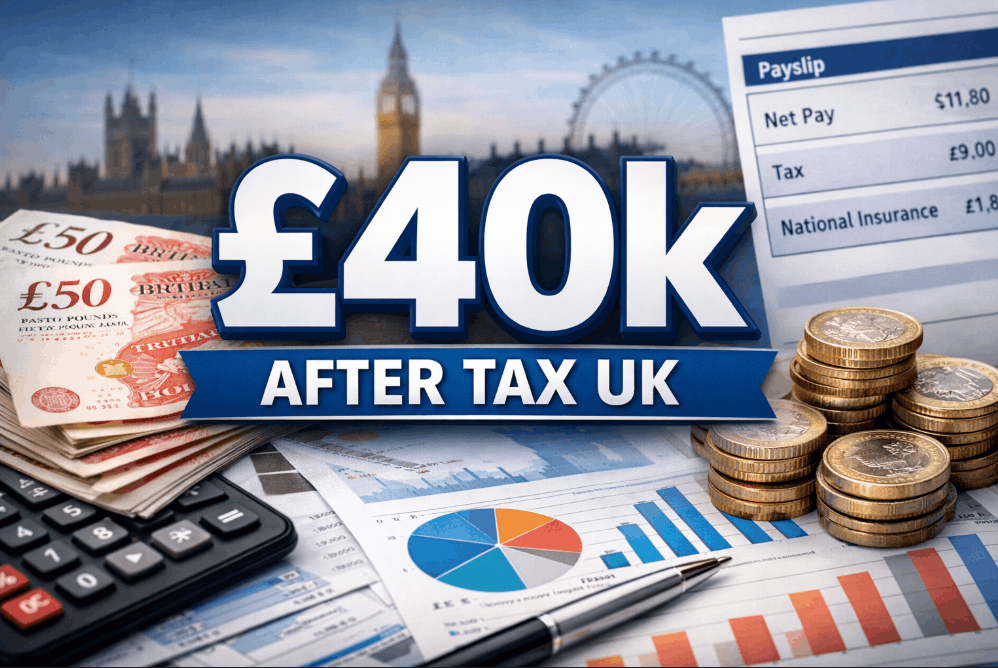
40k After Tax UK: 2025/26 Take-Home Pay, Monthly Budgeting, And SME Employer Cost Guide
If you are earning a £40,000 salary in the UK for the 2026/27 tax year, your standard annual take-home pay is approximately £32,320. This net figure is what remains after a total deduction of £7,680, consisting of £5,486 in Income Tax and £2,194 in National Insurance contributions, assuming a standard 1257L tax code with no added workplace pension or student loan deductions.
For most employees, this yields a monthly budget of £2,693 and a weekly income of £622. While this forms a solid financial foundation, regional cost-of-living gaps and active deductions shape your true spendable cash.
Key Takeaway
- Standard take-home pay on a £40,000 gross salary equals roughly £32,320 annually or £2,693 per month.
- The Personal Allowance remains frozen at £12,570, meaning earnings above this threshold face a 20% basic income tax rate.
- Employee National Insurance is charged at a flat rate of 8% on earnings spanning between £12,570 and £50,270.
- Workplace pension auto-enrolment and student loan plan deductions will further adjust your final bank deposit amount.
What is meant by 40k after tax UK?
The term 40k after tax UK refers to the net or disposable income remaining after all statutory deductions are removed from a £40,000 gross annual salary.
In the UK, your gross pay is the headline figure on your contract, but your net pay, the amount that actually lands in your bank account, is subject to the UK’s progressive tax system and National Insurance (NI) thresholds.
Understanding your net pay is essential for accurate household budgeting. In practice, a standard £40,000 salary is divided into two parts: your tax-free personal allowance and your taxable income.
For 2025/26, the first £12,570 is yours to keep in full. The remaining £27,430 is taxed at the basic rate of 20%, while NI is applied at a rate of 8% on earnings above the primary threshold.
The 2025/26 Payroll Breakdown: Monthly and Weekly Totals
| Frequency | Gross Income | Income Tax (20%) | National Insurance (8%) | Net Take-Home |
| Yearly | £40,000 | £5,486 | £2,194 | £32,320 |
| Monthly | £3,333 | £457 | £183 | £2,693 |
| Weekly | £769 | £105 | £42 | £622 |
Why is the £40,000 salary benchmark trending in 2026?
The search for 40k after tax UK has seen a significant surge in volume as we enter 2026. This trend is largely driven by a phenomenon known as fiscal drag. Because the UK government has frozen the Personal Allowance at £12,570 until 2031, inflationary pay rises are pushing more workers toward the £40k mark.
This surge in interest is largely driven by three distinct groups of professionals:
- The Squeezed Middle: Career professionals who have received a 3–5% raise and want to see how much actually reaches their pocket after tax.
- Career Changers: Individuals moving from the £30k bracket who are surprised to find that a £10k jump doesn’t result in an extra £10k of spending money.
- Small business owners and HR leads are increasingly using this benchmark to gauge what a competitive, livable offer looks like in today’s market.
A common pattern observed during salary reviews is that many employees feel £40k no longer has the same buying power it did five years ago, leading to a desperate need for precise, real-time take-home calculations.
Understanding the UK Tax Slabs and Thresholds for 2026
The UK operates a slab or banded tax system. This means you don’t pay 20% on your entire £40,000; you only pay it on the portion that exceeds the Personal Allowance.
For the 2025/26 and 2026/27 tax years, the slabs are as follows:
- Personal Allowance: £0 – £12,570 (0% Tax)
- Basic Rate: £12,571 – £50,270 (20% Tax)
- Higher Rate: £50,271 – £125,140 (40% Tax)
- Additional Rate: Over £125,140 (45% Tax)
On a £40,000 salary, you are entirely within the Basic Rate band. This is statistically the most tax-efficient sweet spot for UK workers, as you are still far from the 40% Higher Rate cliff edge, where you lose more of your incremental earnings to the Treasury.
However, as you climb toward a 60k after tax UK earnings level, the tapering of personal allowances and higher-rate deductions starts to play a much larger role in your financial strategy.

How Pension and Student Loans Shift Your 40k Net Pay
While tax and NI are the main deductions, your actual 40k after tax UK experience will likely be impacted by two other major factors: student loans and pension auto-enrolment.
1. Workplace Pensions: Under UK law, most employees are auto-enrolled into a pension. The standard employee contribution is 5% of qualifying earnings. On a £40k salary, this is roughly £137 per month.
2. Student Loans:
- Plan 2 (Pre-2023 grads): You pay 9% on everything over £27,295. Monthly cost: £95.
- Plan 5 (Post-2023 grads): You pay 9% on everything over £25,000. Monthly cost: £112.
The real-world impact: A Bristol-based example
Sarah works for a local SME on £40,000. On paper, her net pay is £2,597. However, after her 5% pension and Plan 2 student loan, her actual bank deposit is £2,365. This £232 difference is often the missing link in people’s financial planning.
Will I receive a tax return or refund on 40k after tax UK?
There is often confusion between a Tax Return and a Tax Refund. If you are a standard PAYE (Pay As You Earn) employee on £40,000, you generally do not need to file a Self-Assessment tax return.
However, you may be eligible for a Tax Refund (a rebate) if:
- You worked from home for a portion of the year (SME policy dependent).
- You pay professional subscriptions or fees required for your job.
- You are eligible for the Marriage Allowance, which allows you to transfer £1,260 of your personal allowance to your spouse if they earn less than you.
When reviewing decisions made by HMRC, it is estimated that millions in unclaimed rebates go back to the Treasury every year because employees on the 40k threshold assume their tax is all sorted by their employer.
How to make tax payments online and avoid HMRC fines?
If you have a side hustle earning over £1,000 or are self-employed on £40k, you must navigate the online payment system. Failure to do so now carries heavier penalties than ever before.
- Secure your Government Gateway access: This portal is the essential hub for managing your personal tax affairs and checking your NI record.
- Download the HMRC App: This is the fastest way to see your tax code and pay via Open Banking.
- Check the Deadlines: 31st January is the hard deadline for both filing and paying.
- Set up a Budget Payment Plan: If you can’t pay the full amount at once, HMRC allows monthly direct debits.
- Watch the Interest: As of 2026, late payment interest is a staggering 7.75%.
- The Penalty Points System: Under the new 2026 rules, you accumulate points for late filings. Once you hit the threshold, a non-negotiable £200 fine is triggered.
One oversight we frequently see at this income level is neglecting to declare interest from high-yield savings, which can unexpectedly erode your tax-free savings allowance.

Is 40k a good salary? The 2026 Purchasing Power Index
A salary of £40,000 is statistically above the UK median, but its value is highly dependent on where you live.
| City | Average 1-Bed Rent | Monthly Net Left | Lifestyle |
| London | £1,900 | £697 | Very Tight |
| Manchester | £1,050 | £1,547 | Comfortable |
| Glasgow | £900 | £1,697 | High |
| Belfast | £750 | £1,847 | Excellent |
For someone living in the North or Midlands, 40k provides a high quality of life. For a Zone 2 Londoner, it is a struggle for independence.
SME Employer Insight: The Hidden Cost of a 40k Salary
For the business owners reading smebusinessblog.co.uk, an employee requesting a £40,000 salary costs significantly more than the face value.
- Gross Salary: £40,000
- Employer National Insurance (15% above £5,000 secondary threshold): £5,250
- Employer Pension (3% of qualifying earnings): £982
- Total Annual Cost: £46,232
This hidden 14%–15% uplift is why many SMEs are cautious about crossing the £40k threshold during salary negotiations in a tight economy.
For firms looking to secure senior leadership, benchmarking the total employer liability for an 80k after tax UK package is vital for ensuring long-term payroll sustainability.
How Does a £40,000 Salary Impact Small and Medium Enterprises (SMEs)?
For small and medium enterprises (SMEs), hiring or promoting an employee to a £40,000 salary carries an actual annual cost of approximately £46,232. This figure factors in hidden overheads, including 15% employer National Insurance contributions and statutory 3% workplace pension auto-enrolment obligations.
- Total Employment Cost Overheads: While the employee sees a net take-home pay of around £32,320, business owners must budget an additional 14% to 15% in statutory employer taxes and pension contributions above the gross salary.
- Payroll and Cash Flow Planning: Incremental wage shifts toward the £40k threshold require tighter cash flow forecasting, as mid-tier salaries significantly impact operational overheads for lean teams.
- Talent Retention vs. Budget Caps: Navigating the £40k bracket is critical for SMEs aiming to offer competitive remuneration packages that attract skilled professionals without straining fiscal sustainability in a high-inflation market.
Cocnclusion
Earning £40,000 remains a prestigious milestone in the UK job market. While the headline 40k after tax UK figure is £31,164, your actual lifestyle will be dictated by your student loan plan, your city’s rent, and your pension choices.
Essential next steps for your finances:
- Audit your payslip: Ensure your tax code matches your current circumstances.
- Check for Rebates: Use the HMRC app to see if you can claim for flat-rate job expenses.
- Plan for MTD: If you have side income, ensure you are ready for the April 2026 digital transition to avoid the new penalty points.
Disclaimer: This guide is for informational purposes only and does not constitute formal financial or tax advice; always consult HMRC or a certified accountant for personal queries.
FAQ
Is 40k a good salary in the UK?
Yes, A £40,000 salary sits comfortably above the UK median full-time earnings threshold. In northern cities, Scotland, and Wales, it affords a high quality of life and comfortable independent renting. In central London, however, it remains tight and requires strict budgeting due to high housing costs.
How much tax on 40k a year in the UK?
On a £40,000 salary with a standard 1257L tax code, you pay £5,486 in Income Tax. The first £12,570 is tax-free under the Personal Allowance, while the remaining £27,430 is taxed at the basic 20% rate.
How much is 50k after tax in the UK?
For a £50,000 gross salary in the rest of the UK, your net take-home pay is approximately £39,520 per year (or £3,293 monthly), after accounting for standard income tax and employee National Insurance deductions.
Is 40k middle class in the UK?
Yes, a £40,000 income generally anchors an individual solidly within the UK middle-income bracket. It provides financial stability and standard consumer purchasing power, though lifestyle security varies significantly based on household dependency and geographic location.
Can I avoid tax fines if I miss the deadline?
No, HMRC may waive fines for reasonable excuses (e.g., bereavement or serious illness), but forgetting or the app being confusing will result in a £100–£200 penalty.
Do I get a tax return for 40k after tax UK?
No, you don’t receive a return. You file a return if you have extra income. You may, however, receive a P800 refund if you overpaid tax during the year.
Is 40k after tax enough for a mortgage?
Usually, yes. Lenders typically offer 4x to 4.5x your gross income. A £40,000 salary could qualify you for a mortgage of £160,000–£180,000.
What happens if my tax code is not 1257L?
If your code is lower (e.g., 1100L), you have less tax-free allowance, often because of a company car or medical insurance. This will reduce your monthly take-home.
How does Making Tax Digital (MTD) affect me?
From April 2026, if you are self-employed on £40k, you must use MTD-compliant software to send quarterly updates to HMRC, rather than one annual return.