What Is Gross Profit? UK Formula, Definition and Example
Gross profit is a core profitability metric that shows what a business keeps from sales after subtracting the direct cost of producing or delivering what it sold. It differs from net profit, which also deducts overheads, interest, and tax.
Key Takeaways
- Gross profit equals revenue minus the cost of goods sold (COGS), calculated before operating expenses are deducted.
- Gross profit sits near the top of the profit and loss statement, above net profit and operating profit.
- UK businesses pay tax on net profit, not gross profit, so a healthy gross profit figure doesn’t set the tax bill on its own.
What Is Gross Profit?
For the 2026/27 tax year and beyond, gross profit remains the money a business keeps from its sales after paying only the direct costs of making or delivering what it sold. It appears on the profit and loss statement (also called the income statement), directly under revenue and cost of goods sold.
Companies registered with Companies House must report it in their annual accounts, under rules set out in the Companies Act 2006, though directors should also prepare for upcoming reporting shifts like the Companies House accounts reforms 2028, which will alter how financial information is filed.
Even small companies claiming filing exemptions still need the figure internally, since it feeds directly into every other profitability measure on the accounts.
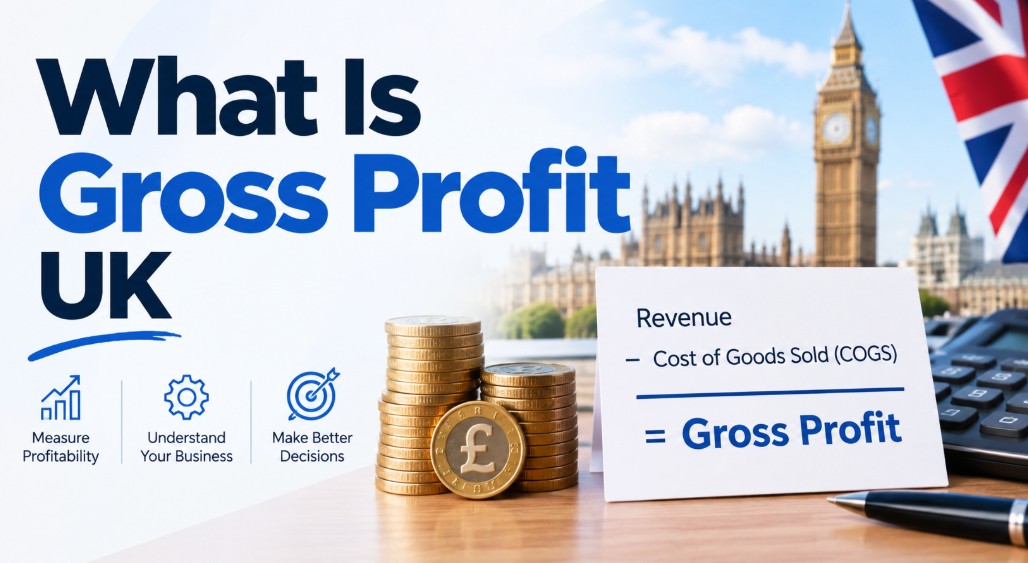
Gross profit = Revenue − Cost of Goods Sold.
The word gross simply means whole or before deductions, the same sense used in gross weight or gross pay.
Net profit takes the opposite meaning: what’s left after everything else is subtracted. That single distinction explains why the two figures are so often confused, even though they measure very different things.
It’s usually the very first profitability line a business owner learns to read, precisely because it isolates pricing and production from everything else going on in the business.
How to Calculate Gross Profit?
The gross profit formula is: revenue − cost of goods sold (COGS), sometimes called cost of sales.
The Financial Reporting Council (FRC) sets the accounting standards that determine which costs count as cost of goods sold rather than operating expenses.
- Add up total revenue (or net sales) for the period, for example, £20,000 in sales over a month.
- Total the direct costs tied to producing or delivering what was sold, say £8,000 in materials, direct labour, and packaging.
- Subtract step two from step one: £20,000 −£8,000 = £12,000 gross profit.
For a product-based business, cost of goods sold usually means raw materials, direct labour, and delivery. For a service business, it typically means only the direct labour and materials used to complete each job.
For example, an IT consultancy would count the billable hours of its consultants in its cost of sales, but would exclude the salaries of its internal HR and payroll staff.
What Counts Toward Gross Profit, and What Doesn’t?
Whether a cost counts toward gross profit depends on whether it’s tied directly to producing or delivering what was sold.
Counted in cost of goods sold:
- Raw materials and stock bought for resale
- Direct labour and wages for staff actually making or delivering the product or service
- Packaging, delivery and production-line costs
Not counted (indirect costs, these come out of net profit instead):
- Office rent, utilities and admin salaries
- Marketing and advertising spend
- Loan interest and tax
Wages count toward gross profit only when the role is tied directly to producing or delivering what’s sold. A factory worker or an on-site tradesperson is a typical example. Wages for office staff, sales teams, or management count as operating expenses instead, subtracted later when calculating net profit.
Getting this split wrong is one of the most common gross profit mistakes, it either overstates how efficiently a business produces what it sells, or hides a genuine pricing problem behind a healthier-looking number.
Implementing solid cost accounting practices can help prevent these errors by systematically categorising direct and indirect expenses.
The same logic applies to any cost: if it varies directly with how much is sold, it belongs in cost of goods sold; if it stays roughly the same regardless of sales volume, it doesn’t.
What’s the Difference Between Gross Profit and Net Profit?
The difference lies in which costs are deducted from your revenue. Gross profit looks exclusively at the direct costs of making or delivering your product, giving you a baseline measure of production efficiency.
Net profit takes everything else into account, rent, administrative salaries, marketing, interest, and tax, to show what the business actually earned at the end of the day.
| Feature | Gross Profit | Net Profit |
| What is deducted? | Only Cost of Goods Sold (COGS) | COGS, operating expenses, interest, and tax |
| Position on P and L | Near the top (just below revenue) | At the very bottom (the bottom line) |
| What it measures | Pricing strategy and production efficiency | Overall financial health and business viability |
| Tax implication | HMRC does not tax gross profit | HMRC taxes are based on net profit |
| Example costs deducted | Raw materials, factory worker wages, freight | Office rent, marketing, software subscriptions |
Why Does Gross Profit Matter for a Small Business?
Gross profit is the fastest first check on a business’s pricing strategy and production costs.
- It shows immediately if a pricing strategy covers what it costs to deliver, before any other expenses are even considered.
- A shrinking gross profit is often the first warning sign of rising supplier costs or underpricing, well before it shows up in the bank balance.
- It gives a business owner a clear figure to take into supplier negotiations, showing exactly how much room there is to work with.
- It makes it possible to compare performance across products or time periods fairly, once expressed as a margin rather than a raw figure.
The Institute of Chartered Accountants in England and Wales (ICAEW) treats gross profit as one of the first figures a new business owner should learn to read, precisely because it isolates pricing and production from everything else.
Reviewing it monthly, rather than only at year-end, makes it far easier to catch a slipping margin before it becomes a bigger problem.

What Is a Reasonable Gross Profit Margin for a UK Business?
There is no single good gross profit margin, because the direct cost of delivering a product varies wildly between industries. A margin that signals runaway success in a supermarket would mean bankruptcy for a software company.
- Software-as-a-Service (SaaS): Often targets margins of 70% to 85%. The cost of reproducing and hosting code for one additional user is exceptionally low, meaning almost all revenue flows through to gross profit.
- Professional Services (Consulting/Agencies): Typically aims for 30% to 50%. The primary cost of goods sold is the direct labour of billable staff.
- Retail and E-commerce: Generally operates on 20% to 40%. Buying physical stock and paying for packaging and shipping consumes a large portion of the revenue.
- Hospitality and Restaurants: Usually sits around 65% to 70% on food and drink. However, this high gross margin is quickly eaten away by high operating expenses, such as rent, utilities, and front-of-house staff.
Benchmarking against direct competitors is the only reliable way to judge a gross profit margin. If your margin is significantly lower than the industry average, it indicates a structural problem with supplier costs or pricing power.
How to Increase Gross Profit Margin?
Improving your gross profit margin requires widening the gap between what you charge customers and what it costs to produce the goods or services.
Because gross profit ignores operating expenses (like office rent and admin software), cutting overheads will not improve this specific metric.
You can increase gross margin using two primary levers:
1. Adjusting Pricing Strategy
- Raise prices: The most direct way to improve margin is to charge more for the same product, provided the market can bear the increase without a severe drop in sales volume.
- Bundle products: Combine high-margin items with lower-margin necessities. This increases the average order value while blending the overall margin upward.
- Eliminate discounts: Heavy discounting directly erodes gross profit. Moving away from a discount-led sales strategy immediately improves the margin per unit sold.
2. Reducing the Cost of Goods Sold (COGS)
- Negotiate with suppliers: Secure bulk discounts, renegotiate raw material costs, or find alternative suppliers who offer better rates for the same quality of materials.
- Improve production efficiency: Reduce waste on the manufacturing line or streamline the delivery process so less direct labour is required per unit.
- Review your product mix: Identify the products or services with the lowest gross margins and consider discontinuing them to focus on your most profitable offerings.

Does Gross Profit Affect How Much Tax You Pay?
No, UK businesses pay tax on net profit, not gross profit. HM Revenue and Customs (HMRC) taxes what’s left after every allowable expense is deducted. Gross profit only measures production costs, not the full picture.
This is a common confusion for small business owners and online sellers. Some assume a strong gross profit figure is what HMRC assesses, when net profit is the actual number that counts, the figure sole traders report on their Self Assessment tax return.
Keeping clear, separate records of revenue and direct costs still matters, because it’s the starting point HMRC expects a business to be able to show.
- Start with gross profit (revenue minus cost of goods sold).
- Subtract operating expenses, interest, and tax to reach the net profit figure HMRC actually assesses; full guidance is available on gov.uk.
Both figures should be worked out on a VAT-exclusive basis if the business is VAT-registered, since VAT collected on sales was never part of its revenue to begin with.
This reflects the rules for the current tax year on trading income, though different rules apply when selling business assets or shares, where the capital gains tax allowance becomes the relevant metric rather than your trading profit margins. Allowable expenses and allowances are reviewed at each Budget.
Conclusion
Gross profit is the clearest first check on whether a business’s pricing and direct costs add up. It’s calculated as revenue minus cost of goods sold, and it sits apart from net profit, which is the figure that determines tax.
Tracking both gross and net profit regularly gives an early warning of pricing problems, well before they show up anywhere else in the accounts.
Disclaimer: Figures and worked examples in this article are illustrative and reflect current UK accounting and tax rules. Individual circumstances vary, so business owners should confirm specifics with HMRC or a qualified accountant before making decisions.
FAQs
Can a business have a high gross profit but still make a net loss?
Yes. A business can have a very healthy gross profit if it produces goods cheaply, but still make a net loss if its operating expenses, such as office rent, excessive marketing spend, or high administrative salaries, exceed that gross profit.
Does gross profit include VAT?
No. For VAT-registered businesses, both revenue and the cost of goods sold should be calculated exclusive of VAT. The VAT collected on sales belongs to HMRC and is never counted as part of a business’s revenue or profit.
Is gross profit the same as markup?
No, although they are frequently confused. Gross profit margin measures profit as a percentage of total revenue, whereas markup measures profit as a percentage of the cost of goods sold (COGS).
Why should a small business review gross profit monthly rather than annually?
Monthly reviews allow business owners to catch rising supplier costs, material price spikes, or pricing errors in real time. Waiting until year-end accounts means a slipping margin can quietly erode cash flow for months before it becomes visible on the annual P and L.