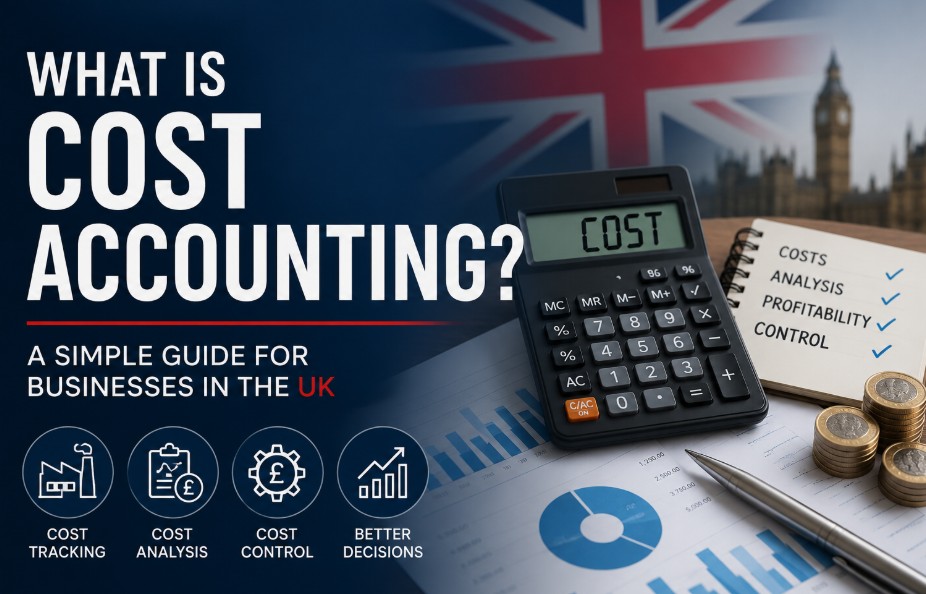
What Is Cost Accounting? A Complete Operational Guide for SME Businesses
Cost accounting is an internal management accounting system UK businesses use to track, measure, and analyse total operating expenses.
By splitting direct production costs from variable and fixed overheads, it gives directors clear unit-cost visibility to set profitable prices, cut operational waste, and safeguard gross margins.
Key Takeaways
- Cost accounting provides internal management visibility to evaluate operating expenses without being bound by statutory reporting rules.
- Categorising expenditure into direct material, direct labour, variable overhead, and fixed costs reveals the true cost of production.
- Calculating unit cost thresholds prevents underpricing services and protects gross profit margins in competitive markets.
- Standard cost profiles and variance analysis enable early detection of material price inflation and labour inefficiencies.
What Is Cost Accounting?
Cost accounting gives UK SME owners clear visibility over day-to-day business performance by systematically tracking, grouping, and reviewing operational expenditure.
Unlike statutory financial accounting, which reports past performance to external authorities, cost accounting focuses on forward-looking internal financial control.
How Does It Work for UK SMEs?
In practice, managing cash flow effectively requires looking beyond top-line revenue to examine how every pound spent contributes directly to gross profit.
This operational tracking must also account for outstanding Debtors and Creditors across your supply chain, ensuring that uncollected revenue and unpaid trade liabilities do not distort your true cost of goods sold.
Small business owners who track cost allocation gain significant strategic control across four core financial functions:
- Internal Cost Control: Spotting operational waste, unallocated labour hours, and rising material expenses before they erode profitability.
- Profitable Unit Pricing: Establishing accurate unit cost baselines so that product and service pricing reliably covers fixed overheads and delivers targeted profit margins.
- Overhead Expense Allocation: Assigning shared company overheads, such as commercial rent, utilities, software subscriptions, and administrative salaries, fairly across specific revenue lines.
- Cash Flow Budgeting: Using historical cost trends to build reliable operational forecasts and project future working capital requirements.

What Is the Purpose and Role of Cost Accounting in a Business?
The purpose of cost accounting is to convert raw transactional data into actionable operational insights for business management.
Professional accounting standards set out by bodies like the Chartered Institute of Management Accountants (CIMA) and the Institute of Chartered Accountants in England and Wales (ICAEW) define cost management as the foundation of sustainable business growth.
When evaluating financial performance, business owners must ensure every revenue stream generates a positive contribution margin after accounting for total operating costs.
Understanding the role of cost accounting within your business involves mastering four fundamental cost categories:
- Direct Material Costs: The raw ingredients, parts, or inventory directly consumed to create a finished product or deliver a billable service.
- Direct Labour Expenditure: Gross wages, employer National Insurance, and pension contributions paid directly to staff engaged in production or client delivery.
- Variable Overheads: Operating costs that fluctuate in direct proportion to production volume, such as equipment power consumption or freight charges.
- Fixed Operating Expenses: Baseline overheads that remain constant regardless of output volume, including premises rent, business rates, and core management salaries.
What Is the Importance of Cost Accounting to Financial Accounting?
Cost accounting feeds critical operational data into financial accounting systems, ensuring statutory records reflect accurate inventory values and true gross margins.
While cost accounting serves internal decision-makers, financial accounting produces formal financial statements for external parties under UK GAAP and Financial Reporting Standard 102 (FRS 102).
In practice, statutory reporting to HM Revenue & Customs (HMRC) and Companies House depends on precise cost tracking to value work in progress (WIP) and cost of goods sold (COGS) at the end of each accounting period.
| Criteria | Cost Accounting | Financial Accounting |
| Primary Audience | Internal directors, SME owners, operations leads | External stakeholders (HMRC, Companies House, lenders) |
| Statutory Mandate | Voluntary management tool | Mandatory for registered UK limited companies |
| Temporal Focus | Present and future operational activity | Past financial performance (Historical financial period) |
| Accounting Framework | Tailored to internal management preference | FRS 102, UK GAAP, Companies Act rules |
| Reporting Frequency | Continuous, weekly, or monthly reports | Quarterly or annual financial statements |
How Does Cost Accounting Help SMEs Protect Profit Margins?
Cost accounting protects profit margins by alerting business owners to cost overruns and margin erosion before they impact statutory financial statements.
Tracking variable costs against fixed overheads ensures every quote or product price leaves a clear profit margin.
A common pattern among growing SMEs is experiencing top-line revenue growth while bottom-line net profit stagnates.
This usually happens when indirect overheads or unallocated labour hours creep up without being priced into client contracts. To calculate your exact operational threshold and protect profit margins, follow this six-step process:
- Calculate Total Fixed Costs: Sum all static monthly operating expenses, including property rent, core salaries, insurance, and administrative software subscriptions.
- Determine Unit Variable Costs: Add up all direct material, direct labour, and variable delivery costs required to produce one unit of product or service.
- Establish Selling Price: Set a unit price that covers total variable inputs while generating a healthy contribution margin toward fixed overheads.
- Calculate the Unit Break-Even Point: Divide total fixed costs by the contribution margin per unit using the standard operational formula:
- Break-Even Point (Units) = Total Fixed Costs ⁄ Price per Unit−Variable Cost per Unit
- Monitor Monthly Budget Variances: Compare actual operational spending against initial budgets to catch material cost inflation early.
- Adjust Client Quotes Continuously: Update pricing models whenever supplier costs or billable hourly rates increase across your supply chain.

What Are the Main Types of Cost Accounting Methods for SMEs?
Selecting the right cost accounting method depends on your business model, service structure, and operational complexity. Different industries require distinct costing methodologies to capture their operational expenditure accurately.
Key Cost Accounting Frameworks for Growing Businesses
The four primary cost accounting methods used by UK small businesses include:
- Job Costing: Tracks direct materials, direct labour, and assigned overheads for specific, bespoke projects. Ideal for tradespeople, creative agencies, and IT consultancies.
- Marginal Costing: Isolates variable costs to evaluate the incremental expense of producing one additional unit. Helps management set short-term discount pricing without selling at an overall loss.
- Activity-Based Costing (ABC): Assigns indirect overheads to products or services based on the activities and resources they consume. Excellent for businesses with diverse, complex product lines.
- Standard Costing: Compares actual production costs against predetermined standard benchmarks. Highlighted variances show where operational performance strays from target budgets.
What Is the Work of a Cost Accountant in an SME?
A cost accountant reviews internal operations, audits supply chain spending, and provides directors with clear profitability figures across all departments. Unlike general accountants who focus on end-of-year tax compliance, a cost accountant works continuously to improve day-to-day profit margins.
When reviewing operational decisions, a cost accountant systematically investigates cost drivers to highlight inefficient spending. In a typical UK business, their main duties include:
- Auditing Material Expenditure: Tracking raw material costs, negotiating bulk supplier rates, and identifying stock leakage or waste.
- Analyzing Labour Efficiency: Comparing billable staff hours against unallocated downtime to ensure labour costs match output targets.
- Calculating Unit Economics: Establishing precise production costs per unit to guide pricing strategies and minimum order thresholds.
- Executing Variance Reports: Preparing monthly reports that highlight differences between budgeted targets and actual cash expenditure.
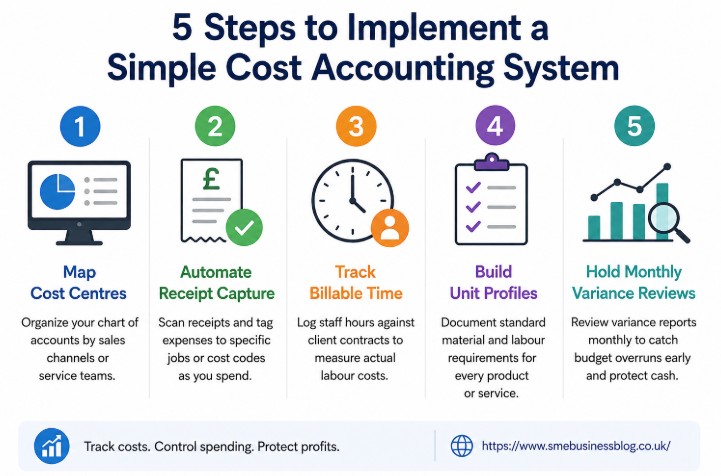
How Can SMEs Implement a Simple Cost Accounting System in 5 Steps?
Establishing an internal cost accounting system does not require complex enterprise systems. Most growing firms implement cost tracking through modern Small Business Accounting Software, using standard tagging features to create custom cost categories and clear tracking routines.
Small business owners can implement simple cost tracking by following five practical steps:
- Map Cost Centres: Organize your chart of accounts in cloud tools like Xero or QuickBooks by dividing business operations into clear sales channels or service teams.
- Automate Receipt Capture: Use receipt-scanning software to tag expenses directly to specific jobs or operational cost codes as spending happens.
- Track Billable Time: Require staff to log hours against specific client contracts to measure actual labour expenditure accurately.
- Build Unit Profiles: Document standard material and labour requirements for every core product or service you sell.
- Hold Monthly Variance Reviews: Review variance reports monthly to catch budget overruns before they impact cash reserves.
What Are Common Cost Accounting Mistakes SME Owners Make?
Without structured management accounting, small business owners often fall into common costing traps that quietly erode profit margins.
A frequent oversight is failing to include director time when calculating project costs. If a director contributes unbilled management hours to client work, the service will look far more profitable than it really is.
Watch out for these four common cost accounting mistakes:
- Ignoring Hidden SaaS Overheads: Overlooking recurring software subscriptions, cloud storage, and digital tool fees when allocating fixed overheads.
- Failing to Track Work in Progress (WIP): Omitting partially completed jobs or unbilled client hours from monthly cost reviews.
- Using Outdated Supplier Pricing: Quoting new client work based on old material prices rather than current market rates.
- Treating Fixed Costs as Variable: Assuming fixed overheads like rent and rates naturally fall when production slows down.
Conclusion
Cost accounting converts operational expenses into clear commercial data, giving business owners precise control over profit margins.
By categorizing direct expenditure alongside fixed overheads, calculating accurate break-even points, and reviewing monthly variances, SMEs protect cash flow and eliminate hidden waste.
To strengthen internal financial controls across your business, begin with these three practical steps:
- Audit Expense Allocation: Review your current chart of accounts to ensure direct project expenses are separate from fixed administrative overheads.
- Build Standard Unit Profiles: Calculate true unit costs for your top three products or services, including direct materials, billable labour, and overhead allocations.
- Establish a Monthly Variance Routine: Compare actual operational spending against target budgets at the end of every month to catch cost inflation early.
Disclaimer: This article is for informational purposes only and does not constitute formal financial, accounting, or legal advice.
FAQs
Is cost accounting compulsory for UK small businesses?
No, cost accounting is not compulsory for UK small businesses. Unlike statutory financial accounting required by Companies House and HMRC, cost accounting is a voluntary internal management tool designed to track expenses, optimize pricing, and protect profit margins.
What is an example of cost accounting in a small business?
An example is a joinery business calculating the exact timber, screws, joiner labour hours, and workshop power consumed to build a custom dining table. Adding a fair share of workshop rent reveals the true unit cost for accurate quoting.
How much do cost accountants ask in the UK?
As of 2026, external cost accounting consultants and freelance management accountants in the UK typically charge £45 to £120 per hour. Monthly advisory retainers for SMEs range from £250 to £900 per month, while full-time in-house cost accountants earn between £38,000 and £58,000 annually depending on location.
What is the main difference between cost accounting and management accounting?
Cost accounting focuses specifically on recording, allocating, and analyzing operational expenditure. Management accounting is a broader discipline that uses cost data alongside strategic analysis, market trends, and financial forecasting to guide overall business strategy.
How does activity-based costing benefit service-based SMEs?
Activity-based costing identifies the exact administrative, technical, and operational activities required to deliver a client project. This prevents complex, high-maintenance clients from consuming shared business resources without paying for their true operational footprint.
Can small businesses use standard accounting software for cost tracking?
Yes, mainstream UK cloud platforms like Xero, QuickBooks Online, and Sage 50 include built-in tracking categories, project tracking, and cost-centre tagging. These features allow SME owners to manage cost accounting effectively without purchasing expensive enterprise systems.
What is variance analysis in cost accounting?
Variance analysis is the practice of comparing actual operational expenditure against initial budgeted or standard costs. Favourable variances indicate savings, while adverse variances highlight cost overruns, supplier price inflation, or internal labour inefficiencies.