Corporation Tax Payment Reference: Format, Where to Find It, and How to Pay HMRC
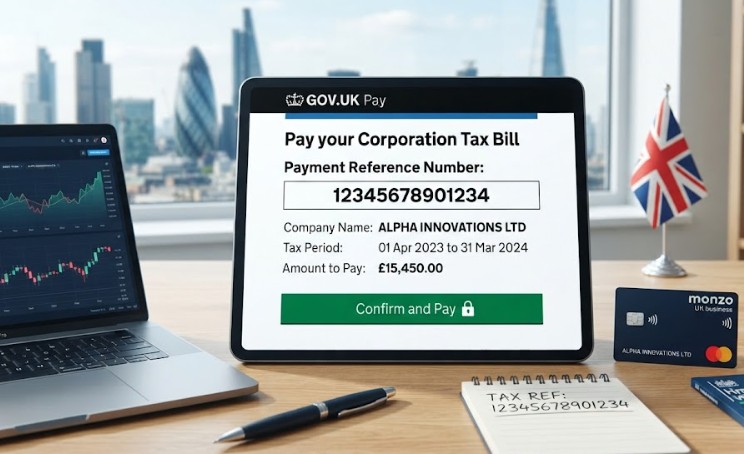
A Corporation Tax payment reference is a unique 17-character administrative code required by HM Revenue and Customs for limited companies to settle annual corporation tax liabilities accurately.
It ensures that funds transferred through commercial banking networks reconcile directly with the correct company record and accounting period on government ledgers.
The code functions as an essential identifier designed to eliminate administrative ambiguity across high-volume tax receipts. In practice, corporate finance teams handle dozens of transactions annually, making structured payment identifiers the primary defense against misapplied funds.
When limited companies submit annual accounts, HMRC issues specific payment tracking parameters tied directly to the taxable trading window. Ensuring these filings and records are up to date often involves verifying your corporate status via the Companies House beta search.
Key Takeaways
- Corporation Tax payment references consist of exactly 17 characters combining a Unique Taxpayer Reference, fixed sequence codes, and a specific period digit.
- Entering an incorrect reference or stale accounting period code forces payments into an unallocated suspense account, risking late penalties.
- Business owners can instantly retrieve valid reference numbers by logging into their official online tax accounts or checking previous CT600 returns.
- Payment instructions require transferring exact tax liabilities to official government bank accounts using Faster Payments, CHAPS, or Direct Debit.
How to Find Your Corporation Tax Payment Reference?
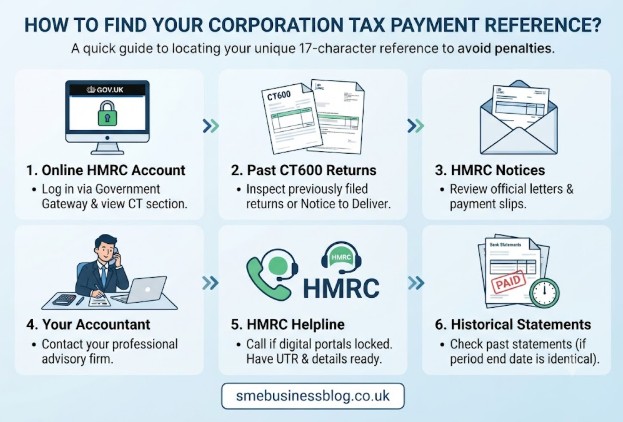
Finding your unique 17-character Corporation Tax payment reference quickly prevents payment processing delays and avoids late-filing penalties. Several reliable methods allow you to locate or retrieve this code depending on your current access level:
- Online Business Tax Account: Log in to your HMRC online account via Government Gateway, navigate to the Corporation Tax section, and view active payment instructions and references.
- Past CT600 Returns: Inspect previously filed CT600 tax returns or official Notice to Deliver a Company Tax Return letters issued by HMRC.
- Official HMRC Notices: Review physical or digital payment slips and correspondence sent by HMRC before your filing deadline.
- Your Accountant or Tax Agent: Contact the professional advisory firm managing your company’s fiscal compliance to request the active reference code.
- HMRC Helpline: Call the official Corporation Tax helpline directly if digital portals are locked. You must verify your identity with your company registration number, registered office address, and permanent 10-digit UTR.
If banking prompts require an immediate code outside standard operating hours, historical bank statements from previous years can serve as a temporary indicator, provided your accounting period end date is identical.
What Does the 17-Character HMRC Payment Reference Look Like?
The 17-character HMRC payment reference follows a rigid, mathematically structured format that cannot be altered or guessed without risking payment rejection. Every valid code incorporates four distinct segments arranged in a strict linear sequence without spaces.
- Characters 1–10: The company’s 10-digit Unique Taxpayer Reference.
- Characters 11–14: The fixed alphanumeric sequence code A001.
- Characters 15–16: The 2-digit accounting period code corresponding to the end month of the taxable period.
- Character 17: The mandatory verification letter A.
An example of a complete payment reference appears as 1234567890A00112A, where 1234567890 represents the corporate tax identifier, A001 denotes the standard payment stream, 12 signifies a December accounting period end, and the final A serves as the validation suffix
What Should You Do If You Lose Your Payment Reference?
When digital portals are locked and historical paper notices are misplaced, retrieving a valid payment code requires contacting HM Revenue and Customs directly or utilizing internal verification backups.
Keeping your administration in order also means staying aware of wider corporate obligations, such as reviewing guidelines on a Companies House filing extension if deadlines loom.
- Contact HMRC Directly: Call the official Corporation Tax helpline to request your current reference. Corporate directors or authorized administrators must verify their identity by providing their company registration number, registered office address, and permanent 10-digit Unique Taxpayer Reference (UTR) before tax agents disclose payment details over the telephone.
- Consult Internal Ledgers: Check internal accounting software, digital communication threads, or records maintained by your corporate accountant or tax agent, who often manage multiple client profiles and keep active payment codes on file.
- Check Historical Bank Statements: If electronic banking prompts require an immediate payment code outside standard operating hours, reviewing historical bank statements for previous year formats can provide a temporary indicator, provided the accounting period end date remains identical.
Always confirm the correct reference string with official HMRC records as soon as possible to prevent funds from being misrouted into an unallocated suspense account and triggering late-payment penalties.
Corporation Tax Payment Reference vs. UTR: What Is the Difference?
The Unique Taxpayer Reference (UTR) and the Corporation Tax payment reference serve entirely different administrative purposes and follow distinct formats:
- Unique Taxpayer Reference (UTR): A permanent 10-digit identification number assigned to your company upon incorporation. It remains completely identical across the entire lifetime of the corporate entity and is used by HMRC to identify the business across all tax registers.
- Corporation Tax Payment Reference: A dynamic 17-character composite string that changes for every distinct chargeable accounting period. While its first 10 digits consist of your permanent UTR, the trailing characters adapt to reflect the exact timeline of the profits being settled.
| Identifier Type | Length | Stability | Core Function |
| Unique Taxpayer Reference | 10 Digits | Permanent | Identifies the corporate entity across all tax registers |
| Payment Reference | 17 Characters | Variable | Matches a specific financial payment to a single accounting period |
Can You Calculate Your Own Corporation Tax Payment Reference?
No, constructing a payment reference manually without official HMRC confirmation introduces severe operational risks.
While the first ten characters (your UTR) and the middle A001 block remain constant, determining the exact two-digit accounting period code depends entirely on how your company’s financial year is registered on central tax databases.
| Accounting Period End Month | Corresponding 2-Digit Code | Complete Reference Pattern Example |
| March | 03 | 1234567890A00103A |
| June | 06 | 1234567890A00106A |
| September | 09 | 1234567890A00109A |
| December | 12 | 1234567890A00112A |
Companies operating non-standard accounting periods or shortening their financial years often find that standard month-end codes do not align with expectations. Guessing these digits frequently results in misrouted funds being diverted into unallocated suspense accounts.
How to Pay Using Your Corporation Tax Payment Reference?
Executing payments successfully requires inputting your 17-character reference into the mandatory reference field of your online banking application or electronic transfer system.
HM Revenue and Customs maintains specific banking channels to process corporate receipts based on the speed and type of transfer you choose:
- Faster Payments or Online Banking: Input the exact 17-character reference into your business banking app for immediate or next-day clearance of standard corporate tax liabilities.
- Direct Debit: Set up automated Direct Debit instructions directly through the government business tax portal to collect funds safely on agreed statutory deadlines.
- CHAPS Transfers: Utilise same-day settlement protocols for high-value transactions submitted close to statutory filing deadlines, ensuring you include the correct reference string in the payment instructions.
- Bacs Transfers: Apply standard Bacs transfers when processing payments three working days ahead of the formal liability due date.
Crucial Warning: Always double-check every character of your 17-digit reference before authorizing the transfer.
Entering an incorrect code or a stale accounting period forces HMRC computer systems to reject automated allocation, diverting your funds into an unallocated suspense ledger and triggering late-payment penalties.
What Happens If You Use the Wrong Corporation Tax Payment Reference?
Using an incorrect payment reference causes HMRC computer systems to reject automated allocation, diverting your transferred funds directly into an unallocated suspense ledger.
- Persistent Liabilities: Although the money leaves your corporate bank account, central tax records continue to register an unpaid balance, prompting automated late-payment penalty notices and daily interest charges.
- Administrative Delays: Resolving unallocated payments requires submitting formal tracing requests to HM Revenue and Customs payment support teams, providing proof of transfer, bank confirmation receipts, and the correct reference strings.
- Operational Strain: This administrative burden distracts management teams and can take weeks to resolve while financial penalties and interest accumulate on your corporate accounts.
Conclusion
Securing accurate tax compliance relies on mastering the mechanics of the 17-character Corporation Tax payment reference. Beyond corporate tax, business directors must also keep pace with broader fiscal shifts, such as monitoring UK pension tax reform proposals that could impact long-term employee remuneration structures.
Companies must verify every character string before authorising bank transfers to prevent suspense account errors and late payment penalties.
Regularly auditing online tax portals ensures administrative workflows remain aligned with statutory requirements.
Disclaimer: This article is for informational purposes only and does not constitute formal financial or legal tax advice; consult a qualified accountant for your corporate requirements.
FAQs
What is the format of a Corporation Tax payment reference number?
The format consists of a 17-character string comprising a 10-digit tax identifier, the sequence characters A001, a 2-digit period code, and a trailing validation letter.
How do I pay Corporation Tax in the UK?
Payments are executed via online banking, Faster Payments, Direct Debit, or CHAPS transfers using official government sorting codes and the correct payment reference.
Does my corporation tax reference change every year?
The first fourteen characters remain static while the final accounting period digits change annually to reflect different chargeable financial windows.
What is the Cumbernauld address used for?
Cumbernauld serves as the primary processing location for traditional paper remittance vouchers and physical tax payments managed by HM Revenue and Customs.
What should I do if my payment is unallocated?
Contact HMRC support immediately with transaction receipts, bank confirmation slips, and correct reference data to manually reapply the misrouted funds.