
Companies House Filing Extension: How UK SMEs Can Apply and Avoid Penalties
A Companies House filing extension allows private limited companies, PLCs, and dormant companies to extend their statutory accounts filing deadline with the Registrar of Companies, as long as they apply before the original deadline and have valid exceptional grounds.
Key Takeaways
- Private limited companies must request a filing extension through the official online service before their original statutory accounts deadline expires.
- Valid grounds for approval are strictly limited to unforeseen exceptional circumstances such as severe director illness or catastrophic IT system failures.
- Standard statutory filing windows require private companies to submit annual accounts within nine months of their accounting reference date.
- Late filing penalties for private companies start at £150 and can rise to £1,500 when accounts are more than six months late.
What is a Companies House filing extension?
A Companies House filing extension can give organisations extra time when unexpected problems affect their ability to file on time.
When unexpected circumstances disrupt normal financial reporting, company officers can request extra time to prepare and file their statutory accounts without facing late filing penalties.
As part of the latest verification requirements, directors should also be familiar with Companies House identity verification when managing their company’s compliance.
Under the Companies Act 2006, the Registrar of Companies oversees corporate compliance while allowing for genuine emergencies in certain circumstances.
When a business faces a serious disruption, understanding how this extension works can help it stay compliant with its filing obligations.
Can I extend my Companies House filing deadline?
Yes, directors can extend their Companies House filing deadline, but only if they meet the required conditions and submit their request before the original deadline passes.
The Registrar will reject applications submitted after the filing deadline has passed. Routine administrative backlogs, pressure from accountants, or staff holidays also do not qualify as reasons for extra time.
| Company Type | Standard Filing Window | Maximum Extension Period |
| Private Limited Company | 9 months from ARD | Up to 3 additional months (discretionary) |
| Public Limited Company (PLC) | 6 months from ARD | Up to 3 additional months (discretionary) |
| Dormant Company | 9 months from ARD | Up to 3 additional months (discretionary) |
What are the Valid Grounds and Reasons for a Companies House Filing Extension?
Valid grounds for a Companies House filing extension are limited to unexpected and exceptional circumstances outside the control of the directors or management, where filing is not physically or technically possible. These can include:
- Severe illness or medical emergencies: A key director or the sole company secretary becomes seriously ill and cannot manage the financial records.
- Critical IT or cyber-security failures: Digital accounting records become corrupted or financial software stops working shortly before the accounts are due.
- Destruction of records: Accounting records are unexpectedly destroyed or lost because of a fire, flood, or serious damage at the registered office or accountant’s premises.
- Postal strikes or administrative delays: Unexpected postal disruption affects the delivery of paper documents when digital filing is not available.
Routine administrative backlogs, pressure from accountants, or staff holidays are not accepted as valid reasons.
How to apply for a Companies House filing extension online?
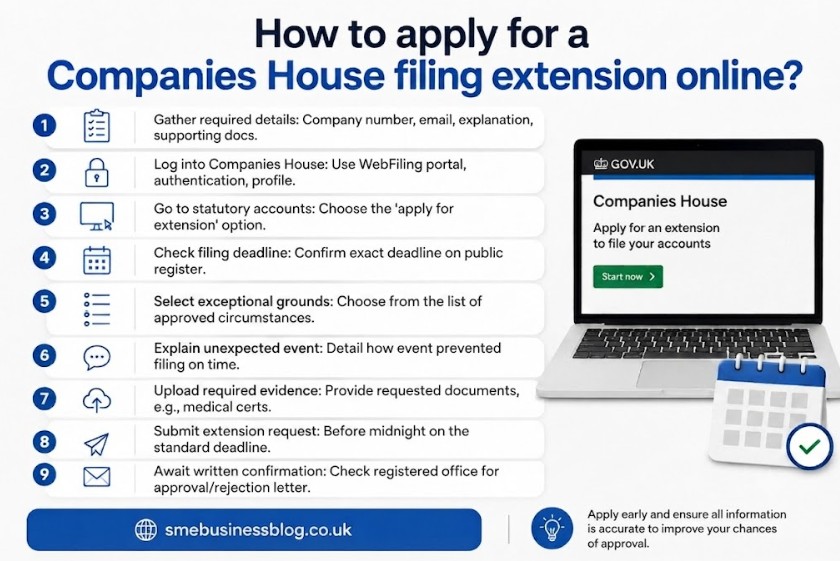
Applications for a Companies House filing extension can be made online through the official GOV.UK service. The application takes around 15 minutes, and you will need to:
- Gather details such as your company registration number, an active email address, an explanation of why the unexpected event has prevented you from filing on time, and any supporting documents, such as medical certificates or incident reports.
- Log into the Companies House WebFiling portal using the company’s registered login details and director profile.
- Go to the statutory accounts section and select the option to apply for a filing deadline extension.
- Review the current accounting reference period dates and confirm the exact filing deadline currently recorded on the public register.
- Select the relevant reason from the approved list of exceptional circumstances.
- Explain clearly how the unexpected event prevented you from completing the accounts on time.
- Upload any mandatory supporting evidence, such as medical certificates or official incident reports, where requested by the portal.
- Submit the extension request before midnight on the final day of the standard filing window.
- Look out for written confirmation from the Registrar of Companies at the registered office address.
How long does a Companies House filing extension take to be processed?
Companies House typically reviews online extension requests within two to five working days and sends its decision to the company’s registered office address. However, directors should not assume an extension has been approved until they receive confirmation.
If an application does not provide enough detail or uses a reason that does not qualify, the Registrar can reject it. Directors should wait for written confirmation before assuming the extension has been granted, as the usual late filing penalties can still apply.
What is the deadline for submitting accounts to Companies House?
The deadline for submitting accounts to Companies House depends on whether it is your company’s first financial year or a subsequent year:
- Subsequent Annual Accounts: 9 months from the company’s Accounting Reference Date (ARD) / financial year-end for private limited and dormant companies. For Public Limited Companies (PLCs), the window is shortened to 6 months.
- First Ever Accounts: 21 months from the exact date of incorporation. This extended window is a one-time allowance for new businesses.
The deadline is calculated from the end of the accounting period, rather than when the accounts are signed or audited. Historical records and due dates can also be checked using the Companies House beta search tool.
What are the late filing penalties for UK private limited companies?
Missing the statutory accounts filing deadline without an approved extension results in automatic financial penalties from Companies House, with the amount increasing the longer the accounts are overdue.
These penalties are required by law and cannot simply be waived because a director was unaware of the deadline.
| Delay Duration (Private Company) | Standard Penalty | Penalty if Late Two Consecutive Years |
| Not more than 1 month | £150 | £300 |
| 1 month to 3 months | £375 | £750 |
| 3 months to 6 months | £750 | £1,500 |
| More than 6 months | £1,500 | £3,000 |
Does a Companies House extension also cover HMRC Corporation Tax deadlines?
No, obtaining an extension for filing accounts with Companies House does not automatically extend the deadline for submitting company tax returns (CT600) or paying corporation tax to HMRC. The two bodies have separate compliance and filing requirements under UK law.
To ensure your corporation tax and statutory obligations are met on time, it helps to understand when taxes are due across different corporate filing cycles.
A common mistake is assuming that extra time from the Registrar also gives you more time for other reporting obligations.
HMRC has a separate penalty system for late corporation tax returns, so directors must deal with each filing requirement separately when the same disruption affects both.
What changes will Companies House implement in accounts filing from April 2028?
From 1 April 2028, Companies House will introduce major reforms under the Economic Crime and Corporate Transparency Act 2023 to digitise filing, improve corporate transparency, and help tackle economic crime.
For a deeper breakdown of upcoming procedural shifts, review the Companies House accounts reforms 2028 guide.
The main changes will include:
- Mandatory Software-Only Filing: All annual accounts must be filed using commercial software in iXBRL (Inline eXtensible Business Reporting Language) format. The existing free Companies House WebFiling portal and paper submission routes will be permanently closed for account filings (though they will remain open for other statutory tasks like confirmation statements).
- Profit and Loss Filing for Small Companies and Micro-Entities: Small companies and micro-entities will be required to include a profit and loss account as part of their annual filing. However, businesses will be provided with an option to opt out of public publication, meaning the data goes to Companies House, HMRC, and law enforcement for compliance checks without being publicly viewable.
- Abolition of Abridged Accounts: Small companies will no longer be able to prepare and file simplified abridged accounts.
- Strengthened Audit Exemptions: Directors claiming an audit exemption will need to provide a more explicit, formal statement on the balance sheet identifying the exact exemption being claimed and confirming their eligibility.
- Restrictions on Changing Accounting Reference Periods: Companies will be limited in how frequently they can shorten their accounting reference period, requiring a valid business reason if they wish to do so more than once within a five-year window.
Conclusion
Managing statutory reporting obligations requires careful deadline tracking and prompt action when unexpected problems could affect filing dates.
By checking accounting reference dates early, using the official WebFiling portal only for genuine exceptional circumstances, and keeping Companies House filings separate from HMRC corporation tax obligations, SME directors can reduce the risk of financial penalties and stay compliant.
Disclaimer: This article is for informational purposes only and does not constitute formal legal or professional accounting advice.
FAQs
Who can apply for an extension to file accounts?
A company director, company secretary, or authorised corporate representative registered with Companies House can submit a formal extension application on behalf of the sanitation.
Can micro-entities apply for a filing extension?
Micro-entities have the same statutory right to apply for a filing extension as other private limited companies, provided they apply through the official channels before the standard deadline expires.
What happens if a filing extension request is rejected?
If the Registrar rejects an extension request, the original filing deadline remains unchanged. Late filing penalties will apply if the accounts are not submitted by that deadline.
What is the deadline to file a company tax return in the UK?
Unlike Companies House statutory accounts (which are usually due within 9 months), a UK company tax return (Form CT600) is due 12 months after the end of your company’s accounting period. Note that any Corporation Tax owed must be paid earlier, typically 9 months and 1 day after the accounting period ends.
What is the tax deadline for 2026 in the UK?
There is no single fixed calendar tax deadline for all UK companies in 2026, because corporate tax deadlines are tied to each individual company’s Accounting Reference Date (ARD) or financial year-end.
How long do you have to submit CT600?
You have 12 months from the end of your company’s accounting period to submit your CT600 Company Tax Return to HMRC. Filing after this 12-month window triggers automatic HMRC penalties, which are separate from any late penalties issued by Companies House.