Complete UK Tax Deadlines Guide: Exactly When Are Taxes Due for Self Assessment & Ltd
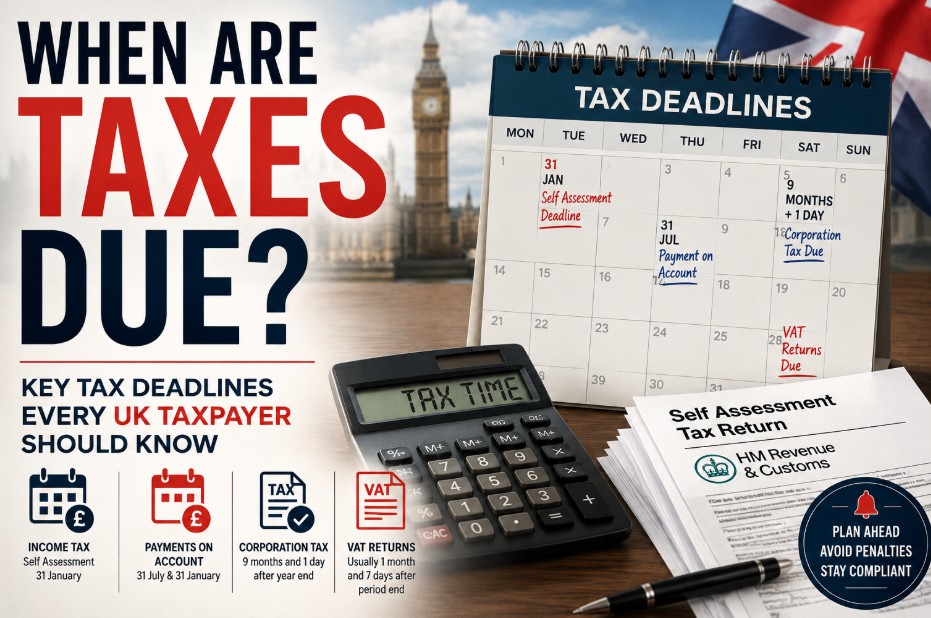
In the UK, personal Self Assessment tax deadlines fall on 31 October for paper submissions and 31 January for online returns and balancing payments. Corporation Tax payments are due 9 months and 1 day after the accounting period ends, keeping business and personal schedules distinct.
Key Takeaways
- Self Assessment online filings and balancing payments must reach HMRC by 31 January following the end of the 6 April to 5 April tax year.
- Paper Self Assessment tax returns face a strict deadline of 31 October and trigger an instant £100 fine if submitted late without switching online.
- Corporation Tax payments are due 9 months and 1 day after year-end, whereas the CT600 return is due within 12 months.
- Standard quarterly VAT payments and returns are due 1 month and 7 days after the specific accounting quarter closes.
When Are Taxes Due UK?
UK tax deadlines vary by regime: Self Assessment online returns are due on 31 January, paper returns on 31 October, Corporation Tax payments 9 months and 1 day post-year-end, and electronic PAYE liabilities on the 22nd of each month.
In the UK, tax due dates are strictly determined by the category of tax you owe. Understanding these timelines helps prevent overlap and ensures your business or personal finances remain secure.
The Structure of the British Tax Year
The UK personal tax year runs continuously from 6 April to 5 April the following year, applying to all sole traders, partners, and high earners navigating changing UK tax bands while reporting untaxed income.
Managing these obligations requires a clear understanding of individual tax categories. The standard timeline progresses through key milestones:
- 6 April: Tax year begins.
- 5 October: Deadline to register for Self Assessment if you are new to the system.
- 31 October: Paper return submission deadline by midnight.
- 31 January: Online return submission and final payment deadline by midnight.
When Are Personal and Self-Employed Taxes Due in the UK?
Anyone earning untaxed income exceeding £1,000, operating as a sole trader, pulling in over £100,000, or serving as a registered company director must complete and submit a personal Self Assessment tax return to HMRC each year.
Key Self Assessment Deadlines
- 5 October: Deadline to notify HMRC and register for Self Assessment if you became self-employed or received untaxed income during the prior tax year.
- 31 October (Midnight): Deadline for submitting a paper Self Assessment tax return.
- 31 January (Midnight): Deadline for submitting an online tax return, paying your remaining tax bill (balancing payment), and submitting your first Payment on Account.
- 31 July (Midnight): Deadline for submitting your second Payment on Account.
Self Assessment Deadlines Schedule
- 2024/25 Tax Year: Tax period covered 6 Apr 2024 to 5 Apr 2025; Paper deadline 31 Oct 2025; Online and payment due 31 Jan 2026.
- 2025/26 Tax Year: Tax period covered 6 Apr 2025 to 5 Apr 2026; Paper deadline 31 Oct 2026; Online and payment due 31 Jan 2027.
- 2026/27 Tax Year: Tax period covered 6 Apr 2026 to 5 Apr 2027; Paper deadline 31 Oct 2027; Online and payment due 31 Jan 2028.
Paper vs Online Filing Rules
Missing the 31 October paper filing date automatically generates a £100 penalty. Filing electronically allows you to submit your return up until 31 January without triggering this fee.
When Can You Submit Taxes in 2026 in the UK?
Taxpayers can submit returns as soon as the tax year ends, meaning the online submission window for the 2025/26 tax year opened on 6 April 2026 and closes on 31 January 2027.
In practice, a sole trader who submits their return early in May receives an instant calculation from HMRC. This establishes the exact amount due on 31 January of the following year, providing significant advance notice for cash flow planning.
Understanding Payments on Account
Payments on Account function as advance installments toward your upcoming tax bill. HMRC automatically enrolls taxpayers if their previous Self Assessment bill crosses £1,000, unless over 80 percent of total tax liability was already settled at source.
Each payment equals 50% of your prior year’s tax liability:
- First Payment on Account: Due on 31 January alongside your balancing payment.
- Second Payment on Account: Due on 31 July.
Example: If your tax bill for the 2025/26 tax year is £4,000, on 31 January 2027 you must pay the £4,000 balancing payment PLUS a £2,000 advance for 2026/27, totaling £6,000. On 31 July 2027, you pay the remaining £2,000 advance.
Making Tax Digital for Income Tax
Starting 6 April 2026, Making Tax Digital (MTD) for Income Tax Self Assessment applies to sole traders and landlords with qualifying gross income over £50,000.
Affected taxpayers must keep digital records and submit quarterly updates to HMRC using compatible software, alongside an end-of-period statement.

When Are Corporate and Business Taxes Due in the UK?
Limited companies follow accounting periods defined by their company registration date rather than the standard personal tax year, operating on a distinct two-step rule for payments and returns.
The 9 Months and 1 Day Rule
Corporation Tax compliance involves two split timelines for limited companies.
- Tax Payment Deadline: Due 9 months and 1 day after the end of your accounting period. For example, a company with a financial year ending 31 March must pay its Corporation Tax by 1 January.
- CT600 Return Filing Deadline: The formal Company Tax Return (CT600) is due 12 months after the accounting period ends.
A common error among business owners is waiting for their accountant to finalize the CT600 return before making the tax payment. Because the payment is due three months before the return filing deadline, late payment interest begins accruing if the tax is not remitted on time.
How to Calculate Business Tax Deadlines?
To calculate business tax deadlines, identify your accounting period end date on Companies House, account for available R&D tax credits, add 9 months and 1 day for payments, and add 12 months for filing your CT600.
- Identify your accounting period end date on Companies House.
- Add 9 months and 1 day to determine your Corporation Tax payment date.
- Add 12 months to determine your CT600 submission deadline.
- Submit quarterly VAT returns within 1 month and 7 days of the period end.
- Remit electronic PAYE and NIC deductions by the 22nd of each month.
- Complete annual P11D benefits reporting by 6 July.
When Are VAT and PAYE Taxes Due?
Value Added Tax (VAT) returns and payments are due 1 month and 7 days after the quarter-end, while electronic PAYE and National Insurance contributions are due by the 22nd of each month.
Value Added Tax (VAT)
- Quarterly Submissions & Payments: Due 1 month and 7 days after the end of the VAT quarter. For a quarter ending 31 March, the deadline is 7 May.
PAYE and National Insurance Contributions (NICs)
- Electronic Payments: Due by the 22nd of each month following the end of the tax month (which runs from the 6th to the 5th).
- Postal Payments: Due by the 19th of each month.
- Quarterly Employers: Small employers paying under £1,500 per month can pay quarterly by the 22nd of July, October, January, and April.
Master UK Tax Deadline Summary Calendar
Reviewing a consolidated tax calendar ensures you never miss a submission window across Self Assessment, Corporation Tax, VAT, and PAYE obligations.
| Tax Obligation | Applicable Period | Submission / Payment Deadline | Late Penalty Risk |
| Self Assessment (Paper) | Tax Year 2025/26 | 31 October 2026 (Midnight) | £100 automatic penalty |
| Self Assessment (Online) | Tax Year 2025/26 | 31 January 2027 (Midnight) | £100 initial fine + daily fines after 3 months |
| Balancing Tax Payment | Tax Year 2025/26 | 31 January 2027 | Late payment interest accrues daily |
| 1st Payment on Account | Tax Year 2026/27 | 31 January 2027 | Late payment interest accrued from 1 Feb |
| 2nd Payment on Account | Tax Year 2025/26 | 31 July 2026 | Late payment interest accrued from 1 Aug |
| Corporation Tax Payment | Annual Accounting Period | 9 months + 1 day post period-end | Daily interest charged automatically |
| CT600 Tax Return | Annual Accounting Period | 12 months post period-end | £100 initial fine (£200 if >3 months late) |
| VAT Quarterly Return | Standard VAT Quarters | 1 month + 7 days post quarter-end | Points-based penalty regime (£200 fine) |
| PAYE & NIC (Electronic) | Monthly Payroll | 22nd of following month | Geared percentage fines for repeated late payments |
What Happens If You Miss a UK Tax Deadline?
Missing an HMRC deadline triggers automatic financial penalties and daily interest charges, which risk drawing wider scrutiny similar to active inheritance tax probes, escalating from a £100 instant fine to daily penalties.
- Late Filing Penalties (Self Assessment):
- 1 day late: £100 instant penalty.
- 3 months late: £10 per day for up to 90 days (maximum £900).
- 6 months late: Additional 5% of the tax due or £300, whichever is greater.
- 12 months late: Further 5% of the tax due or £300.
- Late Payment Interest: HMRC charges daily interest on overdue balances, calculated at the Bank of England base rate plus 2.5%.
If you cannot make a payment, contact HMRC before the deadline to establish a Time to Pay arrangement. This agreement allows you to pay your tax bill in monthly installments while avoiding late payment penalties, provided the arrangement is maintained.
Are UK Tax Returns Automatic and How Do HMRC Refunds Work?
For standard employees whose income is managed exclusively via Pay As You Earn (PAYE), tax collection is fully automatic and requires no manual filing unless notified by HMRC.
Manual filing is required for self-employed individuals, company directors, individuals with untaxed property or investment income, including those affected by current dividend tax rates, or those subject to specific statutory charges.
HMRC Overpayment Refunds
If you overpay tax through PAYE, HMRC calculates the overpayment following the end of the tax year and issues a P800 Tax Calculation letter or a Simple Assessment notice detailing your refund.
For Self Assessment, overpayments are calculated automatically when you submit your tax return.
To claim a refund:
- Log into your official HMRC Personal Tax Account or the HMRC App.
- Verify the overpayment calculation shown under your tax summary.
- Select Claim a Tax Refund and input your UK bank account details.
- Alternatively, enter your bank details directly into your Self Assessment return to receive repayment via Bacs transfer.

Processing Times for Tax Refunds
- Online Self Assessment Refunds: Processed within 2 to 4 weeks.
- PAYE / P800 Refunds: Issued automatically between June and November following the end of the tax year.
- Paper-Based Claim Refunds: Require 6 to 12 weeks due to manual verification requirements.
Delays occur when claims trigger routine security checks, bank account details do not match tax records, or returns are submitted during peak filing periods in January.
Under UK tax law, you can reclaim overpaid tax up to 4 years after the end of the tax year in which the overpayment occurred.
How Do Tax Deadlines Impact SMEs, Startups, and Business Operations?
Understanding when taxes are due directly dictates cash flow stability, compliance risk, and operational efficiency across all business models.
Strict HMRC schedules, spanning Self Assessment, Corporation Tax, VAT, and PAYE, require proactive liquidity management, continuous digital accounting, and strategic capital reserves to avoid severe penalties and maintain enterprise momentum.
Key Business Impacts
- Operational Shifts: Mandates like Making Tax Digital force sole traders and micro-businesses to replace annual reporting with continuous, software-backed quarterly logging.
- Cash Flow Strain: Corporation Tax demands payment 3 months before the CT600 filing deadline, risking surprise capital drain and daily interest fees if mismanaged.
- Administrative Overhead: Recurring monthly PAYE (22nd) and quarterly VAT deadlines divert critical resources from core operations without automated financial systems.
- Compliance Risk: Late submissions trigger immediate £100 fines, escalating percentage penalties, and credit-damaging interest charges from HMRC.
- Competitive Foresight: Early tax filing provides months of advance visibility, letting proactive businesses safely deploy capital while peers react to impending bills.
Final Checklist
Maintaining strict compliance involves tracking specific deadlines, ring-fencing revenue, preparing digital systems, and engaging HMRC early if financial challenges arise.
- Track Specific Deadlines: Maintain separate calendar alerts for personal Self Assessment (31 January), Corporation Tax payments (9 months + 1 day), and CT600 returns (12 months).
- Ring-Fence Funds: Reserve 25% to 30% of gross revenues in a dedicated account to cover tax obligations.
- Prepare Digital Systems: Transition accounting practices to software compatible with Making Tax Digital requirements.
- Engage HMRC Early: If you face payment challenges, set up a Time to Pay arrangement before the payment deadline to avoid statutory surcharges.
For further official guidance, consult the GOV.UK Self Assessment Deadlines Portal.
Disclaimer: This guide is for informational purposes only and does not constitute formal financial or legal advice; consult GOV.UK or a certified accountant for official tax guidance.
FAQ
When are my taxes due in the UK if 31st January falls on a weekend?
The filing deadline remains 31st January at midnight. Electronic payments must clear into HMRC’s bank account on or before 31st January, requiring transfer initiation before the weekend if using non-instant banking methods.
What is the difference between the 2024/25 and 2025/26 tax years?
The 2024/25 tax year covers 6 April 2024 to 5 April 2025 (online tax return due 31 January 2026). The 2025/26 tax year covers 6 April 2025 to 5 April 2026 (online tax return due 31 January 2027).
How far back can I claim overpaid tax from HMRC?
You can claim a tax refund for up to 4 tax years after the end of the year in which you overpaid. The deadline for claiming a refund for the 2021/22 tax year is 5 April 2026.
What is the longest time to wait for an HMRC tax refund?
Most digital claims clear in 2 to 4 weeks. However, manual audits, security checks, or paper processing backlogs during peak winter periods can extend processing times to 8 to 12 weeks.
Does HMRC charge interest on unpaid Corporation Tax instantly?
Yes, interest accrues automatically from the day after the 9-month-and-1-day deadline until payment is received. Daily interest rates track the official base rate.
What happens if I register late for Self Assessment?
Failure to register for Self Assessment by 5 October following the end of the tax year can result in a failure to notify penalty, calculated as a percentage of the unpaid tax.
When do I pay tax on property sales in the UK?
Capital Gains Tax on the sale of taxable UK residential property must be reported and paid using HMRC’s online service within 60 days of the completion date.