How to register and Manage Your HMRC Business Tax Account: Complete Setup Guide
An HMRC business tax account is a free online dashboard that lets sole traders, partnerships and limited companies manage tax obligations, VAT, PAYE, Corporation Tax and Self Assessment in one place, distinct from a personal tax account.
As of the 2026/27 tax year, HMRC signs businesses in through Government Gateway, as GOV.UK One Login is currently only available for personal tax services.
Key takeaways
- A business tax account is free to set up and works for sole traders, partnerships and limited companies alike.
- HMRC currently offers sign-in through Government Gateway or the newer GOV.UK One Login.
- A newly added tax service can take up to 10 working days for its activation code to arrive by post (21 days if the registered address is abroad).
How to register for an HMRC Business Tax Account?
Registering means creating sign-in details, then linking a business’s taxes to them. HMRC currently requires a Government Gateway user ID to access business services.
While GOV.UK One Login is actively rolling out across government platforms, it cannot yet be used to manage a business tax account.
- Go to the HMRC sign-in page and select Create sign-in details
- Choose Government Gateway as the sign-in method
- Enter an email address and confirm the verification code sent to it
- Set a password and a recovery word
- Choose Organisation as the account type when registering a limited company or partnership
- Add the tax service needed, VAT, PAYE, Corporation Tax or Self Assessment, using its reference number
Two-step verification is set up during this process too, usually by text message or authentication app, and it’s required at every future sign-in.
What information do you need before you register?
Existing Government Gateway details can be reused, there’s no need to start from scratch. First-time registrants need a few key numbers instead, depending on business type.
| Business Type / Tax | Reference Numbers Required |
| Sole traders | National Insurance number and Unique Taxpayer Reference (UTR) |
| Limited companies | Company Registration Number and Corporation Tax UTR |
| VAT-registered businesses | VAT registration number |
| Employers | PAYE employer reference |
HMRC may also ask for identity verification, such as a passport or a recent payslip, if it can’t confirm identity from existing records.
If an accountant already handles a business’s taxes, they can usually confirm which reference numbers are already on file, saving a search through old letters.
What does a HMRC business tax account let you do?
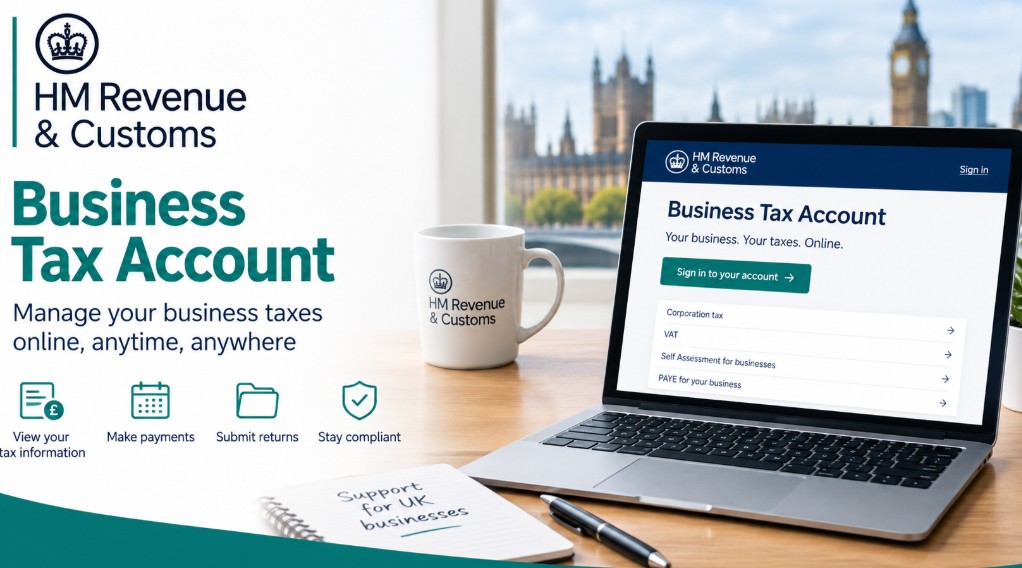
A business tax account brings a business’s tax affairs into a single online dashboard rather than scattered logins for each tax. HMRC built it to reduce paperwork and give businesses real-time visibility over what they owe and when returns are due.
Beyond the core four taxes, the account can also hold over 40 additional schemes and duties, from Construction Industry Scheme registration to Alcohol Duty, added as a business needs them.
From one login, a business can manage:
- Submit VAT returns, register for VAT, and view payment history
- Manage PAYE for employers, including staff tax codes and liabilities
- Track Corporation Tax balances, deadlines, and your corporation tax payment reference
- File Self Assessment tax returns for sole traders and partnerships
Each tax appears as a separate summary, called a tax card, showing the reference number, balance, and next deadline for that service. Adding a new tax later doesn’t require starting over, it’s simply linked to the same account.
It is also the portal where a business authorises an accountant or tax agent to act on its behalf. Using the Manage account section, businesses can approve digital handshakes to link their specific taxes to their accountant’s Agent Services Account.
When can you actually start using the account after signing up?
Access to a newly added tax service isn’t usually instant. After a business requests it, HMRC posts an activation code to the registered address, which can take up to 10 days to arrive, or 21 days if that address is abroad.
The code then expires 28 days after HMRC issues it, so activate matters promptly.
Click Get online access to a tax, duty or scheme on the account home page to request the specific service.
- Request access to the tax service from the account home page
- Wait for the activation code to arrive by post
- Sign back in and enter the code where prompted
- Confirm activation, the service then appears on the account home page
If nothing arrives after 10 days, sign back in and check whether the request actually went through before assuming it’s lost. HMRC’s service availability page also shows any current system issues, which can occasionally explain a delay beyond the usual posting time.
Who needs an HMRC business tax account: sole trader, partnership, or limited company?
Any business structure can use one. Sole traders, partnerships, and limited companies are all eligible, and there’s no legal requirement to set one up. Skipping it just means relying on paper letters or phone calls for information the account would show instantly.
Companies House registration changes things slightly: a limited company’s tax affairs are legally separate from its director’s personal tax, so the account becomes the main way to manage Corporation Tax.
Sole traders see it differently. Filing Self Assessment or using Making Tax Digital for Income Tax means those obligations sit here too, not in a separate personal-only account.
The same sign-in details can also manage accounts for more than one business, each kept apart by its own reference numbers.
Setting up an account early ensures you never miss a filing deadline.
How is a business tax account different from a personal tax account?
A business tax account manages a business’s taxes; a personal tax account manages an individual’s.
The two platforms are completely separate, though sole traders often need to use both to manage their full financial picture.
| Business tax account | Personal tax account | |
|---|---|---|
| Manages | VAT, PAYE, Corporation Tax, business Self Assessment | Income Tax, tax code, National Insurance record |
| Used by | Sole traders, partnerships, limited companies | Individuals, including employees and directors |
| Sign-in | Government Gateway or GOV.UK One Login | Government Gateway or GOV.UK One Login |
| Shows | Business tax balances and deadlines | Personal tax code, refunds, State Pension forecast |
A limited company’s Corporation Tax always sits in its business tax account, never a director’s personal one. A director typically needs both accounts, the business one for the company’s Corporation Tax, and a personal one for their own salary or dividend income.
Sole traders filing Self Assessment sometimes see it listed under both, since HMRC treats self-employment income as tied to the individual.
How to contact HMRC if you can’t log in?
Contact the HMRC Online Services Helpdesk on 0300 200 3600, open Monday to Friday, 8am to 6pm. This line handles technical sign-in problems, lost user IDs, password resets, and activation code issues, not tax queries.
VAT-specific technical problems go through a separate VAT online services helpline instead, since the two teams handle different systems.
Before calling, have ready:
- A Government Gateway user ID or One Login email, whichever applies
- The postcode or address linked to the account
- Details of the specific error message or problem
If an accountant manages a business’s taxes, they can’t use its Government Gateway details directly, they access it separately through an HMRC agent services account, set up under their own credentials. Getting through to the right helpline first time saves a second call.
Conclusion
A business tax account remains the fastest way to see what a business owes HMRC and when it’s due. Registration takes minutes, but full access to a new tax service can take up to 10 working days once an activation code is posted.
Setting one up before a filing deadline, rather than scrambling close to it, avoids that wait becoming a problem.
Disclaimer: The information in this article is for general guidance only and does not constitute financial or tax advice. Always check the latest deadlines, thresholds, and registration processes directly on GOV.UK or consult a qualified accountant before making tax decisions.
FAQs
Is a business tax account the same as a Government Gateway account?
No, Government Gateway is simply the sign-in method, while a business tax account is the tax dashboard itself. The same Government Gateway or One Login details can also access a personal tax account.
Do sole traders need a business tax account?
Not legally, but most benefit from one. It lets sole traders manage VAT, PAYE and Self Assessment together instead of relying on separate paper correspondence from HMRC.
Does HMRC check business bank accounts?
HMRC can request business bank records during a formal enquiry or compliance check, but it doesn’t routinely monitor accounts. Reviews are typically triggered by inconsistencies in submitted returns, not random checks.
What’s the HMRC business tax account contact number?
The HMRC Online Services Helpdesk is 0300 200 3600, open Monday to Friday, 8am to 6pm. This line covers login and technical issues rather than tax-specific queries.