
UK Dividend Tax Rates 2026: Complete Guide to Bands, Calculations, and Tax Strategies
Dividend tax is an HMRC tax levied on company profit distributions paid to shareholders, calculated using specific dividend tax bands above a tax-free allowance.
UK dividend tax rates depend on your total taxable income bracket, spanning basic, higher, and additional thresholds, and apply equally to company directors extracting profits and individual stock market investors across the United Kingdom.
Key Takeaways
- Taxpayers receive a five hundred pound tax-free dividend allowance alongside the twelve thousand five hundred and seventy pound personal allowance.
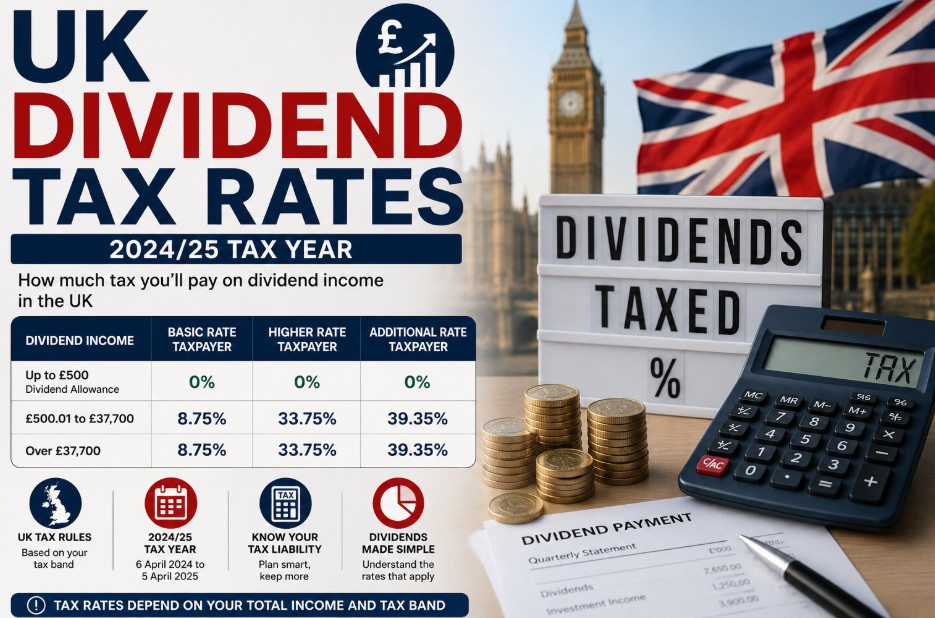
- Dividend tax rates for basic, higher, and additional rate bands sit at eight point seven five, thirty-three point seven five, and thirty-nine point three five percent.
- Starting from six April twenty twenty-six, dividend tax rates rise by two percentage points for basic and higher bands to ten point seven five and thirty-five point seven five percent.
- Taxpayers receiving dividend income over ten thousand pounds in a tax year must register for and report earnings through HMRC self-assessment.
What Are Dividends?
Dividends are cash or share payments made by a corporation to its shareholders to distribute post-tax profits. Issued after Corporation Tax deductions, dividends allow directors and investors to receive business earnings legally without generating a direct National Insurance liability.
When a company generates a profit, its board of directors can choose to either:
- Retain those earnings within the business to fund future growth.
- Distribute them to shareholders as a cash return on their investment.
Dividends are typically paid as cash directly into a shareholder’s bank account, though they can also be issued as additional shares. For small business directors, dividends serve as a primary mechanism for extracting business profits alongside or in place of a standard salary.
What Is Dividend Tax?
Dividend tax is a specific category of Income Tax levied by HM Revenue & Customs (HMRC) on profit distributions received by individuals holding company shares.
Because dividends represent income derived from investments or business ownership rather than direct employment, HMRC taxes them under a distinct set of rates and allowances separate from standard salary tax rates.
- Individual Liability: Dividend tax is an individual personal tax liability, not a business expense.
- Double Taxation Protection: The company distributes dividends from money already subjected to UK Corporation Tax, and the recipient shareholder is personally responsible for settling any dividend tax owed to HMRC.

When Do You Have to Pay Tax on Dividends?
You must pay dividend tax whenever your annual dividend earnings exceed your combined tax-free thresholds, specifically the £12,570 Personal Allowance and the £500 Dividend Allowance.
Tax owed is collected via PAYE tax code adjustments (£500–£10,000) or annual Self Assessment tax returns (over £10,000).
The actual payment deadline depends on the payment method and reporting route:
- Through PAYE (Dividends between £500 and £10,000): If HMRC adjusts your tax code to collect the tax directly via your monthly salary, the tax is collected incrementally throughout the tax year.
- Through Self Assessment (Dividends over £10,000): You must report the earnings on a Self Assessment tax return and pay the total tax owed by 31 January following the end of the relevant tax year (e.g., tax for the 2024/25 tax year is due by 31 January 2026).
What Are the Current UK Dividend Tax Rates and Allowances?
UK dividend tax rates dictate the exact percentage of personal tax owed on profit distributions after deducting allowances. For 2025/26, rates sit at 8.75% (basic), 33.75% (higher), and 39.35% (additional). Rates rise by 2% for basic and higher bands starting 6 April 2026.
How Much Is the Tax-Free Dividend Allowance in the UK?
The UK Dividend Allowance is £500 per tax year. Dividends falling within this threshold incur a 0% tax rate. Unused £12,570 Personal Allowance can also shield dividend income, allowing up to £13,070 total tax-free dividends if no other income exists.
Every UK resident receives two distinct tax-free allowances that cover dividend earnings:
- Personal Allowance (£12,570): Applied to salary, dividends, or savings income if unutilized elsewhere.
- Dividend Allowance (£500): For the 2024/25, 2025/26, and 2026/27 tax years, this tax-free threshold is set at £500.
Dividends falling within this £500 allowance incur a 0% tax rate. However, income inside this tax-free allowance still counts toward your overall income band when determining which rate bracket applies to earnings above the threshold.

How Have UK Dividend Tax Rates Changed Over Time?
The UK government has systematically adjusted tax rates and reduced allowances over recent tax years to align tax liabilities across earned employment income and investment returns.
The table below outlines historical and upcoming rates based on official GOV.UK tax updates:
| Tax Year | Dividend Allowance | Basic Rate | Higher Rate | Additional Rate |
| 2023/24 | £1,000 | 8.75% | 33.75% | 39.35% |
| 2024/25 | £500 | 8.75% | 33.75% | 39.35% |
| 2025/26 | £500 | 8.75% | 33.75% | 39.35% |
| 2026/27 | £500 | 10.75% | 35.75% | 39.35% |
As of 2026, tax policy changes mandate a 2 percentage point increase in the basic and higher rate bands, taking effect from 6 April 2026. This shift increases profit extraction costs for SME directors relying on distribution models.
How Do You Calculate Dividend Tax in the UK?
To calculate UK dividend tax, sum all annual income and apply the standard UK tax bands. Deduct your £12,570 Personal Allowance first, then apply the £500 Dividend Allowance.
Tax remaining dividends at your applicable band rate: 8.75%/10.75% (basic) or 33.75%/35.75% (higher).
Total Income = Salary + Savings Interest + Dividend Income
- Apply Personal Allowance (£12,570)
- Apply Dividend Allowance (£500)
- Tax Remaining Dividends by Band (Basic / Higher / Additional)
What Is the Income Stacking Order for HMRC Tax Bands?
MRC’s income stacking order dictates that non-savings income (salary) is taxed first, savings interest second, and dividend income last.
Because dividends sit at the top of the stack, previous salary earnings consume lower tax bands, pushing dividends into higher tax brackets
HMRC applies a strict ordering mechanism known as the income stacking order to calculate total tax liabilities:
- Non-savings income (salaries, pensions, rental income).
- Savings income (bank interest).
- Dividend income (profit distributions from private or public shares).
Because dividends sit at the top of the income stack, your salary and savings interest absorb your basic rates first. Consequently, dividend earnings are frequently pushed into higher tax brackets.
Practical Dividend Tax Calculation Example
In practice, tax outcomes vary significantly depending on total earnings.
Consider a limited company director taking a tax-efficient salary of £12,570 alongside £40,000 in dividends during the 2025/26 tax year:
- Total Income: £52,570
- Salary (£12,570): Covered entirely by Personal Allowance (£0 Tax)
- Dividends (£40,000):
- £500: Covered by Dividend Allowance (£0 Tax)
- £37,700: Taxed at Basic Rate 8.75% (£3,298.75)
- £1,800: Taxed at Higher Rate 33.75% (£607.50)
- Total Tax Payable (2025/26): £3,906.25
Under 2026/27 rates (10.75% basic / 35.75% higher), basic tax rises to £4,052.75 and higher rate tax to £643.50, bringing total tax owed to £4,696.25, an annual increase of £790.
What Are the UK Dividend Tax Rates for Limited Company Directors?
Limited company directors pay dividend tax on distributions extracted from post-tax profits. Dividends avoid National Insurance Contributions (0% NICs), making them structurally cheaper than salaries, though they are not deductible expenses for company Corporation Tax.
Is It Better to Take Salary or Dividends from a UK Ltd Company?
A combination of low salary and high dividends is typically most tax-efficient. Taking a salary up to the National Insurance Primary Threshold (£12,570) secures state pension credits and remains Corporation Tax deductible, while extracting remaining profits via dividends avoids National Insurance.
Extracting value requires balancing Personal Tax, National Insurance Contributions (NICs), and Corporation Tax.
| Extraction Strategy | Corporation Tax Deductible? | Subject to NICs? | Personal Tax Band |
| Director Salary (up to Secondary Threshold) | Yes | No (if below threshold) | Covered by Personal Allowance |
| Dividend Distributions | No (paid from post-tax profit) | No | 8.75%–39.35% (2025/26) |
| Direct Pension Contribution | Yes | No | 0% (Tax-deferred growth) |
A common pattern among small business owners is taking a salary up to the National Insurance Primary Threshold (£12,570) and extracting remaining profits via dividends to minimize combined liabilities.
How Does the 60% Effective Tax Trap Work for High Earners?
Earnings between £100,000 and £125,140 trigger the Personal Allowance taper, reducing your £12,570 allowance by £1 for every £2 earned. Combined with higher rate dividend tax, this creates an effective marginal personal tax rate of ~53.75% (rising to ~55.75% in April 2026).
Extracting dividends within this £100,000 to £125,140 band creates an effective marginal tax penalty that severely erodes take-home earnings.
How Do UK Dividend Tax Rates Apply in Scotland and for Non-Residents?
Dividend tax rates are reserved matters set centrally by the UK Parliament. Scottish residents pay identical UK dividend tax rates (8.75%–39.35%). Non-UK residents usually pay 0% UK dividend tax under HMRC disregarded income rules.
Are Dividend Tax Rates Different in Scotland?
No, dividend tax rates are not different in Scotland. Scottish taxpayers pay the exact same 8.75% (basic), 33.75% (higher), and 39.35% (additional) rates as taxpayers in England and Wales. However, Scottish salary tax bands shift where dividends start.

How Are Foreign Dividends and Non-Resident Shareholders Taxed?
UK residents paying tax on foreign dividends can claim Foreign Tax Credit Relief to prevent double taxation. Non-UK residents receiving dividends from UK companies benefit from disregarded income rules, resulting in zero UK tax liability.
- Foreign Dividends: UK tax residents receiving profit distributions from foreign companies must declare them on their HMRC Self Assessment tax return. If tax was withheld in the origin country, taxpayers can claim Foreign Tax Credit Relief to avoid double taxation.
- Non-Resident Shareholders: Non-UK residents receiving dividends from UK companies are subject to disregarded income rules. Foreign residents usually pay zero UK tax on UK dividends, though they remain accountable to taxation within their home jurisdiction.
How to Avoid or Reduce Dividend Tax Legally in the UK
You can legally reduce UK dividend tax by utilizing Stocks & Shares ISAs (£20,000 annual allowance), transferring shares to a lower-earning spouse, making direct company pension contributions, and timing distribution declarations across separate tax years.
Taxpayers can optimize profit extraction legally using statutory frameworks, tax-free wrappers, and structural planning:
- Transfer stocks into Stocks & Shares ISAs: Income held within an ISA wrapper is completely immune to UK dividend tax and capital gains obligations up to the £20,000 annual allowance.
- Utilize spousal allowances: Transfer shares to a spouse or civil partner in a lower tax bracket to utilize their unused £12,570 Personal Allowance and £500 Dividend Allowance.
- Execute direct employer pension contributions: Distribute company profits directly into a registered director pension scheme as an employer contribution, bypassing both Corporation Tax and personal dividend liabilities.
- Retain profits within the business: Leave excess reserves inside company accounts, managing your corporate ledger, balance sheet, and debtors and creditors efficiently, to defer personal tax bills until lower-income tax years or formal company liquidation under Business Asset Disposal Relief rules.
- Participate in Share Incentive Plans (SIPs): Employees holding dividend shares within qualifying employer SIP schemes for five years incur no tax obligations on distributions.
- Time distribution declarations: Split large profit extractions across multiple tax years to avoid pushing total earnings into higher or additional rate bands.
How Do You Report and Pay Dividend Tax to HMRC?
Dividend income up to £500 requires no HMRC reporting. Earnings between £501 and £10,000 can be collected through PAYE tax code adjustments. Dividend earnings exceeding £10,000 require mandatory registration and submission via HMRC Self Assessment.
When Do You Need to Register for Self Assessment for Dividends?
You must register for HMRC Self Assessment by 5 October following the end of the tax year if your dividend income exceeds £10,000. Dividends under £10,000 can be handled informally by contacting HMRC directly.
- Under £500 in dividends: No formal notification or tax filing is required if covered by allowances.
- Between £500 and £10,000: Contact HMRC directly to request a PAYE tax code adjustment, allowing tax collection through routine salary deductions.
- Over £10,000 in dividends: Registration for HMRC Self Assessment is mandatory, requiring a formal tax return submission.
Key Deadlines for Paying Dividend Tax
Self Assessment tax payment deadlines operate on strict statutory dates: 5 October to register for Self Assessment, 31 October for paper returns, and 31 January for online returns and final tax payments.
Tax Year Ends: 5 April
- 5 October: Registration deadline for Self Assessment
- 31 October: Paper tax return deadline
- 31 January: Online tax return & balancing payment deadline
Failure to register or settle payments by 31 January following the end of the tax year incurs statutory HMRC late penalties and daily interest fees.
Conclusion
Managing profit extraction demands careful alignment between personal tax thresholds and business earnings. As tax allowances remain frozen at £500 and tax rates increase by 2 percentage points from April 2026, forward planning is essential.
Review your distribution strategy before the end of the current tax year, ensure all dividend vouchers and board minutes are correctly documented, and evaluate pension contributions to protect your earnings.
Disclaimer: This guide is for informational purposes only and should not be taken as professional financial or legal tax advice; please consult a qualified accountant for personalized guidance.
FAQ
Are all dividends taxed at 20% in the UK?
No, dividends are not taxed at 20%. Depending on your total income tax bracket, dividends are taxed at 8.75% for basic rate, 33.75% for higher rate, and 39.35% for additional rate taxpayers.
How much tax do you pay on dividends in the UK if you already earn £50,000 salary?
Because a £50,000 salary nearly exhausts the £50,270 basic rate band, most of your dividend income above the £500 allowance will be taxed at the higher rate of 33.75%.
Is the UK dividend allowance tax-free for 2026/27?
Yes, the UK dividend allowance remains a tax-free 0% threshold capped at £500 for the 2026/27 tax year, though distributions exceeding £500 face higher tax rates.
Does a limited company pay tax when issuing dividends to shareholders?
No, limited companies do not pay dividend tax. Dividends are paid out of retained company profits that have already been subjected to UK Corporation Tax.
What happens if dividend income is over £5,000?
If your dividend income exceeds £5,000, you pay tax on the amount above the £500 allowance according to your income band and must register for HMRC Self Assessment.
Can you pay dividends if the company is not making a profit?
No, company law strictly dictates that dividends can only be distributed from cumulative post-tax retained profits. Paying dividends without sufficient profits creates an illegal dividend distribution.
Do non-residents pay UK dividend tax on UK company shares?
Non-UK residents generally face zero UK dividend tax liabilities due to disregarded income rules, though distributions must be reported within their country of tax residence.