The Reducing Balance Method of Depreciation: Formula, Calculation and UK SME Guide
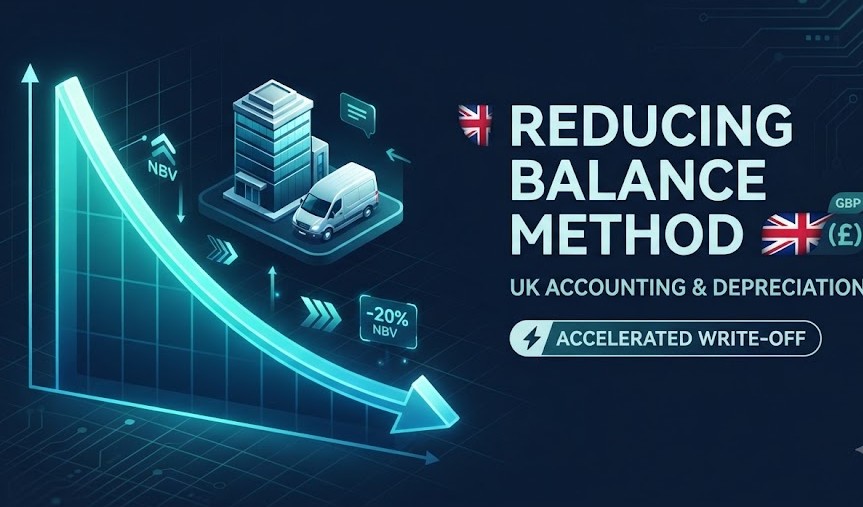
The reducing balance method of depreciation is an accounting method where a fixed percentage is applied each year to the asset’s declining net book value. This means depreciation is higher in the early years and gradually falls as the asset gets older.
This approach reflects the faster wear and tear and loss of value that business assets such as commercial vehicles, machinery and IT hardware can face in their early years.
Key Takeaways
- Reducing balance depreciation applies a constant percentage rate to the declining net book value of fixed assets annually.
- Higher depreciation charges are recorded in the early years to reflect the asset’s faster initial loss in value.
- The calculation multiplies the opening net book value by the chosen percentage rate in line with UK accounting standards.
- Keeping accurate records helps ensure that the profit and loss account and balance sheet show reliable figures.
What Is the Reducing Balance Method?
The reducing balance method is an accounting practice used under UK Generally Accepted Accounting Practice (UK GAAP) and Financial Reporting Standard 102 (FRS 102) to spread an asset’s depreciable amount over its useful economic life.
Unlike the straight-line method, which charges the same amount in each accounting period, this method records a higher expense in the earlier years.
In practice, assets such as commercial delivery vans and computer servers may provide more value at the start of their working life and lose value more quickly during their early years.
Tangible non-current assets can lose value through use, technological changes and normal wear and tear. By applying depreciation as a constant percentage of the remaining balance rather than the original historical cost, the annual charge automatically reduces over time.
This helps match the operating expense more closely with the income the asset is expected to generate during its working life.
The Companies Act 2006 requires directors to ensure that fixed asset values in statutory accounts give a true and fair view, making accurate depreciation important for compliant financial reporting.
How Does the Reducing Balance Method Work?
This method is based on the idea that an asset’s usefulness and value often fall faster during its early years.
When setting up this method in a fixed asset register, accountants and bookkeepers use the asset’s original purchase cost for Year 1. In later financial years, the calculation uses the adjusted net book value after taking previous depreciation into account.
As the fixed percentage is applied to a smaller net book value each year, the depreciation charge also falls.
Institute of Chartered Accountants in England and Wales (ICAEW) guidance states that the depreciation rate should be reviewed regularly to make sure it still reflects the estimated residual value and useful economic life of the equipment.
How to Calculate the Reducing Balance Method?
To calculate depreciation, apply the formula to the asset’s declining net book value over its working life.
Reducing Balance Formula
Annual Depreciation Charge = Net Book Value (NBV) × Depreciation Rate (%)
Net Book Value = Historical Cost − Accumulated Depreciation
Step-by-Step Calculation Example
For example, a UK small business buys a commercial delivery van for £15,000 and uses an approved reducing balance depreciation rate of 25% a year.
| Financial Year | Opening Net Book Value (£) | Depreciation Rate (%) | Annual Depreciation Charge (£) | Closing Net Book Value (£) |
| Year 1 | £15,000.00 | 25% | £3,750.00 | £11,250.00 |
| Year 2 | £11,250.00 | 25% | £2,812.50 | £8,437.50 |
| Year 3 | £8,437.50 | 25% | £2,109.38 | £6,328.13 |
| Year 4 | £6,328.13 | 25% | £1,582.09 | £4,746.04 |
In Year 1, the full historical cost of £15,000 is multiplied by 25%, producing an annual depreciation charge of £3,750.00 and leaving a closing net book value of £11,250.00. In Year 2, that closing figure becomes the opening net book value, resulting in a reduced depreciation charge of £2,812.50.
This pattern continues in the following years, with accumulated depreciation increasing while the annual depreciation expense falls as the vehicle gets older.
What Is the Use of the Reducing Balance Method?
The reducing balance method is mainly used to reflect the way an asset loses value over time and to support accurate financial reporting.
- Accurate Expense Matching: It aligns higher operational depreciation expenses with periods of maximum asset productivity and revenue generation.
- Prudent Balance Sheet Presentation: It reduces asset book values more quickly in the early years, helping to avoid overstating their value on the balance sheet.
- Tax Strategy Alignment: While HMRC requires separate capital allowance computations for tax relief, maintaining proper accounting depreciation ensures clean separation between statutory accounts and tax filings.
When Should You Use the Reducing Balance Method?
Business owners and finance managers choose this method based on how the asset is used, the type of asset, and the business’s investment plans.
You should apply the reducing balance method when dealing with tangible non-current assets that experience heavy initial usage and rapid technological displacement, such as:
- Commercial vehicles and delivery vans
- Plant and heavy machinery
- IT hardware, computer servers, and digital infrastructure
Directors may prefer this method for capital equipment because matching higher early expenses with the higher productivity of new equipment can help prevent profits from being overstated in the early years.
How Do You Determine the Rate of Depreciation Using the Reducing Balance Method?
Business owners and finance managers determine the annual depreciation rate by considering the asset’s expected useful life and its estimated scrap or residual value at the end of that period.
Choosing the right rate requires professional judgement, past asset performance data and compliance with the company’s accounting policies.
- Assess the historical acquisition cost of the tangible non-current asset from purchase invoices and supplier receipts.
- Estimate the total number of years the asset will remain commercially viable and productive within the enterprise.
- Estimate the asset’s residual value or expected scrap value at the end of its useful life.
- Apply the relevant reducing balance formula or refer to industry benchmarks for plant, machinery and commercial vehicles.
- Record the chosen depreciation policy in the company’s accounting manual so it is applied each year consistently.
- Enter the approved percentage rate into the fixed asset register software to automate the annual calculations.
- Review the depreciation rate each year to check that the asset’s book value remains a reasonable reflection of its value.
Why Do UK SMEs Choose the Reducing Balance Method Over Straight-Line Depreciation?
Small and medium-sized enterprises choose accounting methods based on how their assets are used, their tax position and the nature of their investments. The choice between faster write-downs and an even cost distribution affects annual profits and the figures shown on the balance sheet.
| Feature | Reducing Balance Method | Straight-Line Method |
| Expense Distribution | Higher in early years, decreasing over time | Equal charge every financial year |
| Ideal Asset Types | Technology, commercial vehicles, machinery subject to rapid obsolescence | Office furniture, buildings, long-life fixtures |
| Tax and P and L Impact | Reduces early-year taxable profits more aggressively | Smooths out profit and loss statements evenly |
| Calculation Basis | Applied to declining Net Book Value (NBV) | Applied to original cost minus residual value |
Directors may prefer the reducing balance method for machinery and digital infrastructure that see heavy use early on or become outdated quickly.
Matching higher initial expenses with the higher productivity and income generated by new equipment can help prevent profits from being overstated in the early years. In practice, this gives a more cautious view of asset values during the early years of use.
How Does Reducing Balance Depreciation Affect Small Business Balance Sheets?
Recording depreciation affects both the profit and loss account and the balance sheet at the end of each accounting period. The annual depreciation charge is recorded as an operating expense in the profit and loss account, reducing the net operating profit of the business for that financial year.
At the same time, accumulated depreciation is deducted from the original cost of tangible non-current assets on the balance sheet, leaving the assets shown at their net book value alongside items such as debtors and creditors.
Under the Capital Allowances Act 2001 and HM Revenue and Customs (HMRC) rules, accounting depreciation is added back when calculating taxable trading profits.
HMRC requires businesses to calculate tax relief using statutory writing-down allowances rather than their accounting depreciation rates. Maintaining a clear distinction between statutory accounting records and tax computations prevents compliance errors during annual corporation tax filings.
What Are the Common Mistakes Small Business Owners Make When Recording Reducing Balance Depreciation?
Depreciation calculations need to follow the relevant accounting standards to avoid inaccurate financial statements and possible penalties.
- Applying the percentage rate to the original historical cost in every subsequent year instead of using the declining net book value.
- Failing to establish a realistic residual value, causing assets to depreciate down to zero prematurely.
- Confusing accounting depreciation policies with HMRC capital allowance tax rules, leading to incorrect corporation tax computations.
- Omitting newly acquired equipment from the fixed asset register during the financial year in which purchases occurred.
- Continuing to charge depreciation on fully written-down assets that remain in active commercial use.
Conclusion
Implementing accurate asset depreciation schedules ensures compliance with UK reporting standards and maintains transparent financial records for stakeholders, lenders, and directors, which supports broader management accounting practices.
Regularly reviewing fixed asset registers, checking depreciation rates against actual asset performance and keeping accounting depreciation separate from HMRC tax calculations can provide a sound financial base for a growing business.
Disclaimer: This article is for informational purposes only and does not constitute formal accounting, tax, or legal advice; consult a qualified professional for your specific business requirements.
FAQs
What is the reducing balance method formula?
The reducing balance method formula multiplies the asset’s opening net book value for the accounting period by a fixed percentage to calculate the annual depreciation charge.
How do you calculate depreciation using the reducing balance method?
To calculate it, multiply the starting net book value by the depreciation rate for Year 1, then subtract the depreciation charge to get the opening net book value for Year 2.
Why do businesses use the reducing balance method instead of straight line?
Businesses use this method to match higher early depreciation costs with assets that lose value and experience more wear and tear during their early years.
Can a UK company change its depreciation method from reducing balance to straight line?
Yes. A company can change its depreciation method if the change provides a more reliable and relevant presentation under FRS 102. The change must also be formally disclosed as an accounting policy change in the statutory accounts.