

Is State Pension Paid in Arrears? UK Payment Schedules and DWP Rules Explained
The UK State Pension is paid in arrears, which means each payment covers a period that has already passed rather than paying you in advance. The Department for Work and Pensions pays the State Pension directly into your bank account every four weeks.
Understanding how payments in arrears work can help you plan your finances when you retire or stop working.
Key Takeaways:
- The UK State Pension is paid strictly in arrears, meaning each payment covers a statutory entitlement period that has already elapsed.
- Payments are made every four weeks by the Department for Work and Pensions, giving you 13 payments a year.
- Your payment day is based on the final two digits of your National Insurance number.
- There is usually a short wait for the first payment, which includes the amount due for the days that have already passed.
- You can ask The Pension Service to pay your pension weekly if this makes it easier to manage your budget.
Is state pension paid in arrears?
Yes, the UK State Pension is paid in arrears. This means each payment covers a period that has already passed, rather than paying you for future weeks.
This system also gives the Department for Work and Pensions time to deal with changes in eligibility and reduce the risk of overpayments.
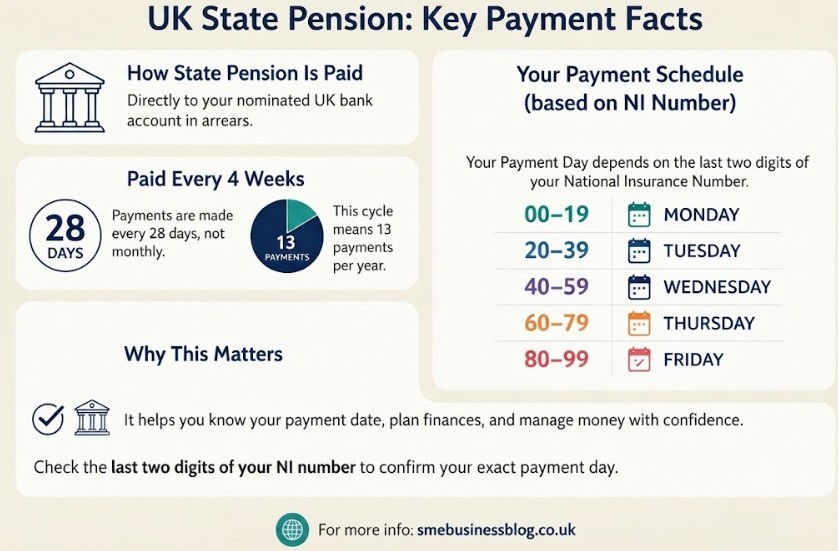
Payments follow a fixed 28-day schedule and are paid directly into your bank account every four weeks, resulting in 13 payments a year. Your payment day is based on the final two digits of your National Insurance number, making it easier to plan household bills and direct debits.

What Does Being Paid in Arrears Mean for Your State Pension?
Being paid in arrears can make it easier for businesses and individuals to plan their finances. For the State Pension, this system gives the Department for Work and Pensions time to check eligibility, reduce overpayments and manage public funds.
For retirees, this means the money reaches your account after the relevant 28-day period has ended.
What Are the Benefits of Paying Staff and Pensions in Arrears?
For businesses, paying wages after a completed working week means employees are paid for work they have already done.
The government uses a similar system for the State Pension, helping it check eligibility and reduce the risk of overpayments. Self-employed directors and sole traders may also use similar payment arrangements to manage their business income and cash flow.
What Is the Current State Pension Age for Self-Employed Directors?
State Pension age is an important milestone for business owners planning when they want to retire or step away from their business.
The State Pension age is currently 66 for both men and women, with planned increases towards 67 under the current timetable, further influenced by ongoing UK pension tax reform proposals.
If you are planning to close or sell your business, check your exact State Pension age using the official government forecast tools.
Some business owners continue working after reaching State Pension age and delay claiming their pension, which may increase their future payments.

How Much Is the UK State Pension Worth for Retiring Business Owners?
Your retirement income depends largely on the number of National Insurance qualifying years you have built up during your working life.
The full New State Pension can provide a useful source of income when directors step away from their business, although the amount you receive depends on your National Insurance record.
When assessing total retirement income, business owners must factor in this statutory baseline alongside private pensions and retained corporate dividends, while also seeking ways to boost the state pension tax allowance to minimize overall tax liability.
HM Revenue and Customs treats state pension disbursements as taxable gross income, requiring careful reconciliation when combined with other income sources, especially when navigating unexpected issues such as an HMRC state pension tax error.
How Is State Pension Paid in Arrears to UK Bank Accounts?
State Pension payments are made automatically every four weeks, giving you 13 payments each year. Because payments are made every 28 days rather than once a calendar month, you receive 13 payments a year.
The day your payment arrives is based on the final two digits of your National Insurance number.
| Final Two Digits of National Insurance Number | Scheduled State Pension Payment Day | Payment Processing |
| 00 to 19 | Monday | Early-week batch settlement |
| 20 to 39 | Tuesday | Standard verification window |
| 40 to 59 | Wednesday | Mid-week automated disbursement |
| 60 to 79 | Thursday | Late-week clearing cycle |
| 80 to 99 | Friday | Final weekly distribution batch |
Knowing this designated weekday allows retirees to align direct debits, utility bills, and financial commitments with their exact four-weekly payment schedule.
Why Is the State Pension Paid In Arrears Rather Than in Advance?
The main reason for paying the State Pension in arrears is to make payments easier to manage and keep them accurate.
Paying in arrears gives the Department for Work and Pensions time to process changes, such as a change in circumstances, moving abroad or a bereavement, before making the payment.
Paying in advance could lead to more overpayments if someone’s circumstances or eligibility changed, making the money harder to recover. This system helps protect public funds and makes sure payments relate to a period for which the person is entitled to receive the pension.
Do Retired Small Business Owners Still Pay Council Tax on Commercial Premises or Dwellings?
Council tax and business rates still need to be paid after you reach State Pension age, so they should be included in your budget.
Reaching State Pension age does not automatically mean you are exempt from council tax or business rates. However, some people on a low income may qualify for Council Tax Reduction.
If you own commercial premises, you will still need to deal with business rates after retirement. Check your local council’s guidance to see whether you qualify for any reduction or exemption.
How Long Does It Take to Release Pension Funds After the Death of a Sole Trader or Director?
How quickly an estate can be dealt with depends partly on how soon the relevant authorities are told about the death.
When a recipient passes away, notifying The Pension Service immediately prevents accidental overpayments that the deceased person’s estate would subsequently be required to repay.
- The Department for Work and Pensions freezes the pension account immediately upon formal notification of death.
- The Tell Us Once service shares bereavement details across multiple government departments simultaneously.
- The Pension Service calculates any final arrears owed up to the exact date of passing.
- Surviving spouses or civil partners may inherit specific protected elements of the state pension depending on historical National Insurance contribution records.
- Probate and the release of final estate funds can take several weeks or months, depending on the assets involved.
Actionable Steps to Track and Verify Your State Pension Account
Checking your entitlement and upcoming payments can help you keep track of your finances during retirement.
- Access the official Government Gateway digital portal to review your comprehensive state pension forecast and check verified National Insurance qualifying years.
- Confirm that your banking or building society details are up to date with the Department for Work and Pensions to avoid transaction rejections.
- Check the final two digits of your National Insurance number to cross-reference your designated payment day against official allocation schedules.
- Contact The Pension Service immediately via telephone or post if a scheduled arrears payment fails to arrive on the expected weekday.
- Review official communications from HM Revenue and Customs regarding coding notices if your total retirement income crosses personal tax thresholds, and should you find discrepancies, you might be eligible to claim an HMRC state pension tax refund.
- Submit a formal request to The Pension Service if you prefer to transition from a four-weekly arrears schedule to weekly arrears disbursements.
Conclusion
Managing your retirement income is easier when you understand how State Pension payments in arrears work, when they are paid and how your payment day is decided.
Check your State Pension forecast, plan your household budget around your payment day and contact The Pension Service if you notice any problems with your payments.
Disclaimer: This article is for informational purposes only and does not constitute official financial or legal advice; consult The Pension Service or a qualified financial advisor for guidance tailored to your specific circumstances.
FAQs
Is UK State Pension paid in advance or in arrears?
The UK State Pension is paid in arrears, so each payment covers a period that has already passed.
What will the State Pension be after April 2026?
State Pension rates are adjusted under the government’s triple lock policy, based on the highest of average earnings growth, inflation or the minimum increase set by law.
How is the UK State Pension paid?
Payments are disbursed automatically by the Department for Work and Pensions directly into a bank or building society account every four weeks in arrears.
Is State Pension back paid?
If you delay claiming after reaching State Pension age, you may be able to backdate your claim by up to three months, provided you meet the relevant conditions.
Can you get your state pension paid monthly?
The standard automated schedule operates on a four-weekly cycle, resulting in thirteen payments a year rather than twelve calendar monthly payments, though weekly disbursements can be requested.
How long does it take to get the first payment?
The first payment is typically processed and deposited within five weeks of reaching State Pension age, incorporating a pro-rata sum for the initial elapsed days.
Do I pay tax on my state pension?
State pension income counts as taxable gross income, though tax is not deducted at source; HM Revenue and Customs collects any tax owed through PAYE adjustments.