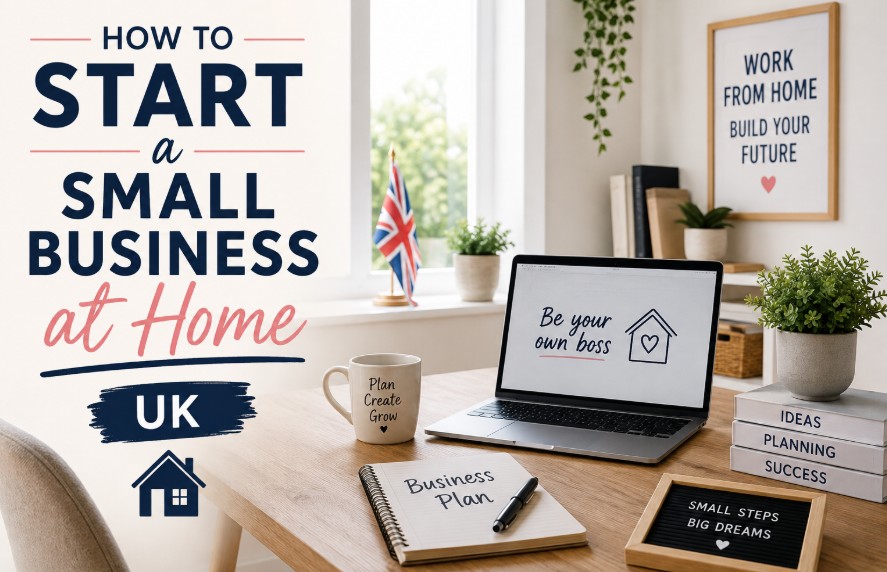
How To Start A Small Business At Home: A UK Guide To Tax, Insurance And Legal Rules
Starting a home business in the UK requires registering with HMRC, selecting an appropriate legal structure, ensuring statutory insurance coverage, and securing landlord or lender permissions.
As of 2026, home-based micro-enterprises must comply with local planning regulations, ICO data protection standards, and specific business rates thresholds to operate legally.
Key Takeaways
- Starting a UK home business requires notifying HMRC for tax registration and securing necessary property permissions before trade begins.
- Micro-enterprises operating from home can claim allowable expenses through HMRC simplified expense rates or itemised actual utility costs.
- Business owners employing staff must secure mandatory Employers’ Liability Insurance with at least five million pounds in coverage by law.
- Government support available for home startups includes British Business Bank Start Up Loans alongside localized Growth Hub business grants.
How to Start a Small Business at Home?
Starting a small business at home requires establishing a legal structure, registering for taxation, opening a dedicated business bank account, and verifying local operational compliance.
Entrepreneurs must notify HM Revenue and Customs (HMRC), assess property agreement permissions, and set up clear financial record-keeping systems before serving their first customer.
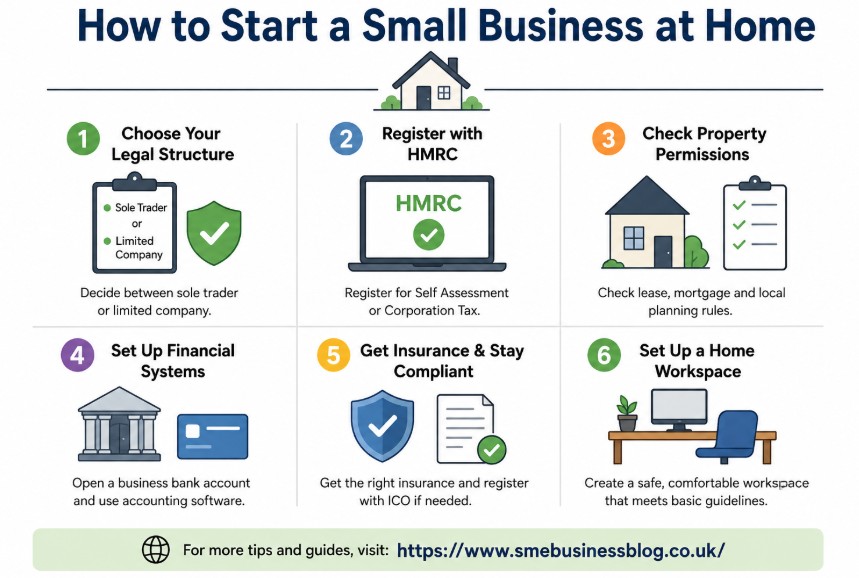
1. Define Your Legal Structure
Choosing between operating as a sole trader or establishing a limited company dictates your legal liability and administrative workload. A sole trader retains all profits after tax but remains personally liable for business debts.
Forming a limited company creates a separate legal entity, shielding personal assets while imposing formal reporting obligations to Companies House.
2. Register for Taxation with HMRC
Registration with HMRC is mandatory once your gross trading income exceeds the statutory £1,000 Trading Allowance within a single tax year.
Sole traders register for Self Assessment to pay Income Tax and Class 2/4 National Insurance contributions. Limited companies must register for Corporation Tax within three months of starting commercial activities.
3. Secure Required Property Permissions
Running a business from a residential property requires checking lease covenants, mortgage agreements, and local authority planning laws.
If the business changes the primary character of the home or increases local traffic, formal planning permission from the local council becomes a legal necessity.
4. Set Up Dedicated Financial Systems
Opening a separate business bank account keeps personal and commercial transactions distinct, simplifying annual tax submissions.
Implementing digital accounting software compliant with HMRC’s Making Tax Digital (MTD) framework ensures accurate expense tracking and seamless record maintenance from day one.
5. Obtain Insurance and Regulatory Compliance
Every home enterprise must secure relevant insurance coverage before commencing operations. Depending on the sector, this includes Public Liability, Professional Indemnity, or statutory Employers’ Liability Insurance.
Additionally, processing client personal details requires registering with the Information Commissioner’s Office (ICO).
6. Establish a Compliant Home Workspace
Designating a specific work area allows owners to calculate accurate proportion-based utility claims.
Ensure the workspace meets Health and Safety Executive (HSE) guidelines if employing workers, covering basic display screen equipment (DSE) standards and ergonomic requirements.
What Are the Benefits of Starting a Small Business at Home?
Operating an SME from a residential address offers significant financial and structural advantages. By eliminating commercial lease commitments, micro-enterprises preserve working capital during early growth phases.
| Financial & Operational Metric | Commercial Premises | Home-Based Enterprise | SME Strategic Advantage |
| Upfront Capital Expenditure | High (Lease deposits, fit-outs) | Low (Existing infrastructure) | Preserves initial liquidity for core business operations |
| Monthly Fixed Overhead Costs | Fixed rent & commercial rates | Proportional utility allocation | Lowers the monthly break-even threshold significantly |
| Tax Expense Deductions | Standard commercial expenses | HMRC Simplified Expenses / Actuals | Reduces taxable income via partial household bill claims |
| Commute & Lost Time Overhead | 1–2 hours daily average | Zero commute travel time | Reclaims operational hours for client delivery and sales |
Lower Overhead Capital Risk
Traditional commercial leases demand multi-year commitments, substantial security deposits, and commercial service charges.
Operating from home converts fixed property rent into flexible household contributions, drastically reducing the firm’s monthly break-even point.
Tax Efficiency and Expense Claims
HMRC allows you to offset a fair chunk of your household running costs against your taxable income.
You can either claim HMRC’s Simplified Expenses, a flat monthly rate tied to the hours you work from home, or work out the exact business split for your actual council tax, heating, electricity, and broadband bills.
Operational Flexibility and Scalability
A home base allows entrepreneurs to test business models, build side streams like Passive Income Ideas, and iterate services without the pressure of strict commercial overheads.
In practice, early-stage consultancies leverage this agility to reinvest early profits directly into digital marketing and software tooling rather than real estate.
What Type of Small Business Can You Start at Home?
When evaluating Best Small Business Ideas for a residential setup, you will find that most micro-SMEs operating from home fall into service, digital, or light production categories. Choosing the right commercial model requires balancing your personal skill sets against local regulatory restrictions.
Professional Digital Services and Management Consultancies
Digital agencies, graphic design practices, content studios, and management consultancies require minimal physical infrastructure beyond high-speed broadband and computing hardware.
These business types carry low spatial demands and rarely trigger local planning permission issues because they generate no client footfall.
E-Commerce and Specialized Online Retail
Running an online shop via independent platforms or marketplace channels allows owners to manage stock directly from home.
However, storage requirements must remain modest; utilizing residential garages for massive inventory storage can alert local councils regarding material change of use.
Specialized Craft and Food Production Enterprises
Artisanal manufacturing, bespoke clothing production, and home catering represent viable commercial paths. Food-based ventures must register their home kitchen with the local council’s Environmental Health department at least 28 days before trading begins to ensure food hygiene compliance.

Do I Need My Landlord or Mortgage Lender’s Permission to Start?
Starting a business from a residential property always requires reviewing underlying legal agreements. Failing to obtain necessary consents can result in breach of contract, mortgage default notices, or lease termination.
Landlord Agreements and the Small Business, Enterprise and Employment Act
If you let your home, you must check your tenancy agreement for any clauses banning commercial activity.
Thankfully, under the Small Business, Enterprise and Employment Act 2015, landlords cannot unreasonably block you from starting a quiet, low-impact home business. Just remember that you still need to get their written permission sorted before you deal with your first customer.
Mortgage Lender Notifications
Freehold or leasehold owners with an active mortgage must review their lender’s terms and conditions.
While most lenders permit non-intrusive administrative or office-based home businesses, activities involving public access, staff employment, or physical stock storage may require formal lender authorization or an adjustment in mortgage classification.
Local Planning Authority Rules and Business Rates
If running the SME alters the overall residential character of the property or causes noticeable disturbance to neighbors (e.g., frequent delivery vehicles, client noise), the local council may deem it a Material Change of Use.
In such scenarios, formal planning permission is required. Furthermore, using a designated part of the home exclusively for commercial purposes can trigger commercial Non-Domestic Rates on that specific area while potentially impacting Private Residence Relief for Capital Gains Tax upon property sale.
What Insurance Policies Are Legally Mandatory for a UK Home Business?
Insurance requirements for home-based enterprises depend heavily on whether the business employs staff, interacts with the public, or provides specialized professional advice. Standard home contents insurance explicitly excludes business assets, inventory, and commercial liabilities.
| Insurance Category | Legal Status in the UK | Standard Coverage Level | Core Protection Function |
| Employers’ Liability | Mandatory (If employing staff) | £5,000,000 statutory min. | Protects against employee injury or illness claims stemming from work |
| Public Liability | Optional (Highly Recommended) | £1,000,000 – £5,000,000 | Covers third-party property damage or personal injury at your home |
| Professional Indemnity | Mandatory for specific professions | £100,000 – £2,000,000+ | Shields against client financial losses caused by advice or design errors |
| Commercial Stock & Equipment | Optional | Reconstitution / Asset value | Replaces business hardware, tools, and inventory excluded by home policies |
Mandatory Employers’ Liability Insurance
Under the Employers’ Liability (Compulsory Insurance) Act 1969, any home business that hires employees, including part-time staff, apprentices, or casual laborers, must maintain Employers’ Liability Insurance.
The policy must provide a minimum cover of £5 million from an authorized insurer. Failure to hold valid cover can result in Health and Safety Executive fines of up to £2,500 for every day the business operates uninsured.
Public and Product Liability Considerations
If clients, couriers, or suppliers visit the home workspace, Public Liability Insurance covers medical and legal costs resulting from slips, trips, or property damage.
Businesses selling physical goods, especially home-prepared foodstuffs or manufactured items, should integrate Product Liability cover to safeguard against claims arising from defective items.
Professional Indemnity for Knowledge-Based SMEs
If you work as a contractor, accountant, or IT specialist, you face genuine risks from claims of bad advice or breach of confidentiality.
Professional Indemnity Insurance steps in to cover your legal defence costs and any compensation payouts. In fact, many UK regulatory bodies insist you have this cover in place before you even start trading.
Is There Any Government Support Available to Start a Small Business at Home?
The UK government provides targeted financial backing, local advisory networks, and mentorship schemes to assist early-stage home businesses.
British Business Bank Start Up Loans
The government-backed British Business Bank provides unsecured personal loans for business purposes ranging from £500 to £25,000 per founder at a fixed interest rate of 6% per annum. Alongside funding, successful applicants receive 12 months of free mentoring to refine business strategy and financial management.
Growth Hubs and Local Enterprise Support
Regional Growth Hubs across England, along with regional support bodies in Scotland, Wales, and Northern Ireland, offer localized grant funding, business training, and digital adoption schemes.
A common pattern involves match-funded micro-grants designed to help home enterprises purchase essential IT equipment or specialized machinery.
Specialized Training and Support Frameworks
The UK Intellectual Property Office (IPO) provides digital tools to help home entrepreneurs protect original branding, designs, and innovations.
Simultaneously, local councils periodically run green transition grants aimed at helping home businesses install energy-efficient equipment to reduce operating carbon footprints.

Conclusion
Launching a home-based SME offers an efficient route into business ownership, providing low overheads and flexible growth pathways.
Success depends on laying strong operational foundations early: confirm property permissions, register for the correct tax framework with HMRC, and secure adequate insurance policies before opening your virtual doors.
To take immediate action:
- Determine whether a sole trader or limited company structure fits your risk profile.
- Calculate your anticipated household running costs to prepare for HMRC expense claims.
- Review tenancy or mortgage documents and submit written requests for approval where necessary.
Disclaimer: This article is for informational purposes only and does not constitute formal legal, financial, or tax advice.
FAQs
Can I run a business from a council house or rented flat in the UK?
Yes, but written permission from the local council or private landlord is mandatory. Landlords cannot unreasonably refuse permission for low-impact home businesses under the Small Business, Enterprise and Employment Act 2015, provided trading causes no neighbor nuisance.
Do I pay business rates when running an SME from my home?
Generally no, provided you use a room for both domestic and business purposes. However, if a space is dedicated exclusively to commercial activity, or if you modify the property structurally for business, the Valuation Office Agency may assess that area for business rates.
How do I claim home office expenses on my HMRC tax return?
You can use HMRC Simplified Expenses, claiming a flat monthly rate based on hours worked at home, or calculate the precise business percentage of shared household bills, including heating, electricity, council tax, and internet services.
Do I need to register with the Information Commissioner’s Office (ICO)?
Yes, in almost all cases. If your home business handles any personal data electronically, like client names, email addresses, or payment details, you legally must register with the ICO and pay the annual data protection fee, unless you meet a specific exemption.
Will running a home business affect my home insurance policy?
Standard home contents insurance typically excludes business equipment, stock, and public liabilities. You must inform your home insurer about your commercial activities; failure to do so can invalidate your entire policy during a domestic claim.
What happens if I make less than £1,000 a year from my home business?
If your total gross trading income stays below the £1,000 tax-free Trading Allowance within a single tax year, you do not need to report it to HMRC or complete a Self Assessment tax return.
Can I register my limited company address at my home?
Yes, Companies House permits using a residential address as the registered office. However, because this address appears on the public registry, many owners utilize commercial virtual office address services to maintain personal privacy.