

UK Business Insolvencies and Pension Debts: What SME Owners Need to Know
Managing a small or medium-sized enterprise through financial distress requires strict navigation of statutory obligations, particularly when workplace pension schemes and corporate liabilities intersect.
UK business insolvencies and pension debts refer to the legal and financial liabilities that occur when an incorporated company enters corporate insolvency while owing unpaid workplace pension contributions or workplace scheme deficits.
For SME owners, managing these liabilities requires an understanding of statutory creditor priorities, employer contributions duties, and director compliance obligations under UK insolvency law.
Key Takeaways
- Workplace pension pots are held in independent trusts, meaning personal retirement savings remain legally ring-fenced from company creditors.
- Unpaid employee pension contributions deducted from payroll during the four months prior to insolvency receive strict preferential status.
- The Redundancy Payments Service and National Insurance Fund assist staff in recovering missing workplace contributions when employers collapse.
- Company directors must adhere to strict statutory notification rules under the Pensions Act 2004 when corporate distress occurs.
What Happens When an SME Faces UK Business Insolvencies and Pension Debts?
Entering formal corporate insolvency while carrying unremitted pension arrears immediately triggers a strict statutory protocol for small and medium-sized enterprises.
Unlike standard trade debt, pension liabilities carry severe regulatory and legal weight under UK insolvency law.
- Appointment of an Insolvency Practitioner (IP): A licensed IP takes control of the company’s affairs, conducting a thorough audit of payroll and contribution schedules to uncover the exact scale of the deficit.
- Enforcement of the Four-Month Rule: The IP specifically checks for employee contributions deducted from wages in the four months leading up to insolvency, as these hold strict preferential creditor status under the Insolvency Act 1986.
- Intervention of Government Backstops: If company assets are insufficient, affected staff can seek recovery of missing employee contributions through the National Insurance Fund (NIF) and the Redundancy Payments Service (RPS), reflecting wider state regulatory oversight similar to the benefits eligibility checks crackdown DWP.
- Regulatory Notification: The Pensions Regulator (TPR) is formally notified under the Pensions Act 2004, prompting a review into whether director misconduct, misfeasance, or wrongful trading contributed to the pension deficit.

Can Creditors Take Your Workplace Pension If Your Small Business Goes Bust?
Formal liquidation or administration does not grant company creditors any legal claim over accumulated workplace pension funds.
Workplace pensions are legally segregated from a company’s general trading assets, meaning employee and director savings pots do not automatically form part of the liquidation estate.
Assets managed through providers such as NEST or independent trust-based schemes are held separately from business operating accounts, protecting retirement capital from asset realization while individuals evaluate limits such as how much can a pensioner earn before paying tax UK.
| Pension Scheme Type | Primary Asset Structure | Treatment During Insolvency | Recovery Mechanism for Arrears |
| Defined Contribution (DC) | Individual pots invested via third-party providers | Pots remain fully protected in trust; employer contributions cease | National Insurance Fund or preferential creditor claim |
| Defined Benefit (DB) | Pooled fund managed for promised retirement income | Subject to Section 75 employer debt liabilities | Pension Protection Fund (PPF) assessment period |
| Group Personal Pensions | Individual contracts held with insurance providers | Fully segregated from company balance sheet | Direct continuation via personal management or transfer |
In practice, while the existing accumulated fund remains secure against ordinary creditors, the central vulnerability for an insolvent enterprise lies in unremitted contribution arrears rather than the underlying fund value.
What Are the Rules for Unpaid Pension Contributions When a Company Fails?
Unpaid employee pension contributions deducted from payroll in the four months before insolvency are treated as high-priority debts, whereas older arrears fall down the creditor hierarchy.
Failure by an SME to remit these sums before entering a Creditors’ Voluntary Liquidation requires the appointed office-holder to audit payroll records and establish the exact deficit.
- Appoint a licensed insolvency practitioner to oversee the formal winding-up or administration process.
- Conduct a comprehensive payroll audit covering the preceding twelve months of contribution schedules.
- Identify all sums deducted from employee salaries for pension purposes but not transferred to the provider.
- Segregate deductions made within the four-month preferential window under the Insolvency Act 1986.
- File formal claims for missing employee contributions via the National Insurance Fund where corporate assets fall short.
- Classify older employer contribution arrears as ordinary unsecured creditor claims within the liquidation statement of affairs.
- Notify scheme trustees and regulatory bodies of the asset distribution schedule and expected recovery timelines.
How Does the Redundancy Payments Service Protect Your Staff?
The Redundancy Payments Service works alongside the National Insurance Fund to help recover missing employee pension contributions and statutory redundancy payouts when an insolvent employer cannot pay.
Business collapses resulting in pension gaps do not leave employees entirely without recourse for recovering recent losses. Official government schemes allow affected workers and scheme trustees to apply for financial redress.
Unpaid employee deductions that the company failed to forward to the pension provider can be claimed directly through government insolvency services, ensuring that staff do not shoulder the financial penalty of corporate failure.

What Is the Golden Rule of 4 Months for SME Directors?
Under UK insolvency legislation, any workplace pension contributions deducted from employee wages during the final four months before a business enters insolvency hold strict preferential status.
This four-month window represents a critical legal threshold that insolvency practitioners review during every corporate failure.
Insolvency practitioners scrutinise case decisions by examining whether directors prioritized ordinary trade creditors over statutory employee deductions.
Failing to hand over these deductions is treated severely by regulators, and directors who misappropriate pension monies or breach auto-enrolment duties can face personal liability, financial penalties, or disqualification proceedings under company law.
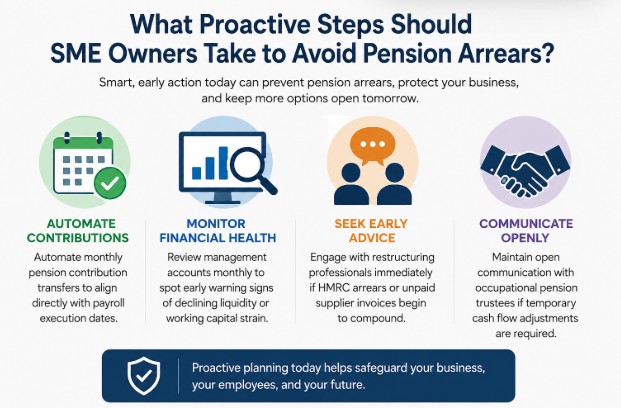
What Proactive Steps Should SME Owners Take to Avoid Pension Arrears?
SME owners can prevent insolvency-related pension debts by monitoring cash flow tightly, automating payroll contributions, and seeking early restructuring advice before arrears accumulate. Waiting until winding-up petitions arrive from creditors drastically limits restructuring options and increases regulatory scrutiny.
- Automate monthly pension contribution transfers to align directly with payroll execution dates.
- Review management accounts monthly to spot early warning signs of declining liquidity or working capital strain.
- Engage with restructuring professionals immediately if HMRC arrears or unpaid supplier invoices begin to compound.
- Maintain open communication with occupational pension trustees if temporary cash flow adjustments are required.
How Can Managing Cash Flow Prevent Business Insolvency and Pension Debt?
Maintaining robust cash flow visibility ensures that mandatory workplace pension contributions are paid on time, protecting the business from statutory fines and sudden insolvency triggers.
In practice, many small businesses fall into arrears because pension liabilities are treated as flexible expenses rather than fixed statutory obligations.
Establishing dedicated cash buffers specifically for payroll taxes and workplace pension commitments shields the enterprise from compliance breaches during seasonal revenue dips influenced by the prevailing stage of the business cycle.
How Can SMEs Reduce the Risk of Insolvency Pension Risk?
Proactively managing workplace pension obligations is vital for avoiding corporate distress and severe regulatory penalties. SME owners can mitigate insolvency-related pension risks by following a structured, disciplined compliance process:
- Automate Payroll and Contribution Transfers: Link your payroll software directly to your pension provider. Automating payments prevents human error, ensures contributions land on time, and eliminates the risk of accidental arrears building up during cash-flow squeezes.
- Ring-Fence Employee Deductions: Treat money deducted from staff salaries for pensions as sacred trust property. Never use employee pension deductions as working capital to cover short-term operational expenses.
- Monitor Management Accounts Monthly: Keep a close eye on cash flow forecasts, working capital metrics, and HMRC liabilities. Spotting liquidity strains early gives you more time to restructure before winding-up threats materialize.
- Maintain Open Lines with Occupational Trustees: If your business hits temporary financial turbulence, communicate proactively with your pension scheme trustees or provider. While statutory obligations remain, early transparency can prevent hostile regulatory escalation.
- Seek Professional Restructuring Advice Early: Consult licensed insolvency or restructuring professionals the moment debt compounding begins. Waiting until creditors issue statutory demands severely restricts your legal options and heightens the risk of personal director liability.
Conclusion
Navigating business insolvency while managing workplace pension obligations demands rigorous adherence to statutory priorities and timely communication with insolvency practitioners.
SME directors must prioritize employee deductions, respect the four-month preferential rule, and engage professional restructuring guidance at the first sign of severe cash flow distress to ensure full regulatory compliance.
Disclaimer: This article is for informational purposes only and does not constitute formal legal or financial advice.
FAQs
What happens to my workplace pension if the company goes bust?
Your accumulated workplace pension pot remains fully protected in an independent trust and cannot be seized by company creditors to pay corporate debts. Only missing employer contributions are impacted.
Can pension be used to pay business debt?
No, company pension funds are legally segregated assets held for scheme members and cannot be redirected by directors or liquidators to settle general business debts.
Who is liable for pension deficits during corporate restructuring?
The corporate entity remains legally responsible for occupational scheme deficits, triggering statutory Section 75 employer debt obligations upon formal insolvency.
Can creditors take your pension UK?
Unsecured corporate creditors have zero legal access to personal or workplace pension savings, as these assets sit outside the insolvent corporate estate.
What is a Section 75 debt in company liquidation?
A Section 75 debt is a statutory obligation triggered under the Pensions Act 1995 when an employer with a defined benefit scheme becomes insolvent while underfunded.
How does The Pensions Regulator handle business insolvencies?
The Pensions Regulator receives mandatory statutory notices under Section 120 of the Pensions Act 2004 to monitor compliance and protect member outcomes.
Are company directors personally liable for unpaid pension contributions?
Directors are generally protected by corporate limited liability unless wrongful trading, misfeasance, or deliberate avoidance schemes prompt regulatory enforcement action.
What role does the Pension Protection Fund play for small businesses?
The Pension Protection Fund assesses eligible, underfunded defined benefit schemes left behind by insolvent employers to secure member benefits.