How Much Can a Pensioner Earn Before Paying Tax UK: Complete Allowance & Tax Guide
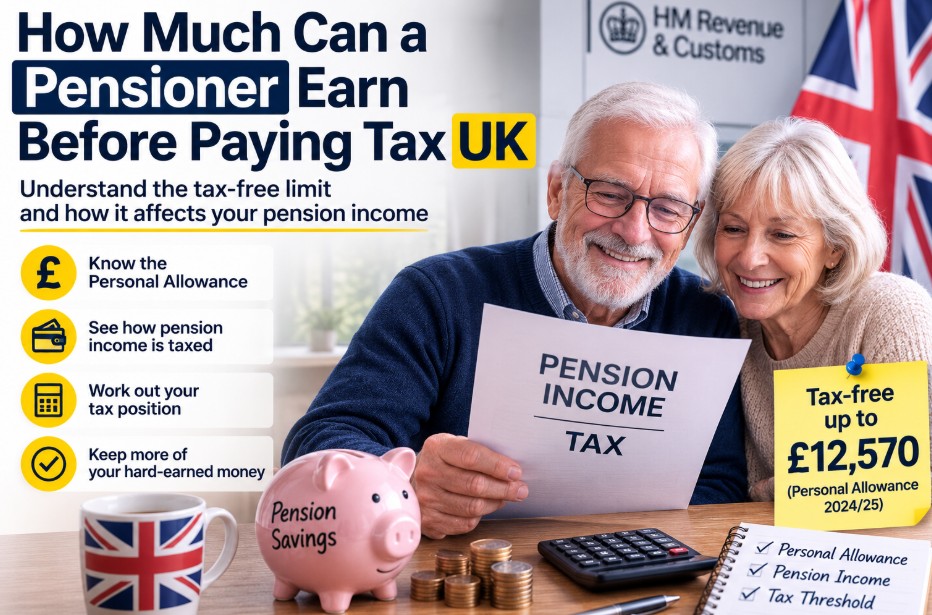
In the UK, a pensioner can earn a total combined income of £12,570 per tax year across all income sources before paying Income Tax.
Because the Full New State Pension pays £12,547.60 annually, retirees drawing the full state benefit have just £22.40 of tax-free allowance remaining for part-time work or private pensions.
Key Takeaways
- The UK Personal Allowance remains frozen at £12,570 per year, setting the total tax-free threshold across all combined income streams for retirees.
- The Full New State Pension pays £12,547.60 annually, leaving just £22.40 of tax-free allowance for employment earnings or private pensions.
- Working pensioners are completely exempt from paying Employee National Insurance contributions on wages earned past the official State Pension age.
- Married couples can transfer £1,260 of unused tax allowance to a spouse, cutting the household tax liability by up to £252 every single tax year.
How Much Can a Pensioner Earn Before Paying Tax UK?
In the UK tax system, how much can a pensioner earn before paying tax UK rules dictate that every individual receives a standard tax-free Personal Allowance of £12,570 per year.
This standard threshold applies equally whether you are actively working, fully retired, or receiving a mixture of salary and pension payments.
However, because the State Pension counts directly toward this allowance, your remaining tax-free employment allowance depends entirely on your specific State Pension entitlement.

What Counts Towards a Pensioner’s Tax Allowance?
HMRC counts multiple streams toward a pensioner’s taxable income, including the State Pension, workplace or private pensions, part-time or full-time wages, rental income, and taxable benefits.
When HMRC calculates whether you exceed your £12,570 Personal Allowance, they evaluate your combined total taxable income from all sources. The following income streams count directly toward your allowance:
- The State Pension: Both the Basic State Pension and the New State Pension count as taxable income. Even though tax is not deducted directly at source from weekly state payments, the amount counts toward filling your £12,570 limit.
- Private and Workplace Pensions: Regular income drawn from defined benefit (final salary) or defined contribution pension schemes is fully taxable.
- Employment Wages and Self-Employed Profits: Money earned from continuing part-time work, full-time jobs, or freelance consultancy post-retirement counts as taxable income.
- Rental Income: Profits generated from letting out property or land in the UK or abroad.
- Taxable Benefits: Certain state benefits, such as contribution-based Employment and Support Allowance (ESA) or Carer’s Allowance, if received in retirement.
- Foreign Income: Pensions, investments, or earnings sourced from outside the United Kingdom.
The Standard Personal Allowance for Retired Individuals
Reaching State Pension age does not grant an increased tax-free allowance; HMRC applies the standard £12,570 basic Personal Allowance to retirees, meaning any combined annual income at or below this amount owes zero Income Tax.
When your total taxable income exceeds £12,570, Income Tax becomes payable only on the portion above that figure.
For high earners whose total adjusted net income surpasses £100,000, the Personal Allowance reduces by £1 for every £2 earned above £100,000, tapering to zero once total income reaches £125,140.
The Impact of Frozen Tax Thresholds on Pensioners
The frozen £12,570 Personal Allowance threshold combined with annual State Pension increases creates fiscal drag, while ongoing debates surrounding frozen state pension policies gradually pull retirees with modest extra income into paying basic rate tax.
How Does the State Pension Consume Your Tax-Free Allowance?
Although HMRC treats the State Pension as taxable income, tax is never deducted directly from weekly or monthly state payments; instead, the State Pension acts as the primary consumer of your £12,570 Personal Allowance.
Calculating Remaining Allowance with the Full New State Pension
The Full New State Pension delivers £241.30 per week, which totals £12,547.60 over a 52-week tax year. When you subtract this amount from the £12,570 Personal Allowance, you are left with a tiny tax-free margin of just £22.40 per year.
| Pension Status | Weekly State Pension | Annual State Pension Income | Remaining Tax-Free Allowance for Extra Earnings |
| Full New State Pension | £241.30 | £12,547.60 | £22.40 per year |
| Full Basic State Pension (Pre-2016) | £184.90 | £9,614.80 | £2,955.20 per year |
| Partial New State Pension (25 Years NI) | £172.35 | £8,962.20 | £3,607.80 per year |
If you draw the Full New State Pension, earning anything more than £22.40 per year from a part-time job or private pension drawdown will trigger an Income Tax liability.
A common pattern is for retirees to take on a light part-time role, such as 10 hours a week at minimum wage, only to discover that almost 100% of those job wages are subject to a 20% tax rate because their State Pension already absorbed their Personal Allowance.
How Early Retirement at 60 Alters Your Tax Position?
Retiring at age 60 means your £12,570 Personal Allowance remains completely unencumbered by government benefits until you reach statutory State Pension age at 66, allowing you to earn up to the full threshold tax-free.
If you choose to retire at age 60, you cannot claim the UK State Pension until you reach your statutory State Pension age, which is currently 66.
- Before reaching State Pension age, your £12,570 Personal Allowance remains completely unencumbered by government pension payments.
- During this window between age 60 and State Pension age, you can earn up to the full £12,570 from part-time work, consulting, or private defined contribution drawdown without paying Income Tax.
- Once you reach State Pension age and begin receiving government benefits, your State Pension will absorb most of your Personal Allowance, shifting your active earnings into taxable territory.
Income Tax Rates and National Insurance Rules for Working Pensioners
Income tax rates applied to earnings above £12,570 depend on your UK residential tax region, while workers past state pension age enjoy complete exemption from Employee National Insurance contributions.
Income Tax Bands Across the UK
Tax rates depend on where you reside within the United Kingdom. The table below outlines the standard tax bands applicable to taxable income above the Personal Allowance.
| Tax Band | English, Welsh, and Northern Irish Taxable Income | Tax Rate | Scottish Taxable Income | Scottish Tax Rate |
| Personal Allowance | Up to £12,570 | 0% | Up to £12,570 | 0% |
| Starter / Basic Rate | £12,571 to £50,270 | 20% | £12,571 to £16,537 | 19% |
| Intermediate Rate | N/A | N/A | £16,538 to £31,092 | 21% |
| Higher / Advanced Rate | £50,271 to £125,140 | 40% | £31,093 to £62,430 | 42% / 45% |
| Top Rate | Over £125,140 | 45% | Over £125,140 | 48% |
When reviewing decisions regarding employment after retirement, note that Scottish taxpayers pay slightly different intermediate rates on wage income, though pension tax principles remain unified across HMRC administrative systems.
The National Insurance Exemption Advantage
Once you reach official State Pension age, you no longer pay Employee Class 1 National Insurance contributions on employment wages, nor Class 2/4 contributions on self-employed profits. This immediately increases your net take-home pay on any salary earned.
Non-Taxable Income Sources and Savings Thresholds
Not all money coming into your bank account in retirement counts toward your £12,570 Personal Allowance. Structuring your finances using non-taxable vehicles allows you to increase your spendable cash while keeping your taxable income below statutory limits.
Tax Free Pension Lump Sum Regulations
Under official UK pension legislation, individuals can withdraw up to 25% of a registered pension pot tax-free as a Pension Commencement Lump Sum (PCLS). Verified against current rules, this lifetime allowance is strictly capped at £268,275 unless special statutory protections apply.
The overall lifetime limit for tax-free lump sums is capped at £268,275 unless specific statutory protections apply.
Taking a 25% tax-free lump sum does not count toward your £12,570 annual Personal Allowance and creates zero Income Tax liability.
The remaining 75% of your pension fund is subject to Income Tax when withdrawn, especially important to monitor given upcoming inheritance tax changes, entering your total income calculation for that tax year.
Bank Savings, ISAs, and Interest Allowances
Many pensioners wonder how much capital they can hold in bank accounts without facing tax penalties. HMRC imposes no direct limits on the total cash savings a pensioner can hold in UK bank accounts. Instead, taxation applies strictly to the annual interest earned on those savings.
- Individual Savings Accounts (ISAs): You can deposit up to £20,000 per tax year into cash or stocks and shares ISAs. All interest, dividends, and capital gains generated within an ISA are 100% tax-free and do not count toward your £12,570 limit.
- Personal Savings Allowance (PSA): Basic-rate taxpayers receive a £1,000 tax-free savings interest allowance each year. Higher-rate taxpayers receive a £500 allowance.
- Starting Rate for Savings: If your non-savings taxable income (wages plus State Pension) is below £12,570, you can earn up to £5,000 in bank interest completely tax-free under the Starting Rate for Savings.
Steps to Report Earnings and Prevent Emergency Tax
To prevent overpaying tax or facing unexpected end-of-year bills, pensioners must obtain state pension forecasts, notify employers of their age status, and monitor PAYE tax codes closely.
When combining employment earnings with pension income, ensuring HMRC assigns the correct tax codes prevents overpaying tax or facing unexpected end-of-year tax bills.
- Obtain an Official State Pension Forecast: Log in to your personal tax account on the official GOV.UK State Pension Portal to confirm your exact weekly benefit payment.
- Notify Your Employer of Pension Status: Provide your employer with proof of age (such as a passport or birth certificate) so they stop deducting Employee National Insurance from your paycheck.
- Check Your PAYE Tax Codes: HMRC adjusts your employment tax code (such as applying a K code or reduced allowance code) so that tax owed on your State Pension is collected through your job’s PAYE system.
- Monitor First Time Pension Drawdowns: When taking an initial flexible drawdown from a private pension, providers often apply a temporary emergency tax code on a month-1 basis, which frequently triggers an unexpected tax error resulting in an initial overpayment.
- Reclaim Overpaid Tax Promptly: Submit an online HMRC Form P55, P53, or P50 to claim an immediate tax refund if emergency tax was incorrectly deducted from your drawdown.
- Register for Self Assessment if Required: If your untaxed side income, self-employment profits, or property rentals exceed £1,000 per year, register for HMRC Self Assessment to submit annual returns.
What Does Pensioner Taxation Mean for Business Owners and Operations?
UK pensioner tax thresholds directly impact businesses employing older talent. Because the frozen £12,570 Personal Allowance is largely absorbed by the State Pension, working retirees face immediate tax liabilities on modest wages, influencing workforce retention and payroll administration.
- Payroll Administration: Employers must accurately process PAYE tax codes and age verifications to ensure qualifying staff are immediately exempt from Employee National Insurance contributions.
- Labor Supply & Hours: Retirees frequently limit working hours or decline extra shifts to avoid unexpected 20% basic-rate tax charges once their minimal remaining tax-free allowance is exhausted.
- Recruitment Strategy: Businesses targeting experienced older workers must navigate these strict fiscal thresholds when structuring flexible compensation packages.
Conclusion
Determining how much can a pensioner earn before paying tax UK comes down to calculating your total combined income against the £12,570 Personal Allowance.
Because the Full New State Pension uses up £12,547.60 of this allowance, individuals receiving the full pension rate can only earn £22.40 per year in extra wages or private drawdown before Income Tax applies.
By making full use of ISAs, the 25% tax-free pension lump sum, and the Marriage Allowance, working pensioners can protect their income while remaining fully compliant with HMRC rules.
Disclaimer: This guide is for informational purposes only and does not constitute formal financial or tax advice; consult HMRC or a certified financial advisor for guidance tailored to your specific situation.
FAQ
What is the maximum a pensioner can earn before paying taxes in the UK?
A pensioner can earn up to £12,570 per tax year across all income streams before paying Income Tax. Any total income above £12,570 is taxed at applicable Income Tax rates.
How much can a pensioner earn before it affects their State Pension?
Your employment earnings do not reduce or affect your UK State Pension payments. You can earn any amount from a job or business while receiving your full statutory State Pension entitlement without penalty.
Do I pay tax automatically on my state pension?
HMRC does not deduct tax directly from State Pension payments. Instead, HMRC adjusts your PAYE tax code on employer wages or private pensions to collect any tax owed on your State Pension.
Do I have to fill in a tax return if I only receive the State Pension?
If your only income is the standard State Pension and your total annual benefit stays below £12,570, you do not need to fill in a Self Assessment tax return or pay Income Tax.
Do working pensioners still pay National Insurance contributions?
No, employees who have reached official State Pension age are exempt from paying Employee National Insurance contributions on wages. Employers must update payroll systems once proof of age is provided.
What pensions are completely non-taxable in the UK?
The initial 25% cash lump sum taken from a private or workplace pension is completely tax-free. Disability pensions, war pensions, and specific statutory benefit payments are also non-taxable.
How do I report extra self-employed earnings to HMRC in retirement?
If you earn more than £1,000 gross per tax year from self-employment or side jobs in retirement, you must register for HMRC Self Assessment and file an annual online tax return.