
HMRC Mileage Rates 2026/27: What SME Owners and Directors Need to Know
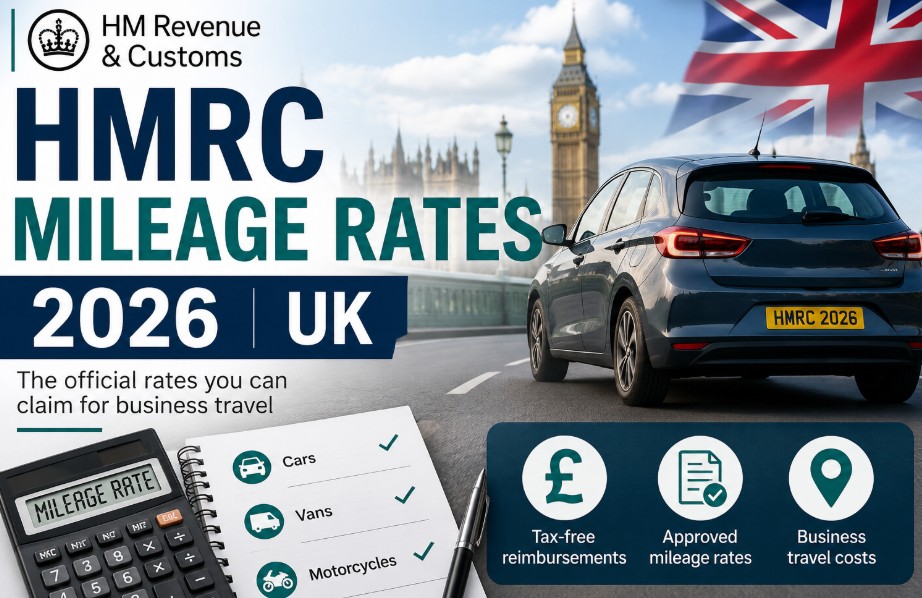
HMRC mileage rates 2026 are the official statutory thresholds established by HM Revenue & Customs (HMRC) under Approved Mileage Allowance Payments.
They allow limited company directors, small business employers, and sole traders to reimburse business travel costs tax-free up to specific annual mileage limits.
Key Takeaways
- The car and van mileage rate is 55p per mile for the first 10,000 business miles driven in the 2026/27 tax year.
- This rate change applies retrospectively from 6 April 2026, requiring employers to audit and top up earlier claims.
- Business mileage exceeding the 10,000-mile threshold remains capped at 25p per mile for cars and vans.
- Motorcycle mileage allowances remain at 24p per mile, and bicycle allowances stay at 20p per mile.
What are the UK HMRC mileage rates 2026?
The approved HMRC mileage allowance payments establish exact statutory boundaries for business vehicle reimbursements. For the 2026/27 tax year, the framework covers four distinct vehicle classifications used by small business fleets.
| Vehicle Category | First 10,000 Business Miles | Business Miles Over 10,000 | Passenger Rate (Per Business Passenger) |
| Cars and Vans | 55p per mile | 25p per mile | 5p per mile |
| Motorcycles | 24p per mile | 24p per mile | N/A |
| Bicycles | 20p per mile | 20p per mile | N/A |
The 10,000-mile threshold applies per individual driver, aggregating all miles driven across multiple personal vehicles used for business purposes within the same tax year.
In practice, sole traders and directors carrying fellow staff members can add a 5p per mile passenger supplement for qualifying business trips.
What will the standard mileage rate be for 2026?
The standard mileage rate for cars and vans is 55p per mile for the first 10,000 business miles, representing the first major structural increase since 2011.
This upward adjustment directly influences operational cash flow for SMEs operating grey fleets, where staff and directors drive personal vehicles for company duties.
The 2026 Standard Mileage Rate
- The Updated Rate: For the 2026/27 tax year, the HM Revenue & Customs (HMRC) Approved Mileage Allowance Payment (AMAP) rate for cars and vans is 55p per mile for the first 10,000 business miles.
- A Historic Shift: This represents the first major structural rate increase since 2011, lifting the previous 45p ceiling by roughly 22%.
- Threshold Structure: Any business mileage accrued beyond the initial 10,000-mile threshold remains capped at 25p per mile.
How does it affect company cash flow?
When reviewing historical operating budgets, employers must account for the higher reimbursement cost required to maintain fair compensation against rising vehicle insurance, maintenance, and fuel inflation.
- Grey Fleet Pressures: The 10p increase directly impacts small and medium-sized enterprises (SMEs) that rely on grey fleets, meaning employees and directors driving their own personal vehicles for business travel.
- Higher Reimbursement Outlays: To maintain fair compensation and remain competitive, businesses often match this tax-free benchmark, leading to an immediate jump in monthly expense claims.
- Budgetary Adjustments: Because the adjustment responds to soaring vehicle insurance, maintenance expenses, and fuel inflation, companies must revise their historical operating budgets and update payroll systems to manage these higher short-term cash flow requirements effectively.
What are the HMRC mileage allowance rules for employers and limited companies?
Employers are not legally mandated to pay the full 55p statutory rate, but paying above or below the threshold triggers distinct reporting obligations.
Reimbursement Structure vs HMRC Compliance Rules
- Paid AT Approved Rate (55p/25p): Fully tax-free, zero P11D reporting required.
- Paid ABOVE Approved Rate: Excess amount treated as taxable benefit (Class 1A NICs apply).
- Paid BELOW Approved Rate: Employee claims Mileage Allowance Relief (MAR) via HMRC.
When managing value added tax, registered businesses can reclaim input VAT on the fuel element of employee mileage payments, aligning with historical benchmarks like the New June 1 HMRC Fuel Rates by applying the official advisory fuel fraction to valid fuel receipts.

What evidence is needed for an HMRC mileage claim during an SME compliance check?
To satisfy an HMRC compliance audit, small businesses must retain contemporaneous digital mileage logs and supporting trip records.
- Driver Logs: Date of travel, start and end locations, business purpose, and total mileage recorded.
- Vehicle Data: Make, model, fuel type, and engine size to verify correct classification.
- Receipts: Valid fuel VAT receipts supporting any input tax reclamation claims.
- Software Integration: MTD-compatible accounting tools linking expense reports directly to payroll records.
What is Approved Mileage Allowance Payments for SMEs?
Approved Mileage Allowance Payments (AMAPs) represent the statutory framework that enables small and medium-sized enterprises (SMEs) and sole traders to compensate drivers for business-related travel using personal vehicles (commonly referred to as grey fleets).
For SMEs, AMAPs provide a streamlined, tax-free mechanism to handle travel expenses without the complex reporting burdens tied to traditional company car schemes.
Under this system, businesses can reimburse qualifying employees, directors, and sole traders up to set per-mile thresholds completely free of income tax and National Insurance contributions, provided the mileage is strictly for business purposes and supported by contemporaneous logs.
How do HMRC mileage rates 2026 car allowance policies compare to company car schemes?
Comparing personal vehicle mileage allowances (AMAP) against corporate company car arrangements involves weighing administrative ease, tax liabilities, and long-term financial commitments.
The following breakdown highlights how the 2026/27 tax framework (incorporating the updated 55p per mile rate for the first 10,000 miles) compares against traditional company car schemes:
AMAP vs. Company Car Schemes
| Feature | AMAP (Personal Vehicle / Grey Fleet at 55p/mile) | Company Car Scheme |
| Tax & NIC Treatment | Completely tax-free up to HMRC thresholds; zero National Insurance Contributions (NICs) for the employer. | Subject to employee Benefit in Kind (BIK) tax based on list price and CO2 emissions; employer pays Class 1A NICs. |
| Administrative Burden | Low; requires maintaining an accurate mileage log (date, destination, business purpose, miles). | High; requires lease or asset management, P11D reporting, and tracking private mileage via Advisory Fuel Rates (AFRs). |
| Corporate Tax Relief | Reimbursed mileage claims are deductible as a trading expense; no company balance sheet asset depreciation. | Corporation tax relief available on lease rentals (tiered by emissions) or capital allowances for purchased vehicles. |
| Risk & Depreciation | The individual bears vehicle ownership, maintenance, insurance, and depreciation risks. | The business or leasing company absorbs asset depreciation and financing commitments. |
| Ideal Use Case | Low-to-moderate business mileage where simplicity and flexibility take priority. | High annual mileage or zero-emission electric vehicles (EVs) leveraging low BIK rates. |
Net Extraction Efficiency for Directors
For limited company directors, reclaiming the 55p per mile allowance often delivers high net extraction efficiency. Because the payments are tax-free up to the statutory limit and bypass BIK calculations, directors can extract funds cleanly without triggering personal income tax on a company vehicle benefit.
However, if a business intends to finance a brand-new electric vehicle (EV) to take advantage of low BIK percentages and broader updates referenced in New Car Tax Rates 2025, a company car scheme can outweigh the personal vehicle approach.
Can SME owners still claim 45p per mile for an electric company car?
No, the 45p rate has been replaced by the updated 55p statutory threshold for all qualifying cars and vans, regardless of powertrain. Electric vehicles, hybrids, petrol, and diesel cars all share the exact same 55p rate for the first 10,000 business miles and 25p thereafter when driven as personal vehicles for business.
For dedicated company-owned electric vehicles, businesses rely on Advisory Fuel Rates December frameworks rather than AMAP rates to settle electricity reimbursement costs.

How do I claim Mileage Allowance Relief for 2026/27?
When a company reimburses travel at a rate lower than the statutory 55p threshold, the driver can recover the tax value of the shortfall from HM Revenue & Customs.
- Calculate Allowable Total: Multiply business miles driven by the statutory 55p or 25p rate.
- Subtract Employer Payments: Deduct any partial mileage allowances received from the company.
- Determine Net Shortfall: Identify the exact unreimbursed expense value.
- Select Filing Method: Submit claims under £2,500 using Form P87 online, or include larger amounts on a Self Assessment tax return.
- Receive Tax Relief: HMRC adjusts the tax code or refunds tax paid based on the individual’s marginal tax bracket.
Which HMRC mileage rate is better for sole traders in 2026?
Sole traders and unincorporated business owners can choose between two approved methods for calculating vehicle deductions on annual tax accounts.
- Simplified Expenses: Apply the flat 55p and 25p per mile rates to business travel, eliminating the need to log individual fuel, insurance, and repair bills.
- Actual Cost Method: Sum all motoring expenses and apply the exact business-to-personal usage ratio based on annual mileage logs.
Choosing simplified expenses provides administrative ease, whereas high-maintenance vehicles with low annual mileage may yield higher deductions under the actual cost method.
How to handle backdated 2026 claims?
Because the updated rates apply retrospectively from April 2026, businesses must reconcile historical claims processed at the older 45p threshold.
- Review Qualifying Travel: Audit all business mileage submitted by staff and directors since 6 April 2026.
- Calculate Top-Up Amounts: Determine the 10p per mile difference for miles driven within the 10,000-mile limit.
- Update Software Settings: Configure payroll and expense management platforms with the new 55p threshold.
- Issue Backdated Payments: Process top-up reimbursements tax-free through company payroll.
- Archive Audit Trail: Store reconciliation reports alongside fuel VAT records to ensure readiness for compliance checks.
Conclusion
The introduction of the 55p HMRC mileage rate requires small business owners and employers to review payroll configurations, update grey fleet reimbursement policies, and settle backdated travel claims.
By maintaining accurate digital logs and proper tax accounting, SMEs can protect cash flow while ensuring full compliance.
Disclaimer: This article is for informational purposes only and does not constitute formal tax or legal advice; consult HMRC or a qualified professional for official guidance.
FAQS
Is it still 45p per mile?
No, the standard car and van mileage rate increased to 55p per mile for the first 10,000 business miles starting in the 2026/27 tax year, replacing the 45p rate established in 2011.
Can employers pay less than 55p per mile in 2026?
Yes, employers are not legally required to pay the full statutory rate. Employees and directors can claim Mileage Allowance Relief for any shortfall directly from HMRC.
What is the passenger mileage allowance in 2026?
The tax-free passenger supplement remains 5p per mile for each fellow employee carried on qualifying business journeys in a car or van.
Are motorcycle and bicycle mileage rates changing in 2026?
No, statutory rates remain unchanged at 24p per mile for motorcycles and 20p per mile for bicycles, with no annual mileage caps applied.
What records must directors keep for mileage claims?
Directors must maintain detailed logs recording travel dates, business destinations, mileage totals, and vehicle engine specifications to satisfy compliance rules.
How does the 10,000-mile threshold apply to company drivers?
The 10,000-mile limit applies per individual driver across all personal vehicles used for business, resetting at the beginning of each tax year on 6 April.
Can sole traders claim mileage on personal van travel?
Yes, sole traders can use the flat 55p per mile simplified expense rate for qualifying business travel completed using personal vans.