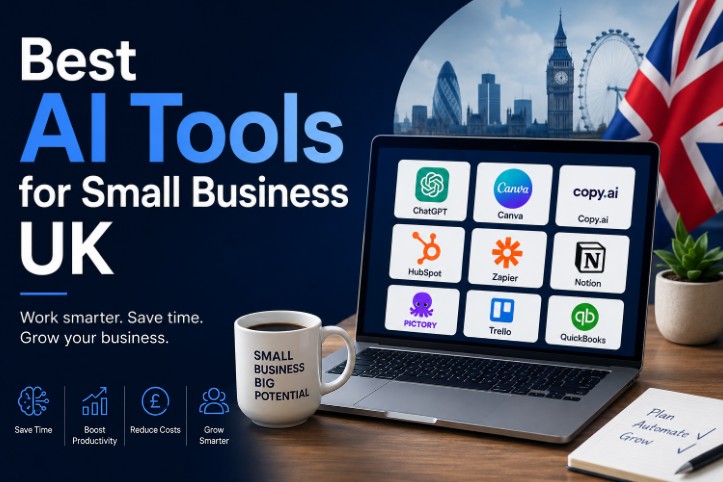
Best AI Tools for Small Business: A UK SME Owner’s Guide
Running a lean UK operation requires precise operational efficiency, strict data governance, and maximum return on investment from every software subscription.
The best AI tools for small business encompass specialised software platforms that automate administrative workloads, streamline customer communication, maintain regulatory compliance, and scale marketing outputs without expanding headcounts.
Small business owners face unique resource constraints, making the strategic deployment of artificial intelligence essential for sustained market competitiveness.
Key Takeaways
- AI executive assistants save UK small businesses up to ten administrative hours weekly by automating scheduling and inbox management tasks.
- HMRC-compliant AI accounting tools ensure real-time expense categorisation while maintaining Making Tax Digital operational standards.
- The UK Data Protection Act 2018 requires business owners to audit third-party AI platforms for secure local data storage compliance.
- AI customer support platforms reduce average response times by resolving routine client queries automatically outside normal operating hours.
What Are the Best AI Tools for Small Business Owners?
The best AI tools for small business owners include multi-layered software applications categorised by core operational pillars such as executive administration, financial management, customer support, and digital marketing.
Implementing these technologies allows founders to delegate repetitive tasks, reduce overhead costs, and focus entirely on revenue-generating strategy.
Best AI Tools for Administration and Productivity
These platforms handle everyday chores like scheduling, note-taking, and document checks, freeing up your time so you can focus on running the business instead of drowning in admin.
ChatGPT Plus
As a versatile AI assistant, ChatGPT Plus is essential for SMEs. It offers advanced web searching and rapid brainstorming capabilities, allowing business owners to draft emails, generate project ideas, and perform quick market research with minimal downtime.
Claude Pro
Claude Pro excels at handling complex, long-form document logic. It is particularly effective for reviewing supplier contracts, drafting internal operational policies, and summarizing dense regulatory documents, ensuring high accuracy for critical business paperwork.
Microsoft Copilot
Built into the Office 365 suite, Copilot is the gold standard for spreadsheet automation. It helps founders analyze data sets within Excel, summarize meeting notes in Word, and manage calendar scheduling, making it an indispensable tool for routine administrative tasks.
Otter.ai
Otter.ai acts as an automated meeting secretary. It records, transcribes, and summarizes business meetings in real-time, allowing founders to focus on the conversation rather than taking minutes, and ensures that action items are captured accurately.

Best AI Tools for Customer Relationship Management (CRM) and Support
These tools use smart automation to handle customer chats and emails across different channels, keeping response times quick and service quality high.
HubSpot AI
HubSpot’s AI features automate lead scoring and email sequencing. By analyzing client interactions, it helps sales teams prioritize high-conversion prospects, ensuring that no potential sale is missed due to human error or lack of follow-up.
Tidio
Tidio provides an intelligent chat agent solution for real-time customer service. It resolves common inquiries instantly, helping businesses maintain professional service standards and provide support even outside standard office hours.
CloudTalk
CloudTalk serves as an AI-powered virtual receptionist. It answers incoming calls, intelligently routes them to the correct department, and automatically logs the conversation notes into your CRM, streamlining the entire voice-based support workflow.
Intercom
Intercom utilizes AI to provide personalized customer support at scale. Their Fin AI bot helps answer support tickets based on your existing help articles, drastically reducing the volume of manual work for your customer service team.
Best AI Tools for Marketing, Design, and Content Creation
They let small teams churn out professional images and copy without having to rely on external agencies, keeping your branding sharp and campaigns moving.
Canva Pro
Canva incorporates generative AI features that allow small business owners to design professional marketing materials without a design degree. You can remove backgrounds, generate custom imagery from text prompts, and instantly resize assets for different social media platforms.
Jasper
Jasper is a dedicated AI copywriting assistant designed for enterprise-grade marketing. It drafts engaging blog posts, email newsletters, and ad copy while adapting to your specific brand voice, ensuring consistency across all marketing channels.
Copy.ai
Copy.ai is optimized for rapid content production, particularly for social media and advertising campaigns. It helps teams create high-converting copy in seconds, allowing lean marketing teams to test multiple variations of ad creative without hiring an agency.
Midjourney
For businesses needing unique, high-quality visual assets, Midjourney is an industry-leading generative design tool. It creates stunning, custom imagery from descriptive text prompts, which can be used for website hero sections, digital advertising, or product packaging.
Best AI Tools for Financial Management and Operations
Beyond traditional bookkeeping apps that handle bank feeds and invoice processing, alternative payment tools are helping small businesses manage cash flow friction, cutting down on manual data entry and keeping your financial operations accurate.
QuickBooks Online
QuickBooks uses AI to automate bookkeeping tasks such as invoice processing and expense categorization. It reduces the overhead of manual data entry and provides real-time financial reporting, helping business owners make data-driven decisions.
Xero
Xero offers powerful AI-driven bank reconciliation, which automatically matches transactions to invoices. This minimizes human error in financial records and ensures that your cash flow statements are always up to date and accurate.
Expensify
Expensify leverages AI to automate expense management. It scans receipts, extracts key data, and categorizes expenses automatically, simplifying the reimbursement process for employees and saving hours of administrative work for the finance team.
Vic.ai
Vic.ai is specialized for automating accounts payable. It uses autonomous AI to process invoices, identify potential duplicates or errors, and approve payments, helping smaller firms manage their cash flow with the efficiency of a much larger organization.
Best AI Tools for Startup Infrastructure and Website Building
They give you the tech foundation to build a digital presence quickly without needing a developer, sorting out professional layouts and site structures right from the start.
Wix Studio
Wix Studio utilizes generative AI to build fully responsive websites rapidly. It allows founders to launch professional storefronts and landing pages without writing code, enabling small businesses to establish an online presence within minutes.
Framer
Framer is a powerful AI design tool that lets you generate functional, high-end websites from text prompts. It is ideal for startups that need a modern, high-conversion design quickly without the high cost of a dedicated design agency.
Zapier
Zapier is the glue for your tech stack. It uses AI to connect over 6,000 applications, allowing you to build automated workflows between your CRM, email, and project management tools, ensuring that your data flows seamlessly across your business.
Squarespace AI
Squarespace AI simplifies the creation of initial web infrastructure. It assists in generating site layouts, drafting page content, and setting up initial store pages, making it a perfect all-in-one solution for founders setting up their first digital footprint.
How to Choose the Proper AI Tools for Small Business?
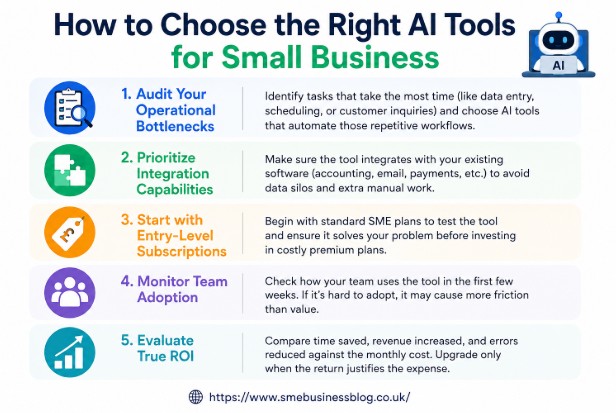
Choosing the right software means weighing quick time-savings against monthly subscription costs, focusing on tools that genuinely cut down your team’s manual workload.
- Audit Your Operational Bottlenecks: Identify the specific tasks that currently consume the most manual hours, such as data entry, scheduling, or customer inquiries, and prioritize tools that explicitly target those repetitive workflows for automation.
- Prioritize Integration Capabilities: Verify that any potential tool connects seamlessly with your current tech stack (accounting software, email clients, and payment gateways) to avoid creating data silos that require manual work to bridge.
- Start with Entry-Level Subscriptions: Avoid purchasing expensive premium or enterprise-tier plans prematurely; begin with standard SME subscriptions to test functionality and ensure the tool solves your problem before committing significant capital.
- Monitor Team Adoption: Observe how effectively your staff uses the tool during the first few weeks; if the team struggles to integrate it into their daily routine, it may be creating unnecessary friction rather than saving time.
- Evaluate True ROI: Regularly compare the measurable productivity gains (time saved, revenue increased, errors reduced) against the monthly subscription costs; only upgrade to advanced tiers once business growth and usage levels justify the higher expense.
Navigating UK Data Protection and GDPR Compliance When Using AI
Using AI in a UK business means staying strictly on the right side of data protection laws. You need to ensure customer and employee details handled by third-party AI apps are fully compliant with the Data Protection Act 2018.
The Information Commissioner’s Office provides comprehensive guidance on managing data protection risks when implementing automated processing systems.
Organisations must conduct thorough vetting of software vendors to confirm where data is stored and whether user inputs are utilised to train public foundational models.
- Review vendor privacy policies to verify local server storage locations within the UK or European Economic Area.
- Disable model training settings on commercial AI subscriptions to prevent proprietary business data from leaking into public datasets.
- Obtain explicit customer consent before processing personally identifiable information through third-party automated customer support tools.
- Maintain an up-to-date record of processing activities detailing which software platforms handle sensitive commercial information.
Failing to secure proper data processing agreements exposes businesses to severe regulatory penalties and reputational damage. Compliance audits should form a regular component of internal IT governance reviews.
Conclusion
Bringing AI into your day-to-day operations transforms how a small business runs by cutting out repetitive admin and speeding up marketing tasks.
Sustainable technology adoption requires balancing cost against measurable time savings while maintaining strict data governance standards.
Business owners should audit current operational bottlenecks, select targeted software solutions, and review performance metrics regularly to ensure continued commercial growth.
Disclaimer: Results may vary; this content is for informational purposes only and does not constitute professional business or financial advice.
FAQs
Which AI is best for small business owners?
Claude Pro is widely regarded as the best option for strategic planning and document review, while Microsoft Copilot suits organisations deeply embedded in the Office 365 software ecosystem for daily administration.
What is the best AI tool for setting up a small business?
AI-powered website builders and business plan generators like Wix ADI and LivePlan provide the fastest pathway to establishing digital infrastructure and formal registration documentation for new ventures.
What AI is better than ChatGPT?
Claude often outperforms ChatGPT in long-form document analysis, nuanced reasoning, and complex coding tasks, whereas specialized tools like QuickBooks offer superior financial accuracy for accounting.
What are the top 10 AI tools for business?
Essential business tools include Claude for writing, QuickBooks for accounts, HubSpot for CRM, Canva for design, Tidio for support, Copilot for productivity, Zapier for workflow automation, and Notion AI for note-taking.