Why Was the Octopus Energy Heat Pump Advert Banned?
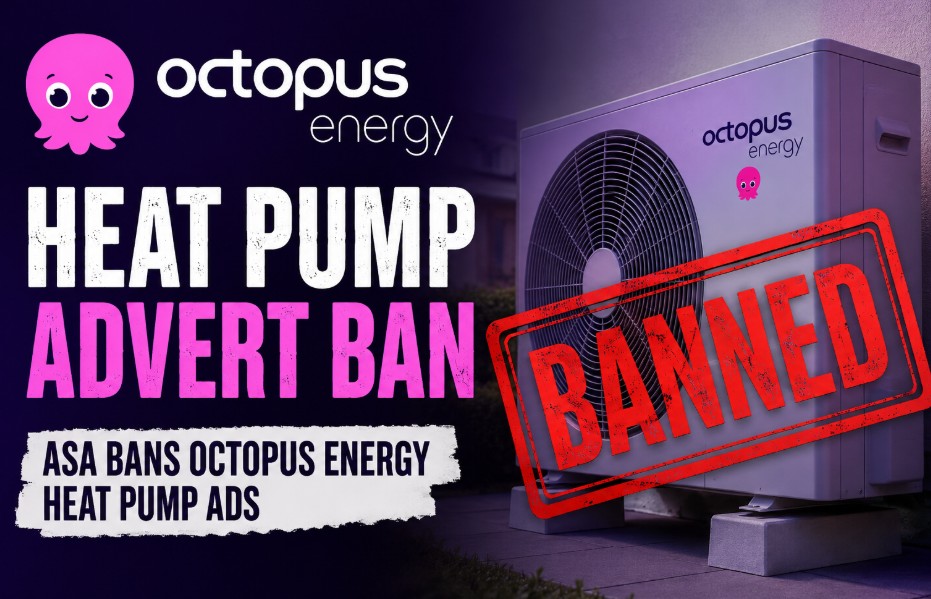
The Advertising Standards Authority recently enforced a landmark ruling regarding clean-tech marketing, highlighting how the Octopus Energy heat pump advert ban signals a major shift in how green pricing must be presented to UK consumers.
The adjudication focused directly on a paid social media campaign that promoted low-carbon installations at an entry-level cost of £500, utilizing government incentives to achieve the figure.
However, the regulatory body upheld challenges regarding price availability and the omission of necessary structural requirements, highlighting the growing scrutiny facing environmental and decarbonisation advertisements across the United Kingdom.
Why was the Octopus Energy heat pump advert banned by the UK regulator?
The UK regulator banned the Octopus Energy heat pump ad because its Installs from £500 headline misled consumers.
The ASA found that only 5.8% of customers qualified for this entry price at launch, failing the legal requirement that introductory prices must be available to a significant proportion of consumers.
The regulatory intervention turned on the legal concept of material omission and price inflation under the Committee of Advertising Practice (CAP) Code.
While Octopus Energy intended the advertisement to demonstrate how affordable a home energy transition could be when paired with national subsidies, the regulator determined that the underlying data failed to support the primary headline at the time the media was actively served to the public.
In practice, when reviewing regulatory advertising decisions in the UK, a business must possess objective, verifiable documentation before an absolute pricing statement is published.
The watchdog concluded that because a home assessment requires a complex matrix of structural variables, pushing a universal entry-level price without displaying immediate conditions on the face of the advert creates an inaccurate consumer journey.
Consequently, the company was ordered to remove the campaign and adjust all prospective digital marketing pipelines.
What are the CAP Code rules behind the misleading heat pump ad?
The CAP Code rules violated by the misleading heat pump ad include Rule 3.1 (omitting the Boiler Upgrade Scheme voucher requirement), Rule 3.7 (relying on predictive data models instead of transactional evidence), and Rule 3.22 (failing the from pricing conversion threshold).
Breach of Rule 3.1: Misleading Advertising
Octopus Energy breached CAP Code Rule 3.1 by practicing material omission, hiding the core requirement that consumers must successfully secure a £7,500 Boiler Upgrade Scheme voucher to achieve the advertised £500 price point.
Breach of Rule 3.7: Substantiation
Octopus Energy breached CAP Code Rule 3.7 because its evidence relied on theoretical predictive models showing a 10% eligibility potential, which the ASA rejected as an invalid substitute for actual, historical transaction data.
Breach of Rule 3.22: Pricing and From Claims
Octopus Energy breached CAP Code Rule 3.22 because only 5.8% of buyers paid the £500 price at launch, failing the legal consumer protection benchmark that any advertised from price must represent what a significant proportion of buyers actually pay.
| Cost Dynamic component | Financial Value | Regulatory Status |
| Standard Baseline Installation Cost | £8,000 | Baseline corporate estimate |
| Boiler Upgrade Scheme (BUS) Subsidy | -£7,500 | Statutory Government Grant |
| Advertised Out-of-Pocket Expense | £500 | Target promotional price |
| Actual Compliance Share (At Launch) | 5.8% | Failed Significant Proportion test |
Because only 5.8% of buyers actually achieved the £500 price point when the campaign launched, the ASA ruled it failed the significant proportion test. It was a low conversion rate.
Although Octopus provided supplementary sales data showing that the share subsequently climbed to between 23% and 24% later in the year, code compliance is judged strictly at the exact moment an advertisement goes live.
How did the corporate clash between Octopus Energy and British Gas unfold?
The corporate clash unfolded when Octopus Energy publicly accused British Gas and the EUA of using regulatory technicalities to slow green tech adoption, while pointing out that British Gas ran identical £499 advertisements.
Furthermore, Octopus pointed toward historical competitor campaigns to highlight what it termed industry-wide hypocrisy. This back-and-forth escalated into a broader industry narrative, often referred to as the attempt by British Gas to ban Octopus marketing narratives, as both giants fiercely contested the low-carbon heating space.
Specifically, the company flagged active marketing materials from Centrica, the parent company of British Gas, which regularly showcased heat pump installations starting from £499 or from £500 under identical government grant assumptions.
A common pattern observed in intense market transitions is for competing brands to utilize regulatory challenges as a mechanism to balance the playing field.
This corporate friction emphasizes that the Octopus Energy heat pump advert ban was not merely an isolated compliance failure, but part of a structural struggle between legacy gas infrastructure networks and emerging electrification platforms.
What is the true corporate and financial profile of Octopus Energy?
Octopus Energy is a highly stable, rapidly growing UK energy supplier owned entirely by the Octopus Group with global backing. It is completely independent of British Gas and is not owned by Shell.
Ownership Structure and the Shell Acquisition
To resolve frequent consumer confusion: Octopus Energy is entirely independent of British Gas. The organisation is owned by the broader Octopus Group, a large UK-based holding company, with significant institutional investment backing from global firms including Generation Investment Management and Canada Pension Plan Investment Board.
While rumours frequently query whether the business is owned by Shell, the reality stems from a major corporate acquisition where Octopus purchased Shell Energy Retail in the UK and Germany.
This transaction absorbed millions of domestic customer accounts but did not change the core ownership of the parent entity.
Market Integrity and Complaint Data
Regulatory data from Ofgem and the Energy Ombudsman confirms that Octopus Energy maintains high market integrity, consistently tracking well below the legacy Big Six providers for official customer complaints.
When analyzing consumer sentiment and industry performance, regulatory data from Ofgem and the Energy Ombudsman provides an objective picture of how the brand compares to traditional suppliers:
Industry Complaint Analysis
- Low Volume: Octopus Energy (Consistently tracks below industry averages per 100,000 customers)
- Mid Volume: Traditional Retail Suppliers
- High Volume: Legacy Big Six Providers (Subject to historical structural backlogs)
Despite the recent advertising challenge, independent consumer reviews and ethical assessment indices generally rank the firm highly for service delivery and green product transparency. Customers frequently look for extra value through initiatives like the Octopus Energy National Trust Perk, which rewards members with energy bill credit.
Part of this favorable consumer tracking stems from their targeted social support structures; for instance, eligible vulnerable households can access specialized financial relief schemes such as the Octopus Energy Social Housing Tariff, which provides heavily subsidized standing charges.
The brand is not under structural insolvency investigations, nor is it in financial trouble; rather, it remains one of the fastest-growing and heavily capitalized energy retail businesses operating within the UK commercial ecosystem.
Are Octopus heat pumps worth it under current structural realities?
Octopus heat pumps offer a strong return on investment (ROI) due to the £7,500 government grant, but real-world out-of-pocket costs vary based on a property’s specific size, insulation, and radiator networks.
Evaluating the Real Installation Costs
For a typical small business premise or residential property, an effective installation rarely matches the minimum promotional baseline.
While the statutory £7,500 Boiler Upgrade Scheme grant, fully detailed on the official GOV.UK portal, drastically lowers upfront financial barriers, final out-of-pocket expenses are dictated by property size, existing pipework infrastructure, and insulation efficiency.
Structural Requirements Checklist
- Comprehensive EPC Verification: Properties must generally possess a valid Energy Performance Certificate devoid of outstanding loft or cavity wall insulation recommendations to maximize system efficiency.
- Thermal Emitter Upgrades: Standard radiator networks often require upgrading to larger, low-temperature alternatives to distribute heat output effectively.
- Internal Power Integration: Upgrading the consumer unit or main electrical incoming supply is occasionally required to handle the electrical load of a compressor unit.
- Siting and External Clearance: Compliance with local Permitted Development rights dictates that the outdoor fan unit must be positioned at a set distance from neighboring property boundaries.
When assessing what the company covers, their service portfolio extends beyond basic unit fitting to encompass comprehensive home asset management, including customized smart meter installations, dedicated solar array integrations, and specialized domestic boiler cover policies designed for hybrid transitional systems.
How can small businesses ensure compliance with green marketing laws?
Small businesses can ensure green marketing compliance by adopting a 6-step review process that bases all pricing on actual historical sales data and prominently displays grant dependencies on the ad.
To avoid costly marketing bans and protect corporate reputation, marketing managers should implement a structured review process based on the following six steps:
- Gather Transactional Baseline: Identify the exact percentage of past clients who paid the advertised price.
- Apply the 10% Empirical Threshold: Ensure your starting price reflects a realistic consumer outcome.
- Reveal Subsidy Dependencies: State clearly if a price relies on grants like the Boiler Upgrade Scheme.
- State Structural Eligibility: Explicitly list required property conditions on the face of the ad.
- Avoid Purely Predictive Models: Base savings or cost claims on actual historical sales, not data forecasts.
- Link to Unrestricted Audit Trails: Provide one-click access to complete pricing data and terms.
When designing promotional assets, companies must ensure that any qualifying constraints are displayed alongside the primary headline rather than hidden behind secondary landing pages.
If a low price relies entirely on external factors like regional topology or specific government grants, those parameters must be made clear from the very first consumer touchpoint.

How to Pitch Green Upgrades Safely?
The Octopus Energy adjudication proves that the era of relying on best-case scenarios in environmental marketing is over. To insulate your brand from regulatory bans and build long-term trust, clean-tech marketers must shift from aspirational forecasting to radical, data-backed transparency.
Three Rules for Compliant Green Marketing
The three rules for compliant green marketing are: lead with historical sales instead of theoretical algorithms, display building requirements explicitly up front, and maintain exportable data trails.
- Lead with Real Sales, Not Projections: If using a from price, ensure that figure reflects a statistically significant portion of actual historical sales at the exact moment the ad runs. Never rely on theoretical data models or algorithms if the real-world conversion rate sits in the single digits.
- Front-Load Dependencies and Caveats: Never hide crucial criteria in secondary landing pages. If an attractive price point relies on a statutory subsidy (like the £7,500 Boiler Upgrade Scheme grant) or specific building properties (such as valid EPC ratings or upgraded pipework), state these upfront alongside the headline.
- Maintain Live Audit Trails: Because compliance is judged in real time, run weekly transactional audits to verify that your active pricing claims still match real consumer outcomes. Keep clear, exportable data trails ready to instantly defend against competitor or regulator challenges.
Replacing aggressive hook pricing with authentic, education-led transparency is the only way to protect your digital pipelines while scaling a sustainable energy brand in the UK.
Summary of compliance steps for green tech providers
The regulatory action taken against the UK’s leading energy supplier underscores that high-profile green campaigns must prioritize absolute transparency over catchy headlines.
For small businesses and clean-tech providers, the path forward requires a strict commitment to verifiable data. Every promotional price must be backed by real transaction history, and any necessary criteria or government grants must be clearly stated from the very first interaction.
By ensuring that advertisements match real-world installation costs, firms can build lasting consumer trust while advancing sustainable energy across the country.
FAQ about Octopus Energy heat pump advert ban
Why exactly was the Octopus Energy heat pump advert ban enforced?
The ASA enforced the ban because the campaign’s headline Installs from £500 was likely to mislead. Regulatory audits revealed only 5.8% of buyers achieved that low price when the ad ran, failing the legal threshold requiring that from prices apply to a significant proportion of consumers.
Is Octopus Energy part of British Gas or owned by Shell?
No. Octopus Energy is an entirely independent entity owned by the Octopus Group. It is not part of British Gas, nor is it owned by Shell; it merely acquired Shell’s residential energy retail supply division in a recent market consolidation.
Can small businesses still advertise low-carbon heating using from pricing?
Yes, but the promoted price must be supported by verifiable historical sales data. Marketers must prove that a significant proportion of recent customers paid that exact rate or less at the time the media is active.
What role did the Boiler Upgrade Scheme play in the controversial heat pump ad?
The advertised £500 price was calculated by subtracting the £7,500 Boiler Upgrade Scheme grant from an estimated £8,000 baseline installation fee. The ad was penalized for omitting the specific consumer eligibility criteria required to qualify for that funding.
Which energy company receives the highest volume of official consumer complaints?
According to historical Ombudsman data, legacy providers and traditional Big Six suppliers generally record higher complaint volumes per 100,000 customers than Octopus Energy, which frequently places among the top-rated suppliers for service.
What structural factors can push a heat pump installation above the advertised £500 baseline?
Total installation costs frequently rise due to required upgrades for internal pipework, the installation of larger thermal radiators, required electrical consumer unit modifications, and property-specific insulation demands.