British Gas Ban Octopus: Truth Behind the Regulatory Feud Explained
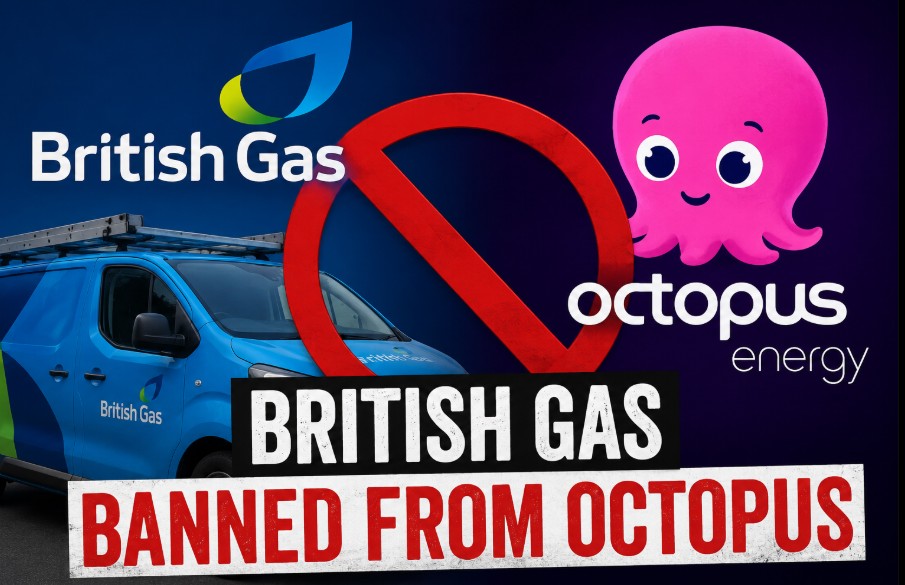
No, Octopus Energy is not banned from taking on new customers in the UK. The viral search phrase British Gas ban Octopus stems from a high-profile corporate dispute where Centrica (the parent company of British Gas) publicly called on the energy regulator, Ofgem, to enforce a customer-acquisition ban on Octopus Energy.
Ofgem formally rejected this demand, confirming that Octopus complies with regulatory rules via an agreed financial capital restoration plan.
This regulatory clearance ensures that standard commercial switching, alongside customer incentives like the Octopus Energy National Trust Perk and dedicated support options like the Octopus Energy social housing tariff, remains 100% operational for all UK households.
Why Does British Gas Want to Ban Octopus Energy from Taking On New Customers?
British Gas requested a temporary onboarding ban on Octopus Energy because Octopus did not meet Ofgem’s strict new capital adequacy targets by the regulatory deadline.
Centrica’s chief executive, Chris O’Shea, labeled the regulator’s lack of immediate intervention as “criminal,” arguing that allowing undercapitalized firms to expand exponentially risks another systemic market collapse similar to the 2021–2022 energy crisis.
In practice, when a major provider expands exponentially, its financial resilience must scale accordingly to protect the wider grid.
British Gas claims that competitors utilizing specific international parent funding models might not meet the precise localized ring-fencing metrics intended to secure consumer deposits.
Octopus Energy management quickly dismissed the call for an acquisition ban, labeling the demand as an attempt to stifle open market competition and restrict consumer choice.
Because Ofgem’s subsequent financial reviews confirmed that Octopus remains in alignment with current capital frameworks, no operational halt or consumer restriction has been levied against the company.
The Core Regulatory Mechanics
The regulatory mechanics governing this dispute dictate that any UK energy supplier failing to meet immediate capital floors must operate under an Ofgem-approved asset restoration plan or face operational sanctions.
Because Octopus Energy formally agreed to a structured capitalization path to hit its financial targets, Ofgem confirmed they are not in breach of licensing conditions, meaning severe punitive measures, like an onboarding ban, are legally unwarranted.
The administrative framework governing these corporate arguments depends heavily on the specific criteria set by the sector’s regulatory body.
- Capital Adequacy Standard: The minimum independent financial reserve an energy supplier must hold within its UK operating entity to absorb wholesale market volatility.
- Supplier of Last Resort (SoLR) Levy: An industry-wide insurance mechanism where stable providers absorb the customers of failed utilities, with costs ultimately subsidized by public energy bills.
- Ring-Fencing Directives: Regulatory rules requiring energy firms to keep consumer credit balances entirely separate from operational capital expenditures.
Is Octopus Energy Owned by or Part of British Gas?
No, Octopus Energy is completely independent and is not owned by, or part of, British Gas; they are fierce direct rivals commanding the largest shares of the UK domestic energy market.
British Gas is a trading name of British Gas Services Limited and British Gas New Energy Limited, both of which are wholly owned subsidiaries of Centrica PLC, a publicly traded company listed on the London Stock Exchange.
As a proud British company headquartered in London, Octopus Energy has scaled its operations internationally, licensing its proprietary Kraken technology platform to utilities across Europe, the United States, and Asia-Pacific.
The two businesses function as direct market rivals within the United Kingdom’s domestic supply network.
Reason Behind the British Gas Ban Octopus Campaign
The primary driver behind Centrica’s (British Gas) aggressive lobbying for an onboarding ban is a fundamental dispute over financial ring-fencing rules and corporate structural advantages.
British Gas argues that by not holding immediate, locked-down liquid reserves in the UK, Octopus can divert capital toward aggressive customer acquisition, which distorts free-market competition.
Centrica frames its argument around three primary industry concerns:
- The Overdraft Argument: British Gas voluntarily segregates its customer credit balances into separate bank accounts so that money paid by users cannot be touched for day-to-day operations. Centrica argues that by not strictly ring-fencing these localized reserves, Octopus Energy is effectively using customer credit balances as a “free, interest-free overdraft” to fuel its rapid corporate expansion.
- The Level Playing Field: British Gas insists that it faces higher operational costs by locking away capital to meet strict independent financial reserves. They claim that because Octopus relies heavily on international parent funding structures (like the CPPIB), it bypasses the localized liquidity pressures that British Gas faces, creating an uneven competitive playing field.
- Preventing a Bulb 2.0: Centrica frames its call for a ban as a public protection measure. Following the catastrophic collapse of Bulb Energy, which cost UK taxpayers billions, British Gas claims that allowing a single challenger to capture over 22% of the market without strict, localized capital ring-fencing presents a systemic risk to the entire UK grid.
How Does This Corporate Sparring Impact the Customer?
This corporate feud has zero direct operational impact on everyday household or commercial energy consumers.
Because Ofgem formally dismissed British Gas Ban Octopus demands, your current energy supply will not be disrupted, your household credit balances remain completely legally protected under the industry safety net, and your right to switch suppliers remains fully intact.
- No Disruption to Supply: Gas and electricity will continue to flow to your home or business uninterrupted, regardless of which supplier you are with.
- Your Money is Safe: Even though British Gas and Octopus disagree on how to protect credit balances (ring-fencing accounts vs. ATOL-style mutual insurance policies), Ofgem’s safety-net mechanics ensure that if any supplier fails, consumer credit balances are legally protected and transferred safely to a Supplier of Last Resort (SoLR).
- Freedom of Choice Remains Intact: Because Ofgem did not grant British Gas’s request for a ban, consumers are entirely free to switch between British Gas, Octopus, or any other provider at any time.
Ofgem has formally dismissed Centrica’s calls for an onboarding cap. The Energy Switch Guarantee remains fully active, and consumer credit balances are entirely legally protected under current regulatory safety nets.
What Are the Upcoming Changes in British Gas and Octopus Energy?
The upcoming regulatory changes for both British Gas and Octopus Energy center on compliance with Ofgem’s newly active Enhanced Financial Responsibility Principle (eFRP), which enforces rigid capital floors.
To balance their sheets under these tighter rules while navigating retail price caps, both suppliers are restructuring their tariff portfolios by lowering fixed standing charges and adjusting per-unit electricity rates.
1. Stricter Ofgem Capital Floors
Ofgem has begun strictly enforcing its new Enhanced Financial Responsibility Principle (eFRP). Both British Gas and Octopus are being forced to adapt to newly active capital targets and strict asset floors.
This means both companies are having to tie up more capital in their UK entities, meaning slightly less aggressive price-war discounting on fixed tariffs.
2. The Lower Standing Charge Rollout
Both giants are restructuring their tariff portfolios due to Ofgem’s regulatory mandates pushing for alternative options with significantly reduced fixed daily fees. To make up the shortfall, both suppliers are increasing their per-unit electricity costs ($kWh$) on these specific plans.
3. Escalating Geopolitical Adjustments
Due to prolonged wholesale market pressures filtering into the summer price caps, both suppliers are heavily altering their fixed-rate paths.
British Gas is leaning into structured, rigid 12-month fixed protections to attract risk-averse consumers, while Octopus is heavily pushing automated smart-meter optimizations to steer users away from volatile peak wholesale hours.
What Should UK Energy Customers Do Now?
UK energy customers should ignore the sensational corporate headlines and actively audit their annual consumption data to choose a tariff style that fits their household setup.
If your home utilizes green technology like electric vehicles or heat pumps, migrating to a dynamic, time-of-use smart tariff is highly beneficial; traditional households should focus on comparing standard fixed-rate offers against variable baselines.
With the regulatory dust settled and market parameters changing, energy consumers should take practical, structured steps:
- Audit Your Annual Usage: Dig out your energy statements and locate your total annual consumption in kilowatt-hours ($kWh$).
- Pick Your Tariff Style Based on Lifestyle:
- If you own an Electric Vehicle (EV), home batteries, or a heat pump, Octopus Energy’s dynamic smart tariffs (like Intelligent Octopus Go) remain significantly more cost-effective if you can automate your heavy consumption to off-peak slots. However, if you are looking into installing these systems, keep in mind the recent controversies surrounding marketing, such as the Octopus Energy heat pump advert ban, to stay informed on realistic performance expectations.
- If your energy habits are traditional and you prefer predictable monthly budgeting, compare British Gas’s current fixed-rate offers against Octopus’s Flexible baseline to see who is undercutting the current Ofgem price cap.
- Leverage Payment Methods: Ensure you are set up on Direct Debit with whichever supplier you choose; both utilities are legally permitted under current price cap rules to levy higher standing charges on accounts that pay on receipt of bills or via manual methods.

The Consumer Cost Battle
The lowest consumer running costs depend entirely on whether a household uses a standard variable tariff or a dynamic smart meter setup.
For standard variable contracts bound directly to the Ofgem Energy Price Cap, price differences between British Gas and Octopus are virtually non-existent, whereas Octopus consistently takes the lead on specialized, automated time-of-use smart tariffs.
While shifting usage windows is the standard approach to lowering expenses, extreme microgeneration strategies have seen some unique households claim I have not paid a single electricity bill since 1970 by completely disconnecting from traditional variable dependencies.
| Comparison Metrics | British Gas | Octopus Energy |
| Standard Variable Tariffs | Priced at or near the absolute maximum permitted by the Ofgem Energy Price Cap; minimal statistical variance. | Tied directly to the Ofgem Energy Price Cap baseline; offers virtually non-existent price differences. |
| Smart & Dynamic Tariffs | Features targeted fixed-rate options and peak-saver rewards programs designed to incentivize off-peak usage. | Focuses heavily on highly flexible, automated time-of-use options tailored for EV owners and home batteries. |
| Target Audience Focus | Traditional households seeking predictable monthly budgeting, standard boiler care, and reward incentives. | Tech-forward consumers looking to automate heavy appliance consumption during cheap off-peak windows. |
| MoneySavingExpert (Martin Lewis) Verdict | Recommended for providing vital budgetary certainty through traditional, structured fixed tariffs. | Recommended for delivering the highest possible savings only if a household can shift heavy usage to off-peak slots. |
How Do I Switch from British Gas to Octopus?
To switch from British Gas to Octopus, you must initiate an application through the incoming provider (Octopus), which handles the entire administrative transfer on your behalf without any interruption to your physical power supply.
Under the Energy Switch Guarantee, the entire structural account migration is fully completed within five working days.
- Locate Your Current Bill Details: Gather your latest statement from British Gas to identify your exact tariff name, annual consumption in kilowatt-hours (kWh), and any potential exit fees.
- Obtain an Incoming Quote: Visit the official Octopus Energy portal to input your postal code and consumption metrics for an accurate projection.
- Initiate the Official Application: Submit your switching request online; you do not need to contact your current provider to cancel.
- The Energy Switch Guarantee Timeline: The structural transfer will complete safely within five working days under standard industry protection rules.
- Provide Verifiable Closing Readings: Submit an up-to-date meter reading on the formal transfer date to prevent estimated crossover billing.
- Settle the Final Closing Account: Pay your remaining balance or receive your credit balance refund from British Gas within six weeks of the completed transfer.
A common consumer concern during this process is whether an existing british gas smart meter compatible with octopus systems will maintain its smart functionality.
Under current SMETS2 technological standards, modern smart infrastructure is fully cross-compatible across all major networks.
Once the system transfer completes, your physical meter will communicate automatically with the new provider to transmit accurate half-hourly usage statistics without reverting to manual operations.
The Battle for the UK Energy Crown
The operational scale and consumer sentiment metrics highlight the distinct market strategies utilized by both major energy institutions.
| Performance and Market Metrics | British Gas | Octopus Energy |
| Primary Corporate Parent | Centrica PLC | Octopus Energy Group |
| UK Domestic Market Share | Approximately 20% | Approximately 22% |
| Core Operational Focus | Traditional supply, boiler care, Hive smart home ecosystems | Green energy investment, tech platform licensing, flexible tariffs |
| Baseline Smart EV Option | Hive Power+ Tariff | Intelligent Octopus Go |
| Average Trustpilot Rating | 4.0 out of 5.0 stars | 4.8 out of 5.0 stars |
Conclusion
The high-profile corporate debate emphasizes the intense competition shaping the modern UK utility landscape. For everyday consumers and small business operators, the ongoing legal and regulatory discussions between British Gas and Octopus Energy will not disrupt daily power or gas deliveries.
Your account remains secure, the Energy Switch Guarantee protects your freedom to change providers, and smart infrastructure remains cross-compatible across networks.
Your best strategy is to look past the executive-level headlines and focus on comparing unit rates, standing charges, and customer satisfaction marks to find the right fit for your budget.
Verified against official Ofgem regulatory updates and UK supply licensing frameworks.
FAQ about British Gas ban Octopus
Why did British Gas say to ban Octopus from taking on new customers?
Centrica argued that Octopus Energy should face temporary onboarding limits until it demonstrates compliance with localized ring-fencing capital rules designed to protect consumer credit balances from market shocks.
Is Octopus Energy currently under investigation or banned?
No. Ofgem has confirmed that Octopus operates within required regulatory frameworks. No customer acquisition ban has been implemented, and the company continues to accept new signups normally.
Is it worth switching from British Gas to Octopus right now?
Switching relies on your specific energy usage pattern. Households utilizing electric vehicles or home battery storage often benefit from time-of-use tariffs, whereas traditional users may find flat fixed rates more predictable.
What is the 30 minute heating rule?
This refers to utilizing automated smart tariffs to run high-load appliances like heat pumps or immersion heaters during specific 30-minute off-peak windows when wholesale electricity prices drop significantly.
Why does British Gas want to ban octopuses?
This query is a common typographical error by web users searching for the corporate dispute where British Gas sought a regulatory growth restriction against its market rival, Octopus Energy.
Who is the cheapest gas supplier in the UK?
No single provider is universally the cheapest, as base rates are capped by Ofgem. Real savings depend on regional distribution costs and your ability to leverage off-peak smart contract windows.
Is Octopus the same as British Gas?
No. They are completely separate, competing corporate entities. British Gas is owned by Centrica PLC, while Octopus Energy is owned by Octopus Energy Group.