Understanding and Resolving an HMRC Savings Tax Error: A Complete Guide
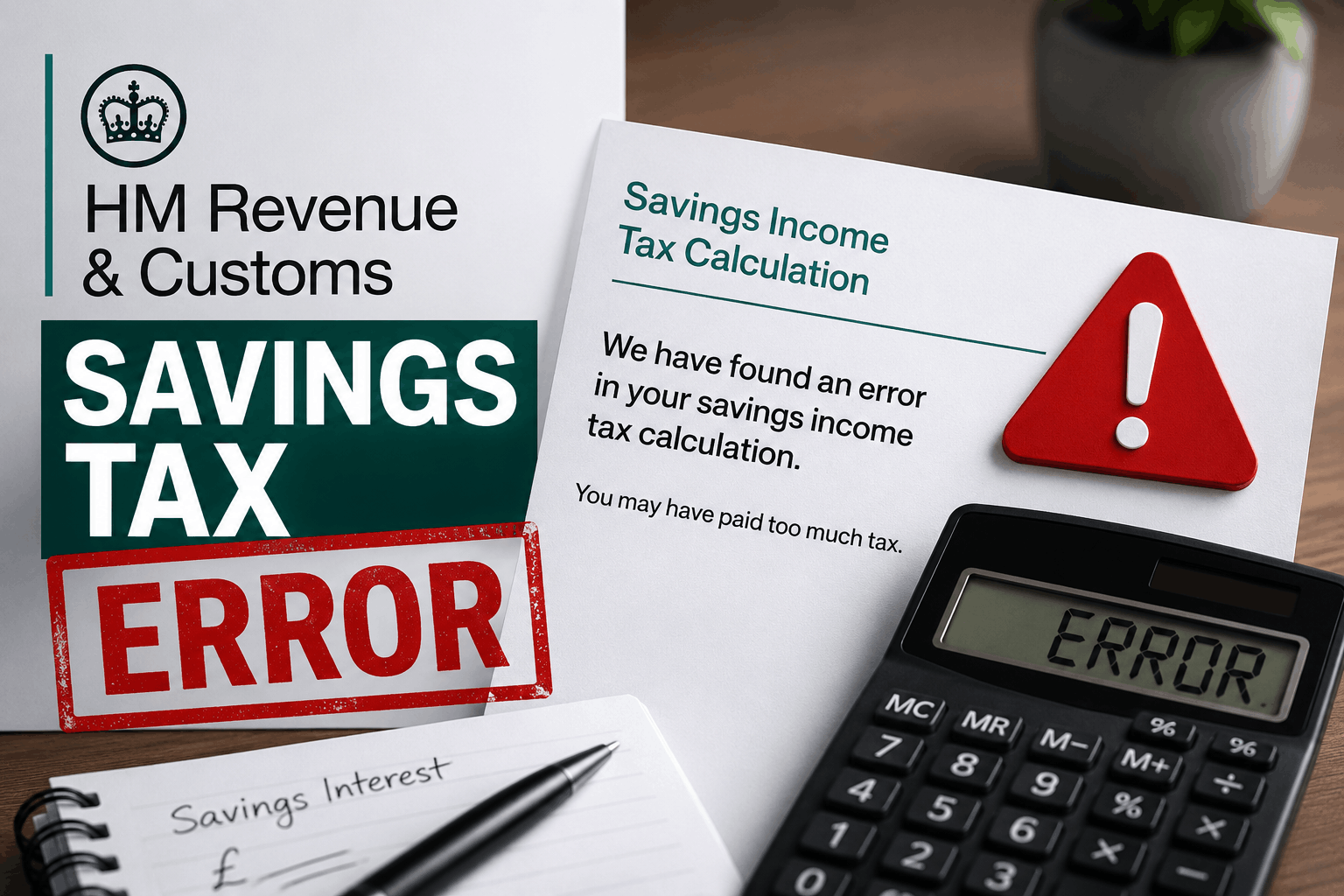
If you have noticed an unexpected drop in your take-home pay or received a surprise tax bill, you may be the victim of an HMRC savings tax error. This occurs when HMRC’s automated systems incorrectly calculate the tax due on your bank interest, often due to data mismatches, double-counting, or outdated information.
To resolve this, you must gather your official Certificates of Interest, compare them against your HMRC Personal Tax Account, and submit a formal correction or appeal through the official GOV.UK portal.
What is the HMRC Warning on Savings?
The HMRC Savings Tax Warning is a notification that high interest rates and frozen tax thresholds have caused millions of savers to breach their Personal Savings Allowance (PSA).
Because banks report interest automatically, HMRC’s systems now issue automated tax demands or adjust PAYE tax codes whenever a threshold is exceeded.
For over a decade, low interest rates meant most people never reached their PSA. However, recent economic shifts have pushed many average savers, sole traders, and small business owners into taxable territory.
Because tax bands have remained static while interest yields have risen, HMRC’s automated software is struggling to keep pace, frequently generating inflated or incorrect tax calculations.
What is the HMRC Warning to Anyone with Over £3,500 in Savings?
HMRC’s warning to savers with over £3,500 highlights the risk of lump-sum interest payments from multi-year fixed-rate bonds. When these bonds mature, all accumulated interest is paid at once, which can breach your annual PSA in a single tax year and trigger an automatic tax demand.
The issue is that HMRC’s system tracks interest at the moment it is paid, not as it accrues. For example, if you hold a 3-year fixed bond and it matures in year three, the total interest earned over three years is credited to your account in one month.
This single transaction often spikes your taxable income for that specific year, causing the system to automatically flag you for tax, even if your total savings were modest.
What are the Main Tax Errors Made by HMRC?
Common HMRC tax errors include systemic processing faults where bank interest data is mismatched, duplicated, or miscalculated.
These anomalies typically result in incorrect P800 tax calculations, flawed Simple Assessment notices (Form PA302), or unjustified nudge letters demanding payment based on flawed income assumptions.
The Common System Flaws Triggering Discrepancies
- The Data Ingestion Duplication Glitch: If you manually update your estimated interest in your Personal Tax Account and your bank later uploads your official annual return, the system often treats these as two separate income streams, double-counting your interest. This glitch is a primary driver for incorrect HMRC Savings Account Tax Letters that double-count your interest.
- The Prior-Year Extrapolation Error: HMRC algorithms may estimate your current year’s interest based on the previous year. If you held a large sum last year that has since been spent, HMRC may still deduct tax from your salary based on ghost interest.
- The Automated 50/50 Joint Account Split: HMRC often defaults to splitting interest from joint accounts 50/50. If the funds belong disproportionately to one partner, the system may incorrectly inflate the taxable income of the higher earner.
- The Inadvertent Sweep of Tax-Free Vehicles: Occasionally, structural data mismatches cause interest from tax-exempt accounts, such as Cash ISAs or NS&I Premium Bonds, to be erroneously included in taxable income calculations.
How Much Savings Can I Have Without Paying Tax in the UK?
Your tax-free savings limit (Personal Savings Allowance) is determined by your total annual taxable income. Basic-rate taxpayers (earning up to £50,270) can earn £1,000 tax-free; higher-rate taxpayers (earning up to £125,140) can earn £500; and additional-rate taxpayers receive no PSA.
| Income Tax Band | Total Taxable Income | Personal Savings Allowance (PSA) | Estimated Max Cash Balance at 4.5% Yield |
| Basic Rate (20%) | £12,571 to £50,270 | £1,000 | ~£22,222 |
| Higher Rate (40%) | £50,271 to £125,140 | £500 | ~£11,111 |
| Additional Rate (45%) | Over £125,140 | £0 | £0 (All interest is taxed) |
As of 2026, low earners or business directors taking minimal salaries may also utilise the Starting Rate for Savings. This provision allows individuals with an income of less than £17,570 to earn up to an additional £5,000 in interest completely tax-free.
This starting rate reduces by £1 for every £1 of ordinary income earned above the standard personal allowance threshold of £12,570.
Do UK Banks Notify HMRC of Savings Interest Automatically?
Yes, UK banks and building societies are legally mandated to report all interest earned by individual account holders directly to the tax authorities at the close of every financial year.
This data transmission relies on matching the financial records against your National Insurance Number, date of birth, and address history.
Under standard data-sharing protocols, you do not need to manually report standard savings interest unless your total investment income exceeds £10,000 per year, or you already file a Self Assessment tax return for your business or freelance work.
The Revenue’s central software engine incorporates this external banking data to constantly update individual taxpayer profiles online.
Which Savings and Investments Are Completely Tax-Free in the UK?
To protect your wealth from automated tax errors, utilise tax-free wrappers. The primary tax-free options include Individual Savings Accounts (ISAs), NS&I Premium Bonds, and specific Children’s Savings Accounts.
Legitimate tax-free savings options
- Individual Savings Accounts (ISAs): Savers can deposit up to £20,000 per tax year across Cash ISAs, Stocks and Shares ISAs, or Innovative Finance ISAs. All interest, dividends, and capital gains generated within these wrappers are entirely immune from income tax.
- National Savings and Investments (NS&I) Premium Bonds: All cash prizes won through the monthly Premium Bonds draw are 100% tax-free and do not contribute to your annual savings threshold.
- Children’s Savings Accounts: Interest earned on Junior ISAs or child trust funds belongs to the minor and is exempt, provided the initial funds did not originate directly from a parent violating the £100 interest rule.
What Happens If I Don’t Declare My Savings or Ignore a Notice?
Ignoring an HMRC tax notice or failing to correct a data error can lead to an automatic reduction in your PAYE tax code. This forces your employer to deduct more tax from your paycheck, and may also trigger late-payment interest charges or formal compliance audits.
If an automated check reveals undeclared interest, HMRC will simply reduce your PAYE tax code without human intervention. This means your employer will be legally required to deduct a higher percentage of income tax directly from your monthly paycheck.
For self-employed individuals or company directors, unrectified variances on a Self Assessment return can trigger automated penalties, with interest rates on outstanding tax debt maintained at significant levels above the base rate.
In extreme cases of non-compliance, the state holds statutory powers to secure direct recovery of debt from bank balances, though this is strictly limited to clear cases of proven evasion.
How to dispute an HMRC savings tax error and claim a refund?
If you have completed a manual reconciliation and verified that an automated calculation has overcharged you, you will need to go through a straightforward dispute process to correct your records and resolve your HMRC State Pension Tax Error or general savings overpayment.
Are Savings Safe in UK Banks Amid Macroeconomic Shifts?
Yes, your cash is highly secure. Deposits up to £85,000 per person, per authorised banking license, are protected by the Financial Services Compensation Scheme (FSCS). If you hold a joint account, this protection increases to £170,000.
Institutional Safety and Inflation Protections
- The Financial Services Compensation Scheme (FSCS): The FSCS automatically protects deposits up to £85,000 per person, per authorised financial institution. If you hold joint accounts, this protection doubles to £170,000.
- The Per-Banking License Rule: The £85,000 safety limit applies per banking license, not per brand. If you hold savings balances with multiple brands operating under one shared license, your total protection is capped at £85,000. Always check if your accounts share a provider license to ensure your coverage is sufficient.
- Inflation and Real Buying Power: While UK bank deposits are fundamentally safe from loss, inflation dynamics mean that if the net interest rate on your account is lower than the prevailing rate of inflation, your capital is technically losing real purchasing power over time.
How to Prevent Future HMRC Savings Tax Errors?
You can prevent future discrepancies by periodically checking your PAYE Income Details in your Personal Tax Account, ensuring your bank interest data is accurate, and proactively using tax-efficient wrappers like ISAs to keep interest out of taxable calculations.
- Maintain Living Records: Don’t wait until the end of the year. Log in to your GOV.UK Personal Tax Account every quarter to ensure the interest figures HMRC has on record align with your own.
- Update Closed Accounts: If you close a bank account, manually update your records in the HMRC portal immediately to prevent the system from using estimated (and likely outdated) data.
- Consolidate Your Savings Strategy: If you have numerous small, forgotten accounts, the cumulative interest is more likely to trigger an automated nudge letter. Consolidating into fewer, more manageable accounts makes tracking significantly easier.
- Use Form 17 for Joint Accounts: If you hold joint accounts with a spouse, ensure you have submitted a Form 17 if the beneficial ownership of the capital is not 50/50. This prevents the system from misallocating interest to the wrong tax band.
Summary
Keeping on top of your tax nowadays means keeping a close eye on your official government portal. Automated system mismatches are an unfortunate side effect of a stressed data-sharing pipeline.
To prevent unexpected drops in your monthly take-home pay, make it a habit to cross-reference your official year-end bank certificates against the recorded figures in your digital Personal Tax Account.
Utilising legitimate tax-free wrappers like ISAs and balancing joint assets thoughtfully remains the most reliable defence against automated administrative errors.
FAQ
Why has HMRC changed my tax code for savings interest out of nowhere?
HMRC reduces your PAYE tax code automatically when bank data indicates your annual savings interest has exceeded your Personal Savings Allowance. This adjustment lowers your monthly tax-free pay allowance to reclaim the tax owed directly through your salary.
Can HMRC make mistakes with savings interest calculations?
Yes. The automated system frequently double-counts income if you update your digital portal manually, taxes individuals on ghost interest from closed accounts using prior-year estimates, and incorrectly splits joint account balances down the middle.
How do I notify HMRC that a savings account is closed?
You can update your account status instantly by logging into the official GOV.UK Personal Tax Account app, navigate to your current income details, select the specific financial institution, and update the estimated interest figure to zero.
What happens if I ignore an HMRC savings interest nudge letter?
Ignoring a nudge letter allows HMRC to adjust your current tax code based on potentially flawed assumptions, resulting in lower monthly take-home pay, or leading to an automated Simple Assessment tax demand backed by late-payment interest penalties.
Does shifting personal money to my corporate account stop the savings tax threshold check?
Company directors cannot arbitrarily shift personal funds into a corporate account without creating complex loan relationships. Corporate cash earns business interest, which is subject to Corporation Tax rather than individual Personal Savings Allowances.
How do I dispute an incorrect Simple Assessment PA302 notice?
You must formally object to the calculation within 60 days of the date printed on the letter. This can be done directly through your personal tax account portal or by contacting the PAYE helpline with your bank certificates ready.
How long does it take to receive an HMRC savings tax error refund?
Once an error is formally recognised online or via phone, tax code corrections generally take 15 to 35 days to filter down to your employer’s payroll system, resulting in an automatic tax rebate on your next payday.