
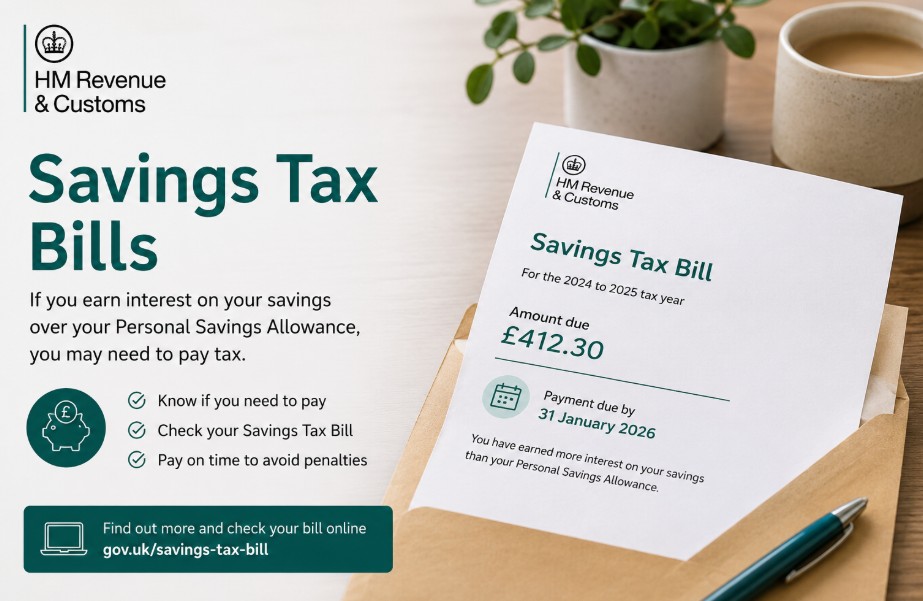
HMRC Savings Tax Bills: The Complete UK Guide to Allowances, Warnings, and Protections
An HMRC savings tax bills is an income tax liability issued by HM Revenue and Customs when the interest you earn on regular, non-ISA savings accounts exceeds your annual Personal Savings Allowance (PSA). These tax liabilities are calculated automatically using annual data sent directly to HMRC by UK banks and are collected via PAYE tax code adjustments, P800 Simple Assessment letters, or Self-Assessment tax returns.
The UK savings environment is undergoing a massive structural shift. Millions of everyday savers are receiving unexpected income tax liabilities on cash assets that previously sat safely below the government radar. This financial squeeze is driven by a combination of high-yield savings accounts and frozen personal income tax thresholds.
Why Are So Many UK Savers Receiving Unexpected HMRC Savings Tax Bills Now?
UK savers are facing unexpected HMRC savings tax bills due to a phenomenon called fiscal drag, where frozen personal tax bands (£12,570) and static Personal Savings Allowances collide with surging high-street interest rates.
Because banks have paid interest gross since 2016, savers are solely responsible for tracking and paying the resulting tax.
The core mechanism behind this surge in tax demands is a phenomenon known as fiscal drag. While the Bank of England’s base rate adjustments pushed high-street savings yields to heights not seen in over a decade, HM Revenue and Customs guidelines confirm the main Income Tax Personal Allowance remains frozen at £12,570.
Simultaneously, statutory Personal Savings Allowance limits have remained completely unchanged since their introduction in April 2016. In practice, this means far less principal capital is required to breach your tax-free thresholds.
Based on current high-street interest rates, a basic-rate taxpayer holding money in an account yielding 5% will hit their maximum tax-free threshold with just £20,000 in savings. For a higher-rate taxpayer, that official safe zone shrinks to a mere £10,000.
Ever since the government changed the rules to stop banks and building societies from automatically deducting tax from interest, 100% of your returns have been paid gross.
This means the responsibility for tracking and settling any tax due rests entirely with you. The legal burden of tracking, capping, and paying tax on those distributions has shifted entirely onto you, the individual saver.
What Is the Current HMRC Personal Savings Allowance Threshold?
The current HMRC Personal Savings Allowance (PSA) threshold lets basic-rate taxpayers earn £1,000 of savings interest tax-free per year.
This tax-free allowance drops to £500 for higher-rate taxpayers, while additional-rate taxpayers receive a £0 allowance, meaning every pound of interest they earn is subject to tax.
How Much Savings Account Interest Is Tax Free for Your Income Band?
As of the current 2026/27 tax year, the government categorises savers into three distinct personal savings allowance bands.
Crossing into a higher income tax bracket by even a single pound causes your tax-free interest allowance to shrink instantly.
| Income Tax Band | Annual Taxable Income Range | Personal Savings Allowance (PSA) | Tax Rate on Excess Interest |
| Basic Rate | £12,571 to £50,270 | £1,000 | 20% |
| Higher Rate | £50,271 to £125,140 | £500 | 40% |
| Additional Rate | Over £125,140 | £0 | 45% |
What Is the Maximum Amount in a Savings Account to Avoid Tax?
The exact principal balance you can hold safely without paying tax fluctuates based on the interest rate your bank pays. When reviewing financial decisions, many individuals assume their savings are safe simply because their balance seems modest.
To see how this works in practice, take the case of David. He is a higher-rate taxpayer with a £12,000 cash balance in a fixed-rate bond yielding 4.5% interest. Over the tax year, his account generates £540 in total interest.
Because David’s higher-rate PSA cap is exactly £500, he has breached his threshold by £40. HMRC will issue a calculation demanding 40% tax on that excess, resulting in a sudden bill.
Is the £3,500 Savings Rumour True?
No, the HMRC £3,500 savings rule is an online rumour. There is no penalty or tax threshold triggered simply for holding more than £3,500 in cash within a UK bank account.
Tax is calculated entirely on the annual interest generated by your capital, not the total balance size.
There is absolutely no rule stating that you will face a tax penalty simply for holding more than £3,500 in total capital inside a UK bank account.
The confusion online stems from confusing total savings capital with the actual annual interest generated. If you receive an official alert or notice from the Revenue, it is not because of your total balance size; it is a direct warning that your accumulated annual interest has breached either your £500 or £1,000 allowance limit.
The true HMRC savings tax warning making headlines relates to the sheer volume of data matching occurring behind the scenes. The tax authority has actively upgraded its automated systems to cross-reference third-party financial data, flagging accounts that historically went unnoticed.
How Does HMRC Know My Savings Interest?
HMRC automatically tracks your savings interest through mandatory data sharing. Under UK compliance laws, all banks and building societies must electronically report your account details, National Insurance number, and the exact total interest paid to you at the close of every tax year on April 5th.

Do banks inform HMRC about joint accounts?
Yes. For joint savings accounts, the interest is automatically split 50/50 and reported under each individual’s National Insurance number.
If you attempt to circumvent this by opening multiple accounts across separate high-street brands, HMRC’s systems aggregate all reported income against your unique tax profile.
Under statutory guidelines, the revenue holds the legal right to audit, check, and investigate historic banking records stretching back up to twenty years if deliberate non-disclosure or tax evasion is suspected.
How Does HMRC Collect Tax on Savings Interest Automatically?
HMRC automatically collects unpaid savings tax by adjusting your workplace PAYE tax code or by mailing a P800 Simple Assessment letter at the end of the tax year. However, if your total annual interest from investments and cash accounts exceeds £10,000, you must file a Self-Assessment return.
The PAYE Route
If you are an employee paid via PAYE or you receive a regular private pension, HMRC will typically adjust your tax code for the upcoming tax year.
For example, if your standard tax code is 1257L and you owe tax on your savings, they may reduce it to a lower code. This forces your employer to deduct the owed savings tax gradually from your monthly paycheck, spreading the cost across 12 months.
The P800 Route
If your tax cannot be collected smoothly through a PAYE payroll adjustment, which frequently happens to retirees whose state pension is their primary income, HMRC will issue an official P800 Tax Calculation or a Simple Assessment letter.
These physical compliance notices reflect growing changes in HMRC digital letters communication and are distributed between June and March following the end of the tax year, detailing exactly how much you owe and providing a secure deadline to settle the debt online.
The Self-Assessment Tax Return Mandate
You do not need to contact HMRC to report small interest gains that fall below your personal allowance. However, there is a strict statutory boundary where automation stops and manual filing becomes mandatory.
You are legally required to register for and file a Self-Assessment tax return if your total income from savings and investments exceeds a hard threshold of £10,000 in a single tax year, even if a portion of that interest sits within an allowance.
How Does Paying Tax on Savings Work When Retired?
Pensioners can earn up to an additional £5,000 of tax-free interest via the Starting Rate for Savings if their total gross income remains under £17,570. However, this specialised buffer is reduced by £1 for every pound of alternative income earned over the standard £12,570 Personal Allowance.
A common misconception among senior citizens is that state pensions exempt them from modern interest penalties.
In reality, a pensioner in the UK can have their personal savings limits heavily altered by their total retirement income mix, which makes staying aware of potential issues like an HMRC state pension tax error incredibly important.
If your total gross income (State Pension plus private annuities) is below £17,570, you can claim the unique Starting Rate for Savings. This provides up to an additional £5,000 of 0% tax-free interest.
However, for every £1 of alternative income you receive above the standard £12,570 Personal Allowance, your starting rate for savings shrinks by exactly £1.
Once your pension income hits £17,570, this specialised low-earner buffer disappears completely, leaving you with only the standard £1,000 or £500 PSA.
Dividend Distributions vs. Cash Interest
If you choose to invest your capital into stocks, shares, or open-ended investment companies (OEICs), the fiscal rules change completely.
Returns from equity investments are categorised as dividend distributions or capital gains, which do not count towards your Personal Savings Allowance. Instead, they are subject to entirely separate dividend tax thresholds and capital gains tax exemptions.
The Parental Tax Trap on Children’s Accounts
While money gifted from grandparents or friends to a child grows completely tax-free, strict anti-avoidance rules apply to biological parents and legal guardians.
If a parent gifts money to an unmarried child under the age of 18, and that capital generates more than £100 in total interest in a single tax year, the entire interest amount is legally treated as the parent’s personal income.
It will be stacked on top of the parents’ income tax band and can rapidly trigger an unexpected savings tax bill.
How to Calculate Your Potential Liability?
Understanding the internal logic of an HMRC savings tax bills calculator process is essential to verify whether official HMRC savings account tax letters are mathematically accurate.
To determine your exact exposure, you must follow a structured sequence of calculations:
Step-by-Step Worked Calculation Example
Let us review a practical, step-by-step example for a basic-rate taxpayer who has accumulated substantial high-yield interest.
How Can You Legally Protect Your Savings Interest from HMRC?
You do not need to stop saving to avoid unexpected tax calculations. The UK financial system contains several built-in, fully compliant wealth-protection shelters.
- Max Out Your Annual Individual Savings Account (ISA) Limits: Every UK adult has a statutory allowance allowing them to deposit up to £20,000 per tax year into an ISA. Whether you opt for a Cash ISA, a Stocks & Shares ISA, or an Innovative Finance ISA, 100% of the interest, capital growth, and distributions earned inside that shelter remain completely immune to HMRC income tax bills.
- Utilise Strategic Asset Shifting Between Partners: If you are legally married or in a registered civil partnership, you can freely transfer cash assets to your partner without triggering capital gains implications. If one partner sits in a lower income bracket or has not fully utilised their annual £1,000 PSA, shifting the savings account into their name can instantly lower or wipe out the household tax burden.
- Allocate Capital to National Savings and Investments (NS&I) Premium Bonds: While individual returns are not strictly guaranteed via a fixed percentage interest rate, every single cash prize won through the monthly NS&I Premium Bond draws is structurally classified by the government as tax-free lottery winnings, entirely separate from your PSA calculations.
Ways to Pay an HMRC Tax Bill and Get Help
If you receive an official P800 calculation or a Simple Assessment notice confirming that you owe money, you must act decisively to avoid automated debt collection actions or statutory interest penalties.
Secure payments can be made directly via your official GOV.UK Personal Tax Account using a debit card, an open banking transfer, or via electronic BACS routing.
A common pattern is that savers panic when hit with a large back-dated interest bill they cannot immediately afford.
If an unexpected bill creates genuine financial hardship, you should contact the HMRC helpline immediately to request a Time to Pay Arrangement.
This compliance framework allows individuals to securely dismantle their debt through affordable monthly instalment plans tailored to their actual income profiles.
Summary
Managing your UK savings tax liabilities requires consistent oversight rather than passive accumulation.
If you have substantial cash capital resting in regular high-street bank accounts, your immediate next step should be to log into your online banking portals and download your absolute interest statements for the past tax year.
If your principal yields are tracking dangerously close to your £500 or £1,000 allowance boundaries, take proactive control of your wealth structure by migrating those funds into compliant tax-sheltered environments before automated data matching issues an unexpected demand.
Protecting your savings from an HMRC savings tax bill means shifting assets into tax-free wrappers for UK taxpayers in the 2026/27 tax year.
FAQ about HMRC Savings Tax Bills
Do banks deduct this tax before paying me?
No. Since April 2016, UK banks and building societies have been legally required to pay out all savings interest gross, leaving 100% of the earnings in your account. The responsibility to calculate and settle any resulting tax liability rests entirely with the individual saver.
What happens if I don’t declare savings interest?
If you fail to declare interest over your thresholds when required to do so via Self-Assessment, HMRC’s automated data-matching systems will eventually flag the discrepancy. This triggers back-dated tax assessments, statutory interest charges on the debt, and potential financial penalties for non-compliance.
How are joint savings accounts handled by HMRC?
HMRC automatically splits the interest earned on a joint savings account 50/50 between the two named account holders. Each individual’s half share is then matched against their personal National Insurance number and stacked against their independent Personal Savings Allowance.
What did Martin Lewis say about tax on savings interest?
Martin Lewis has repeatedly warned that the combination of rising interest rates and frozen tax bands means hundreds of thousands of middle-income earners are falling into the savings tax trap for the first time, making maximising your £20,000 ISA allowance absolutely critical.
What happens if HMRC uses an incorrect interest estimate?
HMRC often estimates your current year’s savings interest based on your previous year’s bank filings. If you have since moved or spent that capital, you must log into your online Personal Tax Account and manually correct the figures to prevent an incorrect PAYE deduction.
Can I keep large sums like £200,000 in a UK savings account without tax issues?
Yes, holding substantial capital in a UK account is entirely legal. However, the interest earned will be subject to standard UK tax rules, meaning anything generated above your £500 or £1,000 allowance will trigger a tax bill.
Is interest earned on tax-free accounts like ISAs completely hidden from HMRC?
While ISA managers report subscription details to ensure you don’t breach the annual £20,000 deposit limit, the interest generated within these wrappers is legally excluded from your income profile and will never trigger an unexpected HMRC tax bill.