The Ultimate Guide To UK Bank Account Closure Rules, Forced Debanking
Under bank account closure rules, banks operating in the United Kingdom must provide a mandatory 90-day notice period and a detailed, transparent written explanation before terminating an account contract, giving consumers and small businesses sufficient time to challenge the decision or transition their finances.
Following extensive political and regulatory scrutiny regarding arbitrary debanking, structural updates via the Payment Services and Payment Accounts (Contract Termination) (Amendment) Regulations are officially in effect.
Key Takeaways
- UK banks must provide a mandatory 90-day written notice before closing a customer account or terminating an indefinite framework contract.
- Financial institutions are legally required to provide a sufficiently detailed and specific written explanation detailing why an account is closing.
- The extended 90-day notice mandate and transparency rules apply strictly to new framework banking contracts established on or after 28 April 2026.
- Banks retain the legal right to freeze or close accounts instantly without notice if they have reasonable grounds to suspect serious financial crime.
What Are the New Bank Account Closure Rules?
The new bank account closure rules in the UK mandate that retail financial institutions must provide a strict 90-day written notice period and a detailed, clear explanation before closing a user’s account, preventing arbitrary debanking for consumers and small businesses.
Under the Payment Services and Payment Accounts (Contract Termination) (Amendment) Regulations, the UK government has overhauled how financial institutions terminate accounts.
These rules amend the Payment Services Regulations 2017 and Payment Accounts Regulations 2015, establishing stronger protections and market security for both individual consumers and small-to-medium enterprises (SMEs).
The 90-Day Rule Explained
The 90-day rule states that UK banks must give customers a minimum of 90 days of active notice before account termination, during which digital access, features, and card services must continue functioning as normal.
Previously, banks only had to give 60 days of notice before closing an account. The updated framework extends this window to a strict 90 days, giving businesses and individuals essential time to transition payroll, bills, and merchant services.
During these 90 days, your account and digital banking must remain fully active. Furthermore, banks must refund any pre-paid account maintenance fees on a pro-rata basis up to the exact day of termination.
The Transparency Mandate
The transparency mandate requires UK banks to issue a highly specific, plain-English written explanation detailing the exact reasons behind a forced account closure, enabling the customer to mount an accurate appeal.
The era of banks shutting down accounts behind a wall of generic commercial boilerplate is over; financial firms must now spell out the exact rationale behind a forced exit in plain English. This shift puts power back in your hands.
By knowing the precise reason, you can quickly spot administrative errors, challenge incorrect transaction flags, or build a robust appeal to escalate directly to the Financial Ombudsman Service (FOS).

Old Rules vs. New Banking Account Closure Rules
| Regulatory Feature | Old Framework (Pre-April 2026) | New Statutory Framework (Post-April 2026) |
| Mandatory Notice Period | Minimum of 2 months (60 days) before termination. | Minimum of 90 days before termination. |
| Reason Disclosure Requirement | No statutory duty to provide specific commercial reasons. | Must provide a detailed, specific written reason. |
| Fee Pro-Rata Reimbursements | Dependent on individual bank terms and conditions. | Mandated pro-rata reimbursement of advance fees. |
| Basic Bank Account Protections | Limited oversight on absolute grounds for refusal. | Strict reason-giving rules apply to applications and closures. |
| Ombudsman Escalation Info | Not consistently mandated inside the closure letter. | Must explicitly outline FOS complaint pathways. |
Can a Bank Close Your Account Without Your Permission or Notice?
Yes, a UK bank can still legally terminate or freeze your account without notice or permission, but only under highly specific, legally defined exceptions outlined within the regulations.
The updated statutory instruments are clear that customer protection rules must not conflict with wider national security, anti-money laundering (AML), and counter-terrorist financing obligations. When a conflict occurs, these broader statutory criminal laws take absolute precedence over the 90-day consumer notice window.
The Serious Crime & Suspicious Activity Exceptions
The serious crime exception bypasses the 90-day notice rule instantly, allowing UK banks to immediately freeze funds if they suspect activities like money laundering, tax evasion, or fraud.
The absolute exception to the 90-day notice rule occurs if a bank suspects the account is linked to a serious crime under the Serious Crime Act 2007 (such as money laundering, tax evasion, or fraud).
If automated systems or compliance teams flag suspicious transaction patterns, like unexplained international transfers or rapid funds layering, the bank will bypass standard notice.
Under the Money Laundering Regulations 2017, they will freeze or close the account instantly to protect assets.
The Tipping Off Legal Dilemma
The Tipping Off provision under Section 333A of the Proceeds of Crime Act 2002 legally bans bank staff from telling a customer that their account is under investigation or frozen for suspicious activity.
When an account is frozen for suspicious activity, banks are legally barred from explaining why due to the Tipping Off provision in Section 333A of the Proceeds of Crime Act 2002 (POCA).
When a bank submits a Suspicious Activity Report (SAR) to the National Crime Agency (NCA), it is a criminal offense for staff to disclose anything that might compromise an active investigation.
Consequently, the bank must remain entirely silent, leaving the account restricted without notice.
Immediate Triggers Beyond Financial Crime
Beyond criminal activity, banks can terminate a contract immediately or with short notice under specific regulatory conditions:
- Abusive Behaviour: Under Regulation 51D, if a customer’s conduct towards bank employees amounts to a public order offence involving harassment, alarm, distress, or threats of violence, the bank can issue an immediate termination notice.
- Application Fraud: If a customer knowingly provides fraudulent or incorrect information during the application process (such as masking earnings from HMRC tax bank accounts to bypass risk screening), and the bank would have rejected the account had the truth been known, immediate closure is permitted.
- Account Misuse: Operating a high-volume retail business through a standard personal current account explicitly violates the bank’s terms of service and can trigger an administrative closure.
- Immigration Enforcement: Compliance with section 40G of the Immigration Act 2014 requires banks to close accounts held by individuals designated as disqualified persons due to their immigration status.

Can a Bank Legally Close an Account With Money in It?
Yes, a bank can legally close an account containing money, but they are legally barred from permanently confiscating your legitimate funds. The money remains your legal property unless a UK court issues a formal asset forfeiture order.
The logistical availability of those funds depends entirely on why the closure occurred. If it is a standard commercial closure, the capital is shifted out seamlessly. If a crime is suspected, the capital is locked until law enforcement concludes its inquiry.
How to Claim Money from a Closed Bank Account?
To claim money from a closed bank account in the UK, you must complete a Closed Account Balance Claim with the bank, provide official identity verification (KYC), and designate an active alternative UK bank account for an electronic transfer.
- Contact the bank’s dedicated web portal or telephony team to request a Closed Account Balance Claim.
- Submit a valid UK driving licence or passport alongside recent proof of address to satisfy identity verification checks.
- Provide the account number and sort code of an alternative, active UK bank account held in your identical name.
- The bank will then process a manual electronic transfer or issue a physical corporate cheque to clear the residual balance to zero.
What Happens if a Bank Blacklists You?
If your account is closed involuntarily due to fraud or systemic deception, the bank will log your details on a shared database managed by CIFAS (the UK’s Fraud Prevention Service).
This CIFAS marker acts as a centralized blacklist warning across the financial sector, remaining on your profile for up to six years.
To contest a marker, your primary recourse is to submit a free Data Subject Access Request (DSAR) to CIFAS to identify who placed it, followed by a formal dispute with the registering institution.
Things to Note Before Closing the Bank Account
Voluntarily ending your relationship with a bank requires planning to prevent administrative headaches, missed payments, or temporary loss of liquidity. Before you issue a formal closure instruction, execute this preparatory checklist:
- Clear Outstanding Debts: A bank cannot block you from walking away unless you owe them money. Ensure all unarranged overdraft balances, pending transaction fees, or negative balances are completely cleared.
- Download Historical Statements: This is your absolute priority. Most UK high-street lenders shut down your digital portal access the moment a closure goes through, meaning you will have to request paper records manually. Because mortgage applications, standard credit checks, or audits following direct HMRC bank account deductions demand multi-year financial histories, you should download the past 5 years of PDF statements beforehand.
- Identify Inbound Income Channels: Make a comprehensive list of everyone who sends you money (employers, commercial clients, or investment dividends). If you receive state support, you must notify the relevant departments immediately, especially amidst ongoing DWP bank account privacy concerns regarding transactional monitoring.
- Audit Active Direct Debits: Check your recurring payments. If you use the Current Account Switch Service (CASS), these will transfer automatically, but it is wise to keep a manual record of all standing orders and direct debits just in case an external merchant requires manual updating.
How to Close a Current Bank Account?
Closing a bank account voluntarily is a basic consumer right, provided you do not owe the bank outstanding debts. You are free to close your account at any time without paying contract termination penalties.
Method 1: The Standard Voluntary Process (Digital or Written)
To close your account permanently without visiting a physical retail branch, you can complete the process securely using online banking portals, dedicated smartphone apps, or via a formal written application letter.
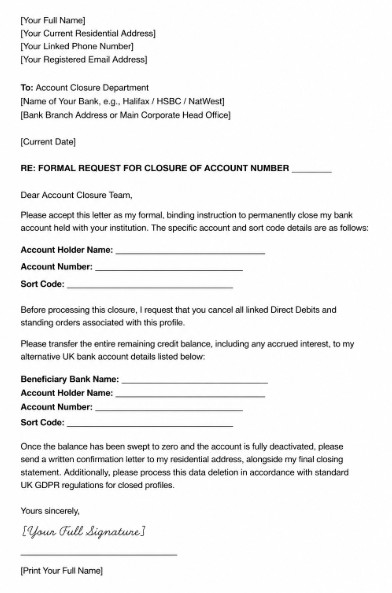
If opting for a written approach, draft a letter referencing your full name, address, account number, and sort code, explicitly stating your instruction to close the account and transfer any remaining balance to your designated backup account.
Method 2: Closing a UK Bank Account from Overseas
If you have relocated outside the United Kingdom and need to terminate a residual sterling account, visiting a physical branch is impossible. To close an account from overseas:
- Log in to your secure online banking app and check if there is an integrated web chat or digital closure tool.
- If digital options are unavailable, draft the formal closure letter displayed above.
- Because you are communicating from overseas, you must attach a certified copy of your photo identification (such as a notarized passport copy) to prevent international identity fraud.
- Instruct the bank to send your residual funds via an International Money Transfer (IBAN/BIC), and state clearly that you accept any corresponding international currency conversion or wire fees.
What Happens After Closing the Bank Account?
Once the bank processes your closure request or the 90-day mandatory notice period expires, the status of your account updates systematically:
Immediate Operational Effects
Your debit cards, credit cards, and digital banking access tokens are permanently deactivated. The bank sweeps the residual credit balance out of the account to your designated alternative account.
A bank can legally close an account that contains an active credit balance, but closing an account does not mean they can permanently confiscate your legitimate money.
The ownership of the capital remains with you unless a formal asset forfeiture order is issued by a UK court.
Inactivity & Dormancy Transitions
If you leave a secondary account empty instead of formally closing it, it enters a structured timeline:
- 2 to 5 Years (Inactivity): Under internal risk rules aligned with UK Finance guidelines, an account with zero customer-initiated activity is systematically flagged as inactive to guard against identity theft. While your digital access and cards are restricted as a safety measure, the account contract itself remains open.
- 15 Years (Dormancy): Under the Dormant Bank and Building Society Accounts Act, if an account remains untouched for 15 consecutive years, it is classified as legally dormant. The bank transfers the unclaimed capital to the Reclaim Fund Ltd, a government-backed scheme that distributes unclaimed financial assets to social causes. You can trace and retrieve this money at any point in the future for free using the national online service My Lost Account.
Risk and Credit Monitoring Profiles
- Standard Commercial Closure: If the account was closed voluntarily by you or under a standard 90-day commercial notice by the bank, it has zero impact on your credit history or credit score.
- Fraud Involuntary Closure: If an account is closed involuntarily due to fraud or systemic deception, the institution will register your details on a shared fraud prevention database managed by CIFAS (the UK’s Fraud Prevention Service). A CIFAS marker acts as a centralized warning system for the entire financial sector and remains active on your profile for six years, making it incredibly difficult to open standard current accounts, secure mortgages, or obtain credit lines.
How Long Does It Take for a Bank Account to Close for Inactivity?
A common pattern is that people open secondary accounts and leave them empty, assuming the account will remain active indefinitely. In the UK, banks distinguish between a live account, an inactive account, and a legally dormant account.
Dormancy Timelines & Asset Recovery
If an account sees no customer-initiated activity (such as deposits, withdrawals, or transfers) for 2 to 5 years, the bank will flag it as inactive to protect against fraud, restricting digital access and cards.
Under the Dormant Bank and Building Society Accounts Act, if the account remains untouched for 15 consecutive years, it is legally declared dormant.
The bank is then permitted to transfer the balance to the government-backed Reclaim Fund Ltd (RFL) to support social and community causes.
Reactivating a Dormant Account
Your money is never lost; under the scheme’s core principles, owners retain a legal right to claim full restitution in perpetuity.
You can easily trace and recover lost assets using the free online national search portal, My Lost Account (co-managed by UK Finance, the Building Societies Association, and NS&I).
Alternatively, visiting a physical branch of your original bank with valid proof of identity and historical account details allows the bank to retrieve the profile from their archives and issue a payout with any historical interest owed.
Practical Action Plan
If you receive a formal notice that your bank intends to close your personal or business account, taking immediate, organized steps can protect your financial operations:
- Secure Your Data: Log in to your online banking app immediately and download the past 5 years of historical bank statements and transaction records. Once the account is closed, accessing these documents becomes administratively difficult.
- Open a Secondary Profile: Do not wait for the 90-day window to expire. Open an alternative current account or an Electronic Money Institution (EMI) account straight away to establish a backup destination for your funds.
- Update Your Income Channels: Provide your employer, the DWP, or your commercial invoicing clients with your new account details to avoid missing salary payments, dividends, or customer revenue.
- Switch Active Direct Debits: Utilize the Current Account Switch Service (CASS) if eligible, as it automatically migrates your standing orders, direct debits, and incoming payments to your new provider within 7 working days.
- File a Formal Complaint: If you believe the bank’s reason is incorrect or unfair, submit a formal internal complaint to the bank’s resolution team. If they fail to resolve the issue within 8 weeks, escalate your dispute directly to the Financial Ombudsman Service.
Disclaimer: The information provided in this article is for educational purposes only and does not constitute formal financial, legal, or regulatory advice.
FAQ
Can a bank close your account without giving a reason?
As of 2026, UK banks must give a detailed, specific written reason for closure. The only exception is if disclosure violates anti-money laundering laws or triggers a criminal tipping off offence.
What happens when a bank closes your account uk?
Your access cards and digital portals are deactivated. The bank provides a notice window to sweep legitimate balances out, unless the funds are legally frozen under an ongoing financial crime investigation.
Can a bank refuse to let me close my account?
A bank cannot force you to keep an account open, but they can block the closure process if your account holds a negative balance, owes active interest, or is subject to a formal court freezing order.
How bad is it if a bank closes your account?
If closed under standard commercial notices, it has zero impact on your credit history. However, if closed due to fraud or suspicious activity, a CIFAS marker will be filed, damaging your financial access for six years.
Can I get my bank account back after being closed?
Once an account contract is formally terminated, it cannot be reopened. If the closure was executed due to a bank error, you can lodge a complaint to seek financial compensation and account reinstatement via the Ombudsman.
Will an involuntary account closure ruin my credit score?
No, the closure itself is not recorded on your traditional credit report and does not alter your score. However, any unpaid overdraft debts left behind will be registered as a default, which severely damages your credit rating.
What is the best reason for closing a bank account?
The most efficient justification for closing an account is switching to a provider that offers superior interest rates, lower business fees, or improved digital tools through the automated Current Account Switch Service.