
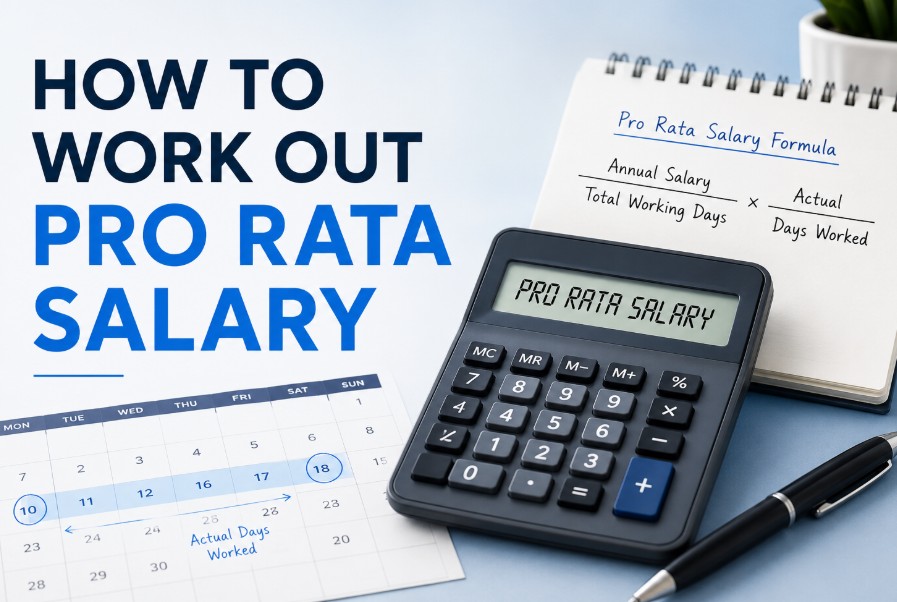
How to Work Out Pro Rata Salary in the UK: Complete Guide to Part-Time Pay and Holiday Rules
Pro rata pay calculation in the UK adjusts a full-time annual salary to match the actual hours or days an employee works. If you are starting a part-time role or adjusting your hours, knowing how to work out pro rata salary ensures you receive fair, proportional compensation, statutory holiday accrual, and workplace benefits for your exact working pattern.
Key Takeaways
- Pro rata salary calculations adjust full-time pay based on exact hours worked, ensuring fair pay for part-time employees across the UK.
- UK workers receive a statutory holiday entitlement of 5.6 weeks per year, which applies on a pro rata basis for part-time working arrangements.
- Under the Part-Time Workers Regulations 2000, part-time staff must receive equal pay rates and benefit access compared to full-time peers.
- Term-time workers calculate annual earnings across 39 teaching weeks plus accrued statutory holiday pay, spread over 12 monthly payments.
What Is a Pro Rata Salary?
A pro rata salary is an annual wage adjusted proportionally to match the actual hours or days an employee works relative to a full-time contract. The term comes from the Latin phrase meaning in proportion.
When a UK job advertisement displays a figure such as £30,000 per annum pro rata, that £30,000 represents the Full-Time Equivalent (FTE) compensation. If you work half of the standard full-time hours, your gross annual pay will be exactly half of that total.
Under the Part-Time Workers (Prevention of Less Favourable Treatment) Regulations 2000, UK employers are legally required to treat part-time employees no less favourably than comparable full-time staff. This covers:
- Equal hourly pay rates
- Pro-rated statutory holiday accrual
- Access to workplace pensions and annual bonuses
- Equal overtime access

Which Employees Are Subject to Pro Rata Salary?
Pro rata salary applies to anyone working non-standard schedules, including part-time employees, job share partners, term-time workers, mid-month starters/leavers, and flexible schedule staff.
- Part-Time Staff: Employees working fewer than the standard full-time weekly hours (e.g., 20 hours instead of 37.5 hours).
- Job Share Workers: Two or more employees splitting the responsibilities and hours of one full-time role.
- Term-Time Only Staff: Common among teaching assistants and school support staff who work only during school terms (typically 39 weeks per year) rather than 52 weeks.
- Mid-Month Starters and Leavers: Employees joining or leaving a company mid-pay cycle whose initial or final monthly pay must be adjusted for actual days worked.
- Flexible Work Pattern Staff: Workers operating on reduced schedules, such as 2 or 3 days per week.
How to Work Out Pro Rata Salary?
Working out a pro-rated salary relies on a simple principle: divide the full-time equivalent (FTE) compensation by standard full-time hours, then multiply that baseline figure by the employee’s actual contracted pattern.
Working Out Base Hourly Rate
If you need to derive the exact hourly rate from an advertised pro-rated package:
- Calculate annual contracted hours: Multiply actual weekly contracted hours by 52 weeks.
- Determine hourly pay rate: Divide the annual pro rata salary by the total annual contracted hours.
Working Out Gross Monthly Pay
Before tax and National Insurance deductions are processed through PAYE, convert an annual salary into monthly pay:
- Divide total annual pro rata salary: Take the calculated annual pro rata gross salary and divide it by 12.
Working Out Part-Time Annual Pay
When establishing gross annual earnings for a part-time contract, follow these steps:
- Determine full-time hourly value: Divide the full-time gross annual salary by the standard full-time weekly hours to find the weekly contractual hourly rate.
- Apply actual working hours: Multiply the weekly contractual hourly rate by the employee’s actual contracted weekly hours.
Part-Time Salary Comparison Table
| Full-Time Salary (FTE) | 2 Days / Week (15 Hrs) | 3 Days / Week (22.5 Hrs) | 4 Days / Week (30 Hrs) |
| £20,000 | £8,000 | £12,000 | £16,000 |
| £24,000 | £9,600 | £14,400 | £19,200 |
| £25,000 | £10,000 | £15,000 | £20,000 |
| £30,000 | £12,000 | £18,000 | £24,000 |
| £40,000 | £16,000 | £24,000 | £32,000 |

Working Out Full-Time Equivalent (Reverse Calculation)
To evaluate what an advertised part-time role pays as a full-time equivalent (FTE) baseline:
- Determine hourly value of part-time rate: Divide the advertised pro rata salary by actual weekly contracted hours.
- Scale up to full-time baseline: Multiply that result by the standard full-time weekly hours for the organization.
Working Out Pro Rata Holiday Entitlement
Calculating statutory annual leave for part-time schedules follows statutory UK guidelines:
- Identify statutory week multiplier: Take the UK statutory annual leave baseline of 5.6 weeks.
- Multiply by days worked: Multiply 5.6 by the number of days worked per week.
Working Out Term-Time Only Pay (School Staff)
Spreading term-time earnings into 12 predictable monthly instalments requires accounting for term weeks and holiday accrual:
- Calculate hourly rate: Divide full-time annual salary by full-time weekly hours multiplied by 52.
- Determine total paid weeks: Add total active term weeks (typically 39) to pro-rated statutory holiday weeks (typically 5.6), resulting in paid weeks (e.g., 44.6 weeks).
- Calculate gross annual total: Multiply the hourly rate by weekly contracted hours, then multiply by total paid weeks.
- Divide into equal monthly installments: Divide the gross annual sum by 12 to generate 12 equal monthly payments.
Working Out Mid-Month Starts & Leaves
Adjusting pay for an employee joining or leaving mid-cycle depends on actual working days rather than a flat monthly split:
- Calculate daily rate: Divide annual gross salary by the total standard working days in the calendar year (typically 260 days).
- Calculate partial month pay: Multiply the daily rate by actual days worked in that initial or final pay window.
How Does Pro Rata Affect Holiday Entitlement and Mid-Month Starts in the UK?
Under UK employment law, nearly all workers are entitled to a statutory minimum of 5.6 weeks of paid annual leave per year. For a full-time worker on a 5-day week, this equals 28 days.
For part-time staff, holiday entitlement is pro-rated by multiplying working days per week by 5.6:
- 4 days per week: 4 × 5.6 = 22.4 days
- 3 days per week: 3 × 5.6 = 16.8 days
- 2 days per week: 2 × 5.6 = 11.2 days
Employers must round partial days up rather than down if contract terms specify rounding, ensuring workers receive their statutory minimum entitlement.
According to statutory guidelines enforced by the Fair Work Agency, UK employers are required to maintain comprehensive annual leave and holiday pay records for a minimum of 6 years

Working Pattern Summary Table
When an employee joins or leaves mid-month, payroll departments calculate pay based on actual working days in that initial pay period rather than a simple 1/12th monthly split.
| Working Pattern | Standard Full-Time Basis | Pro Rata Calculation Rule |
| Part-Time Hours | 37.5 hours/week | Pro-rated based on contracted weekly hours vs standard hours |
| Term-Time Only | 52 weeks/year | Pro-rated based on active teaching weeks + statutory holiday entitlement |
| Mid-Month Starter | Full calendar month | Pro-rated using actual working days divided by total working days in that month |
Checklist for Pro Rata Calculations
When reviewing job offers, updating employment contracts, or checking monthly payslips, follow this practical checklist:
- Verify standard full-time hours for the role (typically 37.5 or 40 hours per week).
- Confirm agreed weekly hours and calculate the exact FTE fraction (Actual Hours ÷ Full-Time Hours).
- Apply the FTE fraction to the full-time gross annual salary.
- Check that annual leave entitlement reflects the 5.6-week statutory minimum on a pro-rated basis.
- Refer directly to the official GOV.UK Holiday Entitlement Calculator for statutory leave verifications or consult Advisory, Conciliation and Arbitration Service (ACAS) guidelines for workplace standards.
Conclusion
Understanding pro rata pay calculations is essential for both employees and employers across the UK.
By anchoring compensation directly to full-time equivalents, the pro rata framework guarantees that part-time, term-time, and flexible staff receive equitable pay, statutory holiday entitlement, and pension access without penalty.
Whether you are reviewing a job offer advertised at an FTE rate or checking your monthly payslip after a schedule change, applying the core step-by-step formulas ensures complete financial transparency and legal compliance under UK employment law.
Disclaimer: This article provides general educational guidance only and does not constitute formal legal, financial, or employment advice; consult ACAS or a qualified HR professional for specific workplace cases.
FAQ
What does pro rata salary mean in the UK?
A pro rata salary is a reduced annual wage calculated in proportion to full-time hours. Part-time employees receive equal hourly pay rates and pro-rated benefits compared to full-time staff.
Is pro rata salary calculated before or after tax?
Pro rata salary is always calculated on a gross basis before income tax, Pay As You Earn (PAYE), and National Insurance deductions are applied by payroll.
Do pro rata employees get the same bank holiday entitlements?
Yes. Part-time employees receive a pro-rated bank holiday allowance based on their contracted hours, regardless of whether bank holidays fall on their normal working days.
How do you calculate pro rata pay for starting mid-month?
Divide the annual salary by total working days in the year to find the daily rate. Multiply that by actual days worked during that partial first month.
Can an employer offer less than pro rata minimum pay?
No. Under UK employment law, part-time workers must not be paid a lower hourly rate than comparable full-time workers for doing the same role.
How do zero-hours or irregular workers calculate pro rata holiday?
Irregular-hours and part-year workers accrue holiday entitlement at a statutory rate of 12.07% of actual hours worked in each pay period.
What is the difference between FTE and pro rata?
FTE (Full-Time Equivalent) represents the total full-time salary or hour benchmark. Pro rata is the salary an employee receives for working a portion of those FTE hours.