What is a Deed Poll? The Complete UK Guide to Legally Changing Your Name (2026)
A deed poll is a legal document that serves as formal, binding evidence of a name change. In the UK, it is the primary instrument used to update your name with government bodies, financial institutions, and the NHS. Contrary to common myths, you do not need a solicitor to draft one, and an unenrolled deed poll is legally recognised by the Passport Office and the DVLA.
What is a deed poll in the UK?
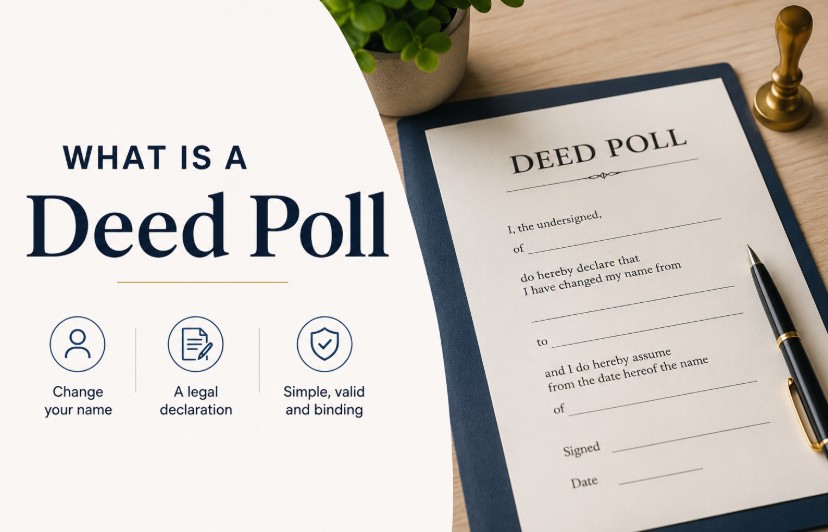
A deed poll is a formal legal instrument, a binding declaration, signed and witnessed to confirm that an individual has abandoned their former name and adopted a new one for all official purposes.
A deed poll acts as your primary proof of identity during the administrative transition of your name. Because the UK has no central name change register, this document acts as the bridge that allows you to replace your old identity with a new one across all legal records.
Whether you are searching for what is a deed poll for marriage, divorce, or personal preference, this document remains the universal standard for legal identity updates in the UK.
The Foundation of Name Change
Under UK common law, you are free to change your name at any time, provided the change is not for fraudulent purposes, debt evasion, or criminal activity.
While the act of changing your name is a personal right, daily life in the UK requires verifiable proof to ensure consistency across government databases.
Without a properly executed deed poll, institutions such as the HM Passport Office, the DVLA, and the General Register Office lack the legal evidence required to update your records. Understanding the legal foundation of what is a deed poll is the first step in ensuring your change is accepted without friction.
What are the Types of Deed Polls?
There are two main types of deed poll in the UK: the unenrolled deed poll (a private document) and the enrolled deed poll (a document deposited at the Royal Courts of Justice, creating a public record).
Understanding the difference is crucial for your privacy and budget:
- Unenrolled Deed Poll: A simple, private legal statement that remains in your possession. It is the most common choice, as it is free or inexpensive to create and is accepted by all major UK institutions.
- Enrolled Deed Poll: Your new name and address are published in The Gazette (the UK’s official public record). This is a formal process involving a fee (£53.05) and is generally used if you require an extremely high level of official documentation.
- Specialised Deed Polls: Depending on your needs, there are specific versions such as Replacement Deed Polls (for lost documents), Retrospective Deed Polls (to document a name change by usage), and Physically Impaired Deed Polls (for those unable to sign themselves).

Limitations of a Deed Poll
A deed poll cannot be used to change birth, marriage, or educational certificates, nor can it be used to evade legal obligations, debts, or criminal proceedings.
While a deed poll is a powerful tool, it does have boundaries:
- Historical Records: You cannot alter your birth certificate or degree certificates; these are historical records and will remain as issued.
- Fraud Protection: You cannot change your name to escape credit history, bankruptcy, or court orders. Credit agencies will link your new name to your existing financial profile.
- Criminal Requirements: If you have a criminal record or active proceedings, you are legally obligated to notify the police of your name change within three days.
Understanding the Enrolment Process
Enrolment is the optional process of depositing your deed poll at the Royal Courts of Justice, which creates a permanent, public record of your name change.
Most UK residents opt for an unenrolled deed poll to maintain privacy. Below is a comparison to help you choose the right path:
| Feature | Enrolled Deed Poll | Unenrolled Deed Poll |
| Privacy | Public Record | Private |
| Location | Royal Courts of Justice | Retained by you |
| Cost | Higher (includes court fees) | Lower/Free (if DIY) |
| Acceptance | Universal | Universal |
When to Use a Deed Poll?
You should use a deed poll whenever you need to prove a change of name to a government agency, bank, or utility provider and do not have another valid document (like a marriage certificate) to act as evidence.
You generally need a deed poll if:
- You want to change your forename, surname, or both for personal reasons.
- You are getting divorced and wish to change your name back before the decree absolute.
- You are in a civil partnership and want to double-barrel your name.
- You do not like your name or wish to adopt a name that better reflects your identity.
- Your marriage certificate is in a foreign language or script, making it difficult to use as evidence in the UK.
How does the UK deed poll process work?
To execute a valid name change, you must draft a document declaring your intent to abandon your old name, sign it in the presence of an independent witness, and use the original as your evidence for legal updates.
Follow these steps to ensure your document is legally compliant:
- Draft a document clearly stating your abandonment of the old name and adoption of the new one.
- Include your full name, address, and date of birth in the declaration.
- Ensure the document is dated clearly to mark the transition point.
- Print the document on high-quality, durable paper for official use.
- Sign the document in both your old and new names in the presence of a witness.
- Ensure the witness provides their name, address, and signature on the document.
- Use your original, signed deed poll to update your passport and driving licence.

A valid witness must be an independent adult (aged 18+) who does not live with you and is not a direct family member, ensuring the impartiality of the verification.
Using a family member as a witness is the most common reason for rejection by government departments. The witness is there to verify your signature and the intention behind the deed; if the witness appears to have a conflict of interest, your documentation may be rejected for lacking sufficient impartiality.
Ensuring Your Deed Poll is Accepted
To ensure acceptance by the Passport Office or your bank, your deed poll must include a clear, formal declaration of intent and be signed in the presence of a qualified witness.
As of 2026, the guidance from the UK government confirms that a correctly executed, witnessed deed poll is the primary evidence required to support a change of name. If your document uses vague phrasing, it may be rejected. Ensure your wording explicitly states that you have abandoned the old name and adopted the new one.
What is an unenrolled deed poll, and why is it common?
An unenrolled deed poll is a private document that remains in your possession, serving as legal proof of a name change without being filed in the public record.
It is the preferred method for the majority of UK residents because it offers full privacy while remaining accepted by all major institutions, including the NHS and HMRC. When you research what is a deed poll, you will find that the unenrolled version is the most practical solution for 99% of name change scenarios.
Updating Your Records
After executing a deed poll, you must update your records systematically, starting with the identity documents that act as foundational proof, specifically your passport and driving licence.
The Order of Updates
Consistency is key. Do not attempt to update utility bills before presenting your official government ID.
- Passport and Driving Licence: These are high-security documents. Changing these first establishes your new identity for all subsequent requests.
- Financial Institutions: Banks require a sight of the original deed poll.
- Utility Providers and Employers: Use your updated passport or bank statement as evidence to change these records.
What is a Deed Poll for Minors?
If a child is under 16, a person with parental responsibility must apply for the deed poll on their behalf, typically requiring consent from everyone with parental rights.
If you are investigating what is a deed poll in the context of family law, remember that the requirements differ significantly from adult applications. The child’s welfare and clear evidence of consent from all legal guardians are paramount to the validity of the document.

Navigating Administrative Hurdles
Once you have your signed deed poll, you must systematically update your “Chain of Identity” by notifying your bank, the DVLA, and your employer in that order.
Travel Considerations
You must update your passport before booking international travel, as airlines strictly mandate that the name on your flight ticket must match the name on your passport exactly.
Retaining an old passport with a former name while using a new name for travel often leads to denied boarding and significant border delays. Always update your passport as the first major step after executing your deed poll.
Summary and Next Steps
Changing your name is a significant legal act requiring the creation of a witnessed deed poll and the subsequent systematic update of your identity across government and financial records.
To successfully change your name in 2026:
- Draft/Obtain a high-quality deed poll.
- Ensure it is witnessed by a non-relative.
- Prioritise updating your Passport and Driving Licence first.
- Keep multiple original copies in a secure, fireproof location.
FAQ
Can I change my name by deed poll in Scotland?
Scotland operates under different legal traditions for name changes. While you can use a deed poll, many residents instead use a statutory declaration to change their name, which is equally recognised by Scottish authorities and organisations.
How many times can you change your name by deed poll in the UK?
There is no legal limit to the number of times you can change your name. However, excessive changes may be flagged by credit agencies or government departments as suspicious or potentially indicative of fraudulent activity.
What do I do if I lose my deed poll certificate?
If you lose your original, you must execute a new deed poll. This is why it is best practice to order or create multiple original copies and store them in a secure, fireproof location.
Do I need a solicitor to draft a deed poll?
No, you do not need a solicitor. You can draft your own, provided it contains the necessary legal wording. However, many people prefer using professional services to ensure the document is error-free.
Can I use a deed poll if I am under 18?
If you are under 16, a person with parental responsibility must apply for the change on your behalf. If you are 16 or 17, you can sign the deed poll yourself without parental consent.
Is a deed poll online legit?
Many online services are legitimate and provide legally compliant templates. Always check reviews, look for professional branding, and ensure the company provides clear instructions on how to sign and witness the document correctly.
Can I still use my passport with my maiden name in the UK?
If you have legally changed your name via deed poll, your passport must be updated to reflect this. Continuing to use a passport in your old name after a formal change can cause discrepancies in official records.
How long does it take for a UK deed poll?
If you draft your own, the process is instantaneous upon signing. If you use an online service, you can typically receive your documents within a few working days via post.