How to Change Name by Deed Poll in the UK? The 2026 Guide
To change name by deed poll in the UK, you must prepare a legal document declaring your formal intention to abandon your old name and adopt a new one. This document requires independent witnessing to become legally binding, serving as the essential evidence needed to update your passport, driving licence, and bank records.
While you can legally assume any name in the UK, provided it isn’t for fraudulent purposes or using offensive language, a deed poll is the standard mechanism to formalise that change.
Although marriage certificates suffice for marital name changes, a deed poll provides the necessary legal bridge for all other personal or professional transitions.
What is a Deed Poll?
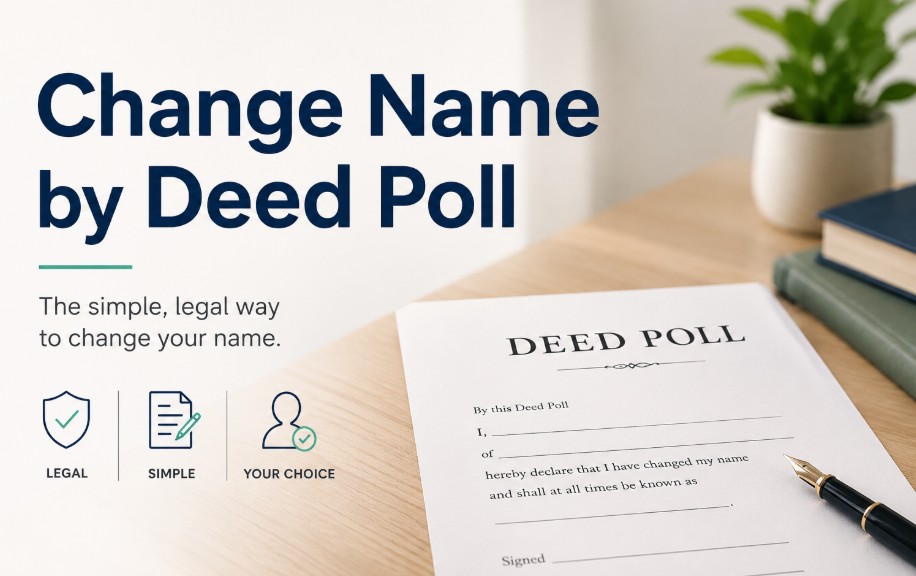
A deed poll is a private legal contract signed by an individual that serves as evidence of a name change. It is not a government-issued certificate; it is a private document that you use to prove to institutions that you have renounced your former name and adopted a new one.
How Does a Deed Poll Work?
A deed poll works by acting as the official bridge between your old and new identity. By signing the document in the presence of an independent witness, you create a legally binding declaration.
You must then present this original, witnessed document to each agency, such as the DVLA, HM Passport Office, and your bank, individually, to update your records.
Understanding your right to change your name
Under English law, you have the right to be known by any name you choose, provided it is not for fraudulent purposes, to avoid debt, or to use offensive language. A formal deed poll is simply the standard documentary evidence required by state bodies and private organisations to officially recognise your new identity.
The law requires that you adopt your new name for all official dealings consistently. Once you have a valid deed poll, you are essentially replacing your previous identity in the eyes of the law.
- Verification of intent to change names permanently.
- Requirement for signatures from independent witnesses.
- Standardisation for record-keeping at the HM Passport Office.

What documents do I need to change my surname?
To update your records, you typically need your original signed deed poll, your current proof of identity (passport or birth certificate), and sometimes secondary proof like utility bills or marriage certificates. Always check with the specific organisation first to see if they require an original deed poll or a certified copy.
- Primary Identity: Current passport or birth certificate.
- The Key Document: The original signed deed poll.
- Supporting Evidence: Marriage certificate (if changing due to marriage/divorce) or naturalisation certificates for foreign nationals.
- Proof of Address: Recent utility bill or bank statement (essential for updating your driving licence).
Who Can Witness Your Deed Poll?
A witness must be an independent adult (18+) who is not a relative, partner, or someone you live with. To be valid, the witness must be physically present while you sign the document and must then sign it themselves, providing their full name and current UK address.
Best practices for choosing a witness:
- Independence: They must have no personal interest in the transaction.
- Physical Presence: They must watch you sign in real-time.
- Reliability: Choose someone who is easily contactable should a government agency have questions about the validity of your signature.

How Long Does It Take to Legally Change Your Name?
The act of executing a deed poll is nearly instantaneous, as the document becomes legally binding the moment it is signed and witnessed.
However, the overall process of updating your identity across all institutions can take anywhere from a few days to several months, depending on how quickly you notify each agency.
What Are the Costs of Changing Your Name?
The cost depends on your chosen method: a DIY approach is minimal (costing only printing and postage), online services typically charge £20–£50 for templates and support, and solicitor services generally cost between £100 and £250.
| Method | Estimated Time | Approximate Cost |
| DIY Approach | 1–2 Days | Minimal (Printing/Post) |
| Online Service | 24–48 Hours | £20 – £50 |
| Solicitor Service | 3–5 Days | £100 – £250 |
What Happens if Your Deed Poll is Rejected?
If a deed poll is rejected, it is typically due to improper witnessing, incorrect legal wording, or poor document quality. To resolve this, contact the organisation to identify the specific error, fix the document (or order a new, professionally certified copy), and resubmit it with your proof of identity.
Common reasons for rejection:
- Signing before a witness is present.
- Using a family member as a witness.
- Printing on low-quality paper or using a format that doesn’t look official.
- Mismatched details between your deed poll and your ID documents.
Choosing between an enrolled and an unenrolled deed poll
Most people choose an unenrolled deed poll because it is private, fast, and free to create. An enrolled deed poll is a formal process where your name change is recorded at the Royal Courts of Justice and published in The Gazette; it is more expensive, slower, and makes your name change part of the public record.
| Feature | Unenrolled Deed Poll | Enrolled Deed Poll |
| Privacy | Private (No public record) | Public (Published in The Gazette) |
| Cost | Minimal (DIY) | £53.05 (Court fee) |
| Speed | Immediate | Several weeks |
| Best For | Most people | Those requiring a public audit trail |
Step-by-step guide to change name by deed poll online
To change your name, select your new name, draft a deed poll document, sign it in front of two independent witnesses, and then order several certified copies. Once signed, send these copies alongside a cover letter to organisations like the DVLA and Passport Office to update your records.
- Select your new name, ensuring it complies with naming laws and lacks offensive connotations.
- Purchase or prepare a formal deed poll template that meets legal standards.
- Fill in both your former name and your chosen new name accurately.
- Print the document on high-quality paper suitable for legal signatures.
- Sign the deed poll in the presence of an independent witness.
- Ensure your witness provides their full name, address, and signature.
- Order multiple certified copies, as various organisations will require originals.
Who to notify after your name change?
Updating your records is a critical final step in the process. Failure to notify specific bodies can lead to administrative delays in professional or financial matters. Prioritise your updates based on the institution’s criticality.
- High Priority: HM Passport Office, DVLA, and local tax authorities (HMRC).
- Medium Priority: Financial institutions, credit card providers, and mortgage lenders.
- Low Priority: Utility providers, subscription services, and professional memberships.

Getting started with your name change
Changing your name is a straightforward process, but it does require careful attention to detail. Execute your deed poll, secure independent witness signatures, and methodically work through your notification checklist.
Keep all original documentation in a secure location, as you will need to present these physical copies to various authorities throughout the year. Change name by deed poll means securing a legally recognised identity shift for UK residents in 2026.
Verified against official guidance from the UK Government (gov.uk).
FAQ about change name by deed poll
Is it easy to change my name?
Yes, the process is straightforward for most UK residents. Provided the deed poll is correctly prepared, witnessed, and signed, it acts as a legally binding document that organisations must recognise for updating their records.
Does changing my name affect my credit score?
No, a name change does not directly impact your credit score. However, you must inform your bank and lenders promptly so they can update their files and ensure your credit history remains linked to your profile.
Can I change my name even though I am not divorced?
Yes, you can change your name at any time, regardless of your marital status. You do not need to be divorced or provide any reason for the change, provided it is not for fraudulent purposes.
How many times can a name be changed?
There is no legal limit to how many times you can change your name in the UK. However, multiple frequent changes may trigger security checks by government bodies to ensure no fraudulent activity is occurring.
Do I need a solicitor to create a deed poll?
No, you do not need a solicitor. You can create a valid deed poll yourself or use reputable online services. The primary requirement is that the document is signed and witnessed correctly to make it legally binding.
What if I lose my deed poll?
If you lose your original deed poll, you will need to execute a new one. This is why it is highly recommended to order multiple certified copies at the time of your initial application to avoid future hassle.
Does a deed poll change my birth certificate?
No, a deed poll does not change your original birth certificate. The certificate remains a record of your birth, while the deed poll serves as the legal evidence that you have chosen to use a different name.