Ultimate UK Guide: How Long Does a Mortgage in Principle Last Across Major Lenders?
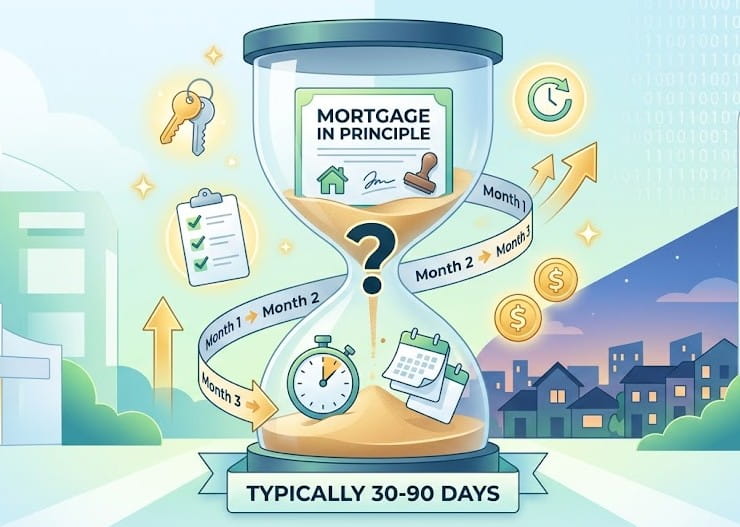
A mortgage in principle typically lasts for 30 to 90 days in the UK, depending on your chosen bank or building society. Most major high-street lenders default to a 90-day (three-month) expiration timeframe, giving buyers a fixed validity window to make property offers before the non-binding borrowing estimate automatically expires.
What is a Mortgage in principle?
A mortgage in principle is an initial, conditional statement issued by a bank or building society that outlines how much mortgage you can get in theory. It represents the foundational phase of your home-buying journey, long before property valuations or underwriting occur.
It represents the foundational phase of your home-buying journey, long before property valuations or underwriting occur. It provides you with a realistic budget and proves to sellers that you have the financial backing to make a serious offer.
How long does a Mortgage in principle last UK?
A UK Mortgage in principle is valid for a fixed window of 30 to 90 days from its issue date. Most high-street banks default to a 90-day (three-month) expiry period.
UK lenders frequently tweak their affordability calculators behind the scenes to account for inflation, risk appetite, and shifting base rate forecasts. Because your personal finances or the broader property market can move quickly, high-street brands simply cannot guarantee borrowing limits past this standard timeframe.

Typical Expiry Windows Across Major High-Street Lenders
To prevent user bounce and establish immediate information density, the following table outlines how major UK brands handle validity periods:
| UK Mortgage Lender | MIP / AIP Validity Period | Credit Check Type |
| Halifax | 90 Days | Soft Search |
| NatWest | 90 Days | Soft Search |
| Nationwide | 90 Days | Soft Search |
| HSBC UK | 60 Days | Soft Search |
| Santander | 60 Days | Soft Search |
What are the 5 stages of a Mortgage?
The path to securing home finance follows a strict operational sequence within the UK property market:
Stage 1: The Decision in Principle (AIP/MIP): Your preliminary assessment to determine what Mortgage you can afford.
Stage 2: The Property Search & Offer: Finding a home and having an estate agent accept your purchase price.
Stage 3: The Full Underwriting Application: Submitting verified proof of income, tax records, and bank statements for rigorous underwriting checks.
Stage 4: The Formal Mortgage Offer: The official, legally binding document issued after a satisfactory physical valuation.
Stage 5: Exchange & Legal Completion: Funds are transferred via solicitors, contracts are signed, and keys are released.
How long does a Mortgage in principle last, Scotland vs England?
A Mortgage in principle is valid for 30 to 90 days in both Scotland and England, but it must be obtained much earlier in the Scottish home-buying process due to differing property laws. The physical validity timeframe does not change across borders, but how estate agents treat the document varies greatly based on legal protocols:
| Property Market Feature | England & Wales | Scotland |
| Legal Point of No Return | Exchanging contracts (takes weeks/months) | Conclusion of missives (happens very early) |
| MIP Requirement Timing | Needed before putting forward a formal offer | Often required by estate agents just to book a viewing |
| Transaction Speed Risk | High risk of gazumping due to long delays | Fast-paced binding system; requires financing ready upfront |
How reliable is a Mortgage in principle?
A Mortgage in principle is not a legally binding contract and is only as reliable as the unverified information provided during the initial application phase.
While it carries weight with property professionals, a lender is under no obligation to advance the funds if your economic situation alters or if hidden issues appear during deep financial screening. It acts as an estimate rather than a guaranteed loan approval.
Can I extend my Mortgage in principle?
You cannot extend the physical expiration date printed on an active Mortgage in principle certificate. Once the 30-to-90-day window closes, the document automatically becomes invalid.
However, you can easily renew or refresh the agreement. If your personal circumstances, credit history, and employment terms have stayed exactly the same, your Mortgage broker or lender can usually issue a new certificate within minutes.

Step-by-Step Process to Renew an Expired Certificate
If your house hunt takes longer than 90 days, follow this straightforward sequence to refresh your documentation safely:
- Audit Your Accounts: Review your bank accounts to ensure your regular outgoings have remained stable over the last 90 days.
- Gather Updated Income Proofs: Download your latest consecutive payslips or request recent certified business accounts if you are self-employed.
- Check for Economic Policy Changes: Verify whether the bank has adjusted its affordability calculations due to shifts in the Bank of England base rate.
- Re-submit via Soft Search: Have your broker process a new digital request, ensuring it is done via a soft search to protect your credit file.
Does a Mortgage in principle hurt your credit score?
A Mortgage in principle does not harm your credit score, provided the lender performs a soft credit search.
A soft search acts as a background identity check. It allows the bank to look at your payment track record without leaving a visible footprint for other lenders to see. You can hold multiple soft-search preliminary agreements at the same time without dragging down your credit score.
A temporary dip in your rating only occurs when you convert your preliminary document into a full, formal Mortgage application. This action triggers a hard search, leaving a permanent record on your credit file.
Crucial Habits to Protect Your Credit Score Before Applying
- Ensure you are registered on the electoral roll at your current address.
- Keep your overall credit utilisation well below 30% of your available limits.
- Avoid opening any new personal finance lines or overdraft facilities within six months of buying a home.
What Things Can Stop You From Getting a Mortgage After an MIP?
An active Mortgage in principle can be cancelled or rejected during full underwriting due to undisclosed debts, employment changes, lower-than-expected property surveys, or sudden drops in self-employed income.
A lender’s underwriting team can still decline an application during the full assessment for several lesser-known reasons:
- Undisclosed Debts and Financial Commitments: Taking out new car finance, opening store cards, or running up large balances on credit cards after your certificate is issued will instantly break your affordability calculations.
- Employment Transitions: Changing jobs, switching sectors, or entering a workplace probation period right after receiving an MIP will cause many strict lenders to halt applications.
- Fluctuating Self-Employed Income: For company directors, startup founders, or independent freelancers, a sudden drop in your latest SA302 tax calculations or reduced dividend distributions can quickly void your initial borrowing calculations.
- Property Anomalies: If a structural surveyor discovers severe damp, concrete construction issues, or the presence of Japanese knotweed, the property itself may be deemed unmortgageable.
How long does a Mortgage offer last once approved?
A formal Mortgage offer typically lasts for 3 to 6 months. It is critical not to confuse this stage with your initial preliminary certificate.
An MIP is a non-binding budget estimate calculated before you find a property. Conversely, a formal Mortgage offer is a fully underwritten, legally binding pledge issued after a property survey has been conducted and your specific payslips or business accounts have been thoroughly verified.
How do high-street lenders handle delays in property chains across the market?
- Standard Purchases: Lenders often grant a discretionary 30-day extension if delays occur due to local authority searches or complex legal title issues.
- New-Build Properties: Some specialised lenders extend formal offers up to 9 months because construction schedules can suffer from weather or supply disruption.
What is the 6-month rule for Nationwide Mortgage offers?
For certain purchases, Nationwide requires the entire transaction to be completed within six months of the formal offer date. If your property chain stalls past this deadline, they may request updated bank statements or withdraw the specific fixed-rate deal you locked in.
Does your Age Affect Getting a Mortgage in the UK?
Your age plays a direct role in determining the maximum length of your Mortgage term, which heavily influences your monthly affordability.
While the Equality Act protects against arbitrary discrimination, lenders use strict mathematical calculations regarding life expectancy and retirement transitions to evaluate risk.

At what age will a bank not give you a 30-year Mortgage?
Most UK lenders require the Mortgage term to end before you reach your planned retirement age or a hard ceiling of 70 to 75. Therefore, if you wish to secure a standard 30-year Mortgage term, you generally need to apply before the age of 40 to 45.
Applying past this point means your loan term will be compressed into a shorter timeframe (e.g., 15 or 20 years), which significantly increases your monthly repayments.
Can a 70-year-old woman get a 30-year Mortgage?
In standard scenarios, a 70-year-old individual cannot secure a conventional 30-year mortgage, as the loan term would extend until they are 100 years old, breaking standard underwriting risk limits. However, alternative solutions exist for mature applicants:
Which lenders lend to age 80 or above?
- Mainstream High-Street Brands (Halifax, NatWest, Nationwide): Age 75 to 80 maximum at term end. Requires strict transition checks if the term runs past your planned retirement age.
- Specialist Building Societies (Hodge, Family Building Society): Age 85 to 90 maximum at term end. Requires full, verified proof that pension income or investments can cover the remaining debt.
Do Mortgage lenders look at retirement accounts and pension statements?
Yes. If your mortgage term extends past your state retirement age or your employer’s retirement threshold, underwriters will review your pension statements.
They examine your annual dividend allocations, projected annuity payouts, and current pension pots to ensure your retirement income can comfortably cover the monthly debt payments.
Next steps for UK property buyers
Managing your financing timeline carefully is essential for a smooth home-buying journey. To protect your credit file and position yourself as a strong buyer, avoid applying for a preliminary certificate months before you start your property search.
Instead, secure your agreement right as you begin active viewings. This ensures your documentation remains valid when you find the right property and make an offer to the estate agent. Ultimately, managing how long a Mortgage in Principle lasts means a smoother home-buying journey for UK property hunters in 2026.
Verified against official Financial Conduct Authority (FCA) guidelines and high-street lender criteria.
FAQ about How long does a Mortgage in Principle Last?
Can you be declined after receiving a Mortgage in Principle?
Yes. An agreement in principle is merely an initial estimate based on unverified information. A lender can easily turn down your full application if underwriters uncover discrepancies in your payslips, undisclosed debts on your credit file, or structural issues during the physical property valuation.
How long does a Mortgage take to go through from start to finish?
The journey from your initial preliminary application to final completion typically takes 8 to 12 weeks. This depends on the speed of the conveyancing solicitors, the length of the property chain, and how quickly the underwriting team processes the paperwork.
How many times can you apply for an MIP?
There is no legal limit to how many times you can apply for an agreement in principle. Since most modern lenders only use a soft search at this stage, you can secure a new certificate without impacting your credit score.
How quickly can you get a new decision in principle?
If you apply online and have your income figures, outgoings, and three years of address history ready, you can often secure a digital decision in principle within 10 to 15 minutes.
What should you ask a Mortgage advisor before your certificate expires?
You should ask your advisor if the lender uses soft searches for renewals, whether recent base rate shifts have altered the bank’s maximum lending limits, and which documentation you need to update if your house hunt takes longer than 90 days.
Can you get a longer-term Mortgage than 30 years in the UK?
Yes. Quite a few mainstream lenders now offer extended terms of 35 or even 40 years to help younger first-time buyers get onto the ladder. While stretching the loan lowers your monthly outgoings, it will significantly increase the total amount of interest you repay over the lifetime of the debt.
Can a retired person get a home loan?
Yes. Retired individuals can access home finance by proving that their regular pension payouts, investment portfolios, or rental income streams can comfortably cover the Monthly Mortgage Payments.