Best Fixed Rate Savings: Lock In Top UK Returns Today
Rates checked on 3 October 2026. The date of each source figure appears beside it.
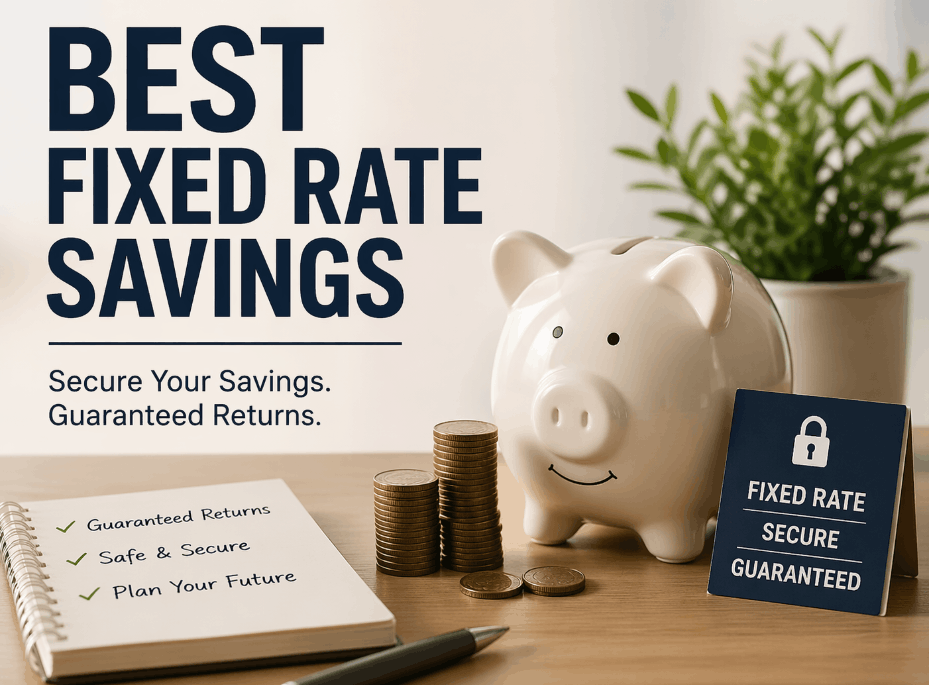
The best fixed rate savings are cash accounts that lock your money away for a strictly defined set term in exchange for a guaranteed return. As of 2 October 2026, the top UK deals pay up to 5.35% AER over five years and 5.12% AER over one year.
Key Takeaways
- In early October 2026, top fixed rates ranged from 5.12% AER (one year) to 5.35% AER (five years).
- The Financial Services Compensation Scheme (FSCS) protects up to £120,000 per person or company, per authorised firm.
- A limited company cannot use a personal fixed rate bond; it needs a business account.
Best Fixed Rate Savings Rates by Term: What Pays Most Today
The best fixed rate savings pay between 5.12% and 5.35% AER, and the longer terms currently pay a little more; the best 2 year fixed rate savings pay 5.15%. Those figures sit well above Bank Rate, which the Bank of England held at 3.75% on 17 September 2026.
| Term | Top rate (AER) | Provider | Date of rate |
|---|---|---|---|
| 1 year | 5.12% | Close Brothers Savings | 2 October 2026 |
| 2 years | 5.15% | DF Capital | 30 September 2026 |
| 3 years | 5.18% | thisbank | 2 October 2026 |
| 5 years | 5.35% | DF Capital | 2 October 2026 |
Source: Moneyfacts. Rates can change or be withdrawn at any time.
A 1 year fixed rate saver at 5.12% AER shows the arithmetic: £10,000 earns £512 over the year before tax. Choosing the right rate requires understanding the exact restrictions placed on the funds.
How a Fixed Rate Savings Account Works
A fixed rate savings account lets savers lock in a guaranteed rate for a set term, and the money stays locked until the maturity date. The same product is sold as fixed rate savings bonds, a fixed term deposit or a locked savings account, and the names are interchangeable.
- Most accounts take a single lump sum, often from £1,000, and some pay monthly interest while others pay annually or at maturity.
- Savers cannot withdraw until maturity, and the rate is fixed for the whole term even if Bank Rate moves.
In the rare cases where early access exists, an early access penalty, usually a loss of interest, applies, though the vast majority of UK fixed bonds do not permit early withdrawals under any circumstances. Whether that trade-off suits a particular pot of money is the next question.
Fixed Rate, Notice or Easy Access: Which Suits Your Money?
A fixed rate suits money that will not be needed before the term ends, while easy access and notice accounts suit money that might be.
Fix when the money:
- Is surplus to the emergency fund and will not be needed before maturity;
- Should earn a known return, because a fixed rate cannot be cut mid-term; and
- Is a lump sum, since most fixed accounts accept one deposit at opening.
Keep it flexible when the money:
- Covers emergencies or irregular bills, which easy access savings handle without penalty;
- May be needed at short notice, where a notice account allows withdrawals after a set notice period, at a lower rate than the best fixed bonds; or
- Arrives in regular amounts, which most fixed bonds cannot accept after the funding window.
However, rates at familiar high-street names are often significantly lower than the market leaders.
Why Big-Name Fixed Rates Trail the Best Deals
The largest high-street banks pay roughly 1 percentage point less on fixed rate savings bonds than the best deals on the market.
| Provider | 1-year rate (AER) | 2-year rate (AER) | Date checked |
|---|---|---|---|
| Best on the market (Moneyfacts) | 5.12% | 5.15% | 30 September to 2 October 2026 |
| Shawbrook | 4.87% | 4.96% | 3 October 2026 |
| Leeds Building Society | 4.50% | 4.55% | 3 October 2026 |
| NatWest | 4.11% | 4.15% | 3 October 2026 |
| Lloyds Bank | 4.00% | 4.10% | 3 October 2026 |
NatWest rates apply to balances under £100,000. Other provider rates are for standard fixed bonds.
Challenger banks that rely on online deposits tend to pay the leading rates, while branch-based banks and building societies carry higher overheads. A savings marketplace lists accounts side by side and shows the gap quickly.
On £10,000, Lloyds Bank’s 4.00% sits 1.12 percentage points below the one-year market best, about £112 a year before tax.
All four state that they are authorised by the Prudential Regulation Authority (PRA) and regulated by the Financial Conduct Authority (FCA), so the gap reflects pricing, not regulatory status. Seeing the gap is the easy part; six checks decide which deal is worth taking.
How to Choose the Best Fixed Rate Savings Account: 6 Checks
The best fixed rate savings account is the one whose rate, term and rules fit the money, and six checks establish that fit.
- Compare AER, not the headline rate. AER shows a year’s interest with annual compounding, so it puts different accounts on equal terms. The gross rate is the rate before tax.
- Match the term to when you need the cash. Choose the end date first, then find the best rate at that term, whether a 1 year fixed rate saver or a five-year bond.
- Check how interest is paid. Fixed-rate savings with monthly interest suit anyone wanting regular income, but interest paid out cannot compound, so total interest ends up lower.
- Check the minimum deposit. Minimums commonly run from £1,000 to £10,000, and some accounts cap deposits.
- Check the funding window. Many bonds accept money only for a short period after opening, sometimes 10 or 28 days.
- Check early access and maturity rules. Confirm whether any withdrawal is allowed, what the penalty is and what happens when the term ends.
MoneyHelper offers free, impartial guidance for anyone unsure which features matter most. The term has the biggest effect on the outcome, so it deserves a closer look.
1, 2, 3 or 5 Years: Picking the Right Term
No single term wins every time: the right one depends on when the money is needed and where rates are heading.
At present, the curve rises with length, from 5.12% at one year to 5.35% at five, and the best 2 year fixed rate savings sit at 5.15%.
For those seeking a shorter commitment, several providers also offer three-month or six-month fixed bonds, providing a middle ground between easy access and a full one-year lock.
Moneyfacts notes that 2026 has returned to a market where longer bonds out-pay one-year ones. Individual providers still differ: Shawbrook’s three-year bond pays 3.90%, below its one-year bond at 4.87%.
Bank Rate adds uncertainty. The Bank of England held it at 3.75% on 17 September 2026, with three of nine Monetary Policy Committee members voting for a rise. The next decision is due on 5 November 2026.
A ladder, which splits money across one-, two- and three-year bonds, matures part of the money every year and avoids fixing everything at one point in the rate cycle. The UK interest rate forecast covers the outlook in more detail.
What Happens When a Fixed Rate Bond Matures
When a fixed rate bond matures, the guaranteed rate ends, and money left without instructions can fall to a fraction of what it earned.
Lloyds Bank, for example, moves maturing Online Fixed Bonds to a Standard Saver paying 0.75% to 1.00% AER.
- Without instructions, the provider chooses: some reinvest the money in a new fixed bond, while others move it to a low-paying variable account.
- A term cannot be changed once agreed, so the choices are to wait for maturity or, where allowed, withdraw early at a penalty.
- Diarising the maturity date and sending instructions before the deadline avoids both outcomes.
Money tied up for years raises a fair question about how safely it is held.
Is Fixed Rate Savings Protected? FSCS Limits Explained
The FSCS provides deposit protection for eligible deposits up to £120,000 per person or company, per authorised firm. Joint accounts are protected up to £240,000 for two holders. The limit applies to the firm, not the account, so brands that share one banking licence share one limit; HSBC and First Direct are an example.
As a simple illustration, £170,000 can be split as £120,000 with one firm and £50,000 with another to stay fully covered.
Older figures are still in circulation. Some pages, including earlier versions of this article, quote £85,000. The Bank of England confirms the limit rose from £85,000 to £120,000 on 1 December 2025 for firms that fail from that date.
Protected or not, the interest still counts as income, and tax is the next thing to price in.
Tax on Fixed Rate Savings Interest
Interest on fixed rate bonds is paid gross, and tax is due only when total savings interest exceeds the Personal Savings Allowance. HM Revenue & Customs (HMRC) sets the 2026/27 allowance by tax band:
- Basic-rate taxpayers: £1,000 a year;
- Higher-rate taxpayers: £500 a year; and
- Additional-rate taxpayers: £0.
Savers should check GOV.UK for the most up-to-date tax bands, as tax rates and allowances are subject to change in future tax years.
Cash ISA interest is tax-free for individuals, as the best 2-year fixed rate ISA guide explains. Interest above the allowance may need reporting; see the HMRC savings interest notification.
Companies and sole traders follow different rules, which the next section sets out.
Business Fixed Rate Savings: Who Can Open What
Eligibility depends on legal form: a limited company needs a business account, while a sole trader can often use a personal one.
| Legal form | Personal fixed rate bond | Business fixed-term account | Interest taxed as |
|---|---|---|---|
| Sole trader | Often available, as the sole trader is not a separate legal entity | Offered by some providers | The individual’s own income |
| General partnership | Depends on the provider’s terms | Offered by some providers | Each partner’s share of income |
| Limited company | Not available, as a company is a separate legal entity | Offered by several providers | Corporation Tax, as part of company profits |
Sole traders and partnerships
Some providers, including Shawbrook, accept sole traders and general partnerships on business bonds, and personal bonds are often open to sole traders too.
Limited companies
A limited company is registered at Companies House as a separate legal entity. Business fixed-term accounts come from banks such as Aldermore, Cambridge & Counties Bank, Hampshire Trust Bank and Virgin Money.
A limited company cannot open a personal fixed rate bond. As a separate legal entity, it needs a business fixed rate savings account, where interest counts as company profit for Corporation Tax. The FSCS protects up to £120,000 per company, per authorised firm.
Recent comparison pages listed one-year business bond rates from about 3.1% to 4.7% AER, below the personal market best, and several were open to existing business customers only.
Best Fixed Rate Savings for Business Owners: Matching a Term to Cash Flow
A business fixed rate savings account should hold only cash that will not be needed before the term ends, sized against dated outflows. Business cash carries dated calls such as VAT, payroll and Corporation Tax, so a locked savings account is a liquidity risk.
- Map your dated outflows. List VAT, payroll, supplier payments, Corporation Tax and seasonal dips for the next one to five years.
- Ring-fence working capital first. Keep enough in easy access or notice accounts to cover the largest foreseeable gap.
- Fix only the surplus cash. Choose terms that mature just before known outflows.
- Ladder the terms. Split the surplus across one-, two- and three-year business bonds so part of it matures regularly.
- Check the funding window and the FSCS limit per firm. Some business accounts need a linked current account or a funding period. Each company is protected up to £120,000 per authorised firm, so larger sums should be spread across banking licences.
Common mistakes
- Locking cash that is needed for a tax bill or payroll run.
- Assuming a personal bond is open to a company, when a separate legal entity needs a business account.
- Holding more than £120,000 with one banking group.

Conclusion
The best fixed rate savings currently pay 5.12% to 5.35% AER, but the right deal depends on term, access and protection, not rate alone. Check AER, the funding window and the maturity rules, and keep each deposit within the £120,000 FSCS limit. Business owners should fix only surplus cash and confirm eligibility first.
FAQs
Where should £100,000 go in savings?
£100,000 is fully protected at a single authorised firm, because it sits below the £120,000 FSCS limit. Money needed within a year suits easy access or notice accounts, while money not needed for one to five years suits a fixed rate bond.
Can a limited company open the best fixed rate savings accounts?
Only the business versions. A limited company cannot use a personal fixed rate bond, but several banks offer business fixed-term deposits, usually at lower rates than the personal market best.
Can savers withdraw early from a fixed rate bond?
Usually not. Most bonds allow no withdrawals before maturity, and those that do typically charge a loss of interest. A 14-day cooling-off period may apply after opening.
What happens when a fixed rate bond matures?
The fixed rate ends, and the provider’s default applies unless instructions are given. Some providers reinvest automatically, while others move the money to a low-paying variable account.
Is NS&I 6.2% still available?
National Savings & Investments (NS&I) launched a one-year 6.2% bond on 30 August 2023 and withdrew it on 6 October 2023.
Rates, terms and eligibility vary by provider and individual circumstances, and figures reflect published rates as of 2 and 3 October 2026. Confirm current terms with the provider or an official source before making a decision.