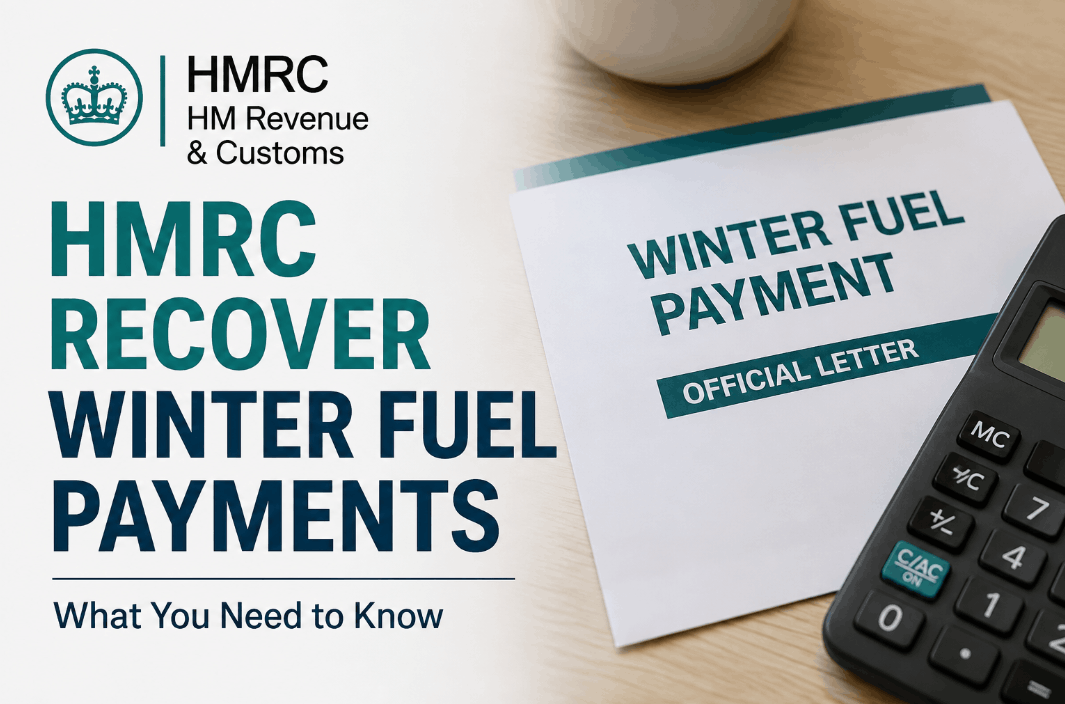
HMRC Recover Winter Fuel Payments: Tax Code, Income Rules
HM Revenue and Customs (HMRC) can recover Winter Fuel Payments from UK pensioners whose total gross taxable personal income exceeds the statutory £35,000 threshold in the qualifying tax year.
Recovery takes place automatically through Pay As You Earn (PAYE) pensioner tax code adjustments or via a balancing charge on Self Assessment tax returns.
- HMRC claws back the Winter Fuel Payment if your individual gross taxable income exceeds £35,000 in the qualifying tax year.
- Spouses and civil partners are assessed individually on personal earnings rather than combined household income.
- Repayments are collected automatically through monthly PAYE pension tax code deductions of roughly £17 per month or via annual Self Assessment balancing charges.
How Will HMRC Recover Winter Fuel Payments?
HM Revenue and Customs collects repaid winter fuel payments automatically through two statutory recovery routes: Pay As You Earn (PAYE) tax coding notices and annual Self Assessment tax returns.
The Department for Work and Pensions (DWP) issues payments automatically during the qualifying week in September. HMRC subsequently cross-matches year-end income records against taxable pension and employment registries.
Taxpayers with occupational pensions have their tax codes adjusted, whereas self-employed individuals and direct filers settle the recovery via their annual tax calculation.
Which recovery route applies depends entirely on whether retirement income is taxed at source or declared through an annual tax return.
The £35,000 Income Threshold: How the Clawback Is Triggered?
The £35,000 cliff-edge income threshold applies to your aggregated taxable personal income under Step 1, Section 23 of the Income Tax Act 2007.
The table below outlines how different pension streams, savings returns, and earnings are treated under the £35,000 threshold:
| Income Stream Category | Included in £35,000 Threshold? | Statutory Treatment Under Tax Law |
| Basic and New State Pension | Yes | Full gross annual entitlement is counted as taxable income. |
| Private Pension Annuity Income | Yes | Taxable distributions from occupational and defined contribution pots. |
| Employment or Self-Employed Earnings | Yes | Gross salary, freelance profits, and taxable director dividends. |
| Taxable Savings Interest & Dividends | Yes | Non-ISA interest and dividends exceeding annual tax-free allowances. |
| Rental Property Profits | Yes | Net taxable property profits after allowable revenue expenses. |
| Pension Credit (Guarantee or Savings) | No | Statutory means-tested welfare benefits remain completely tax-exempt. |
| Attendance Allowance & PIP | No | Disability welfare payments are excluded from gross income calculations. |
| ISA Capital Growth & Withdrawals | No | Tax-free wrappers remain entirely outside Section 23 income aggregation. |
Figures confirmed as of 2026 via official statutory guidance on the Winter Fuel Payment and HM Revenue and Customs tax manuals.
Because this acts as a strict cliff-edge threshold, exceeding the £35,000 limit by even £1 triggers full repayment of the allowance.
Is the £35,000 Winter Fuel Allowance Per Person or Household?
The £35,000 clawback limit applies exclusively to individual income, meaning HMRC never combines the earnings of spouses or civil partners.
The individual income test for married couples assesses each pensioner entirely in isolation. When a household receives a shared payment, HMRC reclaims only the portion allocated to the partner whose personal gross earnings exceed £35,000.
The lower-earning partner retains their full entitlement without any clawback or tax code restriction.
According to the Civil Service Pensioners’ Alliance (CSPA), joint income is never aggregated for fuel payment recovery.
For instance, if one spouse receives £40,000 in private pensions while the other receives £18,000, HMRC recovers only the higher earner’s £150 share. The remaining £150 remains untouched in the lower earner’s account.
Widely circulated claim: Pensioners must repay the full household payment if combined spousal income exceeds £35,000.
Correct position: Income assessment is strictly individual; one partner breaching £35,000 does not trigger recovery of the other partner’s benefit share.
Source: HM Revenue and Customs (HMRC) Technical Guidance and Civil Service Pensioners’ Alliance (CSPA).
This individual separation ensures that one partner’s higher pension does not penalise a lower-income spouse.

HMRC Is Recovering Winter Fuel Payments Through Updated Pensioner Tax Codes
HMRC reclaims the payment by reducing your personal tax-free allowance, spreading the deduction across 12 equal monthly instalments.
For pensioners taxed under PAYE, HMRC collects the clawback across four key stages:
- Annual Taxable Earnings Reconciliation: HMRC cross-references DWP distribution registries against real-time PAYE pensioner earnings records at the close of the financial year.
- PAYE Coding Notice Issuance: The authority issues a P2 coding notice detailing a specific pensioner tax code restriction to reduce your available personal tax-free allowance.
- Monthly Pension Deduction: Pension scheme administrators apply the adjusted tax code from April, taking a monthly pension deduction of roughly £17 on a standard £200 clawback.
- Transition Year Alignment: The HMRC winter fuel payment tax code adjustment 2026/27 ensures prior-year liabilities are settled smoothly alongside standard monthly pension distributions.
Checking your annual P2 coding notice when it arrives helps avoid unexpected shortfalls in your monthly pension payments.
Declaring the Repayment on Self Assessment Tax Returns
Pensioners who file an annual tax return must report the allowance directly on their Self Assessment Form SA100.
HMRC online filing platforms automatically calculate your clawback liability when total gross taxable income exceeds £35,000. The Chartered Institute of Taxation (CIOT) notes that paper returns require manually completing the designated Winter Fuel Payment charge box.
Self-employed retirees must observe the paper tax return deadline of 31 October or complete online submissions before the online self assessment deadline of 31 January.
Historical policy debates surrounding the UK Winter Fuel Payment legal challenge highlighted the administrative burden placed on self-filing pensioners.
Filing your Self Assessment return accurately prevents automated compliance penalties and statutory late-payment interest charges.
Rules for Scotland and Devolved Equivalents
Scottish pensioners receiving the devolved Pension Age Winter Heating Payment from Social Security Scotland face the exact same HMRC recovery criteria.
The devolved payment is distributed directly by Scottish authorities, but taxation and clawback powers remain reserved to the UK central government. HMRC enforces the pension age winter heating payment clawback in Scotland through Scottish PAYE tax codes and Self Assessment charges.
The £35,000 threshold applies uniformly across all UK nations regardless of Scottish income tax bands.
Cross-border parity ensures that Scottish retirees are subject to the same clawback mechanics as pensioners in England and Wales.
How to Opt Out of Winter Fuel Payments?
You can opt out of winter fuel payments before the qualifying deadline by notifying the Department for Work and Pensions directly.
To decline the payment and avoid subsequent tax adjustments, complete the following steps:
- Calculate Projected Earnings: Review your anticipated annual income using the official DWP clawback estimation calculator to confirm whether your earnings will breach £35,000.
- Access the Government Portal: Complete the formal opt-out form on GOV.UK or contact the Winter Fuel Payment Centre directly by telephone.
- Submit Prior to Deadlines: Lodge your formal refusal before the mid-September qualifying deadline for the upcoming winter distribution cycle.
- Confirm Record Updates: Check subsequent correspondence from the DWP confirming your removal from the automated payment register.
Opting out in advance removes the administrative hassle of repaying funds through future tax code alterations.

Pension Scams and Official HMRC Security Advice
HMRC never contacts pensioners via SMS text messages, WhatsApp, or unsolicited phone calls demanding immediate bank card repayments for fuel allowance clawbacks.
Keep the following security checks in mind before responding to any unexpected correspondence:
- Official Recovery Channels: Legitimate fuel payment recoveries occur solely via your PAYE tax code or through balancing entries on your Self Assessment statement.
- Suspicious Digital Links: Never click links in unexpected text messages requesting banking details or payment verification for energy support schemes.
- Reporting Protocol: Forward suspicious text messages claiming to be from HMRC to 60599 and report scam emails directly to report@phishing.gov.uk.
Recognising that HMRC collects clawbacks exclusively through formal tax channels protects you against fraudulent schemes.
Conclusion
Understanding how HMRC recovers Winter Fuel Payments allows retirees to plan their finances and manage taxable income effectively. If your personal income exceeds £35,000, preparing for PAYE tax code adjustments or opting out early avoids unexpected balancing charges.
The statutory clawback framework means predictable tax deductions for higher-earning UK pensioners throughout 2026.
FAQ
Is the £35,000 winter fuel allowance per person or per household?
No, the £35,000 limit is not based on household income. HMRC assesses each individual partner on their personal gross taxable income. If only one spouse earns over £35,000, only that individual’s share of the payment is clawed back.
Does State Pension count towards the £35,000 threshold?
Yes, your gross State Pension entitlement counts as taxable income under Section 23 of the Income Tax Act 2007. It is combined with private pensions, employment salary, and rental income to determine if you exceed the £35,000 limit.
How much is deducted from monthly pension payments?
HMRC reduces your tax-free allowance through your PAYE tax code, spreading repayment across 12 monthly deductions. For a basic rate taxpayer repaying a £200 sum, the reduction is approximately £16.66 to £17 per monthly pension payment.
Which pensioners are exempt from the Winter Fuel Payment clawback?
Pensioners whose total gross taxable personal income remains below £35,000 are entirely exempt from recovery. Additionally, recipients of means-tested Pension Credit retain their full entitlement without any tax code deductions or repayment requirements.
Disclaimer: This article provides general tax and welfare information for educational purposes only and does not constitute formal legal or financial advice; always verify your personal tax position directly with HMRC or a qualified financial adviser.