UK Tax Bands 2025/26: Complete Guide to Rates, Thresholds, Allowances and How to Avoid Tax
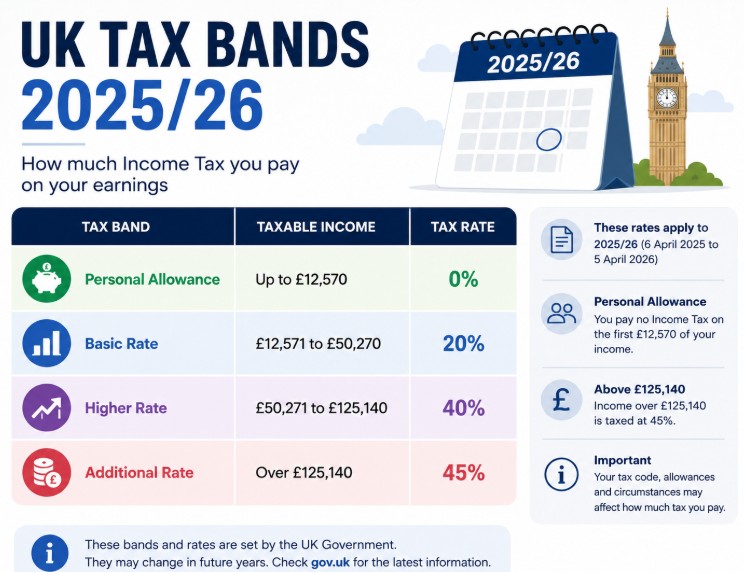
According to official HM Revenue and Customs (HMRC) figures for the tax year spanning 6 April 2025 to 5 April 2026, tax bands 2025/26 in England, Wales, and Northern Ireland apply across three main taxable thresholds set out by the government: Basic Rate (20% on income between £12,571 and £50,270), Higher Rate (40% on income between £50,271 and £125,140), and Additional Rate (45% on income exceeding £125,140).
As outlined in official GOV.UK guidance, the standard tax-free Personal Allowance remains frozen at £12,570.
Key Takeaways
- Standard tax-free Personal Allowance remains set at £12,570 for the entire 2025/26 tax year before basic rate tax applies to earnings.
- Income between £12,571 and £50,270 is taxed at the basic 20% rate, while earnings from £50,271 to £125,140 face the 40% higher rate tax.
- Earnings above £100,000 trigger a tapering rule that reduces Personal Allowance by £1 for every £2 earned, creating an effective 60% tax zone.
- Scotland operates a distinct six-tier income tax system with rates ranging from 19% to 48% depending on overall annual income thresholds.
What Is the Tax-Free Personal Allowance for 2025/26?
The standard tax-free Personal Allowance for the 2025/26 financial year is £12,570. This represents the amount of earnings an individual can receive each tax year before paying any UK Income Tax to HM Revenue and Customs.
Statutory Baseline and Income Thresholds
In practical application, the frozen baseline of £12,570 means that nominal wage growth pushes employees into higher tax bands over time, a process known as fiscal drag. Every pound earned up to £12,570 falls within this tax-free bracket, provided total taxable income stays below six figures.
For high earners, the allowance is reduced. Once adjusted net income passes £100,000, the Personal Allowance shrinks by £1 for every £2 of income above that limit.
When total earnings reach £125,140, the tax-free Personal Allowance is completely removed, leaving all income subject to direct taxation.
What Are the Income Tax Bands 2025/26 in England, Wales, and Northern Ireland?
The official rates for the 2025/26 tax year maintain three primary tax bands across England, Wales, and Northern Ireland: Basic Rate at 20%, Higher Rate at 40%, and Additional Rate at 45%.
Breakdown of UK Tax Rates and Thresholds
| Tax Band | Taxable Income Threshold | Income Tax Rate |
| Personal Allowance | Up to £12,570 | 0% |
| Basic Rate | £12,571 to £50,270 | 20% |
| Higher Rate | £50,271 to £125,140 | 40% |
| Additional Rate | Over £125,140 | 45% |
Individuals pay the 40% higher rate on earnings exceeding £50,270. This threshold is calculated by combining the £12,570 Personal Allowance with the £37,700 basic rate allocation.
Income falling between £50,271 and £125,140 is taxed at 40%, whereas all earnings past £125,140 incur the top 45% additional tax rate.

How Do Scottish Income Tax Bands Differ for 2025/26?
Scotland exercises devolved powers over non-savings and non-dividend income tax rates. Rather than following the three-tier framework used across the rest of the UK, Scottish taxpayers are subject to a six-band progressive framework.
Scottish Rates and Threshold Comparison
| Scottish Tax Band | Taxable Income Threshold (Scotland) | Scottish Tax Rate | Rest of UK Equivalent Rate |
| Personal Allowance | Up to £12,570 | 0% | 0% |
| Starter Rate | £12,571 to £14,876 | 19% | 20% |
| Basic Rate | £14,877 to £26,561 | 20% | 20% |
| Intermediate Rate | £26,562 to £43,662 | 21% | 20% |
| Higher Rate | £43,663 to £75,000 | 42% | 20% / 40% |
| Advanced Rate | £75,001 to £125,140 | 45% | 40% |
| Top Rate | Over £125,140 | 48% | 45% |
The Scottish framework applies lower tax rates on lower earnings, but introduces higher rates earlier. For instance, the Scottish higher rate of 42% begins at £43,663, whereas workers elsewhere in the UK do not enter the 40% rate until reaching £50,270.
What Is the 60% Tax Trap in the UK?
The 60% tax trap is an effective marginal tax rate created by the withdrawal of the Personal Allowance for earnings between £100,000 and £125,140.
When an individual’s adjusted net income exceeds £100,000, HMRC reduces their Personal Allowance by £1 for every £2 earned above that mark.
Consequently, for every £100 earned in this band, £40 is lost to Higher Rate Income Tax, and £20 of tax-free allowance is removed, which is then also taxed at 40%.
This results in an effective 60% tax rate on income within that window, excluding Class 1 National Insurance contributions.
How Can You Avoid It?
- Calculate total adjusted net income by summing salary, bonuses, taxable benefits, and rental income, then subtracting allowable personal pension contributions.
- Review gross pension contributions to determine if salary sacrifice or direct pension payments can bring adjusted net income back down to £100,000.
- Execute Gift Aid donations to registered charities, which extends basic tax bands and lowers overall taxable income figures.
- Utilise tax-efficient employee benefits like cycle-to-work schemes or EV car leases to adjust gross pay structures.
- Deduct professional subscriptions and work-related expenses approved under HMRC statutory codes.
- Submit a formal Self Assessment tax return to reconcile adjusted allowances and claim higher-rate tax relief due on relief-at-source payments.
How Do Tax Bands 2025/26 Apply to the Self-Employed?
Sole traders and business partners register for Self Assessment and pay Income Tax on trading profits rather than total turnover. The exact same tax bands apply to self-employed net profits as PAYE employees, alongside Class 4 National Insurance contributions (NICs).
Self-Employed Taxation Mechanics
When calculating net taxable profit, sole traders subtract allowable business expenses from total revenue. The remaining profit then utilizes the £12,570 Personal Allowance. Earnings above this mark follow the standard basic, higher, and additional tax rates.
Class 2 NICs have been abolished for most self-employed workers with profits above the Small Profits Threshold (£6,725), though voluntary payments remain available to maintain State Pension records.
Class 4 NICs apply at 6% on self-employed profits between £12,570 and £50,270, dropping to 2% on profits exceeding £50,270.

How to Calculate Your Taxable Income?
When evaluating take-home pay, Income Tax is applied progressively rather than as a single flat percentage on total earnings.
Worked Calculation: Comparing Salary Points
| Gross Annual Income | Tax-Free Allowance | 20% Basic Rate Tax | 40% Higher Rate Tax | Total Income Tax Payable |
| £30,000 | £12,570 | £3,486 (on £17,430) | £0 | £3,486 |
| £50,000 | £12,570 | £7,486 (on £37,430) | £0 | £7,486 |
| £60,000 | £12,570 | £7,540 (on £37,700) | £3,892 (on £9,730) | £11,432 |
| £100,000 | £12,570 | £7,540 (on £37,700) | £19,892 (on £49,730) | £27,432 |
An employee evaluating a 60k After Tax UK income package finds that earning £50,000 pays no higher-rate tax because their total taxable sum remains below the basic rate allocation limit.
Moving from lower figures up to levels comparable with an 80k After Tax UK salary introduces 40% higher rate tax on amounts exceeding the £50,270 threshold, while also triggering potential high-earner benefit charges.
What Other Key Allowances Apply in 2025/26?
Beyond standard wage income, taxpayers can access supplementary statutory allowances covering savings interest, investments, and dividend revenues.
Savings, Dividends, and Statutory Reliefs
- Personal Savings Allowance: Basic-rate taxpayers can receive up to £1,000 in savings interest tax-free each year. Higher-rate taxpayers receive a £500 allowance, while additional-rate taxpayers receive £0.
- Dividend Allowance: Set at £500 for the 2025/26 tax year. Dividend income above £500 is taxed according to overall tax band status at 8.75% (basic), 33.75% (higher), or 39.35% (additional).
- Capital Gains Tax Allowance: Set at £3,000 for individual tax filings, covering profits realised from disposing of non-exempt assets.
HMRC routinely receives automated reports from UK banks and financial institutions detailing annual interest yields, prompting recent advisories highlighted in the HMRC Savings Tax Warning.
If savings interest exceeds the relevant allowance, tax adjustments are routinely made automatically by updating the taxpayer’s PAYE code or requiring payment through Self Assessment.
Official guidance on statutory rates can be verified directly via GOV.UK Tax Rates and Thresholds.
What Are the Expected Tax Rates and Rules for 2026/27?
Legislative policy maintains the freeze on main Income Tax thresholds through at least 2028, meaning the £12,570 Personal Allowance and £50,270 Higher Rate threshold remain static into the 2026/27 financial year.
This freeze means that as wages increase with inflation, additional earners will continue moving into higher tax brackets.
Planning around pension allocations and tax-efficient accounts remains an important strategy for managing tax exposure over multi-year horizons.
Conclusion
Managing tax exposure during a period of frozen thresholds by understanding your tax bands 2025/26 involves staying organized and making full use of statutory allowances.
- Audit annual income: Track all streams including employment salary, bonuses, interest, and dividends to identify potential threshold crossings.
- Review pension contributions: Check if boosting workplace or personal pension payments can keep your adjusted net income below £50,270 or £100,000.
- Utilise tax-free accounts: Maximize annual ISA limits (£20,000) to generate tax-free interest and investment returns.
- Track self-employed expenses: Sole traders should accurately log all allowable business expenses to ensure net profit figures are calculated correctly before Self Assessment deadlines.
FAQ
What are the official tax bands 2025/26 in the UK?
The tax bands 2025/26 are Personal Allowance (0% up to £12,570), Basic Rate (20% from £12,571 to £50,270), Higher Rate (40% from £50,271 to £125,140), and Additional Rate (45% over £125,140).
What is the income tax slab for the year 2025-26?
The UK uses income tax bands rather than slabs: 0% on earnings up to £12,570, 20% on £12,571 to £50,270, 40% on £50,271 to £125,140, and 45% on earnings over £125,140.
How much can I earn before I pay 40% tax in the UK?
You can earn up to £50,270 in total gross income across the 2025/26 tax year before paying the 40% higher tax rate on earnings above that threshold.
Is it better to stay in a lower tax bracket?
No, because moving into a higher tax bracket only applies the increased percentage to the specific portion of earnings that exceeds the threshold rather than your entire income. However, keeping track of your thresholds can help protect valuable benefits like Child Benefit or your full Personal Allowance.
How much can I earn tax-free in 2025/26?
Most UK residents can earn up to £12,570 tax-free through the Personal Allowance. You may also qualify for extra tax-free allowances on savings interest (£500–£1,000) and dividends (£500).
How does pension contribution reduce my tax band?
Gross pension contributions lower your adjusted net income figure. This reduces the amount of income falling into higher tax bands and can help restore lost Personal Allowance above £100,000.
Does Scotland have different income tax bands 2025/26?
Yes, Scotland sets its own income tax bands for non-savings income, using six bands: Starter (19%), Basic (20%), Intermediate (21%), Higher (42%), Advanced (45%), and Top (48%).
Disclaimer: This guide is for informational purposes only and does not constitute formal financial or legal advice; consult GOV.UK or a qualified accountant for your specific tax situation.