The Ultimate Guide to Removing Name from Joint Mortgage UK: Transfer of Equity & Fees Explained
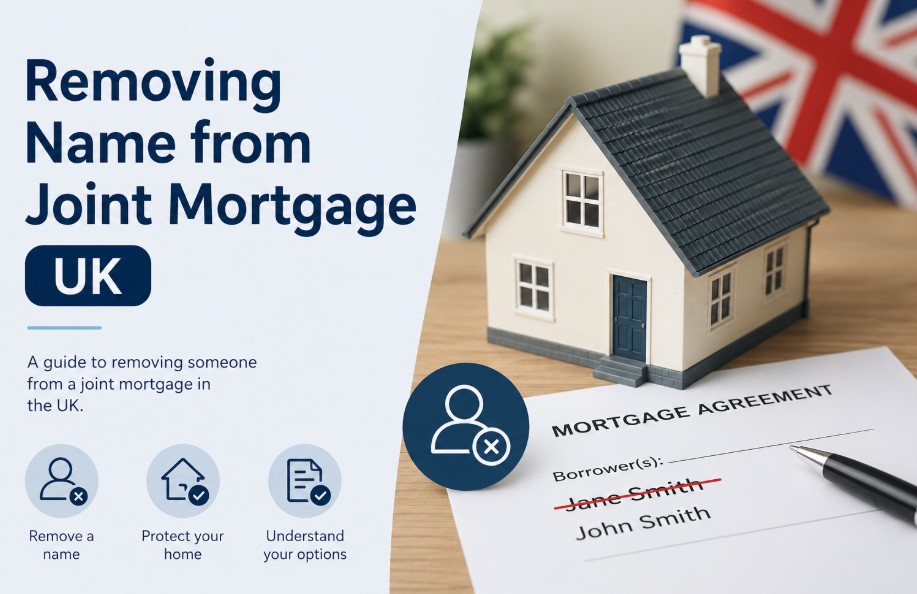
Removing name from Joint Mortgage UK is a formal process that releases one party from their financial obligations to a lender while transferring sole ownership of the property to the remaining individual.
This process requires explicit approval from the mortgage provider and the execution of a legal transfer of equity by a licensed conveyancer or solicitor.
Key Takeaways
- Removing a name requires a formal ‘Change of Parties’ application and passing a sole affordability assessment.
- Joint mortgages carry joint and several liability, meaning both parties are 100% responsible for the debt until legally separated.
- Divorcing couples are usually exempt from Stamp Duty Land Tax (SDLT) on equity transfers, but separating unmarried couples may face a tax bill if the consideration exceeds £125,000.
- If an ex-partner refuses to sign the transfer deeds, a court-ordered sale under TOLATA 1996 may be required.
How to Remove a Name From a Joint Mortgage in the UK?
To remove a name from a joint mortgage in the UK, you must submit a Change of Parties application to your lender to prove the remaining borrower can afford the loan alone, followed by instructing a solicitor to complete a Transfer of Equity to update the property deeds.
This formal legal and financial process releases one individual from their binding debt obligations while transferring sole ownership of the land or building to the remaining person. It cannot be done through an informal agreement or simply by moving out of the property.
The Step-by-Step Removal Process
- Contact the Current Lender: Request a formal ‘Change of Parties’ application from your existing mortgage provider to kick off their internal financial assessment process.
- Submit Financial Evidence: Provide the remaining applicant’s proof of sole income. This includes three months of consecutive payslips, three months of personal bank statements, and a recent P60 document.
- Pass the Affordability Assessment: The lender runs a comprehensive credit check and stress-tests the remaining sole income against current interest rates to ensure long-term payment security.
- Receive Offer of Conditions: The lender issues an official mortgage offer confirming their written consent to the name removal and detailing any updated interest rates or borrowing terms.
- Instruct a Conveyancing Solicitor: Retain a qualified legal professional to draft the Transfer of Equity contracts and manage the structural ownership shift.
- Sign the Transfer Deed: Both parties must sign the Land Registry AP1 and TR1 forms in the presence of an independent, unrelated witness to legally confirm mutual consent.
- Register with HM Land Registry: The conveyancer submits the completed deeds to HM Land Registry to formally update the public property ownership records.

The Structural Reality of Joint Property Debt
Joint mortgages in the UK are governed by ‘joint and several liability’. This means lenders hold each named individual 100% responsible for the entire outstanding mortgage balance, rather than splitting it 50/50.
Many co-owners confuse property ownership with mortgage liability, but the two concepts are separate legal mechanisms under UK law.
- Title Deeds: Establish your official ownership stake in the land or physical building.
- Mortgage Deeds: Create a binding, joint financial liability for the entire outstanding loan balance.
Common Misconception Under UK Mortgage Frameworks
| Myth | Reality |
| Moving out of the property cancels your payment obligations. | You remain fully liable for the monthly payments until the lender formally releases you. |
| Making a private agreement with your ex splits the debt 50/50. | Lenders ignore private contracts; both parties are held 100% responsible for the whole loan. |
| Credit files untangle automatically when a relationship ends. | Your financial files stay linked until a formal notice of disassociation is filed with credit agencies. |
Is it hard to get out of a joint mortgage?
Getting out of a joint mortgage is straightforward if the remaining borrower passes strict income affordability assessments and both parties cooperate. It becomes highly difficult if the sole income fails the lender checks or if an ex-partner refuses to sign the transfer deeds.
The overall difficulty depends entirely on two key factors: financial eligibility and mutual cooperation. If the individual staying in the property has a stable income, low debt-to-income ratios, and sufficient earnings to pass affordability stress tests, the transition moves smoothly.
However, lenders will reject a sole application if they feel the remaining borrower’s income is stretched too thin. Additionally, if the separation is acrimonious, the entire process can stall, making court intervention necessary.
How a Joint Mortgage Affects Credit Scores?
A joint mortgage affects credit scores by creating an explicit financial association link between both co-owners’ credit reports.
This means any missed payments or defaults by one person will directly and instantly damage the credit score of both individuals.
When you take out a mortgage with someone else, credit reference agencies link your financial profiles together. This connection can have severe long-term consequences for the person who moves out.
Key Credit Impacts to Monitor
- Shared Risk: Any missed payments or defaults caused by one party will directly damage the credit scores of both individuals.
- Borrowing Capacity: The joint debt remains visible on both credit files, reducing the individual borrowing capacity of the person who has moved out when they apply for new credit lines.
- Financial Disassociation: Credit files do not automatically separate when a relationship ends; a formal credit disassociation must be requested after the name removal is complete.

Can a joint mortgage be transferred to one person?
Yes, a joint mortgage can be transferred to one person via a Change of Parties application with the current lender or through a full sole remortgage to a completely new financial provider.
The entire process hinges on verifying income security. The remaining borrower must undergo the exact same rigorous credit checks, background underwriting, and affordability reviews as a brand-new homebuyer to guarantee they can safely shoulder the existing debt alone.
How do you buy someone out of a joint mortgage?
To buy someone out of a joint mortgage, you must calculate their share of the net property equity (Valuation minus Mortgage Balance), pay them that cash value, and legally transfer the remaining mortgage debt into your sole name.
This process requires establishing an accurate, objective baseline value for the asset before modifying any legal agreements.
Equity Buyout Calculation
To establish a transparent equity value, you should obtain an independent valuation of the property from a Royal Institution of Chartered Surveyors (RICS) qualified surveyor, then deduct the remaining mortgage balance.
Step 1: Property Valuation – Remaining Mortgage Balance = Total Equity
Step 2: Total Equity ÷ 2 = Buyout Value (assuming a 50/50 split)
If the remaining partner does not have the personal cash reserves to pay the departing partner their share of the equity, they must raise the funds through the mortgage itself. For example, an individual might increase a £150,000 mortgage to £180,000 to buy out a partner’s £30,000 equity share.
However, you must also consider your new Loan-to-Value (LTV) ratio. Borrowing more against the property increases your LTV.
If borrowing the extra £30,000 pushes your LTV above the lender’s maximum threshold or into a higher interest rate bracket, the application could be rejected even if your income is technically sufficient.
However, lenders will run strict stress tests on your sole earnings, making it vital to calculate exactly what mortgage you can afford before initiating the formal transfer.
Your Options at a Glance
| Option | Process Model | Typical Timeline | Ideal Scenario |
| Internal Transfer of Parties | Retaining the current lender and interest rate while removing one name. | 4 to 8 weeks | Amicable separation where the remaining party easily passes the affordability tests. |
| Full Remortgage to New Lender | Switching the debt to a new bank to release equity or secure better solo terms. | 6 to 12 weeks | Current lender rejects sole application, or a better fixed-rate deal is available elsewhere. |
| Guarantor / JBSP Arrangement | Adding a family member to support affordability without giving them property ownership deeds. | 5 to 9 weeks | The remaining borrower has a solid income but falls short of the lender’s strict borrowing multipliers. |
Every lender applies its own internal underwriting rules when assessing a Change of Parties, meaning the difficulty of removing a name depends heavily on who your mortgage is with.
Removing someone from a mortgage at NatWest, Santander, and Halifax
Bank policies vary significantly: NatWest treats name removals as a brand-new sole application; Santander heavily scrutinises two years of self-employed SA302 income; and Halifax allows you to combine name removal with a penalty-free product switch.
Major UK high-street banks follow distinct internal compliance frameworks when assessing a change of parties’ application:
- NatWest: Requires a full underwritten affordability review, treating the remaining borrower as a brand-new applicant. They assess outgoings, childcare costs, and outstanding credit commitments against their current net income.
- Santander: Known for taking a particularly close look at future financial stability. They thoroughly scrutinise self-employed income, often requiring a minimum of two years of certified accounts or SA302 forms to validate that the remaining borrower can sustain the debt solo.
- Halifax: Provides options to switch mortgage products simultaneously during a name removal. If the existing fixed-rate term is ending, they allow the remaining applicant to transition into a new sole product without triggering early repayment charges, provided the structural transfer of equity aligns with the product change date.
My ex won’t take my name off the mortgage
If an ex-partner refuses to take your name off the mortgage, you cannot force the lender to remove you unilaterally. You must maintain payments to protect your credit score and seek direct legal intervention through the UK family courts to force a resolution.
When a relationship ends, a major dispute can arise if an ex-partner refuses to cooperate or lacks the financial capability to remove your name. Legally, a mortgage company cannot force an individual to take over a loan, nor can it remove a name without the express consent of both parties and the lender.
If one partner stops paying the mortgage out of spite or financial distress, both individuals remain legally exposed. The lender can pursue either party for the full monthly payment, regardless of who occupies the property.
Continued non-payment will result in arrears, mortgage defaults, and eventual repossession actions, severely damaging the credit profiles of both co-owners.
Legal Alternatives for Removing Name From Joint Mortgage UK
The top legal alternatives to resolve a joint mortgage deadlock are formal family mediation, applying for a court-ordered Order for Sale under TOLATA, or securing a Mesher Order to defer the sale until children finish school.
When communication breaks down completely, the UK legal system provides structured pathways to resolve property deadlocks.
- Mediation Services: Engaging an independent family mediator to reach an amicable agreement regarding a property buyout or sale.
- Court-Ordered Sale: Applying to the county court for an Order for Sale under the Trusts of Land and Appointment of Trustees Act 1996 (TOLATA) to force a property sale.
- Mesher Orders: Utilising family law courts during divorce proceedings to defer the property sale until specific milestones are met, such as children finishing full-time education.
Cost of Removing Name from Joint Mortgage UK
Changing a joint mortgage contract involves several legal and administrative fees.
| Expense Category | Estimated Cost Range | Responsible Party / Recipient |
| Lender Administration Fee | £100 – £300 | Paid directly to the existing bank or building society for underwriting processing. |
| Conveyancing Solicitor Fees | £600 – £1,200 (+ VAT) | Paid to the legal professional managing the Transfer of Equity and contract redrafting. |
| HM Land Registry Registration | £40 – £150 | Scale-dependent fee paid to the state to update the official digital Title Register. |
| Stamp Duty Land Tax (SDLT) | Variable (0% to standard rates) | Paid to HMRC depending on relationship status and total consideration value. |
Stamp Duty Land Tax Realities in Transfers of Equity
Divorcing or dissolving couples are exempt from Stamp Duty Land Tax (SDLT) during a name removal. However, unmarried couples may face an SDLT bill if the chargeable consideration (the cash buyout plus the transferred debt share) exceeds £125,000.
The tax implications of removing a name vary significantly based on your legal relationship status.
- Married/Civil Partnerships: Under UK tax law, if a couple is legally divorcing or dissolving a civil partnership, the Transfer of Equity is typically exempt from Stamp Duty Land Tax (SDLT), regardless of the property’s value or the size of the outstanding mortgage debt.
- Unmarried Couples: Conversely, for unmarried couples who separate, HMRC calculates SDLT based on the chargeable consideration. Chargeable consideration for unmarried couples means the total value of the mortgage debt taken over, plus any cash buyout sum paid. If this combined consideration figure exceeds the standard threshold of £125,000, an SDLT tax bill will be triggered for the remaining owner.

What is a declaration of trust for?
A Declaration of Trust is a legally binding document that defines how property equity is split upon separation. This document overrides standard joint tenancy rules, which assume an equal 50/50 split regardless of individual financial contributions.
A custom trust deed ensures that if one party contributes a larger portion of the initial deposit or pays a higher percentage of the monthly mortgage repayments, their financial stake remains legally protected.
In practice, having this document drawn up at the point of purchase drastically simplifies the process of removing a name later, as it provides a pre-agreed mathematical roadmap for the property buyout.
How a Declaration of Trust Protects You
A Declaration of Trust protects you by securing unequal deposit contributions, outlining custom mortgage payment percentage splits, and establishing pre-agreed property valuation and buyout rules to avoid expensive court legal fees.
By laying out these parameters early, couples can completely bypass the emotional and financial friction that typically occurs during an unexpected breakup.
- Unequal Deposit Protection: Formally registers that one partner contributed a higher initial cash amount, ensuring that the specific sum is returned to them first upon sale.
- Mortgage Contribution Clout: Outlines percentage splits based on who is paying the monthly mortgage instalments, shielding individuals from unfair equity claims.
- Pre-Agreed Buyout Mechanics: Establishes clear valuation procedures and timelines for one partner to buy out the other, avoiding costly court disputes.
What to Do Next?
Removing name from joint mortgage UK requires systematic execution to safeguard your credit rating and capital assets.
- Check the Terms: Review your original mortgage offer to determine if early repayment charges apply to your current fixed-rate term.
- Gather Documentation: Secure three months of sole income statements, bank statements, and utility bills to prepare for the lender’s affordability check.
- Consult a Specialist: Contact your current lender to explore an internal Transfer of Parties, or speak with an independent broker to compare external remortgage options.
- Instruct Representation: Hire a licensed conveyancer or solicitor specialising in Transfers of Equity to oversee the legal property deed adjustments.
FAQs
Can my name be taken off a mortgage without my permission?
No. Your name cannot be removed from a joint mortgage or property deeds without your explicit, witnessed signature on the transfer documentation. The only exception is if a UK court issues an overriding order during divorce or property proceedings.
What happens to my mortgage if I break up with my partner?
The joint mortgage remains fully active, and both parties remain 100% liable for monthly payments. Separation does not alter the lender contract. You must proactively choose to either sell the property or arrange an official transfer of equity to buy one partner out.
How much does it cost to take someone off a mortgage in the UK?
Costs typically range between £800 and £2,000, provided there are no early repayment charges. This covers lender admin fees (£100–£300), conveyancing solicitor fees (£600–£1,200+VAT), and Land Registry fees. Unmarried couples may also face Stamp Duty if the transfer value exceeds £125,000.
Do I have to pay the mortgage if I move out?
Yes. Moving out does not end your legal obligation to pay. Under ‘joint and several liability’, if the partner remaining in the property stops paying, you must cover the shortfall to prevent defaults and protect your credit score.
How to remove a name from a joint property?
This requires lender consent and updating the property deeds. Once the lender approves a ‘Change of Parties’ application, your solicitor will submit a TR1 form and an AP1 application to HM Land Registry to formally transfer the legal title.
Can I remove myself from a joint account without the other party?
Generally, no. Standard UK banking mandates require both account holders to sign and consent to a name removal. If there’s a dispute, you can request the bank to freeze the account so no money can be withdrawn, but you cannot unilaterally remove your name from an open account.
Can a mortgage be transferred to another person?
Yes. You can transfer a mortgage to a new person via a ‘Transfer of Parties’ or a full remortgage. The incoming individual must pass the same rigorous credit checks and affordability stress tests as a new homebuyer to prove they can afford the debt.