
80k After Tax UK: The 2026 Guide To Take-Home Pay, Tax Slabs, Savings, And NI Strategy
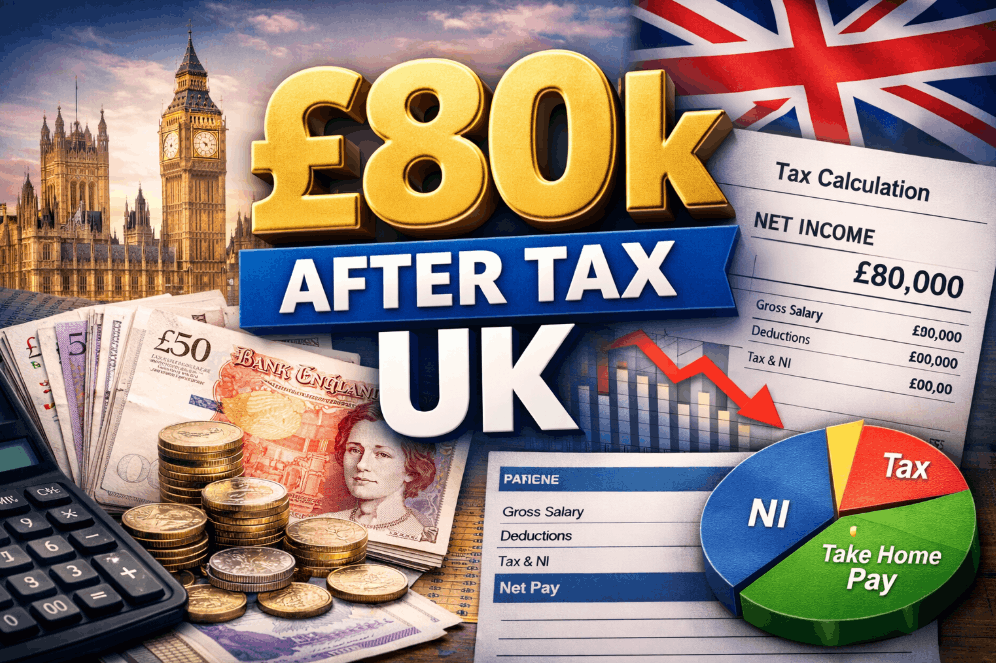
Earning a gross salary of £80,000 places you in a high-income bracket, yet the actual amount reaching your bank account is shaped by specific deductions and regional tax laws. For the 2025/26 tax year, an individual on 80k after tax UK typically receives a monthly net pay of approximately £4,746 in England, Wales, or Northern Ireland.
This figure accounts for standard Income Tax and Class 1 National Insurance contributions for those on a standard 1257L tax code, though student loans and pension contributions will reduce this further.
How much is £80,000 after tax in the UK?
An annual salary of £80,000 results in a total take-home pay of approximately £56,957 per year for most residents.
This calculation is based on the 2025/26 tax thresholds, where your first £12,570 is tax-free, the next £37,700 is taxed at 20%, and the remaining £29,730 is subject to the 40% Higher Rate.
Monthly, this leaves you with a disposable income of £4,746.45 before any voluntary deductions. At this level of income, your cash reserves can grow quickly.
It is worth noting that HMRC warns that savings over £3501 may incur tax if the interest you earn exceeds your annual Personal Savings Allowance, a common issue for higher-rate taxpayers.

Why this salary is a psychological milestone
Many professionals search for 80k after tax UK because it represents the point where you are firmly a “Higher Rate” taxpayer.
At this level, you begin to feel the impact of Fiscal Drag, where frozen tax thresholds mean that pay rises result in more of your income being taxed at 40%.
It is also the specific point where the High Income Child Benefit Charge fully claws back any benefit received, making it a critical threshold for family budgeting.
| Pay Period | Gross Salary | Income Tax (40% Band) | National Insurance | Net Take-Home |
| Annual | £80,000 | £19,432 | £3,611 | £56,957 |
| Monthly | £6,666.67 | £1,619.33 | £300.92 | £4,746.42 |
| Weekly | £1,538.46 | £373.69 | £69.44 | £1,095.33 |
Understanding the UK tax slabs and your rate
The UK uses a progressive tax system, meaning you only pay higher rates on the portion of your income that falls into specific slabs.
As an £80,000 earner, you navigate two main bands (Basic and Higher) across most of the UK, while Scotland utilizes a more complex six-tier system.
How to find out your exact tax rate
To find your specific rate, you must check your Tax Code, usually found on your payslip or via the HMRC Personal Tax Account.
A standard code is 1257L. If your code starts with “BR,” you are being taxed at 20% on everything (often an error for a main job); if it starts with “K,” you have untaxed income from previous years that HMRC is recovering.
In practice, I often see senior managers on “Emergency Tax” codes after a job change, which can temporarily slash an £80k take-home by hundreds of pounds.
If a job move or bonus has left you on an incorrect code, the priority is getting your money back. You may find yourself questioning do HMRC automatically refund overpaid tax or whether you need to be proactive and trigger a P800 calculation yourself.
UK Income Tax Slabs 2025/26 (England, Wales & NI)
- Personal Allowance: £0 – £12,570 (0%)
- Basic Rate: £12,571 – £50,270 (20%)
- Higher Rate: £50,271 – £125,140 (40%)
- Additional Rate: Over £125,140 (45%)
Is £80,000 a good salary for the 2026 cost of living?
Statistically, £80,000 is an exceptional salary, placing you in the top 10% of UK earners. However, the “feel” of this money varies.
In 2026, a £4,746 monthly take-home provides a high standard of living in cities like Newcastle or Belfast, where mortgage costs are lower. In London, however, a three-bedroom family home can easily consume 50% of this net pay.
Do I get any returns from paying this much tax?
While seeing £1,920 in tax leave your payslip every month is difficult, it funds the UK’s social infrastructure. For an £80k earner, these “returns” include:
- State Pension Credits: Your National Insurance ensures you build years toward a full state pension.
- NHS Access: Comprehensive healthcare with no at-point-of-use costs.
- Infrastructure: Funding for the national rail and road networks you likely use for commuting.
High-income tax contributions also support the legal frameworks that protect long-term family wealth. This includes the regulations governing Inheritance tax when second parent dies and the specific exemptions available when passing an estate to the next generation.
How can you reduce your 80k tax bill?
Higher-rate taxpayers have several legal avenues to lower their “Adjusted Net Income.” This is particularly important because at £80,000, you are in the “Phase Out” zone for Child Benefit.
- Pension Salary Sacrifice: Contributing more to your pension is the most effective tool. Since you save 40% tax on these contributions, a £100 pension boost only costs your take-home pay £60.
- Cycle to Work Schemes: Paying for a bike from your pre-tax salary saves you both Income Tax and NI.
- Gift Aid: Donations to charity extend your basic rate band, meaning more of your £80k is taxed at 20% rather than 40%.
- The Marriage Allowance Trap: Note that at £80,000, you cannot claim the Marriage Allowance. This is strictly for basic-rate taxpayers. If you or your partner earn over £50,270, this tax break is no longer available.
Managing payments and avoiding HMRC fines
If you are a PAYE employee, your tax is deducted automatically. However, if you have side income, dividends, or need to repay the High Income Child Benefit Charge, you must engage with HMRC directly.
Can I pay my tax via cash?
In 2026, you cannot pay your income tax in physical cash at a bank or Post Office. HMRC has moved almost entirely to digital payments. Approved methods include:
- Online or telephone banking (Faster Payments).
- Direct Debit (set up via your Self-Assessment account).
- The HMRC App (using “Open Banking” for a secure, instant transfer).
7 Steps to Avoid HMRC Penalties
- Register for Self-Assessment by 5 October if you have untaxed income.
- File your online return by midnight on 31 January.
- Pay your tax bill by the same 31 January deadline to avoid 5% late payment interest.
- Check your Tax Code annually in April to ensure your Personal Allowance is correct.
- Notify HMRC of address changes to ensure you receive “Notice to File” letters.
- Report Child Benefit if you earn over £60,000 to avoid “Failure to Notify” fines.
- Keep records of expenses and Gift Aid for at least five years.

SME Perspective: Salary vs Dividends on £80,000
For business owners, taking an £80k salary is often tax-inefficient. Most SME directors structure their income by taking a small salary (up to the NI Primary Threshold) and the remainder as dividends.
| Income Method | Primary Tax Type | Tax Rate for 80k Earner | National Insurance? |
| PAYE Salary | Income Tax | 40% (on portion >£50k) | Yes (8% Employee / 15% Employer) |
| Dividends | Dividend Tax | 33.75% (Higher Rate) | No |
| Pension | Deferred | 0% (Immediate relief) | No |
Note: From April 2025, Employer National Insurance rose to 15%, making dividend-heavy strategies even more attractive for SME owners looking to control costs.
Do’s and Don’ts for 80k Earners
| DO | DON’T |
| Use a salary sacrifice pension to stay below the £60k Child Benefit threshold if possible. | Don’t assume a pay rise to £82k is always “better” if it triggers more complex tax charges. |
| Check for “Emergency Tax” codes (like 1257 W1 or M1) after changing jobs. | Don’t try to pay HMRC with cash; use the HMRC App for secure digital transfers. |
| Claim back the “extra” 20% pension tax relief via Self-Assessment if you use a SIPP. | Don’t forget that Student Loan repayments are calculated on gross pay, not net pay. |
Final Summary
Moving into the £80,000 bracket marks a shift from simple PAYE to more deliberate financial planning.
Even with a monthly take-home exceeding £4,700, the combination of student loan repayments and the High Income Child Benefit Charge means your “real world” disposable income may feel more restricted than the headline figures suggest.
FAQ
Is £80k a high-earner salary in 2026?
Yes. It is significantly higher than the UK median and puts you in the top 10% of earners, though “Fiscal Drag” is slowly eroding the purchasing power of this bracket.
How much is £80k monthly after tax?
Without a pension or student loan, the net monthly pay is approximately £4,746. With a 5% pension, this drops to roughly £4,546.
Do I lose Child Benefit at £80k?
Yes. At £80,000, the High Income Child Benefit Charge is 100% of the benefit amount. You must either opt out of payments or pay it back via tax.
What is the 60% tax trap?
It occurs between £100,000 and £125,140 when your Personal Allowance is tapered away. At £80,000, you are safe from this, but pay rises will bring you closer to it.
Can I pay my income tax in cash?
No. HMRC does not accept cash at banks or Post Offices. You must pay via Faster Payments, Direct Debit, or the HMRC App.
How much mortgage can I get on £80k?
Most lenders offer 4x to 4.5x salary, meaning a mortgage of £320,000 to £360,000 is typical, assuming a clean credit history.
What is the tax on £80,000 in Scotland?
Due to different Scottish tax bands (42% higher rate), your take-home pay is roughly £2,000 lower per year than in England.