
ISA Allowance 2024/25: The Complete Guide to Maximising Your Tax-Free Savings
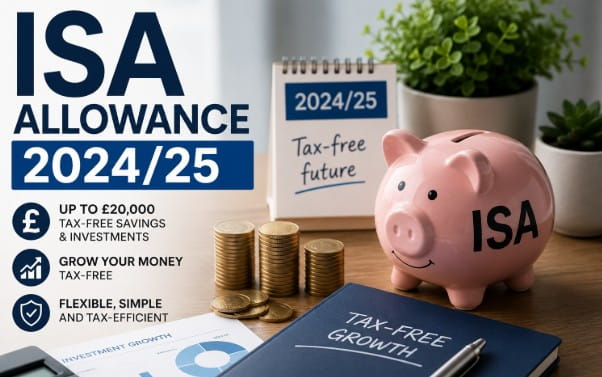
The statutory UK ISA Allowance 2024/25 permits eligible adults to save or invest a maximum cumulative total of £20,000 without paying tax on the returns. This ceiling applies to all combined accounts opened between 6 April and 5 April, offering complete shelter from income tax and capital gains tax.
Recent legislative updates introduce significant flexibility to the UK savings landscape, making it simpler to manage a multi-year portfolio across competitive financial providers.
What is an ISA allowance?
An ISA allowance is the maximum statutory cash limit an eligible individual can deposit into tax-exempt Individual Savings Accounts during a single financial year. For the 2024/25 tax year, the UK government has fixed this total cumulative contribution boundary at exactly £20,000.
This capital limit operates on a strict use-it-or-lose-it basis. The entire allocation resets completely when the new financial year begins on 6 April.
How does the ISA Allowance work?
An ISA allowance works by tracking your cash deposits across multiple registered financial accounts throughout the tax year. Once your combined net deposits reach the £20,000 statutory limit, financial institutions automatically block further contributions until the system resets on 6 April.
- The Shared Allocation Rule: You do not get a separate £20,000 limit for each account type. The threshold is an aggregate total shared across all forms of ISAs you fund within the same year.
- Midnight Deadline: Contributions must physically clear into your accounts before midnight on 5 April 2025 to count toward the 2024/25 cycle.
- Non-Transferable Cap: You cannot roll over unused allowance portions into the following financial year.
What is the maximum ISA Allowance?
The maximum ISA allowance for the 2024/25 tax year is exactly £20,000 per eligible adult. This statutory investment limit is set by the UK government and represents the total aggregate amount you can deposit across all eligible ISA wrappers combined between 6 April 2024 and 5 April 2025.
Sub-allocations Under the Maximum Threshold
While the overarching limit is capped at twenty thousand pounds, certain specialized accounts within the wrapper system carry their own distinct internal ceilings:
- Lifetime ISA (LISA): Limited to a maximum annual deposit of £4,000.
- Junior ISA (JISA): Operates on a separate, independent maximum limit of £9,000 per child.
- Standard Cash and Investment Wrappers: Can absorb up to the full £20,000 maximum if no other accounts are funded.
Are ISAs tax-free?
Yes, ISAs are completely tax-free savings and investment wrappers in the UK. Any capital growth, dividend distributions, or interest yields earned inside an authorized ISA wrapper remain entirely exempt from UK Income Tax and Capital Gains Tax (CGT).
If you complete a self-assessment tax return, there is no need to declare these yields to HMRC. This makes it an excellent tool to utilize alongside the HMRC Tax-Free Allowance Increase to minimize your overall tax burden.

Eligibility and Interaction with State Provisions
To open an account, you simply need to be a UK resident for tax purposes (or a Crown servant working abroad) and meet the standardized age thresholds across the financial services sector.
Using an ISA is an excellent tool to deploy alongside the broader HMRC Tax-Free Allowance Increase to minimize your cumulative tax burden.
Furthermore, if you receive other state benefits, such as the Carer’s Allowance 2024/25, your structural eligibility to save into an ISA remains entirely unaffected.
What is the ISA allowance and limit for 2024-2025?
The statutory ISA allowance and limit for 2024-2025 is set at an aggregate maximum of £20,000 per adult. Running from 6 April 2024 to 5 April 2025, this capital limit can be split across Cash, Stocks and Shares, Innovative Finance, and Lifetime ISAs.
A common point of confusion is whether you can put 20,000 into a Cash ISA and 20,000 into a Stocks and Shares ISA within the same period. In practice, you cannot.
Depositing £20,000 into a single cash account completely exhausts your allowance for that tax year, leaving zero headroom for investment wrappers until the next financial reset. Whether you are locking away funds to secure stable Leeds Building Society ISA rates or opting for a flexible plan, the statutory limits must be distributed cleanly across the five specialized account wrappers:
| ISA Variant | Annual Capital Limit | Primary Regulatory Characteristic |
| Cash ISA | Up to £20,000 | Tax-free interest; zero market volatility risk. |
| Stocks & Shares ISA | Up to £20,000 | Tax-free dividends and capital gains; exposed to market fluctuations. |
| Innovative Finance ISA | Up to £20,000 | Peer-to-peer lending assets and crowdfunding debentures. |
| Lifetime ISA (LISA) | Up to £4,000 | Restricted to ages 18–39; includes a 25% government bonus capped at £1,000 annually. |
| Junior ISA (JISA) | Up to £9,000 | Sourced on behalf of minors under 18; locked by UK law until adulthood. |
What are the new ISA rules for multiple accounts and transfers?
The new ISA rules for multiple accounts explicitly permit UK savers to open and pay into multiple ISAs of the exact same type within a single financial year. This updated framework removes the legacy restriction that penalized individuals for funding competing platforms simultaneously.
This modern flexibility dismantles structural bottlenecks that had restricted retail investors since 1999. When assessing how many ISAs you can open in a year, there is no statutory numerical cap on accounts, provided your total aggregate deposits across all platforms remain under the £20,000 threshold.
This change means you can comfortably hold two Cash ISAs with separate banks or distribute allocations across competing financial apps to capture top-tier interest rates. When evaluating if it is worth having two ISAs, the strategy proves highly effective for splitting capital between instant-access structures and fixed-term rates.
Step-by-Step Official ISA Transfer Protocol
To reposition your capital without invalidating its tax-protected status, you must meticulously follow this formal provider-to-provider process:
- Select a New ISA Provider: Identify an account offering superior interest rates or lower platform management fees that accepts incoming transfers.
- Submit an Official Transfer Form: Complete the new provider’s transfer application. Do not withdraw the cash manually, as doing so removes the money from the tax wrapper.
- Specify Transfer Value: Under modern rules, choose between a full transfer or a partial transfer of current-year or previous-year funds.
- Provider-to-Provider Processing: The new platform communicates directly with your existing manager via the automated ISA Transfer Service network.
- Liquidation of Incompatible Assets: For investment accounts, non-transferable funds or specialized fractional shares are liquidated into cash inside the wrapper.
- Capital Settlement and Reinvestment: The capital settles securely into the new account, preserving its tax-exempt status without affecting your remaining annual limit.
How to Make the Most of Your ISA Allowance 2024/25?
To make the most of your ISA allowance, you should maximize your tax-free wealth by deploying a mix of regular monthly contributions, utilizing flexible account rules for cash management, coordinating marital allowances with your spouse, and diversifying across cash and investment vehicles.
To protect your personal wealth effectively under the current legislative framework, implement these four core actions before the financial year ends:
- Review Account Flexibility: Audit your current savings providers to ensure they support modern flexible ISA rules, allowing you to withdraw and replace cash without using up your contribution limit.
- Coordinate Spousal Allowances: If you live with a spouse or civil partner, combine your annual limits to shield up to £40,000 collectively from HMRC each year.
- Utilize the Official Transfer Service: Never move capital between separate financial institutions via standard bank transfers; always request a formal provider-to-provider transfer to protect the tax wrapper.
- Balance Cash and Investments: Regularly evaluate your portfolio split. If your cash savings are close to maxing out the allowance, look into whether diversifying a portion into Stocks and Shares matches your broader long-term financial goals.

How to Apply for ISA Allowance?
To apply for an ISA, you must choose an authorized UK financial provider, select your preferred account variant, and submit an application with your National Insurance number and proof of residency. Applications can be completed online, via mobile banking apps, or in-branch.
The Standard Application Workflow
The process of activating your new tax wrapper involves a few straightforward steps:
- Check Identity Credentials: Ensure you have your National Insurance (NI) number and valid UK address details on hand.
- Pass Age Verification: Confirm you meet the minimum age of 18 for adult accounts.
- Execute the Initial Deposit: Fund the account via debit card, electronic bank transfer, or an official ISA transfer form to secure your allocation.
Can you have £100k, £200k, or £1,000,000 in an ISA?
Yes, you can legally accumulate balances of £100k, £200k, or over £1,000,000 inside an ISA portfolio. While the UK government limits your annual inputs, there is absolutely no statutory upper ceiling on the total compound growth or long-term value your accounts can reach.
A frequent query among long-term savers focuses on building large portfolio balances. Can I put 20k in an ISA every year tax-free? Yes, you can repeatedly contribute up to the maximum allowance each tax year.
Over an extended timeframe, this allows your capital to compound significantly inside the tax-free shield. In fact, thousands of dedicated retail investors have reached ISA millionaire status.
Security Guarantees and Wealth Planning
While there is no cap on how large your tax-free pot can grow over time, the Financial Services Compensation Scheme protects cash holdings only up to £85,000 per person, per banking license.
When analyzing whether you should max out your ISA every year, doing so remains one of the most reliable legal methods to shelter large cash reserves.
Additionally, you do not pay tax on ISA withdrawals, meaning you can access six-figure sums completely tax-free at any stage of retirement or business expansion, making it a perfect companion strategy to boost State Pension Tax Allowance limits during later-life financial planning.
What are the disadvantages and risks of an ISA?
The main disadvantages and risks of an ISA include macroeconomic inflationary erosion on cash deposits, stock market volatility within investment wrappers, and potential early withdrawal penalties imposed by individual banking institutions on fixed-rate, long-term savings accounts.
While the tax advantages are clear, savers must look at practical limitations to avoid inflation traps or capital loss.
- Inflationary Erosion: A clear disadvantage of a Cash ISA is that fixed interest rates often lag behind inflation. Over a multi-year horizon, cash left stagnant can lose real purchasing power.
- Market Exposure Risks: Shifting into a Stocks and Shares ISA exposes your principal capital to stock market volatility. Asset values can drop significantly during market corrections, meaning you could get back less than you originally invested.
- The Mythical 5-Year Rule: Savers often ask about the 5-year ISA rule or the 5-year Cash ISA rule. In reality, there is no statutory 5-year restriction imposed by HMRC on standard accounts. This term simply refers to the standard industry advice that investments should be held for at least five years to ride out short-term market drops, or it relates to individual bank terms on fixed-rate accounts that penalize early withdrawals.
Is the £20k ISA allowance being cut or changed?
No, the £20k ISA allowance is not being cut or reduced. The core annual contribution threshold remains frozen at exactly £20,000 per adult, providing a stable, predictable baseline for UK savers executing multi-year financial planning models.
When mapping out your financial future, you must separate fixed current guidelines from potential future statutory changes. For the immediate future, your total contribution capacity remains steady.
Savers asking how much they can put into an ISA in 2026 or planning for the 2026-2027 tax year will find the core limit frozen at £20,000.
While the government consistently reviews savings frameworks in autumn and spring statements, the core annual contribution threshold remains frozen at £20,000. Savers should base their long-term planning on this baseline unless explicit structural changes are introduced in future Budgets.
The ISA Allowance 2024/25 At a Glance
The Individual Savings Account ISA Allowance 2024/25 tax year (running from 6 April 2024 to 5 April 2025) is locked at a maximum threshold of £20,000 per eligible adult.
This allowance acts as a full statutory shield, keeping all interest, investment growth, and dividend yields 100% free from UK Income Tax and Capital Gains Tax (CGT).
FAQ about ISA Allowance 2024/25
What happens if I exceed my 20,000 ISA allowance?
Do not attempt to withdraw the excess funds manually. HMRC runs an automated year-end reconciliation process and will contact you directly to explain how they will claw back the tax relief or invalidate the excess contributions.
Does transferring an old ISA reduce my current 2024/25 limit?
No. Moving an existing ISA balance via the official provider-to-provider transfer service does not count toward your current annual limit, preserving your full £20,000 allowance for new savings.
What is the new cash ISA limit for young adults?
The minimum age requirement to open an adult Cash ISA is now 18. This change removes the legacy loophole that previously allowed 16 and 17-year-olds to open an adult account alongside a Junior ISA.
Can I hold peer-to-peer loans inside my 2024/25 allocation?
Yes, peer-to-peer lending contracts and alternative crowdfunding debentures are fully eligible assets, provided they are managed entirely within an Innovative Finance ISA structure.
Do flexible ISA rules allow me to replace withdrawn money?
Yes, if your provider offers flexible terms, you can withdraw cash and replace it within the exact same tax year without the replacement counting as a fresh contribution against your £20,000 limit.
Can I lose money inside a Cash ISA wrapper?
Your capital balance is secure from market drops, but you face the risk of purchasing power loss if your account’s interest rate is lower than the UK inflation rate.
Are accumulated ISA assets exempt from Inheritance Tax?
No. While ISAs shield your money from Income Tax and Capital Gains Tax during your lifetime, the total value of the portfolio forms part of your estate for Inheritance Tax purposes when you pass away.