
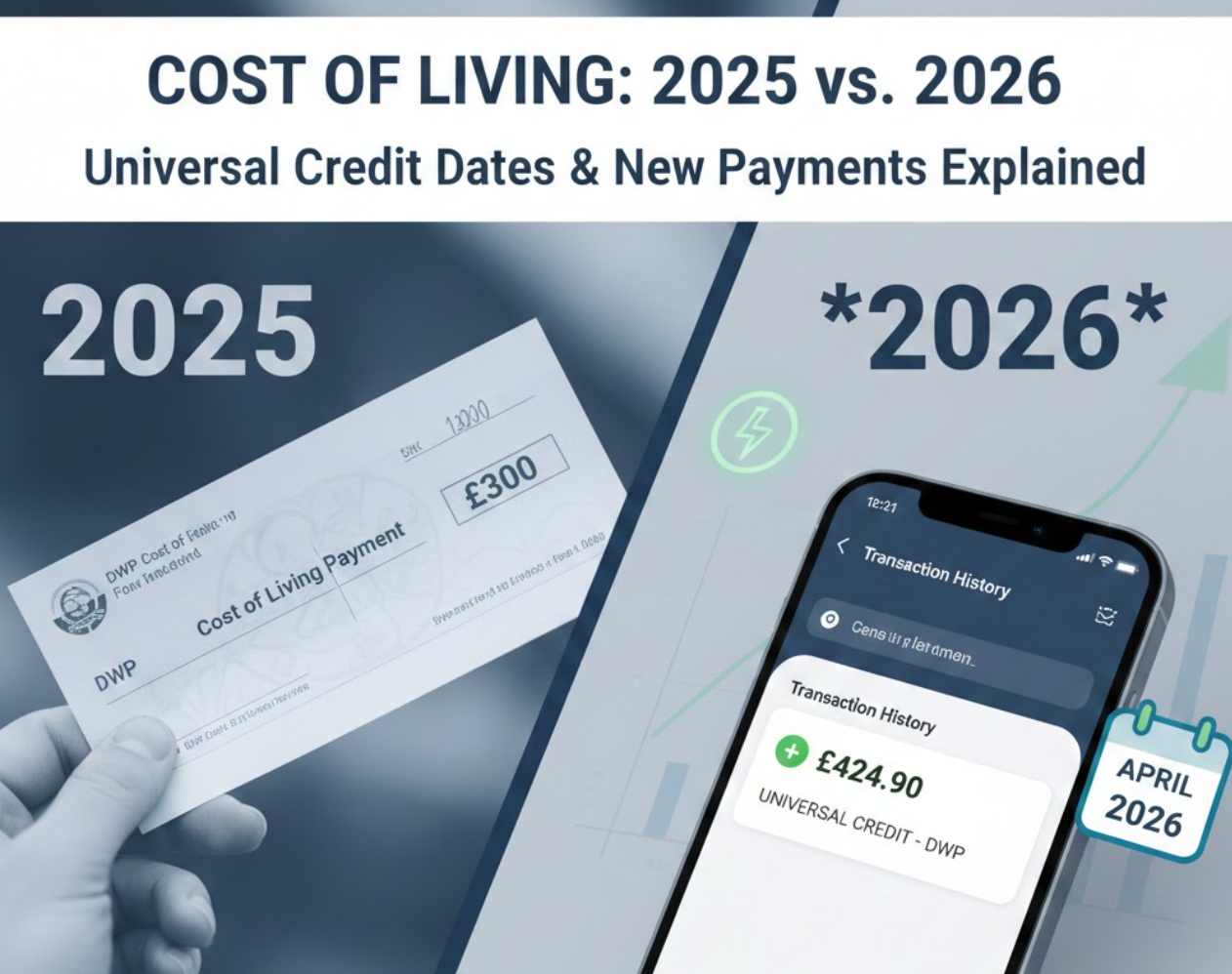
Cost of Living Payment 2025 When Will It Be Paid Universal Credit
Cost of Living Payment 2025 & 2026: When Will It Be Paid for Universal Credit Claimants?
For millions of households across the UK, the “Cost of Living Payment” became a vital lifeline between 2022 and 2024. As we move through February 2026, many Universal Credit claimants are still searching for the next “lump sum” date.
However, the Department for Work and Pensions (DWP) has fundamentally changed how it delivers financial support. For 2026, the strategy has shifted from emergency one-off grants to a permanent structural increase in monthly benefit rates.
In this guide, we clarify exactly what you will receive, when the April 2026 “uplift” hits your bank account, and how to access the residual crisis funds that many people overlook.
Is there a Cost of Living Payment in 2026?
The official stance from the DWP is that no further one-off Cost of Living lump-sum payments are scheduled for 2026.
The previous cycles—such as the £900 and £300 payments—were temporary measures introduced during the peak of the energy crisis. For the 2026/27 tax year, the government has transitioned that funding into the Universal Credit Act 2025, which mandates above-inflation increases to the standard allowance.
Expert Note: Be wary of social media reports claiming a “£500 Cost of Living Payment” in 2026. These are currently unverified and often refer to local council grants rather than a national DWP payment. Always check your Universal Credit Journal for official notifications.
When will the next Universal Credit increase be paid in 2026?
The most significant financial boost for 2026 comes in April. Benefits will rise by a combined 6.1% for most households. This is made up of a 3.8% CPI inflation match plus a 2.3% additional uplift introduced by the new government.
Universal Credit Standard Allowance Rates (Monthly)
| Claimant Status | 2025/26 Rate | New 2026/27 Rate (April) | Estimated Annual Gain |
| Single (Under 25) | £316.98 | £338.58 | +£259.20 |
| Single (25 or over) | £400.14 | £424.90 | +£297.12 |
| Joint (Both under 25) | £497.55 | £528.34 | +£369.48 |
| Joint (One or both 25+) | £628.10 | £666.97 | +£466.44 |
Important: The “May Gap”
Because Universal Credit is paid in arrears, you will not see this increase in the first week of April.
- Your Assessment Period must start on or after 6 April 2026 for the new rate to apply.
- Most claimants will see their first increased payment in May 2026.
What about the “Universal Credit Health Element” Changes?
Starting in April 2026, the government is “rebalancing” support for those with health conditions.
- New Claimants: If you are found to have a Limited Capability for Work and Work-Related Activity (LCWRA) after April 2026, the additional health element is expected to be roughly £217.26, down from the previous £429.80.
- Existing Claimants: If you are already receiving the LCWRA element, your payment is protected. You will stay on the higher rate, which will increase to £429.08 in April 2026.
How can I get extra help in 2026 without the lump sum?
While the £300 checks have stopped, three specific funds remain active in 2026 to help with “emergency” costs.
1. The Household Support Fund (HSF) Extension
The HSF has been extended through to March 31, 2026. This is a pot of money given to your local council.
- How to use it: You must apply via your local council website (e.g., Birmingham City Council, Leeds City Council).
- What’s available: Vouchers for food, assistance with water arrears, and “white goods” (fridges/ovens) if yours has broken.
2. The Warm Home Discount 2026
The government has expanded this scheme for the 2025/26 winter.
- The Payment: A £150 credit applied directly to your electricity bill.
- Eligibility: Most Universal Credit claimants with high energy usage qualify automatically.
- Key Date: Payments for this winter must be completed by 31 March 2026. If you haven’t received a letter by now, contact the WHD Helpline at 0800 030 9322.
3. Removal of the Two-Child Limit
Under the Universal Credit (Removal of Two Child Limit) Bill, many larger families will see an immediate boost in 2026. If you have a third or subsequent child born after 2017, you may now be eligible for the Child Element (£290+ per month) that was previously capped.
SME Business Blog Advice: Supporting Your Employees
For business owners and HR managers, understanding these dates is crucial for supporting staff on “top-up” benefits.
- Encourage “Help to Save”: Remind staff that for every £1 they save (up to £50/month), the government adds 50p.
- Social Tariffs: Most major broadband providers (Sky, BT, Virgin) offer £12–£20 monthly packages for those on Universal Credit. This can save an employee £300 a year—more than a Cost of Living payment.
FAQ
Will there be a £300 payment in late 2026?
Currently, no. The 2026 Budget focused on lowering energy bills via “structural reductions” (removing policy costs) rather than cash grants. This is expected to save the average household £150 per year automatically.
Do I need to apply for the April 2026 increase?
No. The DWP will update your statement automatically. You can check the “Statement” section of your online journal in late April to see your new monthly entitlement.
Can I still report a missing payment from 2024?
Yes. If you believe you were eligible for the final £299 payment in February 2024 but never received it, you can still use the “Report a missing Cost of Living Payment” tool on the GOV.UK website.
What is the Household Support Fund “Crisis Payment”?
Some councils offer a one-off “Crisis Payment” of up to £200 for residents facing eviction or total fuel poverty. This is part of the HSF and is usually paid within 48 hours of a successful application.
Immediate Next Steps for 2026
- Check your Council Tax Support: Unlike Universal Credit, this is not automatic. Apply to your council to potentially reduce your bill by 80–100%.
- Log into your Journal: Check for any “Review” messages. The DWP is currently migrating all remaining “Legacy Benefit” (Tax Credits/ESA) claimants to Universal Credit, a process finishing in March 2026.
- Update your Housing Costs: If your rent increases in April, you must report this in your Journal immediately, or your housing element will remain at the 2025 rate.