Which Stage of the Business Cycle Is an Economy in When It Reaches Its Low Point? The Trough
When evaluating market fluctuations, many directors ask: which stage of the business cycle is an economy in when it reaches its low point?
The answer is the trough, a critical phase that marks the end of a contraction and the beginning of a new recovery.
An economy is in the trough stage of the business cycle when it reaches its low point. The trough marks the absolute bottom of an economic contraction, where output, consumer demand, and employment hit their lowest levels before economic activity stabilizes and transitions into a new expansion phase.
Key Takeaways
- The trough stage represents the absolute lowest point in the business cycle, marking the precise turning point where a contraction ends and recovery begins.
- Official UK data from the Office for National Statistics confirms the trough when real quarterly Gross Domestic Product ceases its multi-quarter decline.
- Business insolvencies typically peak during the trough due to lagged cash flow exhaustion from the preceding economic downturn across vulnerable sectors.
- In 2026 UK firms leverage voluntary Fair Payment Code standards and manage phased April 2026 statutory sick pay rules to stabilize operational cash flow.
Which stage of the business cycle is an economy in when it reaches its low point?
The trough is the formal boundary line between a contraction phase and an expansion phase. During this period, economic output stops shrinking, but rapid growth has not yet begun.
For business leaders, the trough represents the floor of the cycle, offering a brief window where operating costs, asset prices, and borrowing rates often reach their most competitive levels.
During this time, indicators like GDP growth, consumer spending, and industrial output reach their cyclical nadir before the upward trend begins.
The Anatomy of the Economic Floor
While the term implies a single calendar day, the trough is usually a multi-month period of bottoming out rather than an instantaneous rebound.
In the UK, economists and the Office for National Statistics (ONS) identify the trough in hindsight when real GDP stops contracting and begins flatlining or recording minor positive growth.
For a small or medium enterprise (SME), the trough is the moment revenue decline stops, even though cash reserves may remain severely stretched.
In practice, liquidity risks remain high during this floor period because working capital has been depleted throughout the preceding contraction.
Successful business directors use the trough phase to shift focus from defensive restructuring to operational efficiency.
By securing supply chain agreements and optimizing internal processes while input costs are low, companies position themselves to capture immediate market share as demand rebounds.

Understanding the Four Phases of the Business Cycle
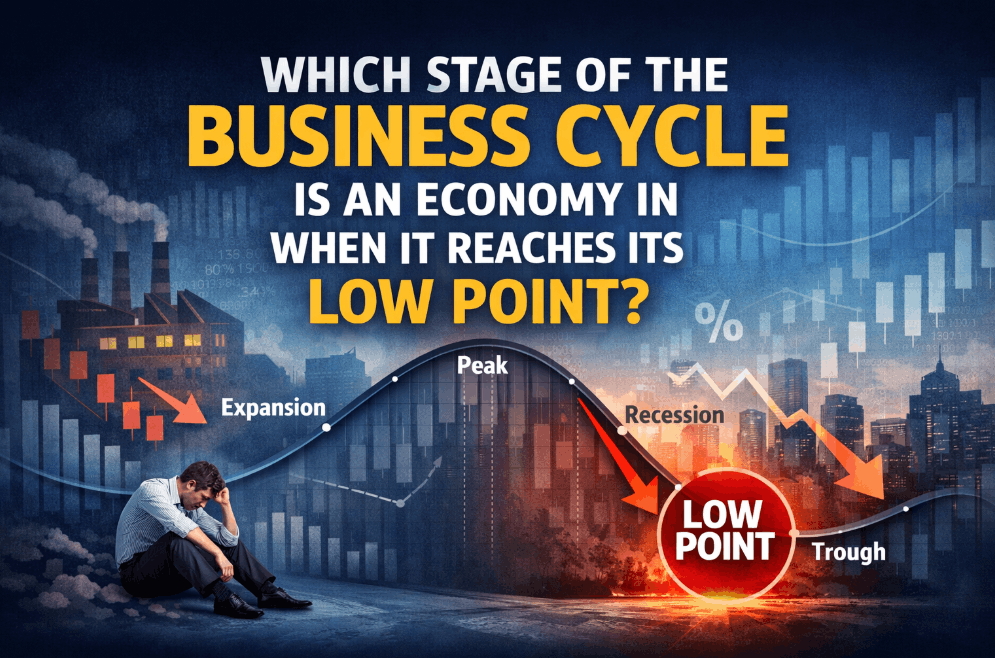
To navigate economic shifts effectively, business leaders must understand how the trough fits into the broader four-stage macroeconomic cycle:
- Expansion: Economic activity accelerates, GDP grows steadily, consumer confidence rises, and employment increases across major industries.
- Peak: The highest point of the cycle where economic growth reaches maximum capacity, often accompanied by rising inflationary pressures and tighter central bank monetary policy.
- Contraction: Economic output slows or shrinks, consumer spending decreases, and businesses scale back investment, often leading to a formal recession.
- Trough: The absolute low point of the cycle where economic activity bottoms out, stabilizing before the next expansionary phase begins.
Leading Indicators: Which stage of the business cycle is an economy in when it reaches its low point? Identifying the Trough.
Identifying the low point in real time is challenging because official quarterly statistics are published with a lag. However, several forward-looking indicators signal that an economy is reaching its floor:
- Monetary Policy Stabilization: The Bank of England pauses interest rate increases or initiates monetary easing to stabilize credit markets and lower borrowing costs.
- Inventory Depletion and Reordering: Wholesalers and retailers stop canceling orders as inventories drop to baseline levels, prompting fresh production orders.
- Payment Settlement Plateau: B2B invoice collection data and Direct Debit failure rates stop rising, indicating that business cash flow stress has peaked.
- Capital Market Rebounds: Equity indices such as the FTSE 100 and FTSE 250 historically begin recovering three to six months before national GDP metrics reflect a broader bottoming out.
| Economic Metric | Status at the Trough Stage | Strategic Impact for SMEs |
| Real GDP | Hits the cyclical nadir | Growth is 0% or slightly negative but stable. |
| Consumer Spend | Focused on essentials | Marketing must pivot to value and utility. |
| Credit Access | Severely restricted | Essential to have pre-arranged credit lines. |
| Labour Costs | Wage growth plateaus | A prime window for strategic, long-term hiring. |
How to Navigate the Transition From Trough to Recovery?
Navigating the trough requires targeted decisions to ensure your business is financially secure and operationally ready for rising demand.
- Leverage the Fair Payment Code: Align trading terms with the voluntary Fair Payment Code framework, encouraging corporate debtors to commit to 30-day payment schedules (Gold Award status) to strengthen cash flow.
- Pivot from Austerity to Automation: Shift capital investment toward workflow software and modern machinery that lower unit costs before customer order volumes scale up.
- Acquire Undervalued Assets: Evaluate distressed equipment, inventory, or competitors available at reduced valuations during the bottom of the cycle.
- Adapt to 2026 Statutory Workplace Rules: Factor in updated employment overheads, including day-one Statutory Sick Pay provisions under the Employment Rights Act 2025, into forward margin calculations.
- Lock in Favorable Commercial Terms: Secure multi-year fixed contracts with key suppliers and commercial lenders while input prices and borrowing rates remain at cyclical lows.
- Reactivate Prospect Pipelines: Re-engage former sales prospects with updated service offerings as corporate budgets unfreeze during early economic stabilization.
Capturing the upcoming growth requires a shift from planning to execution. Understanding what must an entrepreneur do after creating a business plan is vital here, ensuring you move beyond theory to the active scaling required as the market begins its upward climb.

Case Study: Surviving the Trough, A Midlands Manufacturing Success
Successful mid-sized enterprises often treat the trough as an operational reset rather than a period of complete inactivity.
A mid-sized metal fabrication business in the Midlands experienced a significant reduction in order volumes during the preceding economic contraction.
Instead of implementing further workforce reductions at the trough, the firm utilized regional innovation grants to retrain staff and implement automated inventory tracking systems.
While competing firms paused investments, this company reorganized production workflows during the lower-demand period.
When market demand stabilized and shifted into recovery, the firm achieved order lead times 50% faster than sector averages.
As a result, they captured additional market share during the initial expansion phase because their production capacity was fully operational and optimized to fulfill immediate demand.
Why do many businesses fail at the low point?
Academic models note that while the trough represents the end of an economic contraction, it is also the peak period for corporate insolvencies. This phenomenon is known as the lag effect in business cash flow.
During a prolonged contraction, companies survive by drawing down cash reserves, delaying capital expenditure, and stretching supplier terms. By the time the macroeconomic floor is reached, working capital is frequently exhausted.
When order volumes begin to rise again during the initial recovery, businesses face increased cash demands for raw materials and payroll before new invoice receipts are collected.
Furthermore, labor metrics often lag output metrics. Employers usually defer new hiring until sales recovery is firmly established, meaning consumer spending power can remain muted during the early months of the trough.
Businesses that maintain strict working capital controls and pre-arranged credit structures are best equipped to survive this delicate transition.
Is the UK economy currently in a trough in 2026?
While tech and professional services have moved into early expansion, consumer-facing sectors continue to experience a broader bottoming-out phase. Learning the best ways to support local businesses can help traditional retailers and regional services sustain demand during this floor period.
Several structural factors shape the current business cycle floor:
- Gradual GDP Trajectory: ONS estimates point toward modest annual GDP growth in 2026, pointing to a prolonged U-shaped floor rather than an immediate rapid rebound.
- Phased Regulatory Standards: Employers adapting to the April 2026 updates under the Employment Rights Act 2025 are reviewing hiring strategies to accommodate revised sick pay and leave provisions.
- Stabilizing Inflation and Rates: Input price stabilization provides greater predictability for operational budgeting, allowing directors to project multi-year overhead costs with higher accuracy.
| Feature | Contraction Strategy | Trough Strategy | Recovery Strategy |
| Focus | Survival & Cuts | Positioning & Efficiency | Growth & Scaling |
| Marketing | Retention | Brand Awareness | Lead Generation |
| Staffing | Freeze / Redundancy | Key Talent Acquisition | General Hiring |
New labour laws have added caution to 2026 hiring. For directors managing staff health during this stagnant phase, staying current on limited capability for work payments and DWP benefits eligibility checks and welfare reforms ensures your business remains compliant with welfare reforms while consumer demand remains low.

Conclusion
Reaching the trough stage of the business cycle marks a definitive turning point for an economy and its business sector. While the trough represents the absolute floor of output and revenue, it also provides the foundation for subsequent recovery and expansion.
UK business directors navigating the 2026 economic environment should focus on three practical steps:
- Review Sector-Specific ONS Data: Evaluate performance metrics tailored to your specific trade sector rather than relying solely on national top-line GDP figures.
- Optimize Cash Working Capital: Enforce structured invoicing workflows and leverage voluntary payment frameworks like the Fair Payment Code to maintain liquidity.
- Prepare Operational Capacity for Scaling: Use the period of stable input costs to automate processes, negotiate long-term supplier agreements, and ensure full compliance with updated 2026 statutory employment standards.
FAQ
In which stage of the business cycle does the economy reach its lowest point?
An economy reaches its absolute lowest point in the trough stage. The trough marks the end of economic contraction and precedes the transition into a new expansionary phase as production and sales stabilize.
What stage of the economic cycle is the UK in?
As of 2026, the UK economy is transitioning from a prolonged trough into early expansion. Growth varies across sectors, with technology leading recovery while retail and construction complete their bottoming-out process.
Which stage of the business cycle is an economy in when it reaches its low point: expansion, peak, contraction, or trough?
An economy is in the trough stage when it reaches its low point. Peak represents the maximum high point, contraction is the period of decline, and expansion is the subsequent recovery phase.
What are the 4 stages of the economic cycle?
The four sequential stages of the economic cycle are expansion, peak, contraction, and trough. Together, these phases track the rise, peak, slowdown, and recovery of economic output over time.
How long does an economic trough typically last?
An economic trough can last anywhere from several months to over a year. The duration depends on central bank monetary policy, consumer confidence, fiscal stimulus, and broader macroeconomic conditions.
What is the difference between a recession and a trough?
A recession is the overall period of economic decline (the contraction phase), whereas the trough is the specific lowest point or bottom where that decline stops before recovery begins.