

Worst Places to Live in UK: SME and Commercial Risk Guide
The worst places to live in the UK are urban areas characterised by high recorded crime rates per 1,000 residents, severe multi-domain deprivation on the English Indices of Deprivation (IMD), and sustained economic stagnation.
Official metrics reflect this through long-term high street decline, rising anti-social behaviour, and overstretched public services.
Top 20 Worst Places to Live in the UK
The 20 lowest-rated locations in the UK share chronic socioeconomic distress, elevated crime rates, and reduced commercial investment:
- Middlesbrough: Recorded crime rate of 145.0 per 1,000 residents; acute income and employment deprivation.
- Blackpool: Crime rate of 129.4 per 1,000 residents; high violent offences and housing deprivation.
- Bradford: Crime rate of 121.7 per 1,000 residents; persistent urban poverty and vehicle crime.
- Kingston upon Hull: Crime rate of 120.5 per 1,000 residents; high anti-social behaviour and commercial decline.
- Hartlepool: Crime rate of 136.5 per 1,000 residents; post-industrial job losses and property crime.
- Doncaster: Crime rate of 115.8 per 1,000 residents; low disposable income and retail vacancies.
- Walsall: Crime rate of 114.2 per 1,000 residents; high rates of vehicle crime and commercial burglary.
- Blackburn with Darwen: Crime rate of 112.4 per 1,000 residents; marked health deprivation.
- Burnley: Crime rate of 111.9 per 1,000 residents; heavy concentration of bottom-decile LSOAs.
- Rochdale: Crime rate of 110.6 per 1,000 residents; elevated public order offences.
- Luton: Crime rate of 108.3 per 1,000 residents; transit corridor crime and housing density strain.
- Stoke-on-Trent: Crime rate of 107.5 per 1,000 residents; low median wage growth and domestic offences.
- Grimsby: Crime rate of 106.8 per 1,000 residents; coastal isolation and youth outward migration.
- Peterborough: Crime rate of 104.6 per 1,000 residents; infrastructure pressure and vehicle theft.
- Oldham: Crime rate of 103.9 per 1,000 residents; child poverty and retail theft.
- Hastings: Crime rate of 102.8 per 1,000 residents; seasonal unemployment and drug-related disorder.
- Sunderland: Crime rate of 101.4 per 1,000 residents; structural unemployment and public disorder.
- Bolton: Crime rate of 100.2 per 1,000 residents; town centre commercial distress.
- Rotherham: Crime rate of 98.7 per 1,000 residents; elevated anti-social behaviour.
- Aylesbury: Crime rate of 92.4 per 1,000 residents; high living costs clashing with pockets of rising crime.
Combined, these towns and cities face the sharpest overlap of high crime density and deep-seated economic pressure in the UK.

Analyzing the Worst Places to Live in UK
1. Middlesbrough
Middlesbrough records an annual crime rate of 145.0 offences per 1,000 residents, driven by widespread vehicle theft, property crime, and anti-social disorder. The town suffers from acute income deprivation, with nearly half of its local neighbourhoods situated in the bottom national decile.
Persistent high street store closures and declining commercial footfall continue to depress local economic recovery.
2. Blackpool
Blackpool contends with 129.4 crimes per 1,000 residents alongside severe long-term health and employment challenges. The local economy relies heavily on low-wage seasonal tourism, resulting in high off-season unemployment and financial insecurity for households.
Poor-quality private rental housing and elevated rates of violent offences create a deeply challenging environment for permanent residents.
3. Bradford
Bradford registers 121.7 offences per 1,000 population, experiencing significant rates of violent crime, public disorder, and vehicle-related theft. High levels of urban poverty and low educational attainment across central residential wards constrain household disposable income.
These socioeconomic pressures contribute to elevated retail security costs and higher business insurance overheads across the district.
4. Kingston upon Hull
Hull records a crime rate of 120.5 per 1,000 people, with anti-social behaviour and domestic burglary featuring prominently in annual statistics. Geographic isolation along the Humber estuary has slowed industrial diversification, leaving many outer housing estates economically vulnerable.
Widespread retail unit vacancies across the city centre reflect depressed local consumer purchasing power.
5. Hartlepool
Hartlepool logs an elevated crime rate of 136.5 per 1,000 residents, reflecting the severe consequences of long-term heavy industrial decline. The town faces high youth unemployment, low business investment, and frequent incidents of criminal damage and shoplifting.
These financial barriers suppress local property appreciation and limit commercial growth opportunities for independent retailers.
6. Doncaster
Doncaster records 115.8 crimes per 1,000 residents, with anti-social behaviour and drug-related offences concentrated in central urban wards. While large logistics parks have expanded along transport corridors, median wages in town centre districts remain stagnant.
Depressed disposable incomes and high commercial vacancy rates continue to challenge local high street sustainability.

7. Walsall
Walsall experiences 114.2 offences per 1,000 population, recording persistent rates of commercial burglary, vehicle theft, and public disorder. A significant proportion of the local working-age population remains economically inactive due to limited manufacturing opportunities.
Retail footfall in the town centre has dropped steadily, increasing financial stress on local trade counters and service businesses.
8. Blackburn with Darwen
Blackburn with Darwen registers 112.4 crimes per 1,000 residents, compounded by severe health deprivation and low average household earnings. The area struggles with high child poverty rates and an ageing housing stock that requires substantial capital investment.
Elevated theft and property damage offences place an ongoing financial drag on small commercial operators.
9. Burnley
Burnley records 111.9 offences per 1,000 residents, with dense pockets of deprivation situated across former mill-town estates. Low capital investment and substandard private rental accommodation contribute to high population turnover and public order complaints.
Subdued wage growth limits household spending capacity, impacting local service and leisure enterprises.
10. Rochdale
Rochdale logs 110.6 crimes per 1,000 people, with anti-social behaviour, shoplifting, and violent offences impacting town centre stability. The local economy struggles with elevated long-term unemployment and an above-average concentration of empty commercial premises.
Community infrastructure remains under pressure from rising demand for social support services.
11. Luton
Luton experiences 108.3 crimes per 1,000 residents, driven largely by high rates of vehicle theft, transit corridor offences, and violent crime.
Severe housing density and rapid population growth have placed immense strain on local healthcare facilities and public amenities. High living costs combined with localized crime clusters create significant friction for working families and independent employers.
12. Stoke-on-Trent
Stoke-on-Trent registers 107.5 crimes per 1,000 residents as it navigates the lasting transition away from traditional pottery and coal industries. Low average wages, high domestic incident rates, and limited private sector investment contribute to widespread economic stagnation.
Town centres across the city’s six distinct pottery towns face high shop vacancy rates and reduced footfall.
13. Grimsby
Grimsby records 106.8 offences per 1,000 people, dealing with deep-rooted coastal deprivation following the historic decline of its fishing industry. The town faces steady outward youth migration, low educational outcomes, and recurring property and violent crimes.
Depressed commercial real estate values reflect the subdued local economic environment and constrained household finances.
14. Peterborough
Peterborough logs 104.6 crimes per 1,000 residents, reflecting growing pains from rapid residential expansion that has outpaced civic infrastructure.
Rising rates of violent crime, vehicle theft, and public disturbance have eroded local quality of life perceptions. Strained public services and uneven commercial development present noticeable operational hurdles across several central neighbourhoods.
15. Oldham
Oldham records 103.9 crimes per 1,000 residents, driven by persistent retail theft, anti-social behaviour, and property offences. The borough displays high rates of child poverty and economic inactivity, which limits discretionary spending across local business districts.
Stagnant property values and public amenity pressures continue to impact residents across outer residential wards.
16. Hastings
Hastings registers 102.8 crimes per 1,000 people, facing transport isolation along the East Sussex coast alongside heavy reliance on seasonal employment.
The town suffers from above-average rates of substance misuse, public disorder, and mental health challenges among working-age adults. Limited year-round commercial opportunities restrict upward wage mobility for local families.
17. Sunderland
Sunderland logs 101.4 offences per 1,000 residents, dealing with structural unemployment and pockets of severe urban deprivation across former industrial heartlands. Elevated rates of anti-social behaviour and property crime affect community safety ratings in central wards.
Despite regional automotive manufacturing strengths, town centre retail footfall remains subdued.

18. Bolton
Bolton records 100.2 crimes per 1,000 residents, experiencing significant high street retail distress and elevated commercial burglary rates.
Central areas face notable health inequalities and lower-than-average disposable income levels, curbing local service sector growth. Strained municipal budgets have made revitalising empty commercial units an ongoing struggle.
19. Rotherham
Rotherham logs 98.7 crimes per 1,000 residents, with public disorder and anti-social behaviour concentrating in urban residential clusters.
The legacy of post-industrial decline has left significant sections of the workforce in low-wage or temporary employment. Reduced commercial demand has resulted in lingering vacant storefronts across the primary shopping core.
20. Aylesbury
Aylesbury experiences 92.4 offences per 1,000 residents, presenting a distinct contrast between high southern housing costs and localized pockets of crime. Rapid suburban expansion has strained transport corridors and public health infrastructure, leading to increased anti-social incidents.
Elevated residential living expenses combined with commercial rate pressures create financial friction for local households and traders.
Official Crime Rates and Deprivation Benchmarks Across UK Locations
Home Office recorded crime data highlights a clear correlation between elevated crime per 1,000 residents and bottom-decile IMD rankings:
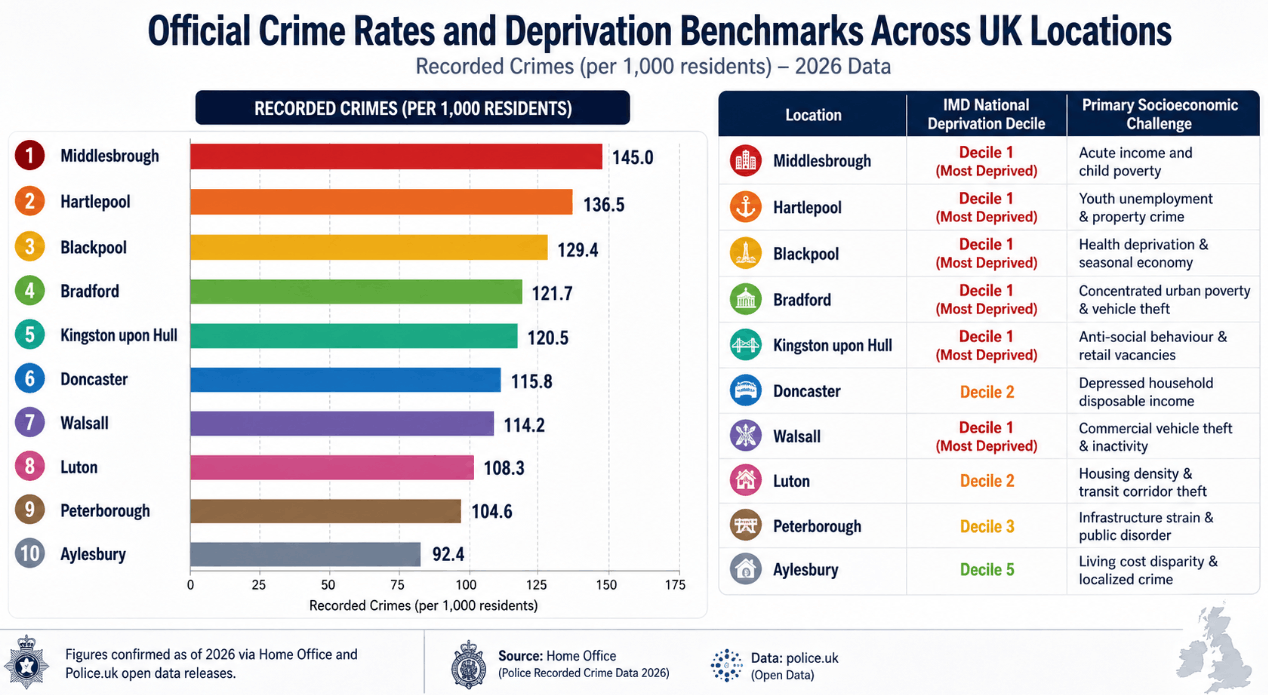
Figures confirmed as of 2026 via Home Office and Police.uk open data releases.
How Government Metrics Measure Local Deprivation
The worst places in England are identified by analyzing statutory metrics rather than public opinion polls.
The Ministry of Housing, Communities & Local Government (MHCLG) tracks multiple deprivation domains in England, while Police.uk provides official police recorded crime data per capita to establish verifiable community living standards.
ONS guidance stresses that measuring local living standards relies on several overlapping factors, not just headline crime rates:
- Recorded Violent Crime and Disorder: Analyzing violent crime statistics and anti-social behaviour offences per 1,000 residents using Home Office databases.
- Indices of Multiple Deprivation (IMD): Measuring the proportion of Lower-layer Super Output Areas (LSOAs) ranked in the most deprived 10% nationally.
- Economic Productivity and Income: Reviewing average household disposable income, local economic inactivity rate figures, and long-term unemployment.
- Commercial Vitality: Auditing high street vacancy rates and commercial property overheads to determine private sector investment levels.
How Regional Deprivation Impacts SME Operations and Overheads
Operating a small business in an area with high deprivation and crime directly inflates commercial cost structures:
- Business Insurance Premiums: Commercial underwriters apply heavy risk surcharges to premises in postal codes with frequent burglary, arson, or criminal damage.
- Retail Shrinkage and Security Outlays: Elevated shoplifting and anti-social behaviour force retailers to hire dedicated security staff and install roller shutters.
- Workforce Recruitment Friction: High local economic inactivity rate metrics and poor transport links restrict the available skilled talent pool.
- Depressed Consumer Footfall: Reduced household disposable income across deprived wards restricts discretionary consumer spending on local high streets.
The Federation of Small Businesses (FSB) and the British Chambers of Commerce (BCC) note that rising commercial crime represents an ongoing financial drain on independent retailers.
Residential Livability vs Commercial Reality: The Impact on Local Trade
A low residential ranking does not automatically mean an area is unprofitable for commercial enterprise.
Industrial, logistics, and B2B operators often thrive in locations like Doncaster or Stoke-on-Trent due to affordable commercial warehousing and excellent motorway connectivity. These commercial risk factors for UK businesses differ significantly from consumer retail dependencies.
Local councils in deprived districts frequently offer targeted business rates relief and enterprise grants. Conversely, affluent consumer hubs often present much higher commercial property overheads, steeper wages, and higher baseline rents that compress operating margins.
How to Operate a Business Safely in High-Deprivation UK Areas
You can protect your commercial assets and staff in challenging operational environments by adopting practical security controls:
- Harden Physical Premises: Install LPS 1175 certified security shutters, reinforced window films, and multi-angle CCTV systems covering customer entry points.
- Join Business Crime Reduction Partnerships (BCRPs): Coordinate with town centre radio networks and local business communities to track active offenders in real time.
- Establish Safe Staff Transit Protocols: Ensure workers on evening shifts have access to well-lit parking or secure shared transport options.
- Minimise On-Site Cash and High-Value Stock: Implement cashless payment systems and secure high-value stock in locked cages during non-trading hours.

Summary
Identifying the UK’s most challenged areas relies on concrete metrics from the ONS and Home Office rather than opinion surveys. High crime and stagnant investment create real hurdles, but they don’t paint the whole picture.
For residents and business owners in 2026, navigating these locations requires looking beyond headline crime figures to weigh genuine local risks against commercial opportunities.
FAQ
What is the roughest city in the UK?
Middlesbrough and Bradford record the highest crime densities among UK cities, with recorded offences exceeding 120 per 1,000 residents under official Police.uk reporting. Both cities experience elevated levels of anti-social behaviour and violent crime.
What is the lowest rated place in the UK?
Middlesbrough is ranked as the lowest-rated UK urban area when combining Police.uk crime metrics (145.0 per 1,000) with Ministry of Housing, Communities & Local Government deprivation deciles.
What are the worst places to live in the UK in 2026?
The most challenging UK places to live in 2026 include Middlesbrough, Blackpool, Bradford, Hull, and Hartlepool, driven by concentrated poverty, elevated violent offences, and high commercial vacancy rates.
Is it more expensive to insure a business in a high-crime UK town?
Yes, insurance underwriters apply substantial premium loadings to commercial property, stock, and public liability policies in areas with elevated recorded crime per capita.
Can a small business succeed in a town with high residential deprivation?
Yes, B2B companies, trade counters, and logistics firms frequently succeed in these areas by leveraging lower commercial rents, motorway access, and local council regeneration incentives.
Disclaimer: This analysis uses public ONS and Home Office metrics for informational business planning; local operational experiences may vary.