
Best Payment Processing Companies: The Definitive 2026 UK Guide
Choosing between different payment processing companies can directly influence an enterprise’s bottom line. For United Kingdom merchants, identifying an optimal partner requires a clear breakdown of transaction charges, hardware reliability, integration capabilities, and adherence to strict local financial rules.
Alongside choosing payment systems, keeping up with broader UK corporate compliance, such as preparing for the upcoming Companies House accounts reforms, is essential for maintaining smooth business operations.
This guide provides a detailed, independent analysis of top-tier payment infrastructure options to help business owners secure the most cost-effective arrangement for their operations.
What Are Payment Processing Companies?
Payment processing companies are financial entities that build and maintain the technology infrastructure required to accept, verify, and settle electronic card transactions.
They act as the primary operational link between a consumer’s issuing bank and a business’s commercial account, ensuring that funds are safely moved from buyer to seller.
How Do They Work?
When a customer taps a card or clicks buy online, a multi-step verification process occurs within a matter of seconds:
- Authorization: The processor captures the payment details via a card terminal or online gateway and sends them through the card network (like Visa or Mastercard) to the customer’s bank to confirm they have sufficient funds.
- Authentication: The customer’s identity is verified, often using security protocols like 3D Secure 2 (3DS2) or biometric checks (like Apple Pay).
- Clearing & Settlement: Once approved, the processor batches the authorized transactions and coordinates the movement of the physical money from the issuing bank into your merchant or business bank account.
What Are the 4 Types of Payment Gateways Used in eCommerce?
Online merchant services rely on specific checkout integrations to securely capture cardholder data. In practice, selecting the appropriate setup alters the scope of a business’s regulatory audit compliance obligations.
- Hosted Checkouts: The online shopper is redirected entirely away from the primary website onto a secure page hosted directly by the payment infrastructure provider. This model heavily minimizes local server liability.
- Embedded Payment Fields: Integrated iframe fields are embedded natively into the checkout page. The primary platform retains visual control over the customer journey, while the cardholder data bypasses local servers entirely.
- Full API Integrations: A completely customized checkout framework built directly via developer APIs. It requires substantial technical architecture and subjects the business to comprehensive validation audits.
- Self-Hosted Gateways: The platform handles code execution directly on local web servers before pushing the data payload to the backend processing architecture.
Top 10 List of Payment Processing Companies in the UK
Selecting a partner from the competitive list of payment processing companies in the UK landscape requires weighing variable transaction costs, technical setup times, and hardware infrastructure requirements.
| Provider | Best Suited For | Est. UK Card Fee | Contract Type |
| Worldpay | Established Retailers | Custom / Interchange++ | Monthly Commitment |
| Stripe | Developer Customization | 1.5% + 20p | Pay-As-You-Go |
| Zettle by PayPal | Mobile In-Person Sales | 1.75% | No Monthly Contract |
| Square UK | Omnichannel Omnipresence | 1.4% + 25p Online | Pay-As-You-Go |
| SumUp | Low-Volume Micro-SMEs | 1.69% | No Monthly Contract |
| Revolut Business | Multi-Currency Scaling | 1.0% + 20p | Subscription Tiers |
| Barclaycard Payments | Institutional Stability | Custom Pricing | Fixed-Term Contract |
| Checkout.com | Enterprise eCommerce | Custom Enterprise | Volume-Dependent |
| Adyen UK | Unified Cross-Border Sales | £0.11 + Method Fee | High-Volume Bespoke |
| Tyl by NatWest | Mainstream Bank Security | Blended Rates | Variable Monthly |
1. Worldpay
As the largest operating infrastructure component in the United Kingdom, Worldpay provides enterprise-grade robustness capable of clearing massive volume spikes without service degradation.
It is a traditional market leader that appeals heavily to multi-location brick-and-mortar storefronts requiring custom interchange-plus corporate account structures.
When reviewing decisions on scale, businesses processing over £250,000 annually often migrate to Worldpay to bypass restrictive flat-rate pricing.
- Core Strengths: Highly negotiable clearing rates for high-volume enterprises, redundant transaction routing networks, and extensive global settlement structures.
- Key Limitations: Complex onboarding timelines and multi-year contract structures that include early termination fees.
2. Stripe Payments
Stripe represents the global developer-first benchmark for online merchant services. It removes the friction of old-school merchant account underwriting by offering an instant sandbox environment that supports localized checkout customization.
A common pattern among rapid-growth UK software platforms is deploying Stripe to quickly integrate recurring subscription modules.
- Core Strengths: Best-in-class developer APIs, native support for modern digital wallets, and no fixed monthly platform overheads.
- Key Limitations: Customer service channels rely heavily on text-based tickets, and automated risk systems can trigger abrupt account reviews if processing profiles change unexpectedly.
3. Zettle by PayPal
Zettle delivers optimized best card payment providers UK performance for businesses prioritizing zero-contract physical point-of-sale processing.
Its hardware ecosystem connects via Bluetooth to mobile smart devices, making it a reliable solution for popup environments, hospitality sectors, and independent traders.
- Core Strengths: Exceptionally intuitive user interface, rapid next-day capital settlement options, and clean inventory software integrations.
- Key Limitations: Card fees remain fixed at a flat rate of 1.75%, which can quickly become uneconomical as gross monthly processing volumes expand.
4. Square UK
Square provides a versatile option for retail configurations that bridge physical counter spaces with standalone online platforms.
Its comprehensive application suite coordinates inventory adjustments, staff shift schedules, and remote invoicing tools out of a unified digital dashboard.
- Core Strengths: Flat-rate online card fees set at 1.4% + 25p, free inclusive digital store builders, and robust point-of-sale terminal options.
- Key Limitations: Standard payout processing timelines follow next-day settlement paths unless extra premium clearing fees are actively paid.
5. SumUp
SumUp provides an accessible entry point for micro-merchants needing to process sporadic card transactions without recurring fixed costs.
Its compact, standalone card readers operate via embedded SIM cards, eliminating dependencies on local smartphone pairings.
- Core Strengths: Low upfront hardware acquisition costs, transparent fee structures, and zero ongoing platform maintenance overheads.
- Key Limitations: Lacks the deep developer customizability and enterprise-scale API frameworks required by high-volume digital storefronts.
6. Revolut Business
Revolut Business leverages its extensive digital banking infrastructure to offer highly competitive processing terms for multi-currency operations.
By keeping transaction fees for domestic UK Visa and Mastercard processing at 1.0% + 20p, it positions itself as an aggressive challenger to established flat-rate alternatives.
- Core Strengths: Low baseline transaction fees, multi-currency settlement capabilities across more than 35 distinct currencies, and rapid ledger settlement.
- Key Limitations: Advanced account benefits require commitment to paid monthly business subscription tiers.
7. Barclaycard Payments
Backed by one of the largest financial brands in the United Kingdom, Barclaycard Payments provides institutional stability for businesses seeking a full-service commercial banking and processing ecosystem.
It offers tailored contract terms suited for enterprise distribution networks.
- Core Strengths: Excellent brand security, deeply discounted interchange pricing options for high-volume entities, and strong hardware leasing options.
- Key Limitations: Underwriting requirements involve manual business documentation audits that can lengthen setup timelines.
8. Checkout.com
Checkout.com is built for large-scale, international online payment processing. Its single-integration API architecture prioritizes payment performance metrics, using granular data insights to maximize checkout approval rates across diverse global boundaries.
- Core Strengths: Superior international conversion rates, clean reporting dashboards, and highly custom configurations.
- Key Limitations: Designed explicitly for high-growth enterprise operations, making it unsuitable for early-stage or low-volume micro-SMEs.
9. Adyen UK
Adyen coordinates global commercial card volumes by unifying backend merchant acquiring, payment processing, and frontend gateway tools under a single software architecture.
This approach eliminates multi-vendor dependencies for large online retailers and enterprise marketplaces.
- Core Strengths: True unified commerce transparency across global locations, granular fraud analysis tools, and highly optimized direct interchange configurations.
- Key Limitations: Imposes strict minimum transaction volume thresholds, making it exclusive to established organizations.
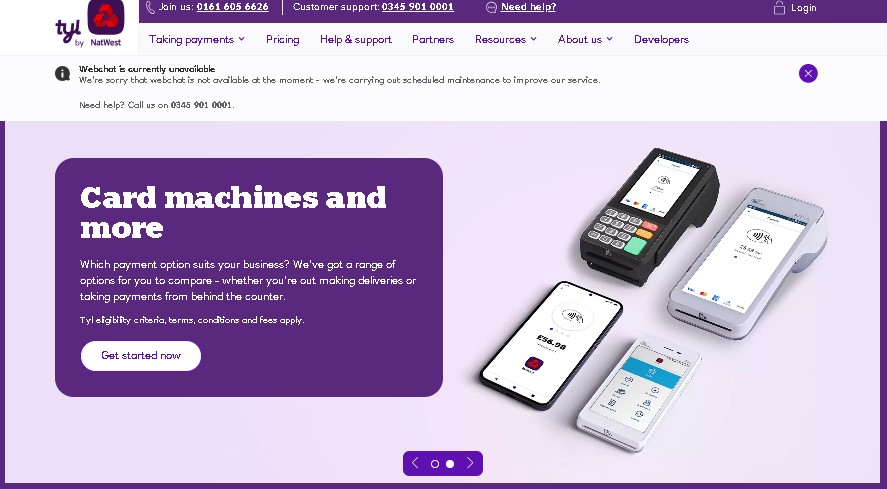
10. Tyl by NatWest
Tyl by NatWest provides a reliable path for UK businesses to secure high-quality merchant services through a trusted clearing bank.
It focuses on transparent pricing structures and providing straightforward, accessible data reporting for growing small businesses.
- Core Strengths: Fast onboarding for existing NatWest banking clients, transparent pricing tiers, and accessible UK-based customer assistance.
- Key Limitations: Native ecommerce extension choices are narrower compared to dedicated software-first competitors.
Which Payment Method is Mostly Used in the UK?
Debit cards remain the single most dominant payment method utilized across the United Kingdom consumer landscape, accounting for the vast majority of physical retail and online merchant service volumes.
Data from the UK Payment Systems Regulator (PSR) confirms that Visa and Mastercard debit networks form the foundational framework for daily consumer commerce.
However, consumer behaviors show rapid operational shifts toward integrated digital wallets, such as Apple Pay and Google Pay, which utilize secure tokenization protocols over Near Field Communication (NFC) bands.
Concurrently, account-to-account bank transfers powered by Open Banking infrastructure are expanding rapidly across the B2B sector, offering a streamlined payment method that bypasses traditional card network transaction clearing costs.
How to Choose the Best Payment Processing Companies for Your Business?
Finding the right card payment solution requires balancing your current sales framework against future growth projections. When evaluating providers, use these five operational pillars to guide your decision:
- Sales Channel Alignment: Pick hardware-heavy processors like Zettle or SumUp for brick-and-mortar setups, robust API-driven platforms like Stripe for e-commerce, or an omnichannel system like Square to sync physical and digital inventory in real time.
- Fee Optimization: If processing under £5,000 monthly, stick to predictable flat-rate, pay-as-you-go models to avoid fixed overheads. If processing over £10,000 monthly, migrate to an Interchange-Plus (Interchange++) structure to secure lower wholesale transaction rates.
- Payment Method Breadth: Ensure the processor natively handles standard networks (Visa, Mastercard, Amex), mobile wallets (Apple Pay, Google Pay) to increase mobile conversion, and Open Banking account-to-account transfers for B2B efficiency.
- Technical Integration: Look for seamless plug-and-play extensions if utilizing major platforms (Shopify, WooCommerce, Xero), or evaluate sandbox environments and comprehensive SDKs if building a custom proprietary checkout.
- Payout Speed & Support: Check standard settlement timelines (ranging from instant to 3 business days) for any hidden premium fast-clearing fees, and verify availability of 24/7 phone support to prevent revenue loss during peak trading failures.
Flat-Rate vs Interchange-Plus Pricing Structures
Understanding how fees are structured is critical to managing merchant processing overheads.
| Metric | Flat-Rate (PSP Model) | Interchange-Plus (Acquirer Model) |
| Pricing Predictability | Absolute. A fixed percentage covers every card type. | Variable. Reflects the underlying wholesale cost. |
| Wholesale Pass-Through | None. The provider pockets the markup variance. | Direct. Merchant pays the actual network cost + fixed fee. |
| Best Suited For | Micro-SMEs under £5,000 monthly volume. | Scaling businesses exceeding £10,000 monthly volume. |
| Cost Advantages | Highly predictable expenses with zero monthly overheads. | Substantial savings on basic domestic consumer debit cards. |
Spotting Hidden Merchant Fees
In practice, evaluating competing provider contract offers requires looking past the initial advertised headline rates. Hidden operational expenses can quickly erode expected processing margins if left unchecked.
Enterprises must carefully evaluate several secondary cost categories before committing to a provider:
- PCI DSS Compliance Fees: Monthly or annual administrative assessments levied to verify infrastructure data security protocols.
- Minimum Monthly Service Charges (MMSC): Baseline service minimums applied by traditional acquirers if gross transaction volumes fall below predefined contract quotas.
- Chargeback Administration Fees: Flat penalty charges (ranging from £15 to £25) applied automatically when a consumer disputes a completed card settlement.
FAQ
Who is the largest payment processing company globally operating in the UK?
Worldpay stands as the largest direct merchant processing entity operating inside the United Kingdom market. The institution clears over 40% of all domestic card transactions, providing the underlying transaction infrastructure for prominent high-street retailers and major enterprise networks.
Which is the best payment gateway in the UK for online stores?
Stripe serves as the industry standard for online merchant platforms due to its highly flexible developer tools and secure APIs. For large enterprise networks requiring advanced optimization, Adyen or Checkout.com offer powerful direct clearing options.
What is the full form of PG in payment terminology?
The term PG stands for Payment Gateway. It represents the secure frontend software layer responsible for capturing, encrypting, and transmitting sensitive card data safely from a website or terminal to the backend processing network.
How do payment processing companies protect against fraud?
Processors utilize real-time risk assessment frameworks, checking geographical points, order values, and spending velocity profiles. They employ 3D Secure 2 (3DS2) protocols to satisfy Strong Customer Authentication requirements, protecting merchants from unauthorized card usage liability.
What is the alternative to Stripe in the UK?
The most prominent alternative to Stripe for digital commerce configurations is Checkout.com. For small-scale businesses or mixed brick-and-mortar operations, Square UK offers an accessible plug-and-play payment infrastructure alternative without ongoing monthly system dependencies.