
How Much Tax Will I Pay on 60,000 Redundancy? Complete HMRC Breakdown & Take-Home Pay
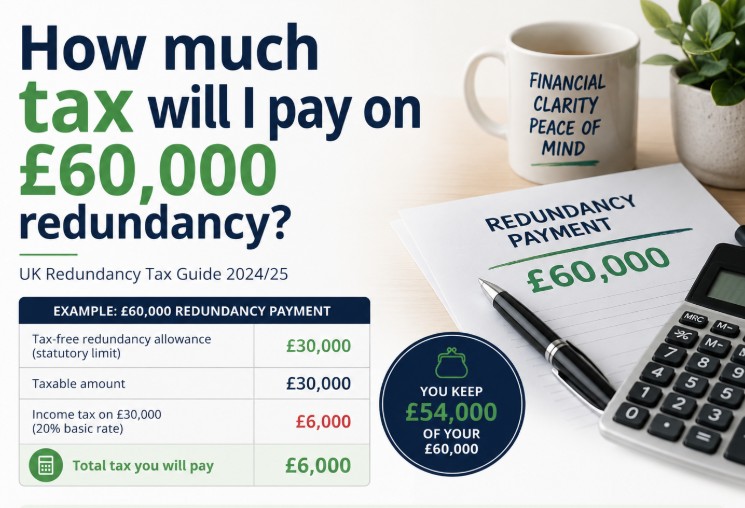
On a £60,000 redundancy payout in the UK, the first £30,000 is completely tax-free under HMRC regulations, with the remaining £30,000 taxed at your normal marginal Income Tax rate. Crucially, genuine severance payments are entirely exempt from employee National Insurance.
Depending on your total earnings for the tax year, standard Income Tax on the taxable half usually works out to £6,000 for basic-rate earners and £12,000 or more for those in higher tax bands.
Key Takeaways
- Under official HMRC guidance, the initial £30,000 of a genuine redundancy payout remains completely exempt from Income Tax and National Insurance.
- The taxable £30,000 balance is subject to standard Income Tax rates of 20%, 40%, or 45%, but incurs zero employee National Insurance deductions.
- Employer payroll systems frequently apply emergency 0T month 1 tax codes to lump sums, causing significant temporary overpayments of tax.
- Directing taxable redundancy funds into a registered pension scheme via salary sacrifice can legally reduce total tax and preserve Personal Allowance, though it is wise to remain aware of upcoming pension inheritance tax changes when structuring long-term retirement wealth.
What is Redundancy?
Redundancy is a no-fault termination occurring when a position is no longer required. Statutory redundancy pay requires 2 years of continuous service, calculated using a formula based on age, service length, and weekly pay limits.
Under UK employment law, common scenarios that lead to genuine redundancy include:
- Closure: The employer closes the business entirely, or closes a specific location or site.
- Reduced Demand: The business requires fewer employees to perform a particular type of work due to economic downturns, restructuring, or technological automation.
- Reorganisation: Roles are restructured, combined, or redefined, often seen during corporate restructuring or when businesses realign budgets away from initiatives like R&D tax credits toward core operations, making existing positions obsolete.
Because redundancy is a no-fault termination, UK employment law gives qualifying staff specific statutory protections, notice periods, and financial compensation.

How Does Redundancy Pay Work?
Redundancy occurs when an employer reduces their workforce because a job itself is no longer required. Common scenarios include business closures, reduced demand, or company reorganisations.
1. Statutory Redundancy Pay
By law, you are entitled to statutory redundancy pay if you have worked continuously for your employer for at least 2 years. The amount you receive is calculated using a formula based on your age, length of service (capped at 20 years), and weekly pay (subject to a government-set maximum cap updated annually):
- Under Age 22: 0.5 week’s pay for each full year of service.
- Ages 22 to 40: 1 week’s pay for each full year of service.
- Age 41 and Older: 1.5 weeks’ pay for each full year of service. (Service is capped at 20 years, and weekly pay is subject to an annual UK government maximum cap).
2. Enhanced (or Company) Redundancy Pay
Many employers offer enhanced redundancy packages above the statutory minimum as part of employment contracts or settlement agreements. Regardless of whether your payout is purely statutory or enhanced by your employer, the exact same tax rules apply.
How much tax will I pay on 60,000 redundancy?
HMRC splits a £60,000 severance payout into two equal £30,000 parts: a tax-free statutory portion and a taxable balance. How much Income Tax you pay on the taxable £30,000 depends entirely on your total annual earnings for the tax year.
Under UK tax law, genuine redundancy pay qualifies for a specific tax-free exemption. When receiving a lump-sum severance package of £60,000, HMRC splits the payment into two distinct buckets:
- The Tax-Free Portion: The first £30,000 is 100% exempt from both Income Tax and employee National Insurance Contributions (NICs).
- The Taxable Portion: The remaining £30,000 is treated as taxable earnings for Income Tax purposes, added on top of any regular income earned during the tax year.
| Payout Breakdown | Total Amount | HMRC Income Tax Treatment | Employee National Insurance |
| Tax-Free Portion | £30,000 | Exempt (0% Tax) | Exempt (0% NI) |
| Taxable Portion | £30,000 | Taxed at Marginal Rate (20% – 45%) | Exempt (0% NI) |
| Total Redundancy Package | £60,000 | £6,000 to £15,000 Total Tax | £0 Total Employee NI |
Note: Voluntary redundancy pay follows the exact same HMRC rules as compulsory redundancy; your choice to accept voluntary status does not change the £30,000 tax-free limit.

How Much Tax Will I Pay on 60,000 Redundancy Across Different Earnings?
Your marginal rate under current UK tax bands determines your final take-home pay on a £60,000 redundancy payout. Basic rate earners pay £6,000 to £7,946 in tax, higher rate earners pay £12,000, and those earning near £85,000 face the £100,000 taper trap, paying up to £15,000.
Because the UK uses a progressive tax system, the taxable £30,000 redundancy portion sits on top of your regular annual salary, potentially pushing you into higher tax brackets.
| Total Annual Salary (Excl. Redundancy) | Tax-Free Portion | Taxable Redundancy | Marginal Tax Band | Total Tax Paid on Redundancy | Net Take-Home Redundancy |
| £20,000 | £30,000 | £30,000 | Basic Rate (20%) | £6,000 | £54,000 |
| £30,000 | £30,000 | £30,000 | Basic (20%) & Higher (40%) | £7,946 | £52,054 |
| £50,000 – £70,000 | £30,000 | £30,000 | Higher Rate (40%) | £12,000 | £48,000 |
| £85,000 | £30,000 | £30,000 | Higher Rate & Taper Trap (60% Eff.) | £15,000 | £45,000 |
| £130,000+ | £30,000 | £30,000 | Additional Rate (45%) | £13,500 | £46,500 |
Scenario A: Basic Rate Taxpayer (Annual Salary of £30,000)
A worker earning an annual salary of £30,000 who receives a £60,000 redundancy package will see the initial £30,000 pass completely tax-free. The remaining £30,000 taxable redundancy is added to the annual salary (£30,000 + £30,000 = £60,000 total income).
- The first £20,270 of the taxable redundancy falls within the remaining Basic Rate band (up to £50,270) and is taxed at 20% (£4,054).
- The remaining £9,730 crosses into the Higher Rate band (40%) and is taxed at 40% (£3,892).
- Total Income Tax paid on redundancy: £7,946. Total net redundancy take-home: £52,054.
Scenario B: Higher Rate Taxpayer (Annual Salary of £50,000 to £60,000)
An employee who already earns £50,000 annually has virtually used up their Basic Rate threshold.
- The entire taxable £30,000 redundancy portion falls straight into the Higher Rate tax band (40%).
- Income Tax calculated on redundancy: £30,000 × 40% = £12,000.
- Total net redundancy take-home: £48,000.
Scenario C: The £100,000 Personal Allowance Taper Trap
For individuals whose total annual income (regular salary plus taxable redundancy) exceeds £100,000, HMRC reduces the standard £12,570 Personal Allowance by £1 for every £2 of income above £100,000.
In practice, a professional earning £85,000 who receives a £60,000 payout (£30,000 taxable) reaches a total adjusted gross income of £115,000. This triggers the taper trap:
- Loss of £7,500 of Personal Allowance, exposing an extra £7,500 of income to 40% tax.
- Effective tax rate on the income within the £100,000–£125,140 bracket reaches an effective 60% rate.
- Total Income Tax on the redundancy portion rises to £15,000.
The Employee National Insurance Exemption
UK employees pay 0% National Insurance on all qualifying redundancy payouts, including amounts over £30,000. Employers, however, must pay Class 1A Employer National Insurance at 13.8% on the taxable portion above £30,000.
Under UK tax legislation, employees pay 0% National Insurance on genuine qualifying redundancy pay, even on amounts exceeding the £30,000 exemption threshold.
However, employers incur a separate Class 1A Employer National Insurance contribution liability (13.8%) on any redundancy amount paid above £30,000. This additional cost falls solely on the company and is never deducted from your personal settlement.
Which Parts of Your Redundancy Package Are Taxed Differently?
Not all lump sums on a final payslip count as redundancy pay. Statutory and enhanced redundancy get the £30,000 tax-free exemption, but Pay instead of Notice (PILON), holiday pay, and unpaid bonuses are 100% taxable for Income Tax and National Insurance.
A final settlement payslip often combines several items into a single bank transfer, but HMRC mandates that different components be taxed separately:
| Settlement Component | Tax Treatment | Employee National Insurance |
| Statutory Redundancy Pay | Tax-free up to £30,000 (combined) | Exempt (0% NI) |
| Enhanced (Company) Redundancy | Tax-free up to £30,000 (combined) | Exempt (0% NI) |
| PILON / PENP (Notice Pay) | 100% Taxable as Regular Earnings | Full Class 1 NICs Apply |
| Accrued Annual Leave / Holiday Pay | 100% Taxable as Regular Earnings | Full Class 1 NICs Apply |
| Unpaid Wages & Outstanding Bonuses | 100% Taxable as Regular Earnings | Full Class 1 NICs Apply |
Pay Instead of Notice (PILON) and PENP Rules
Any payment made instead of working a notice period (PILON) is classified as Post-Employment Notice Pay (PENP). These payments are treated as standard employment earnings and do not qualify for the £30,000 tax-free exemption.
If £10,000 of your £60,000 agreement is allocated to notice pay, only the remaining £50,000 qualifies under redundancy tax rules (£30,000 tax-free + £20,000 taxable redundancy).
Student Loan Deductions on £60,000 Redundancy
The £30,000 taxable portion of your payout counts as income towards student loan repayments. While HMRC completely ignores the initial £30,000 tax-free sum, payroll systems treat the remaining £30,000 balance as earnings for the pay period.
Standard repayment rates, typically 9% for undergraduate loans (Plans 1, 2, and 5) or 6% for Postgraduate loans, will automatically be deducted on anything above your threshold for that pay run.
How to Avoid or Reduce Tax on Redundancy Payments Legally?
You can legally reduce your Income Tax on a £60,000 redundancy payment to zero by using pension salary sacrifice or by negotiating payment dates across tax years to utilize fresh tax allowances.
Step-by-Step Guide to Redundancy Pension Sacrifice
- Calculate the Taxable Portion: Identify the exact amount of statutory and enhanced redundancy pay exceeding £30,000 (e.g., £30,000 excess on a £60,000 package).
- Request Employer Pension Sacrifice: Ask the employer’s HR or payroll team to pay part or all of the taxable redundancy directly into a registered pension scheme as an employer pension contribution.
- Verify Annual Allowance Limits: Check that the intended contribution stays within the HMRC Annual Pension Allowance limit (or use carry-forward rules for unused allowances from the past three tax years).
- Negotiate Employer NI Sharing: Request that the employer add a portion of their saved 13.8% Employer National Insurance onto the pension contribution.
- Finalise the Settlement Agreement: Ensure the written redundancy agreement explicitly records the pension sacrifice arrangement before the official termination date.
- Confirm PAYE Processing: Review the final pay slip to verify that the pension contribution was subtracted prior to calculating Income Tax deductions.
By redirecting the taxable £30,000 into a pension, Income Tax on that portion is reduced to zero immediately. Furthermore, for employees earning near £100,000, pension contributions lower adjusted net income, preserving the £12,570 Personal Allowance and avoiding the 60% tax trap.

Standard Cash Payout vs. Pension Sacrifice Strategy
When dealing with a £60,000 redundancy payment, comparing a standard lump-sum cash payout against a targeted pension sacrifice strategy highlights how much tax you can legally save.
Option A: Standard Cash Payment
- Tax-Free Cash: The initial £30,000 is paid directly to you with 0% Income Tax and 0% National Insurance.
- Taxable Cash: The remaining £30,000 is treated as taxable earnings. If taxed at the 40% Higher Rate band, HMRC deducts £12,000 in Income Tax.
- Net Financial Outcome: You receive a £48,000 total net take-home payment (£30,000 tax-free cash + £18,000 after-tax cash).
Option B: Pension Sacrifice Strategy
- Tax-Free Cash: The initial £30,000 is paid directly to you as tax-free cash.
- Pension Contribution: The remaining taxable £30,000 is paid directly into your registered pension scheme by your employer prior to tax processing.
- Immediate Tax Paid: £0 Income Tax is paid on the pension contribution at the point of exit.
- Net Financial Outcome: You retain £60,000 in total value (£30,000 immediate tax-free cash in your bank + £30,000 invested directly into your pension pot).
Timing Redundancy Payments Across Tax Years
If your employment ends near the end of the UK tax year (March or April), negotiating to receive your payout after April 6th allows you to apply a fresh Personal Allowance and lower tax bands in the new tax year, particularly helpful if you anticipate a temporary break from working.
Why Has Emergency Tax (0T Code) Been Applied to Your Pay?
Employers often process lump-sum severance payments after issuing your P45 using an emergency 0T Month 1 tax code. Because payroll software assesses the payout in isolation, it misinterprets a single £30,000 taxable lump sum as a recurring monthly salary (£360,000 a year), triggering a massive temporary over-deduction of tax.
- Employer processes £30,000 taxable redundancy payment after issuing P45
- Payroll software assumes £30,000 is an ongoing MONTHLY salary (£360,000 annualised)
- System applies 0T Month 1 tax code, granting zero Personal Allowance
- System deducts 40% and 45% tax on the lump sum (Overcollection occurs)
- Employee submits HMRC Form P50 / P53 or waits for automated year-end PAYE refund
How to Reclaim Overpaid Redundancy Tax from HMRC?
You can reclaim emergency tax paid on redundancy directly from HMRC online. Use Form P50 if unemployed, Form P53/P55 if retiring or taking pension funds, or hand your P45 to a new employer for an automatic PAYE refund.
- If remaining unemployed: Complete HMRC Form P50 online via a Personal Tax Account if out of work for at least 4 weeks.
- If retiring or taking full pension flexibility: Submit HMRC Form P53 or P55 depending on whether the pension pot was fully emptied.
- If starting a new job immediately: Hand the P45 to the new employer; HMRC will automatically adjust the tax code and refund excess tax through PAYE in subsequent pay packets.
- Self Assessment: Alternatively, claim back excess tax by listing termination payments on the annual Self Assessment tax return.
How is Redundancy Pay Collected?
Active employers pay redundancy directly via PAYE into your bank account on your final day or next payroll date. If your employer is insolvent, you claim statutory payments directly from the government Redundancy Payments Service (RPS).
1. Standard Payment Method (Active Employer)
Under normal circumstances, your employer pays your redundancy settlement directly to you, you do not need to make a formal application to HMRC or the government.
- Payroll Processing: Payment is processed through your employer’s normal Pay As You Earn (PAYE) payroll system and deposited directly into your designated bank account.
- Payment Schedule: Redundancy pay is usually remitted on or before your final contractual day of employment, or on the next regular company payday immediately following your termination date.
- Written Statement: UK law mandates that your employer provide a written breakdown explaining exactly how your payment was calculated (including years of service, weekly wage figure used, tax deductions, and enhanced elements).
2. Collecting Unpaid Redundancy (Employer Refusal or Dispute)
If your employer fails or refuses to pay the agreed statutory or contractual redundancy sum:
- Formal Written Request: Send a formal letter/email to your employer requesting payment and providing evidence of your entitlement (e.g., contract, length of service, P45).
- ACAS Early Conciliation: Contact ACAS (Advisory, Conciliation and Arbitration Service) to resolve the dispute informally.
- Employment Tribunal: If conciliation fails, you can submit a claim to an Employment Tribunal.
-
- Deadline for Statutory Redundancy Pay: Within 6 months minus 1 day of your official employment end date.
- Deadline for Contractual/Enhanced Pay: Within 3 months minus 1 day of your employment end date.
3. Collecting Redundancy Pay If Your Employer Goes Insolvent
If your employer goes out of business, enters administration, or becomes insolvent, you collect your redundancy pay directly from the UK government’s Redundancy Payments Service (RPS), funded by the National Insurance Fund.
- Obtain a Case Reference Number (CN): The appointed Insolvency Practitioner (liquidator or administrator) will give you a unique CN reference number.
- Online Application (Form RP1): Submit an online claim on GOV.UK using Form RP1 to claim statutory redundancy pay, holiday pay, and arrears of wages.
- Notice Pay Claim (Form RP2): If applicable, you will be invited to complete Form RP2 to claim statutory notice pay.
- Processing Time: The RPS typically processes claims and transfers funds directly to your bank account within 6 weeks of receiving the necessary information.
Note on Government RPS Limits: Statutory redundancy payments made by the RPS are subject to statutory caps on weekly earnings and total payout allowances set by government legislation. Any amount owed above statutory limits can be registered as an unsecured creditor claim with the liquidator.

Conclusion
Receiving a £60,000 redundancy package provides a substantial financial buffer, but understanding HMRC rules ensures you retain as much of it as possible while staying clear of unexpected HMRC tax probes.
Remember that while the first £30,000 is tax-free, the remaining £30,000 is subject to Income Tax, though entirely exempt from employee National Insurance.
What to Do Next?
- Audit Payment Categorisation: Check that redundancy pay, PILON, and holiday pay are separately itemised in the contract.
- Explore Pension Sacrifice: Discuss paying part of the taxable £30,000 balance directly into a pension with your employer before the termination date.
- Check Tax Codes: Prepare for potential emergency 0T tax deductions and keep forms P50/P53 ready for rapid HMRC refund claims.
Disclaimer: This guide provides general information for educational purposes only and does not constitute formal financial or legal advice.
FAQ
Is voluntary redundancy taxed differently from compulsory redundancy in the UK?
No. HMRC applies the exact same tax rules to both voluntary and compulsory redundancy payments. The first £30,000 remains completely tax-free, with the balance taxed at your marginal Income Tax rate.
How is statutory redundancy pay calculated, and is there a statutory cap?
Statutory redundancy pay is calculated based on age, length of service (capped at 20 years), and weekly earnings. Weekly earnings are subject to a statutory cap, updated annually by the UK government.
Does a £60,000 redundancy payment count towards student loan repayments?
Yes, the taxable portion (£30,000) counts as unearned or termination income for student loan calculations. Unaccredited payroll software will deduct Plan 1, Plan 2, Plan 5, or Postgraduate loan repayments on earnings above thresholds.
What is the 4-week rule for redundancy in the UK?
The 4-week rule allows employees to undertake a trial period in an alternative role offered by the employer. If either party deems the role unsuitable within 4 weeks, statutory redundancy rights are retained.
Can I negotiate my redundancy package to maximize my tax-free payout?
Yes, you can negotiate the structure of your settlement agreement. Requesting higher enhanced redundancy pay instead of non-essential bonuses maximizes the tax-free £30,000 allowance allocation.
When should I receive my final redundancy payment in the UK?
Redundancy payments should be remitted on your agreed final contractual date of employment or on the company’s next regular payroll run following termination, as specified in your settlement agreement.