
Business Card Size Specs: The Complete Guide To Perfect UK Dimensions, Pixels, And Bleeds
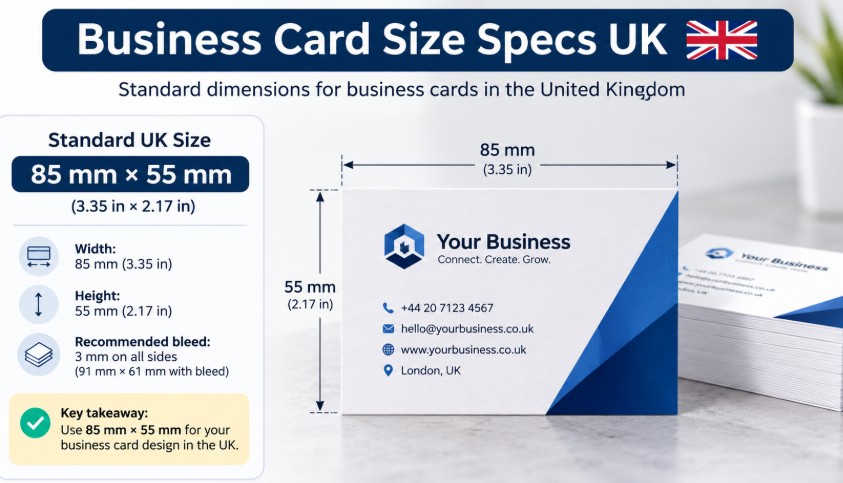
The definitive standard for physical business card size specs in the UK is 85mm wide by 55mm high. This footprint translates precisely to 8.5cm by 5.5cm or 3.35 inches by 2.17 inches.
This metric standard ensures the card matches the scale of a standard UK debit card, allowing it to slide smoothly into modern wallets and cardholders without catching on the edges.
Key Takeaways
- The standard finished print size for a business card across the UK and Europe measures exactly 85mm wide by 55mm high.
- Commercial print presses require a mandatory 3mm bleed allowance on all four sides, creating a total initial layout of 91mm by 61mm.
- Digital design files must be configured to a high-resolution canvas size of 1075 by 721 pixels when printing at the industry standard 300 DPI.
- Premium corporate stationery demands a heavy paper weight of 350GSM to 400GSM to project professional authority and long-term durability.
What are the Business Card Size Specs UK?
The definitive standard for a physical business card in the UK is 85mm wide by 55mm high. This exact footprint translates precisely to 8.5cm by 5.5cm or 3.35 inches by 2.17 inches.
This metric footprint is universally adopted by commercial printers throughout the United Kingdom and continental Europe.
Setting up files at this scale ensures the finished product matches the standard dimensions of a UK debit card, allowing it to slide cleanly into modern wallets, cardholders, and retail display sleeves without catching on the edges.
Standard Business Card Size in MM and CM
In metric terms, the standard trimmed business card size in the UK is exactly 85mm x 55mm, which equates directly to 8.5cm x 5.5cm.
For high-precision cutting, vector graphic asset creation, and layout alignment, professional structural printing frameworks rely heavily on these precise metric values.
When adjusting grid settings in everyday office publishing software, setting the dimensions to exactly 8.5cm by 5.5cm guarantees a standard local print output.
Business Card Size Specs UK in Inches
The exact imperial measurement for a standard UK business card size is 3.35 inches by 2.17 inches.
Unlike North American formats, standard UK cards do not follow a generic 2×3 inch or 3×5 inch layout matrix. By comparison, American printing metrics rely on a standard 3.5 x 2 framework.
Attempting to format a UK print file using a standard US template will cause severe text clipping or stretched imagery during local production.

What Is the Size of a UK Bank Card vs a Business Card?
A standard UK bank card measures 85.60mm x 53.98mm (ISO/IEC 7810 ID-1 standard), while a standard UK business card measures 85mm x 55mm, making the business card slightly narrower by 0.60mm and taller by 1.02mm.
While commercial calling cards do not match local financial cards identically, the minor fractional variance in millimetres ensures business cards maintain near-perfect slot compatibility with standard leather wallets, travel wallets, and plastic ID display badges.
| Region or Card Type | Standard Dimensions (Metric) | Standard Dimensions (Imperial) | Primary Use Case |
| United Kingdom & Europe | 85mm x 55mm | 3.35 x 2.17 | UK Standard Corporate Networking |
| United States & Canada | 88.9mm x 50.8mm | 3.50 x 2.00 | North American Exchanges |
| ISO/IEC 7810 ID-1 Spec | 85.60mm x 53.98mm | 3.37 x 2.12 | UK Credit and Debit Cards |
| Australia & New Zealand | 90mm x 55mm | 3.54 x 2.17 | Oceania Region Networking |
What Is the Standard Business Card Size in Pixels for Digital Design?
To print a sharp UK business card, the canvas must be set to a minimum resolution of 300 DPI (Dots Per Inch), which translates to a digital design layout size of 1004 x 650 pixels for the final trimmed area.
When creating artwork in raster editing software, relying on web-grade screen resolution (like 72 DPI or 150 DPI) causes the finished card to print out blurry or pixelated. Rendering at 300 DPI preserves crisp typography down to tiny 6pt fonts.
What Is 300 DPI in Pixels for a Standard UK Business Card?
At a 300 DPI print profile, a standard UK business card requires a final trimmed resolution of 1004 x 650 pixels, expanding to 1075 x 721 pixels when factoring in the required 3mm print bleed.
The clean-cut boundary is 1004 x 650 pixels. However, to account for mechanical shifts during automated high-speed blade cutting, you must append 36 additional pixels to each outer border edge. This brings your true document creation setup profile to exactly 1075 x 721 pixels.

What are Business Card Size Variations?
The four main business card size variations used in the UK are the Standard Format (85mm x 55mm), the Square Format (55mm x 55mm), the Slim/Mini Format (85mm x 25mm), and the Folded Format (170mm x 55mm flat).
- Standard Format (85mm x 55mm): The classic UK standard. Highly professional, universally compatible with wallet slots, and cost-effective to print.
- Square Format (55mm x 55mm): A modern, symmetrical alternative that instantly stands out. It is highly popular among artists, photographers, and design agencies. Note: It may not slide easily into all traditional wallet slots.
- Slim/Mini Format (85mm x 25mm): Sleek and ultra-minimalist. These cards strip away clutter, making them perfect for clean, modern branding or as unique packaging inserts.
- Folded Format (170mm x 55mm when flat): Folded down the middle to match standard credit card size, this style acts like a mini-brochure. It is ideal for showcasing a brief menu of services, appointment slots, or a map.
Things to Consider While Designing
When designing a UK business card, you must construct your file in the CMYK color space, account for a 3mm bleed margin, maintain a 3mm inner safe zone, use high-contrast legible typography, and incorporate plenty of white space.
- Set the Correct Color Space: Always configure your design software to CMYK (for physical printing ink) rather than RGB (which is meant for digital screens). This prevents unexpected colour shifts during production.
- Account for the Bleed & Safe Zones: Extend all background colours and imagery to the 91mm x 61mm bleed limit. Keep your text, icons, and essential details at least 3mm inside the cut lines (within a 79mm x 49mm safe zone).
- Typography and Contrast: Avoid extremely thin, decorative, or cursive fonts for your contact details, as they can lose crispness on paper. Maintain high contrast between your text and background to guarantee clear readability under any light.
- Keep It Clean (Embrace White Space): Resist the urge to fill every square millimetre. Negative space prevents visual clutter, making the card look significantly more premium and easier to read.
How to Choose the Right Size?
To choose the right business card size, match the physical shape to your industry: use the Standard 85mm x 55mm layout for corporate, legal, or financial trust, and alternative shapes like Square (55mm x 55mm) or Slim (85mm x 25mm) for creative, modern, or artistic fields.
| Card Size & Shape | Best For | Audience & Networking Impact |
| Standard (85mm x 55mm) | Corporate, legal, finance, healthcare, and traditional business consulting | Fits perfectly into wallets; highly practical and trusted by traditional clients. |
| Square (55mm x 55mm) | Designers, photographers, architects, and high-end boutique brands | Highly memorable and artistic; establishes a progressive, design-first brand image. |
| Slim (85mm x 25mm) | Tech startups, modern retail brands, and lifestyle influencers | Feels sleek, tactile, and distinct; great for a minimalist presentation. |
| Folded (170mm x 55mm) | Dentists, salons, tradespeople, and service providers offering loyalty programs | Doubles as a functional tool (appointment reminders, loyalty stamps) that customers keep. |
What Are the Exact Bleed, Trim, and Safe Zone Specs for Printing?
The structural template zones for a standard UK business card consist of a Bleed Line (91mm x 61mm), a Trim Line (85mm x 55mm), and a Safe Zone (79mm x 49mm).
To prepare your print files for high-speed mechanical cutting machinery, you must organize your design across three distinct structural boundaries:
- Bleed Zone: Extends exactly 3mm beyond the final boundaries on all four edges. Background solid fills and images must extend into this space to avoid showing white slivers if the blade shifts.
- Trim Parameter: The physical path where the cutting mechanism drops down, slicing the stock precisely to the 85mm x 55mm specification.
- Safe Zone Boundary: A protective buffer zone placed an additional 3mm inside the cut lines. Keeping key text inside this 79mm x 49mm window prevents details from being cut off by mechanical shifting.
How Does a 3mm Bleed Margin Alter Your Full Artwork Canvas Size?
Adding a mandatory 3mm print bleed to all four sides of a standard 85mm x 55mm document increases your initial creation canvas layout size to exactly 91mm x 61mm.
When building templates in vector platforms like Adobe Illustrator or InDesign, you can automatically add a 3mm bleed margin inside the document setup window.
If you are constructing flat graphics inside Photoshop or Canva, you will need to map these dimensions out manually from the start:
- Open software document settings -> Set baseline dimensions to 85mm x 55mm.
- Add 3mm bleed limits to the top, bottom, left, and right fields.
- Confirm total canvas profile scales upward to 91mm x 61mm.
- Draw interior ruler guides at 3mm inside the trim line to establish a 79mm x 49mm safe area.
- Drag background imagery all the way to the 91mm outer edge.
- Keep typography, logotypes, and core brand identifiers strictly within the 79mm x 49mm inner safe area.
What Paper Weight and Layout Yields a Professional Finish?
A professional business card finish requires a baseline paper density of 350GSM to 400GSM to ensure structural rigidity.
The layout must feature high-contrast typography sized between 8pt and 14pt, leave 30% to 40% open white space, and restrict all text inside a 3mm internal safe printing zone (79mm x 49mm) to prevent accidental edge clipping during trimming.
Is 250GSM Good for Business Cards or Should You Aim Higher?
No, 250GSM stock is too thin, light, and flexible for high-quality professional business cards. To achieve an executive, durable finish that won’t easily bend, you should specify a baseline density of 350GSM to 400GSM.
Paper density is measured in Grams per Square Metre (GSM). Lower 250GSM stock is better suited for marketing flyers or brochure sheets.
Opting for a premium 350GSM to 400GSM rigid board provides a sturdy feel that signals quality during professional introductions.
What Is a Good Layout for a Business Card to Ensure Readability?
An effective corporate layout balances white space with clear information hierarchy. When reviewing layouts, a clean arrangement should place your logo and company name in a prominent position.
You can keep the layout clean by leaving off obsolete URL prefixes like https:// from your domain text.
| Paper Stock Weight | Rigidity & Quality Grade | Practical Applications | Recommendation for Corporate Use |
| 130GSM – 170GSM | Very Low; thin paper consistency | Promotional brochures, takeaway menus, and corporate direct mail | Unsuitable; wrinkles quickly and feels low quality |
| 200GSM – 250GSM | Moderate; mid-weight brochure cover sheet | Economy postcards, entry-level handouts, and retail tags | Poor choice; lacks the structural durability needed for networking |
| 350GSM – 400GSM | Premium; rigid commercial card standard | Professional executive business stationery and loyalty assets | Highly Recommended; industry standard for premium durability |
| 450GSM – 600GSM+ | Luxury; double-thick duplex bonded boards | Bespoke luxury brand assets, blind debossing, and edge-gilding | Recommended; excellent for high-end boutique brands |
How to Choose the Right Business Card Templates?
Selecting the perfect template is about balancing visual style with practical layout requirements. Consider these key steps when choosing a design template for your brand:
- Assess Content Requirements: If you only need to show a name, title, and single contact method, choose a minimalist, spacious template. If you have a physical address, social handles, or a QR code, opt for a double-sided template to split the text cleanly.
- Prioritize Visual Hierarchy: Choose a template that naturally guides the reader’s eye. The brand logo or your name should be the most prominent element, followed by your job title and contact details in a highly readable, clean font.
- Industry Alignment: Ensure the template’s aesthetics match your business sector. A corporate financial or legal template should feature structured lines, traditional typography, and subtle tones. Creative fields can benefit from bold colour blocks, vertical orientations, or asymmetric layouts.
- Print-Ready Setup: Only select templates that explicitly include 3mm bleed lines and pre-configured safe zones. Relying on templates built strictly to on-screen dimensions without bleed margins will lead to printing errors.
Conclusion
When designing a business card for the UK market, setting your document setup parameters to 85mm x 55mm is the best way to ensure an accurate print run.
If you are using digital design software, make sure to add a 3mm bleed margin around the entire canvas (bringing your file layout to 91mm x 61mm) and keep all essential branding elements inside the 79mm x 49mm safe print area.
For your paper choice, opting for a sturdy 350GSM matte or silk stock will ensure a clean, professional finish that stands up to regular handling.
Disclaimer: The dimensions and pricing figures provided are for general educational reference only; always verify template requirements with your chosen commercial printer before running a final press batch.
FAQ
What is the proper size of a business card?
The proper standard size across the UK and mainland Europe is 85mm x 55mm. In North American regions, the correct standard is 3.5 inches by 2 inches.
What is the normal business card size in cm?
The standard metric dimensions are exactly 8.5cm horizontally by 5.5cm vertically. Including a standard 3mm print bleed increases the production layout size to 9.1cm x 6.1cm.
Are business cards 2×3?
No. While some custom novelty options exist, a standard UK card measures 3.35 x 2.17. A 2×3 inch layout is narrower and will not align with standard UK print templates.
Is 250GSM good for business cards?
No, 250GSM stock is generally too lightweight and flexible for professional cards. It is better to use 350GSM to 400GSM paper to ensure your cards feel sturdy and premium.
Are US and UK business cards the same size?
They are not the same size. US cards measure 88.9mm x 50.8mm, making them wider and shorter than the standard UK dimensions of 85mm x 55mm.
What is a good layout for a business card?
A clean layout places your brand logo in a prominent position, uses clear typography between 8pt and 14pt, and includes plenty of breathing space to stay readable.
What is the size of a UK bank card?
A standard UK bank card is manufactured to CR80 specifications, measuring 85.60mm x 53.98mm. This makes it roughly the same size as a standard 85mm x 55mm business card.
What is 300 dpi in pixels for a business card?
At 300 DPI, a clean UK cut size translates to 1004 x 650 pixels. Adding a standard 3mm bleed expands the required full canvas layout to 1075 x 721 pixels.
Is a business card 3×5?
No, 3×5 inches is the standard size for index reference cards. Standard business cards are much smaller to ensure they fit neatly inside standard wallet slots.
How many business cards per 8.5 x 11?
An 8.5 x 11 sheet (US Letter) fits up to 10 standard US cards. However, UK printers use standard metric A4 stock, which holds 10 standard UK cards (85mm x 55mm) per page when factoring in trimming margins.
How much do business cards cost in the UK on average?
As of 2026, a standard digital print run of 250 basic cards on 350GSM stock ranges from £15 to £30. Premium choices with specialized lamination or custom foil finishes typically start around £45 to £70 per batch.