
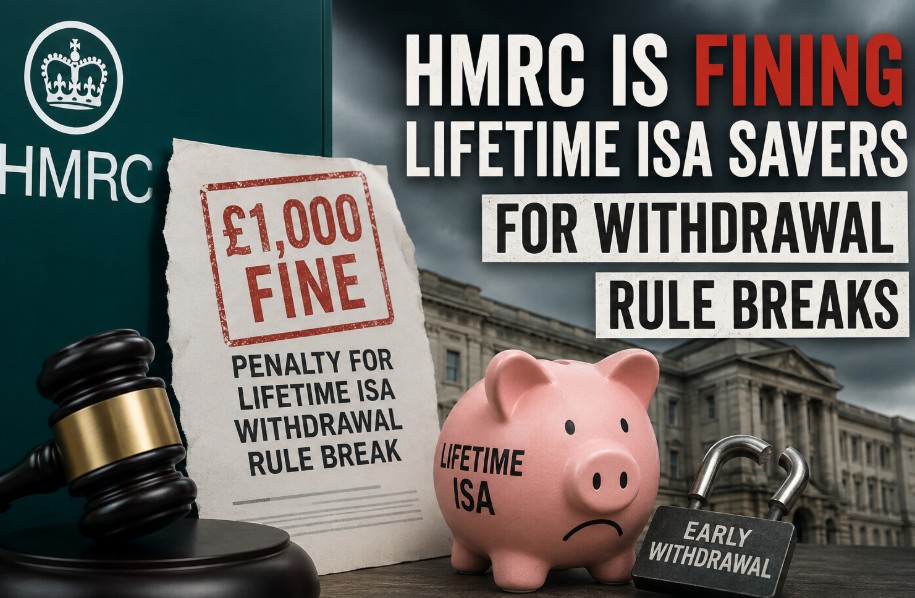
Why HMRC Is Fining Lifetime ISA Savers for Withdrawal Rule Breaks?
A worrying trend has emerged across the UK financial landscape as HMRC is fining Lifetime ISA savers for withdrawal rule breaks. The Lifetime ISA (LISA) offers a generous 25% government bonus on annual contributions up to £4,000, designed specifically to help adults aged 18 to 39 buy their first home or save for retirement.
However, if a saver withdraws funds for any other reason, known legally as an unauthorised withdrawal, HMRC applies a strict 25% government withdrawal charge on the total amount removed.
This structural review reorganises your complete draft into an elite, high-ranking SEO content blueprint.
Key Takeaway
- HMRC applies a strict 25% penalty on unauthorized Lifetime ISA (LISA) withdrawals, often triggered by financial emergencies or crossing the frozen £450,000 property cap.
- The fee reclaims the entire state bonus and inflicts an effective 6.25% net loss on your original personal savings.
- Withdrawals are only penalty-free for a first home under £450,000 (after 12 months), reaching age 60, or terminal illness.
- The system is under review; HM Treasury is actively consulting on reforms to eliminate these capital penalties.
Why HMRC Is Fining Lifetime ISA Savers for Withdrawal Rule Breaks?
HMRC is fining Lifetime ISA (LISA) savers because any fund withdrawal made outside of purchasing a first residential home worth up to £450,000, turning age 60, or terminal illness is legally classified as an unauthorised withdrawal.
These rule breaks trigger automatic HMRC ISA penalties via a 25% statutory withdrawal charge, which reclaims the state bonus and dips directly into the saver’s personal capital.
Because the Lifetime ISA is highly illiquid, savers who use it as a general savings pot rather than a dedicated long-term vehicle find themselves trapped by the rules when an emergency strikes.
Additionally, an ongoing freeze on the property price cap has pushed many buyers to look at homes above the qualifying threshold. This leaves them with no choice but to break the rules and face fines just to access their own deposit money.
What Is the Lifetime ISA Withdrawal Penalty?
The Lifetime ISA withdrawal penalty is a mandatory 25% exit fee applied by HM Revenue and Customs (HMRC) to any non-qualifying cash or asset extraction from a LISA wrapper.
The charge is automatically deducted at source by the account provider and returned directly to the state to recover the initial 25% government bonus plus a 6.25% penalty fee on the investor’s core personal capital.
How Does It Work?
The mathematical reality of this structural fine catches many young investors off guard. Because the government bonus adds 25% to your base contribution, it represents exactly 20% of the newly formed total pot.
For example, if an individual deposits £4,000, the state adds a £1,000 bonus, bringing the total balance to £5,000.
When a 25% penalty is applied to that £5,000, the resulting charge is £1,250. The saver is left with just £3,750.
This means the individual has not only lost the entire £1,000 government bonus, but HMRC has also taken £250 of the saver’s original, hard-earned capital. This equates to an effective 6.25% net loss on personal contributions.
| Financial Component | Standard LISA Contribution Scenario | Impact of Unauthorised Withdrawal |
| Saver’s Personal Input | £4,000.00 | £4,000.00 (Initial Investment) |
| Government Bonus Added (25%) | £1,000.00 | £0.00 (Completely Forfeited) |
| Total Accumulated Account Value | £5,000.00 | £5,000.00 (Gross Balance) |
| HMRC Withdrawal Penalty (25%) | £0.00 | £1,250.00 (Deducted Automatically) |
| Final Cash Returned to Saver | £5,000.00 (If used legally) | £3,750.00 |
| Net Financial Loss to Saver | £0.00 | -£250.00 (6.25% of personal cash) |
What Is the Downside of a Lifetime ISA?
The primary downside of a Lifetime ISA is its extreme illiquidity, rigid operational rules, and a static £450,000 property price cap that has remained frozen since 2017.
Savers who face short-term financial emergencies or find a home slightly above the price threshold are forced to accept severe penalty charges just to access their own money.
This structural lack of flexibility poses a distinct risk to savers who do not maintain a separate, liquid emergency cash reserve.
When Can You Withdraw Lifetime ISA Funds Without Penalty?
You can withdraw Lifetime ISA funds without a penalty under only three specific statutory scenarios: when using the funds to purchase a first home valued at £450,000 or under, when you reach age 60, or if you are diagnosed with a terminal illness with less than 12 months to live.
Any extraction falling outside of these strict parameters automatically triggers the 25% exit charge.
To successfully avoid the early withdrawal fee, account holders must align their financial actions with specific statutory definitions. HMRC permits penalty-free access to LISA balances under only three distinct scenarios:
- First-Time Home Purchase: The funds must be used toward a residential property in the UK valued at £450,000 or less, using a traditional mortgage.
- Reaching Retirement Age: The account holder can access the entire balance tax-free and penalty-free once they reach age 60.
- Terminal Illness: If an account holder is diagnosed with a terminal illness with less than 12 months to live, the penalty is entirely waived.
Lifetime ISA Withdrawal for House Purchase
When planning a home purchase, timing is everything. The statutory framework mandates a strict 12-month rule for LISA compliance. An account must be open and funded for at least 12 whole months before it can be used for a penalty-free property purchase.
The operational clock starts precisely on the date the initial cash deposit lands in the account, not when the application form is submitted.
Lifetime ISA Withdrawal Age
The Lifetime ISA features strict age-related milestones that dictate how long you can save and when you can access your cash. Individuals must open their account between the ages of 18 and 39.
Contributions can continue regularly, and monthly 25% bonuses will be credited up until the day before the account holder turns 50.
How Often Can You Take Money Out of a Lifetime ISA?
There is no legal limit on how often you can take money out of a Lifetime ISA. However, every individual unauthorised withdrawal request made through your platform provider will independently trigger an automatic 25% statutory tax deduction at source, calculated against the specific amount requested.

How to Withdraw a Lifetime ISA Without Penalty?
To withdraw money from a Lifetime ISA without a penalty, you must meet one of three specific legal criteria: use the funds to purchase your first residential home valued under £450,000 (after the account has been open for at least 12 months), wait until you reach age 60, or be diagnosed with a terminal illness.
The withdrawal process must be managed directly through your ISA provider, or via your registered conveyancer for a house purchase, to ensure the 25% HMRC charge is not applied.
To ensure your funds are released safely without triggering the 25% HMRC deduction, follow these exact steps based on your situation:
- For a First-Time Home Purchase:
- Verify Account Maturity: Confirm that at least 12 months have passed since your very first cash deposit into the Lifetime ISA.
- Appoint a Registered Professional: Instruct your acting solicitor or conveyancer to handle the fund extraction.
- Submit Provider Forms: Complete your platform’s formal investor declaration documents, providing full details of your mortgage and the purchase property.
- Execute Direct Transfer: Your conveyancer will submit the official request to your ISA manager. The funds will skip your bank account completely and move directly to the conveyancer to close out the purchase.
- For Retirement (Age 60 or Over):
- Access Your Platform: Log in to your provider’s secure mobile app or online investor portal once you cross your 60th birthday.
- Select Your Distribution Method: Choose whether you want to withdraw the full amount as a single lump sum or set up partial, regular income streams.
- Receive Tax-Free Cash: Confirm your linked UK current account details. The platform will process your withdrawal penalty-free, leaving your remaining savings to grow tax-free.
- For a Provider Switch (Account Transfers):
- Initiate an Official Transfer: Contact your new financial provider to open a new LISA and request a formal account transfer.
- Never Transfer Manually: Do not withdraw the cash yourself to move it to a different bank. Moving cash via official LISA-to-LISA banking channels ensures your tax-free status is protected and bypasses any automatic exit charges.
What Is the Martin Lewis Warning on the Lifetime ISA?
The Martin Lewis warning outlines that the Lifetime ISA penalty system is fundamentally flawed and unfair because it effectively cross-subsidises state costs with the personal savings of young buyers.
Because the 25% exit fee takes back more than the initial 25% bonus provided, the government actively profits from savers who are priced out of homeownership by the frozen £450,000 property limit.
The core of the warning emphasizes that the state is effectively making a profit from young people who are trying to do the right thing by saving for a deposit.
Consumer groups continue to lobby the Treasury to either index-link the property cap to inflation or reduce the penalty rate to 20%, which would simply reclaim the bonus without eating into personal capital.

How to Avoid a Lifetime ISA Penalty and Protect Your Cash?
To avoid a Lifetime ISA penalty, you must ensure that funds are transferred directly from your provider to a registered conveyancer for a qualifying home under £450,000 after the account has been open for 12 months.
For standard account adjustments or provider switches, executing a formal LISA-to-LISA transfer using official banking channels is mandatory to bypass early exit charges.
Will the Lifetime ISA Penalty Be Scrapped?
The Lifetime ISA 25% penalty is not being adjusted or scrapped in isolation. Policy updates from the Treasury show that major structural reforms are under consideration across the entire retail investment landscape.
As speculation grows that Rachel Reeves is set to cut the Cash ISA allowance to rebalance Treasury books, a parallel public consultation was launched in summer 2026 regarding the future of first-time buyer incentives.
Following growing scrutiny over the sheer volume of penal withdrawal charges, the government is seeking urgent industry feedback on winding down the dual-purpose LISA model in favor of a dedicated framework.
What Is the Proposed First-Time Buyer ISA Replacing the LISA?
The proposed replacement for the Lifetime ISA is the First-Time Buyer (FTB) ISA, a dedicated retail savings vehicle focused exclusively on accelerating homeownership.
Unlike the current LISA structure, the proposed FTB ISA pays out its state bonus directly at the point of property completion, completely eliminating the need for an early withdrawal charge if a saver needs to access their personal cash.
| Feature Metric | Current Lifetime ISA (LISA) | New First-Time Buyer (FTB) ISA |
| Primary Policy Focus | Dual: First Home or Retirement | Single: First Home Only |
| Unauthorised Exit Terms | Strict 25% Financial Penalty | No Exit Penalty |
| Bonus Delivery Model | Monthly upfront credits | Completion-only bonus credit |
| Age Eligibility Limits | Opening cap: 18 to 39 only | No Upper Age Constraints |
What Happens to Existing LISAs Under the New Proposals?
Under the current consultation papers, if a new framework is introduced, existing LISA holders will be allowed to keep their accounts open and continue saving under the current rules indefinitely.
While the Treasury is evaluating transition frameworks, savers will not be forced to lose their accrued upfront bonuses if they maintain their current plans.
To facilitate an orderly market transition, the Treasury’s review outlines that existing LISA rules will remain protected.
The consultation explicitly confirms that as long as an individual has opened a LISA by the time any new product rolls out, they can continue to save into it in line with existing rules indefinitely.
Your account, bonus structure, and long-term saving track do not face immediate forced disruption while the wider market framework undergoes modernization.
What Happens if You Don’t Use Your Lifetime ISA?
If you do not use your Lifetime ISA for a home purchase and leave it completely untouched, the funds remain safely inside the tax-free wrapper to earn compounding interest or investment growth.
Upon reaching age 60, the entire balance, including all accumulated 25% government bonuses, becomes fully accessible as a tax-free retirement withdrawal without any penalties.
Once you reach age 60, the entire balance, consisting of your personal contributions, all accumulated government bonuses, and any compounding growth, becomes fully accessible penalty-free.
It can be withdrawn as a tax-free lump sum or in smaller increments to supplement your retirement income. For individuals who can afford to leave their capital locked away until later life, keeping the account open remains a highly tax-efficient strategy.
Final Summary
Keeping your money safe within the Lifetime ISA framework requires strict attention to operational timelines and contribution rules if you want to avoid steep fines from HMRC.
With structural policy changes approaching, savers must actively evaluate their short-term liquidity needs against their long-term homeownership or retirement goals.
To protect your money, prioritize building an independent emergency fund before maxing out your annual LISA allocation. Always ensure your property purchasing plans align with the mandatory 12-month account maturity timeline.
Finally, stay informed about upcoming government migration windows to seamlessly transition your savings into the new, penalty-free First-Time Buyer ISA framework as it rolls out.
FAQ
Is there a LISA withdrawal penalty calculator I can use?
Most major personal finance platforms provide online calculators to help you assess potential losses. To calculate the penalty manually, multiply your total gross account balance by 0.25. The resulting figure is the exact amount deducted by HMRC upon withdrawal.
How do platforms like Moneybox handle a Lifetime ISA withdrawal?
Major platform providers automate the statutory penalty process. When you request an unauthorised cash withdrawal via their app or portal, the platform calculates the 25% reduction instantly, displays the net cash you will receive, and handles the electronic tax transfer directly to HMRC.
Can you transfer a Lifetime ISA without penalty?
Yes, provided you execute a formal LISA-to-LISA transfer through your new provider. You must never withdraw the funds manually to move them yourself. Moving cash out of a LISA into a standard Cash ISA or Stocks and Shares ISA will trigger the full 25% penalty.
What is the maximum amount in a 2026/27 ISA?
The comprehensive annual allowance across all categories has remained structurally capped at £20,000. While this standard threshold has been maintained over successive tax years since the ISA Allowance 2024/25 allocations, savers can still only dedicate a maximum of £4,000 per tax year specifically into a Lifetime ISA wrapper.
Does HMRC know if you have an ISA?
Yes. All UK ISA managers and financial institutions are legally mandated to submit comprehensive automated annual information returns directly to HMRC. These records include National Insurance numbers, contribution metrics, and withdrawal data.
Can I keep my UK ISA if I move abroad?
You can retain your existing ISA account and continue to enjoy tax-free growth on any funds already inside it. However, once you lose UK residency for tax purposes, you can no longer make new contributions or add fresh capital to the account.
Can you use a LISA if buying with someone else?
Yes, as long as you meet the individual eligibility criteria. Your partner can use their own LISA alongside yours if they are also a first-time buyer, or they can use alternative funding methods without affecting your penalty-free status.