
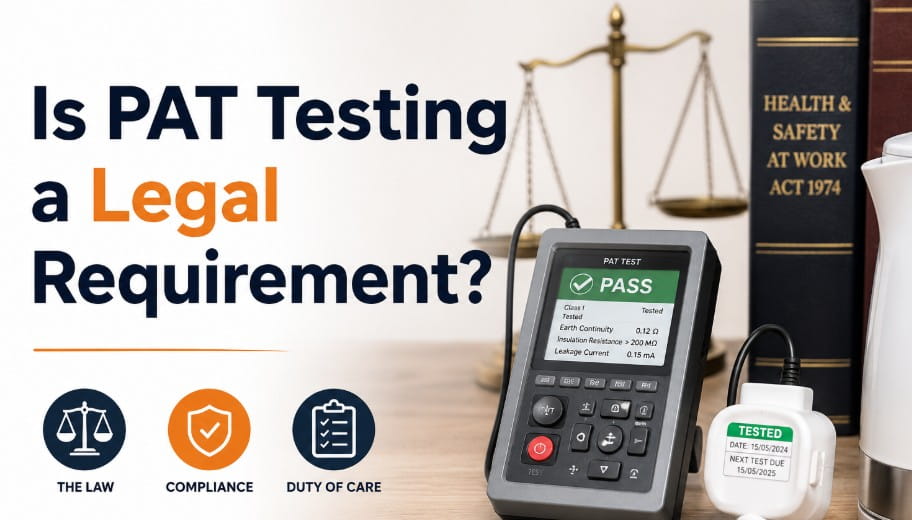
Is PAT Testing a Legal Requirement? The Definitive Guide for UK Businesses and Landlords
No, Portable Appliance Testing (PAT) is not explicitly a legal requirement by name under UK statutory law. However, UK regulations strictly mandate that all workplace and landlord-supplied electrical equipment must be maintained in a safe condition. PAT testing is universally accepted as the definitive method to prove legal compliance.
Is PAT Testing a Legal Requirement in the UK?
The strict legal reality is that portable appliance testing (PAT) is not explicitly a standalone legal requirement by name under UK statutory law. No separate piece of legislation exists called The PAT Testing Act.
Instead, the law focuses on the outcome, demanding that all electrical systems and appliances be maintained in a safe working condition to prevent danger to employees, tenants, and the public.
Because of this open-ended phrasing, many business owners fall victim to predatory compliance firms claiming that a third-party specialist must test every single plug top in the building annually.
The HSE explicitly labels this annual blanket testing approach as a myth, noting that in low-risk environments, an annual test on every item is a waste of corporate capital.
However, if an electrical accident occurs and you cannot present an organised maintenance log, proving you have met your statutory obligations in a court of law is exceptionally difficult. Therefore, while using a manual testing device isn’t compulsory, keeping a structured electrical maintenance record is vital to stay on the right side of the law.
Which UK Laws Mandate Workplace and Rental Property Electrical Safety?
Workplace and rental electrical safety is legally mandated by four core frameworks: The Health and Safety at Work Act 1974, the Electricity at Work Regulations 1989, the Provision and Use of Work Equipment Regulations (PUWER) 1998, and territory-specific housing regulations.
To establish strong organisational compliance, you must understand the specific legislative pillars governing the United Kingdom. In practice, your electrical safety procedures should align with four core statutory frameworks.
The Health and Safety at Work etc. Act 1974
The Health and Safety at Work Act 1974 mandates under Section 2 that employers have an absolute legal duty of care to provide and maintain safe work systems, including all electrical appliances.
This act serves as the foundational legal framework for all workplace safety in Great Britain. Under Section 2, every employer has an absolute duty of care to provide and maintain a safe working environment.
Crucially for business owners, if an employee raises a legitimate concern about faulty equipment and faces termination, they may be eligible to claim unfair dismissal under 2 years of service, as health and safety whistleblowing bypasses standard qualifying periods.
Failing to maintain these assets not only risks workplace injuries but also leaves the business open to costly, uninsured employment tribunals.
The Electricity at Work Regulations 1989 (HSE Regulations)
Regulation 4(2) of the Electricity at Work Regulations 1989 dictates that all electrical systems must be constructed and maintained in a manner that completely prevents danger to any person.
These regulations apply directly to all electrical equipment used in connection with work activities. Regulation 4(2) specifically dictates that, as a duty holder, you must construct and maintain all electrical systems in a manner that prevents danger. This covers everything from heavy industrial machinery to a simple extension lead powering a receptionist’s desk phone.
Provision and Use of Work Equipment Regulations 1998 (PUWER)
PUWER mandates that all work equipment provided to employees must be safe, suitable for its intended purpose, and regularly maintained.
It requires employers to perform routine inspections and keep clear records to show that any equipment subject to deterioration or heavy wear is caught before it poses an imminent hazard.
Is PAT Testing a Legal Requirement for Landlords in Scotland and England?
PAT testing is a strict legal requirement for landlords in Scotland under the Housing (Scotland) Act 2014, requiring 5-yearly tests. In England and Wales, PAT testing is not explicitly mandated by name, but landlords face strict civil and criminal liability to keep supplied appliances safe.
The rules vary across borders:
In England and Wales: Under the Housing Act 2004 and the Electrical Safety Standards in the Private Rented Sector (England) Regulations 2020, private residential landlords must ensure fixed electrical installations are inspected every five years.
While portable appliances supplied as part of the tenancy do not have an explicit annual testing mandate, landlords remain civilly liable if a supplied appliance injures a tenant.
In Scotland, the regulations are significantly more strict. Under the Housing (Scotland) Act 2014, landlords operating private tenancies or Houses in Multiple Occupation (HMOs) face a strict legal mandate to conduct formal PAT testing on all landlord-supplied appliances at least once every five years, aligned with their Electrical Installation Condition Report (EICR).
Does PAT Testing Matter?
Neglecting electrical maintenance exposes a small business to severe operational disruptions, heavy financial penalties, and serious legal risks.
In practice, if an uninspected, faulty microwave causes a commercial property fire, your insurance provider will instantly demand proof of electrical equipment maintenance during the claims adjustment phase. Most commercial insurance providers include a standard reasonable precautions clause in their policies.
If you cannot provide an asset register, a formal visual inspection log, or PAT certificates proving you actively managed your electrical infrastructure, the underwriter can legally void your policy. This leaves your business entirely liable for hundreds of thousands of pounds in structural damage and business interruption costs.
Beyond financial ruin, the legal penalties for breaching the Electricity at Work Regulations 1989 are severe. Under official HSE enforcement guidelines, Magistrates’ courts can impose unlimited fines and sentence responsible directors to up to two years in prison for gross health and safety negligence.
How Often Do You Need to Do PAT Testing in the UK?
There is no uniform, legally mandated calendar schedule for PAT testing. Instead, the HSE demands a dynamic, risk-based approach where the frequency of your inspection regime is determined by the specific workplace environment, the equipment class, and how frequently the item is moved or handled.
A reliable compliance routine follows a practical, step-by-step approach based on official HSE guidance:
The following reference matrix shows how these variables typically interact under standard HSE guidance:
| Workplace Environment | Equipment Type | Formal Visual Check | Combined Testing (PAT) |
| Construction Site | 110V & 240V Tools | Before each shift (User) / Weekly | Every 3 Months |
| Commercial Kitchen | Catering Mixers, Kettles | Monthly | Every 6 Months |
| Industrial Workshop | Extension Leads, Drills | Every 3 Months | Every 6 to 12 Months |
| School / Academy | Classroom Projectors, ICT Labs | Every 12 Months | Every 12 to 24 Months |
| Office / Corporate | Laptops, Desktop Monitors | Every 24 Months | Every 2 to 4 Years |
| Hotel Bedroom | Table Lamps, Hairdryers | Every 24 Months | Only if visual checks fail |
What Needs PAT Testing and What is Exempt?
All mains-powered items operating on 230V, including extension cables and chargers, require structural testing. Low-voltage devices below 50V AC (Class III) are exempt from testing, though their power adapters are not.
Not all electrical items are built the same way. To prevent wasting your maintenance budget on unnecessary testing, you must categorise your business inventory by its electrical insulation type and voltage level.
Class I vs. Class II Appliances Explained
Class I appliances have a safety earth wire and require earth continuity and insulation resistance tests. Class II appliances have double internal insulation with no earth wire, making them legally exempt from earth continuity testing.
Electrical equipment is split into distinct safety categories based on how it protects the user from electrical shocks:
- Class I (Earthed Equipment): These appliances rely on a combination of basic internal insulation and a physical earth wire connected to the main plug. The earth connection ensures that if an internal wire touches the external metal casing, the current trips the fuse immediately rather than passing through the user. Common examples include commercial kettles, office refrigerators, metal desk lamps, and desktop computer towers. When testing Class I appliances, your inspector must perform both an Earth Continuity Test and an Insulation Resistance Test.
- Class II (Double Insulated Equipment): These devices are designed with two independent layers of insulation protecting the internal electrical components. Because no exposed metalwork can become live, they do not require a protective earth connection. You can easily spot Class II equipment by looking for the universal double-box symbol on the manufacturer’s rating plate. Examples include plastic-cased hair dryers, cell phone chargers, and photocopiers. When inspecting Class II items, you are legally exempt from earth continuity testing; only an Insulation Resistance Test is carried out.
Does Low-Voltage Equipment Need PAT Testing?
Equipment classified as Class III operating on a Separated Extra-Low Voltage (SELV) system, typically under 50V AC, does not require manual PAT device testing.
This applies directly to the handheld devices themselves, such as smart tablets, modern laptops, and mobile phones. However, the mains-powered charging bricks and desktop power supply units that plug directly into the 230V wall socket are either Class I or Class II devices and must be integrated into your regular testing regime.
Specific Appliance Audits
Domestic kitchen assets like refrigerators are Class I appliances and require regular PAT testing. Microwaves require standard electrical testing plus specialised radiation leakage checks to protect workplace users.
- Do fridges require PAT testing? Yes. A refrigerator is a Class I appliance with a heavy metal compressor shroud. Because it runs continuously and is frequently placed in damp or high-traffic kitchen areas, it requires standard earth continuity and insulation checks.
- Is microwave testing a legal requirement? While the term isn’t specifically written into text format, standard workplace safety testing protocols dictate that microwave ovens require extra verification. In addition to standard electrical testing, a competent inspector should perform a dedicated microwave radiation leakage test using a calibrated handheld exposure meter to ensure the door seals have not degraded over time.
Can I Do My Own PAT Testing in the UK?
The Health and Safety Executive explicitly states that you do not need to be a fully qualified, registered electrician to carry out regular workplace electrical inspections. The law strictly requires that the person conducting the procedure must be a Competent Person.
When reviewing decisions regarding competency, the HSE defines it as having the appropriate mix of practical electrical knowledge, structured training, and experience to safely execute the work while identifying clear defects.
For simple, formal visual inspections in a low-risk office, a sensible member of your internal staff can manage the process if they understand what a correctly wired plug looks like and can spot external signs of overheating.
However, when performing combined visual and manual instrument testing with a portable appliance tester device, your staff member requires a higher tier of knowledge.
If your in-house team lacks the specialised testing instruments or the confidence to interpret complex data, outsourcing the task to an external professional compliance provider is the safest course of action.

What Gets Checked on a PAT Test?
A professional electrical testing process is structured to prevent equipment damage while identifying hidden insulation flaws. To understand what occurs during the final phase, review the exact criteria required for an appliance to pass or fail its technical instrument checks:
- Earth Continuity: Checks for resistance $\leq 0.1 \Omega$ (Class I).
- Insulation Resistance: Checks dielectric strength $\geq 1.0 M\Omega$ (Class I) or $\geq 2.0 M\Omega$ (Class II).
- Polarity Verification: Ensures correct Line/Neutral configuration for cables.
The Inspection Sequence
To understand what occurs during the final phase, review the exact criteria required for an appliance to pass or fail its technical instrument checks:
| Test Phase | Technical Parameter | Acceptable Pass Limit | Primary Hazard Targeted |
| Earth Continuity | Class I Protective Earth Resistance | Less than or equal to 0.1 Ω | Electric shock via exposed metal casings |
| Insulation Resistance | Class I Internal Dielectric Strength | Not less than 1.0 MΩ | Current leakage into current-carrying components |
| Insulation Resistance | Class II Double-Insulation Strength | Not less than 2.0 MΩ | Fire risks from degraded internal plastic sheathing |
| Polarity Verification | Extension Lead / Detachable Cable | Correct Line/Neutral configuration | Short circuits and unexpected reverse-polarity shocks |
Can PAT testing damage equipment?
Older 25A flash tests could damage sensitive logic boards. Modern battery-powered PAT devices utilise low-current soft screen tests (200mA) designed to fully protect IT systems and microelectronics.
A common concern for business managers is whether high-voltage testing will corrupt modern IT networks or sensitive microelectronics. In the past, older testing units used a high-current flash test or heavy bond test pushing 25A down the circuits, which could easily melt delicate logic boards.
Modern battery-powered PAT devices utilise a soft screen test or a lower 200mA test current specifically designed to protect IT infrastructure while providing accurate earth continuity readings.
What Will Fail a PAT Test?
Common PAT failures include incorrect fuse values, exposed inner wiring, heat discolouration, or loose casing screws. Failed equipment must be isolated, labelled with a red fail sticker, quarantined, and professionally repaired before a retest.
Common PAT Testing Failures
- The deployment of incorrect fuse ratings (e.g., forcing a 13A fuse into an appliance that legally requires a 3A fuse, bypassing overcurrent protection).
- Exposed inner copper wiring caused by deep friction cuts or heavy dragging across abrasive surfaces.
- Severe heat discolouration or localised carbon bubbling around the plug pins indicates internal loose connections.
- Loose structural screws within the plug top casing are causing the cable grip to slide off the outer protective sheath.
The Failure Mitigation Checklist
If an asset fails any part of your safety inspection, execute this process immediately to eliminate corporate liability:
- Isolate the Equipment: Immediately disconnect the appliance from the mains power supply socket.
- Apply a Defective Label: Affix a highly visible, red FAIL or DO NOT USE sticker directly over the plug face to prevent accidental operation.
- Quarantine the Asset: Physically remove the defective item from the operational floor area and place it inside a secure, locked storage zone.
- Notify Management: Update your central internal electrical safety log book to register the asset as out of service.
- Execute Professional Repair: Route the item to a trained electrical technician capable of changing the plug top or replacing damaged cables.
- Perform a Baseline Retest: Ensure the repaired item passes a fresh, combined visual and manual PAT check before it is re-authorised for the workplace floor.
How Much Does PAT Testing Cost?
PAT testing pricing functions on a tiered model with minimum call-out fees of £45 to £75, or volume per-item costs from £1.00 to £2.50. High-quality testing takes between 3 and 8 minutes per appliance setup.
Budgeting for compliance requires a realistic understanding of market rates and time investments within the UK commercial services sector.
Commercial Pricing Dynamics
Most specialist testing compliance companies operate on a tiered pricing structure based on total volume. According to recent UK commercial electrical service market data, providers typically charge a fixed minimum call-out fee ranging from £45 to £75 for small offices or low-density retail shops with under 20 items.
For larger corporate premises, warehousing facilities, or universities managing hundreds of appliances, industry pricing audits show the rate shifts to a per-item model, generally ranging from £1.00 to £2.50 per asset.
How Long Does It Take?
On average, a standard Class I kitchen kettle or workshop drill takes between 3 and 5 minutes to unplug, visually inspect internal fuse links, connect to the instrumentation box, and document. Desktop setups with multiple interconnected leads can take up to 8 minutes per workspace station.
Keeping Compliance Simple and Cost-Effective
Maintaining a safe, cost-effective business premises does not require overspending on annual blanket testing. For an agile UK small business owner or landlord, effective compliance relies on setting up a sensible, risk-assessed inspection routine.
Start by listing your equipment, training a competent employee to perform routine visual checks, and saving manual instrument testing for high-risk assets or when an item changes location.
FAQ about Is PAT Testing a Legal Requirement?
Is it illegal to use untested electrical equipment at work?
It is not illegal simply because an item lacks a testing sticker. However, it is an offence to use equipment that is unsafe. If an untested item has a latent defect that causes an injury, you will be prosecuted for failing to maintain workplace safety.
Does the HSE legally require me to stick a pass label on every plug?
No. The HSE states there is no legal requirement to label equipment with stickers or tracking tags. However, using green labels is highly practical for internal management, allowing managers to spot out-of-date or missed appliances at a glance.
Is keeping an electrical equipment asset log book a legal requirement?
While not explicitly mandatory under English law, keeping an asset log is strongly recommended. It serves as your primary documentary evidence to prove to HSE inspectors, local authorities, and insurance underwriters that you maintain a compliant risk-management program.
Do brand-new electrical appliances require a PAT test?
No. Brand-new items from reputable suppliers holding a valid CE or UKCA mark are assumed safe for immediate use. They only require integration into your inspection timeline once they have been active in your workplace for 12 months.
What is the penalty for non-compliance with UK electrical safety laws?
Failing to maintain safe equipment can lead to unlimited fines from the HSE, closure orders for your commercial premises, and potential imprisonment for corporate directors under corporate manslaughter or gross negligence legislation.
What is a PAT test certificate?
A PAT certificate is a document issued by an inspector detailing the total number of items tested, individual pass/fail records, and technical measurement readouts. It acts as proof of compliance for local councils, insurers, and safety auditors.
What are the most common hazards of working with pats?
The primary operational hazards include electrical shock from degraded insulation, arc flashes caused by short circuits, and localised structural fires originating from overloaded extension leads or incorrect fuse ratings.