
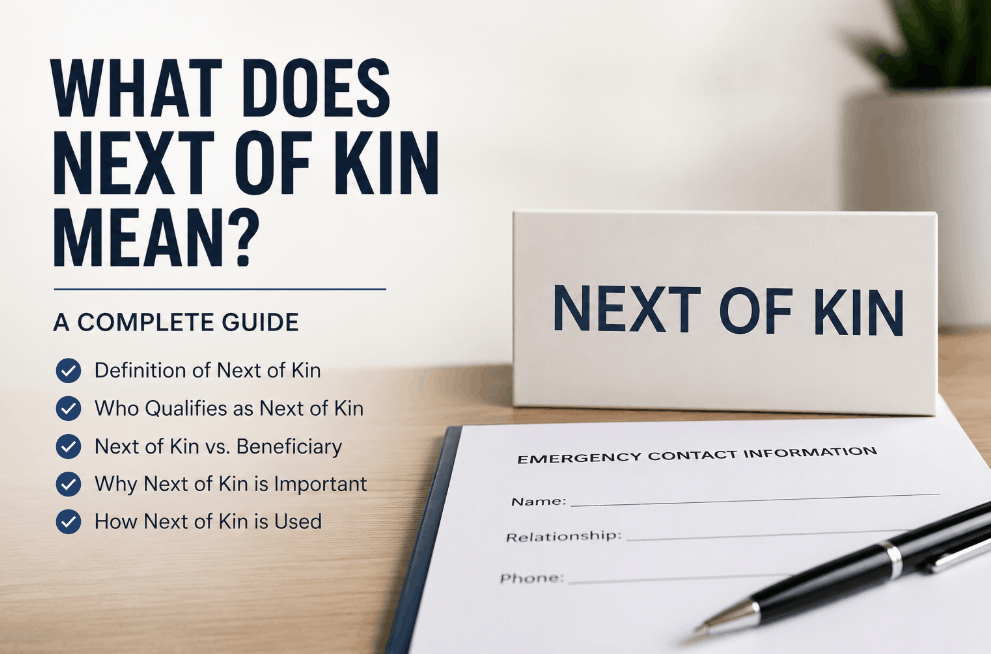
What Does Next Of Kin Mean In The UK? A Legal Guide To Rights, Inheritance, And Power Of Attorney
In the UK, the term next of kin generally refers to a person’s closest living relative, such as a spouse, civil partner, or child. While commonly used in hospitals and for emergency contacts, the term has no formal legal definition under English law.
It does not automatically grant someone the power to make medical decisions or manage financial affairs unless supported by a Lasting Power of Attorney or specific inheritance laws.
What does next of kin mean in the UK?
In a practical sense, what does next of kin mean is simply a way for organisations like the NHS or the police to identify the person you would like to be notified in an emergency. It is a title based on social custom rather than a statutory right.
While you can nominate anyone, including a partner or friend, to be your next of kin, this status alone does not provide them with the legal authority to sign documents on your behalf or override the decisions of medical professionals.
The Reality of Legal Authority in the UK
Many people assume that being named as next of kin provides a safety net for decision-making. In reality, UK law prioritises specific legal instruments over the informal title of next of kin.
Without a Lasting Power of Attorney (LPA), your closest relative may find themselves locked out of vital conversations regarding your care or assets. This gap often leads to distress during hospital stays where doctors must act in your best interests rather than following a relative’s wishes.

How is next of kin determined for medical emergencies?
In medical settings, the hospital will usually ask you to name your next of kin upon admission. If you are unable to communicate, staff will typically follow a standard hierarchy to identify the most appropriate person to consult.
- Spouse or Civil Partner: Generally the first point of contact.
- Adult Children: If no spouse is present or available.
- Parents: Particularly if the individual is young or unmarried.
- Siblings: Brothers and sisters of the patient.
- Unmarried Partners: Often only consulted if specifically named by the patient previously.
- Other Relatives: Grandparents or aunts and uncles.
The Role of the Mental Capacity Act 2005
Under the Mental Capacity Act 2005, if a patient lacks the capacity to make their own decisions, medical professionals are required to act in that person’s best interests.
While they will consult the person identified as the next of kin to understand the patient’s known wishes, the next of kin does not have a veto or the final say on treatment unless they are a registered Health and Welfare Attorney.
Does next of kin automatically inherit your estate?
A common misconception is that being next of kin guarantees an inheritance. However, if a person dies without a valid Will, their estate is distributed according to the Rules of Intestacy, which are strictly defined by UK law.
| Relationship to Deceased | Inheritance Status (No Will) | Legal Authority |
| Spouse / Civil Partner | Inherits all personal belongings + first £322,000 | High (Administering Estate) |
| Direct Descendants | Share the remainder of the estate equally | Moderate |
| Unmarried Partner | No automatic right to inherit | None (Requires Court Claim) |
| Next of Kin (Friend) | No automatic right to inherit | None |
In practice, a next of kin who is a cohabiting partner but not married has zero automatic rights to the deceased’s home or bank accounts. This often results in the common law marriage myth causing significant financial hardship when the estate passes to distant blood relatives instead.
For those currently navigating a separation, understanding the financial implications is key, especially when researching how much does a divorce cost if both parties agree to ensure assets are protected before new kinships are formed.

What are the steps to grant your next of kin legal power?
Because the title itself is legally weak, you must take active steps to ensure your chosen person can actually help you when it matters most.
- Discuss Your Wishes: Clearly tell your family or partner what you want regarding medical care and finances.
- Draft a Professional Will: Document exactly who should inherit your assets to bypass the rigid Intestacy Rules. While drafting, it is equally important to be aware of what you should never put in your will UK to avoid common legal pitfalls that can delay probate.
- Appoint an Executor: Choose the person responsible for carrying out your Will’s instructions.
- Register a Health and Welfare LPA: This gives your next of kin the legal right to make medical decisions.
- Register a Property and Finance LPA: This allows them to manage your bank accounts and bills if you cannot.
- Update Hospital Records: Ensure your GP and local hospital have your current nominated contact on file.
- Notify Your Nominee: Ensure they know where your legal documents are kept and understand their responsibilities.
Can an unmarried partner be considered next of kin?
Yes, you can name an unmarried partner as your next of kin for hospital records. However, for 2026, it remains a critical pain point in the UK that common law partners do not exist in the eyes of the law.
When reviewing decisions made by local authorities or the DWP, it is frequently observed that unmarried partners are overlooked in favour of blood relatives unless an LPA is in place.
For example, if an individual is moved into a care home, a blood relative (like an estranged sibling) might be prioritised in consultations over a partner of 20 years if no legal paperwork exists.
Common limitations of the next of kin status
It is vital to understand the hard borders of what a next of kin cannot do. This prevents legal complications during already stressful times.
- Accessing Bank Accounts: A next of kin has no right to withdraw money or manage the deceased’s or incapacitated person’s finances.
- Signing Legal Documents: They cannot sell a property or sign contracts on your behalf.
- Final Say on Life Support: Without an LPA, the medical team makes the final decision based on clinical best interests.
- Automatic Guardianship: Being next of kin to a parent does not automatically make you the legal guardian of their children.

Summary of next steps for UK residents
To move beyond the limitations of the next of kin label, residents should prioritise three actions:
- Formalise your Will to protect your assets and choose your beneficiaries.
- Register Lasting Powers of Attorney to give your chosen person actual legal teeth in medical and financial crises.
- Organise your digital and physical files so your representative can act quickly if an emergency occurs.
FAQ
Does next of kin have the right to see medical records?
Generally, no. Access to medical records is governed by the Data Protection Act and the Access to Health Records Act 1990. Being next of kin does not grant an automatic right to view these files after a death unless you are the personal representative of the estate.
Who is my next of kin if I am single with no children?
Your next of kin would typically follow the bloodline: parents, then siblings, then half-siblings, then grandparents. Families navigating these successions often need to plan for the eventual settlement of the estate, particularly concerning the specific rules for Inheritance tax when second parent dies and how it impacts the final distribution to siblings.
If none exist, it extends to aunts, uncles, or cousins. You can, however, nominate a friend for medical contact purposes.
Can I have more than one next of kin?
For hospital purposes, you can list multiple emergency contacts. However, for legal and inheritance purposes, the law typically follows a singular hierarchy or a specific list of beneficiaries defined in a Will.
Can a next of kin stop a funeral from happening?
Usually, the person responsible for the funeral is the Executor named in the Will. If there is no Will, the person entitled to administer the estate (often the closest relative) has the right to make funeral arrangements.
Is next of kin the same as a beneficiary?
Not necessarily. A next of kin is a relative; a beneficiary is someone named in a Will or under intestacy rules to receive assets. You can be one without being the other.
Does next of kin automatically get the house?
No. Ownership depends on how the property was held (e.g., Joint Tenants vs. Tenants in Common) and the presence of a Will. Next of kin status alone does not transfer property titles.