
How Long Does A Divorce Take UK? 2026 Step-By-Step Timeline, Costs, And Fast-Track Tips
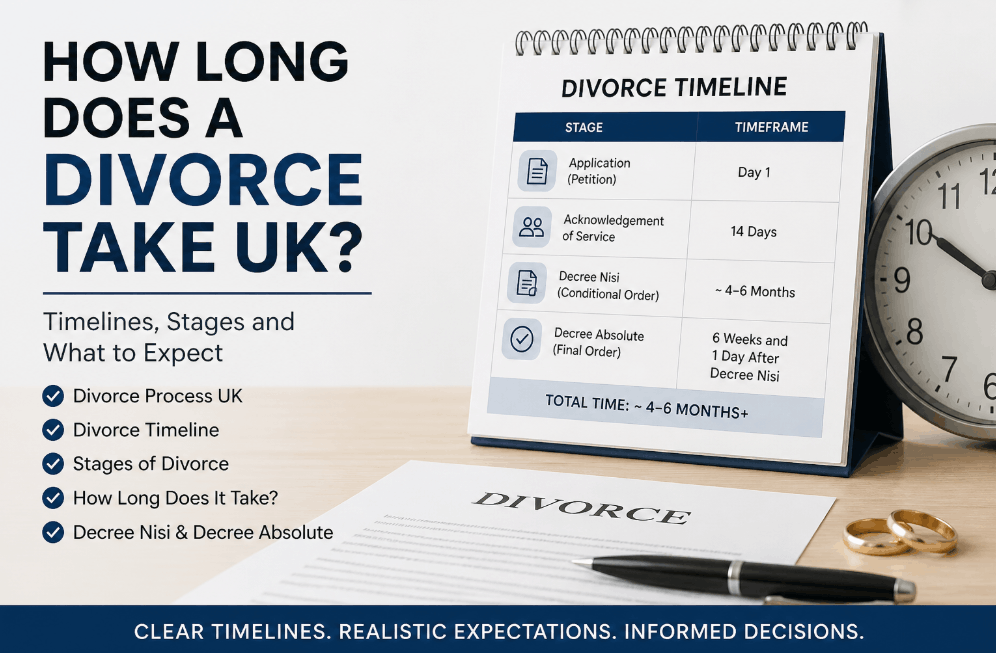
In the UK, a standard uncontested divorce typically takes between six and eight months to complete. This timeframe is largely dictated by the Divorce, Dissolution and Separation Act 2022, which mandates a 20-week period of reflection between the initial application and the Conditional Order, followed by a further six-week wait before the Final Order can be granted.
How long does a divorce take UK?
Under the current no-fault divorce system, the legal process takes a minimum of 26 weeks (six months) from start to finish. This statutory timeframe includes a mandatory 20-week holding period and a subsequent six-week waiting period.
However, administrative backlogs at HMCTS and complex financial negotiations often extend the practical duration to approximately seven to nine months.
The Truth of Modern Divorce Timelines
While the legislation provides a fixed legal structure, the paperwork of ending a marriage is often separate from the process of ending a marriage. In practice, the legal dissolution (the divorce itself) may be ready for completion before the parties have reached a financial settlement.
Many couples often wonder how much does a divorce cost if both parties agree when planning their exit strategy.
Many legal professionals advise delaying the application for the Final Order until a Financial Consent Order is sealed by the court to protect pension rights and property interests. Consequently, while the divorce can finish in six months, the entire exit strategy often takes longer.

What is the step-by-step UK divorce timeline for 2026?
The move to a digital-first system via the HMCTS portal has streamlined the application process, but the statutory waiting periods remain non-negotiable.
- The Application (Week 1): One or both parties submit the divorce application online. Joint applications are encouraged to reduce friction.
- The Period of Reflection (Weeks 2–21): A mandatory 20-week wait begins once the application is issued. This is designed to allow couples time to reconcile or agree on practical arrangements.
- Conditional Order Application (Week 22): After the 20 weeks expire, the applicant(s) confirm they wish to proceed by applying for a Conditional Order.
- The Review Phase (Weeks 23–27): A judge reviews the application. If satisfied, the court pronounces the Conditional Order and sets a date.
- The Statutory Wait (Weeks 28–33): A mandatory six-week and one-day cooling-off period must pass after the Conditional Order is granted.
- The Final Order Application (Week 34+): The applicant applies for the Final Order, which legally dissolves the marriage.
- Granting the Final Order: Once the court processes the request, the Final Order is issued, ending the legal union.
Why do some divorces take longer than six months?
While the 26-week statutory minimum is a fixed baseline, several variables frequently push the timeline closer to a year. Administrative efficiency and interpersonal cooperation are the two most significant factors.
HMCTS Administrative Backlogs
The speed of a divorce is often at the mercy of the regional divorce centres. As of 2026, high volumes of digital applications can occasionally lead to processing delays at the validation stage.
If a marriage certificate is uploaded with poor clarity or requires a certified translation, the clock for the 20-week reflection period may be delayed until the error is rectified.
The Impact of Financial Settlements
A common pattern in UK proceedings is the Financial Shadow Timeline. While the divorce moves through its five stages, the negotiation of assets, including the marital home, savings, and pensions, runs in parallel.
If parties cannot agree on a Financial Consent Order, they may enter mediation or court litigation.
Because the Final Order can extinguish certain spousal rights (such as pension sharing or inheritance), many solicitors recommend holding off on the Final Order until the financial side is resolved, which can add three to six months to the total duration.

Service Issues in Sole Applications
If one party files a sole application and the other spouse (the respondent) fails to acknowledge the papers, the timeline stalls.
This leads many to worry about how long can a spouse drag out a divorce and what legal recourse is available to keep the process moving.
The applicant may then need to instruct a process server to hand-deliver the papers or apply for deemed service, both of which introduce technical hurdles and time delays.
| Factor | Impact on Timeline | Estimated Delay |
| Joint Application | Speeds up the start of the 20-week period. | 0 Days (Optimal) |
| Financial Dispute | Delaying Final Order until assets are split. | 3–12 Months |
| Missing Spouse | Necessity for process servers or deemed service. | 4–8 Weeks |
| Paper Application | Manual processing vs. digital portal efficiency. | 2–4 Weeks |
How do financial orders impact the divorce duration?
The divorce itself only ends the marriage; it does not end the financial ties between spouses. This is a critical distinction that frequently confuses those seeking guidance on how long a divorce takes in the UK.
A Financial Remedy Order is a separate legal document. In practice, when reviewing decisions regarding the timing of the Final Order, practitioners often see a bottleneck where the divorce is legally ready to conclude, but the financial settlement is still being drafted.
- Consent Orders: If both parties agree on asset division, the court can approve a Consent Order alongside the Conditional Order. This is the most efficient route.
- Contested Financials: If the case goes to a Financial Remedy hearing, the process can take 12 to 18 months, far outlasting the 26-week divorce timeline.
Is there a way to speed up the divorce process in the UK?
Strictly speaking, the 20-week and six-week waiting periods are written into the Divorce, Dissolution and Separation Act 2022 and cannot be waived by a judge except in extreme circumstances (such as terminal illness). However, efficiency can be maximised.
- Use the Digital Portal: Online applications are processed significantly faster than paper-based ones.
- Opt for a Joint Application: This removes the need for service of papers and acknowledgement from a respondent, preventing the timeline from stalling at the start.
- Prepare Documents Early: Ensure you have your original marriage certificate (or a certified copy) and any necessary translations ready before Day 1.
- Simultaneous Financial Planning: Start financial disclosures (Form E) the moment the divorce application is issued, rather than waiting for the 20-week reflection period to end.
| Divorce Route | Complexity | Typical Duration |
| DIY Online (Uncontested) | Low | 6–7 Months |
| Solicitor-Managed (with Consent Order) | Medium | 7–9 Months |
| Contested Financials (Litigation) | High | 12–24 Months |

Key considerations before you start your application
Before initiating the process on the government portal, ensure you meet the fundamental legal requirements. Failure to do so will result in a rejected application and a lost fee.
- The One-Year Rule: You cannot apply for a divorce in the UK until you have been married for at least 12 months.
- Irretrievable Breakdown: You must be able to state that the marriage has broken down permanently. Under no-fault law, you no longer need to prove this with facts like adultery or desertion.
- Jurisdiction: At least one party must be habitually resident in England or Wales (different rules apply to Scotland and Northern Ireland).
A realistic approach is essential. For example, a couple in Manchester might find their paperwork processed in exactly 28 weeks, while a couple with complex offshore assets might remain in process for over a year due to the intricacies of their Financial Remedy Order.
Final Summary
The UK divorce process is now more predictable than ever, thanks to the 2022 no-fault legislation. Expect a minimum of 26 weeks, but plan for seven to nine months to account for administrative steps and financial finalisation. Your immediate next steps should be:
- Verify you have been married for at least one year.
- Locate your original marriage certificate.
- If you have lost your documents, you may need to research how do i find my divorce records for free to ensure your paperwork is in order before starting a new application.
- Decide between a sole or joint application.
- Consult a professional regarding a Financial Consent Order to ensure your assets are protected long-term.
FAQ about how long does a divorce take UK
Can I get a divorce in 3 months?
No. Under the 2022 Act, the mandatory waiting periods (20 weeks and 6 weeks) total approximately 6 months. It is legally impossible to conclude a UK divorce in 3 months under standard circumstances.
Does a joint application make it faster?
A joint application reduces the risk of delays caused by a spouse failing to acknowledge service. While it doesn’t shorten the 26-week statutory periods, it ensures the process starts smoothly without procedural hitches.
How long does it take if my spouse disagrees?
Under no-fault law, a spouse cannot contest the divorce itself. They can only dispute the divorce on limited grounds like jurisdiction or legal validity, meaning the 6–8 month timeline generally remains the same.
What is the 20-week reflection period?
This is a mandatory holding period between the start of the divorce and the application for a Conditional Order. It is designed to give couples time to consider the decision and discuss financial and childcare arrangements.
How long does a divorce take UK if we have children?
The legal timeline remains 6–8 months, but resolving Child Arrangement Orders regarding custody and contact may take longer if parents cannot agree, potentially extending the overall period of separation.
Can I speed up the court’s processing time?
You cannot speed up the mandatory waits, but using the HMCTS online portal and ensuring all forms are filled correctly prevents administrative bounce-backs that can add weeks of unnecessary delay to the process.
Does the divorce end my financial obligations?
No. The Final Order only ends the marriage. You must obtain a separate Financial Remedy Order (often a Consent Order) to legally end financial claims; otherwise, a former spouse could claim assets years later.