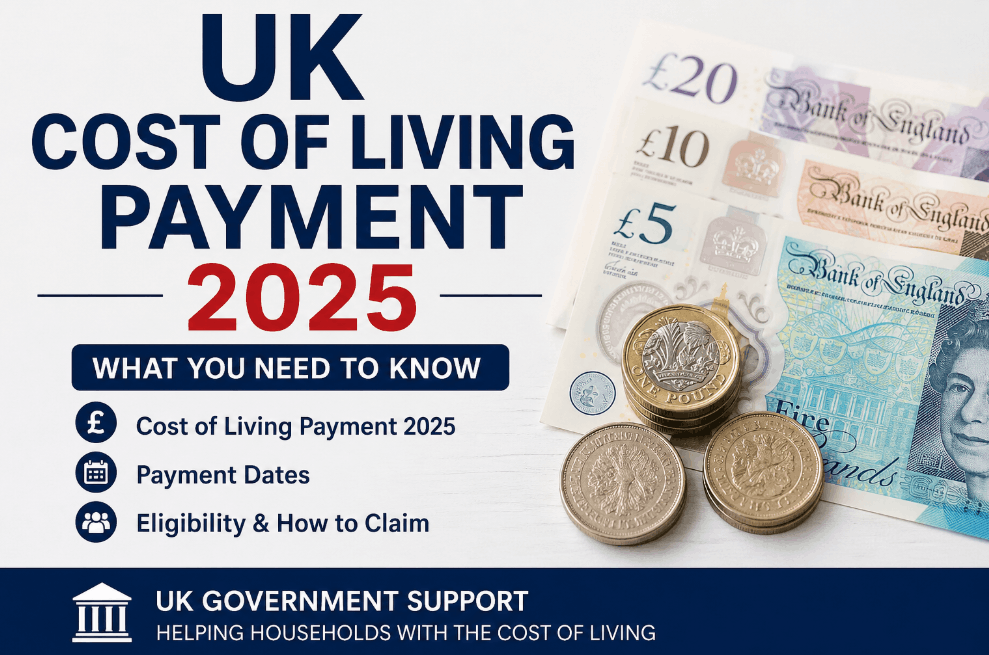
UK Cost Of Living Payment 2025: Dates, Eligibility & Fixes
Financial support for the current year is no longer delivered through the old flat-rate DWP installments. Instead, the UK cost of living payment 2025 is handled through the Crisis and Resilience Fund alongside the substantial April 2026 benefit upratings.
These measures offer targeted help with energy bills and daily essentials, determined by household income levels and specific vulnerability markers set by local authorities.
What is the UK cost of living payment 2025?
The UK cost of living payment 2025 encompasses a range of government-backed financial measures designed to ease the pressure of rising household bills. Moving away from the 2023/24 lump-sum model, the current landscape focuses on the Household Support Fund (HSF) and the newly integrated Crisis and Resilience Fund to provide more flexible, local relief.
The Evolution of Financial Support
The transition from national lump-sum payments to local authority distribution was designed to ensure that funding reaches those with the highest unmet need.
While the Department for Work and Pensions (DWP) no longer issues a single nationwide payment date, the support remains active through different administrative channels.
This shift effectively creates a system where two families on identical benefits could receive varying amounts of assistance based entirely on their local council’s specific spending priorities and remaining budget.

Who will receive the UK cost of living payment 2025?
To receive support under the 2025/26 framework, individuals generally must be residents of the UK and recipients of specific means-tested benefits.
The focus has sharpened on protecting pensioners, those with disabilities, and families with children who are most exposed to price volatility in the energy market.
Qualifying Groups for 2025/26 Assistance
- Low-Income Households: Those receiving Universal Credit, Income-based JSA, or Income-related ESA.
- Pensioners: Individuals receiving Pension Credit are a primary target for the Triple Lock increases and local grants. Eligible seniors should also verify their status for the Winter Fuel Payment to ensure their seasonal energy support is correctly processed alongside these newer measures.
- Disability Benefit Recipients: Claimants of PIP, DLA, or Attendance Allowance.
- Vulnerable Families: Households that previously fell under the two-child cap but are now seeing increased support.
2025/26 Support Type by Claimant Group
| Claimant Group | Primary Support Mechanism | Payment Frequency |
| Universal Credit | Monthly Uprating + Crisis Fund | Ongoing / As Applied |
| Pensioners | Triple Lock + Winter Fuel Payment | Monthly / Annual |
| Disability (PIP/DLA) | 3.8% Benefit Uprating | Every 4 Weeks |
| Low Income (No Benefits) | Local Council HSF / CRF | Discretionary |
Who will not receive the UK cost of living payment 2025?
Not every household experiencing financial pressure qualifies for the specific 2025/26 government funds. The exclusion criteria are often based on capital limits or the specific type of contribution-based benefits an individual receives.
Common Reasons for Non-Eligibility
- High Savings: Most local council support (CRF) and means-tested DWP benefits require claimants to have less than £16,000 in capital.
- Contribution-Based Benefits: Individuals solely on New Style JSA or New Style ESA without a means-tested element often do not qualify for the top-up payments.
- Income Thresholds: If household earnings exceeded the nil award limit during the qualifying period for Universal Credit, the payment is typically not triggered.
A common pattern observed in 2025 was the taper-off effect, where individuals moving into higher-paid work lost eligibility for local grants just as they hit the earnings threshold, despite high fixed costs.

What is the eligibility criteria for UK cost of living payment 2025?
Eligibility is determined by a snapshot of your financial circumstances during specific qualifying windows. For the national benefit upratings that took effect on 1 April 2026, the criteria are strictly tied to your status as an active claimant.
- Active Claim Status: You must have been entitled to a payment of a qualifying benefit during the assessment period.
- Postcode Residency: For the Crisis and Resilience Fund, you must live within the boundary of the local authority you are applying to.
- Income Evidence: Applicants for local grants usually must provide three months of bank statements.
- No Nil Award Status: Your Universal Credit award for the period must not be £0.00 (unless due to rent deductions).
- Means-Testing: Total household income must fall below the local poverty line defined by the council.
- Energy Debt: Priority is often given to those with a live prepayment meter or utility arrears.
How much will benefits increase in April 2026?
The 2026 benefit uprating is the primary way the government has integrated cost of living support into the standard welfare system.
On 1 April 2026, benefits were increased by 3.8% based on the Consumer Price Index (CPI), alongside a specific 2.3% Resilience Uplift for the Universal Credit standard allowance.
Table 2: Comparison of 2025 vs 2026 Monthly Benefit Rates
| Benefit Type | 2025 Monthly Rate (Avg) | 2026 Monthly Rate (Uprated) |
| UC Standard (Single, 25+) | £393.45 | £417.45 |
| UC Standard (Couple, 25+) | £617.60 | £655.27 |
| PIP (Enhanced Daily Living) | £407.60 | £423.10 |
| State Pension (Full New) | £963.40 | £1,009.64 |
How to check the status of my UK cost of living payment 2025?
Since support is now split between national and local pots, you will need to verify your payment status through a combination of your DWP journal and your specific council’s portal. There is no longer a single Cost of Living tracker for the whole UK.
Steps to Verify Your Payment Status
- Check your DWP Journal: Log into your Universal Credit account to view the Payments section for any Manual Addition or Uprating notes.
- Review your Bank Statements: Look for references such as DWP COL or your local council’s name (e.g., BCC CRISIS FUND).
- Visit your Council’s Website: Search for the Household Support or Crisis and Resilience portal to see if your application is Pending or Approved.
- Confirm the Uprating Letter: The DWP sends annual Change in Benefit letters every March; check this for your new 2026 rates.
- Check for Text Alerts: Official DWP notifications may arrive via SMS, but they will never ask you to click a link to claim money.
- Contact Citizens Advice: If you are unsure of your status, an adviser can help you navigate the local postcode lottery of funding.

How to complain if I did not receive UK cost of living payment 2025?
If you believe you meet the eligibility criteria but have not received a payment, you must follow a formal dispute process. When reviewing decisions, the DWP and local councils look for specific qualifying dates that may have been missed.
Reporting Missing Payments and Appeals
For DWP-related upratings, you should first add a note to your online journal under the Payments category. If you are on a legacy benefit (like Income Support), you must call the relevant helpline.
For local council funds, the process is different; most councils have a specific Request for Reconsideration form.
Consider the case of a Leeds resident who was initially refused a 2025 grant because their earnings sat just £1 above the threshold. By demonstrating that their disposable income, once high energy costs were factored in, fell below the poverty line, they successfully overturned the decision on appeal.
The Abolition of the 2-Child Limit: A 2026 Boost
A major turning point for family finances this year is the full abolition of the two-child limit, which came into force on 6 April 2026.
This policy shift allows families with three or more children to receive the child element of Universal Credit for all children, providing an automatic income boost that functions as a permanent cost of living adjustment.
Impact of 2-Child Limit Removal on Monthly Income
| Family Size | Pre-April 2026 Monthly Support | Post-April 2026 Monthly Support |
| 2 Children | £576.00 | £576.00 |
| 3 Children | £576.00 | £864.00 |
| 4 Children | £576.00 | £1,152.00 |
Final Summary
The UK’s approach to cost of living support in 2025 and 2026 has moved away from temporary patches toward permanent benefit increases and localized crisis management.
To maximize your household income, you should ensure your DWP journal reflects your current housing and childcare costs, apply for the Crisis and Resilience Fund via your local council if you face an emergency, and verify that your April 2026 uprating has been correctly applied to your statement.
Given how quickly the rules around eligibility can shift, keeping a close eye on the government’s fiscal calendar is essential. Many are currently checking When is the next budget to stay ahead of any further updates to the UK’s financial support framework for the coming year.
FAQ about UK Cost Of Living Payment 2025
Will there be a £300 payment in 2025?
No, the DWP has replaced fixed £300 installments with the Crisis and Resilience Fund. Support is now distributed by local councils based on individual household financial assessments rather than automatic nationwide dates.
Do I need to apply for the April 2026 increase?
No, the 3.8% benefit uprating is applied automatically to your Universal Credit or Pension award. You will see the new higher rate in your first assessment period starting after 6 April 2026.
What is the Crisis and Resilience Fund?
Launched in April 2026, this fund replaces the old Household Support Fund. It provides vouchers for food, energy, and essential goods to households that are struggling despite receiving standard benefits.
Is the Disability Cost of Living Payment returning?
There is no separate disability-only lump sum announced for 2025/26. Instead, disability benefits like PIP and DLA have been increased by 3.8% to provide ongoing monthly financial relief.
Why did I get a Nil Award for my cost of living support?
A nil award occurs if your earnings for an assessment period were high enough to reduce your Universal Credit to zero. This usually disqualifies you from the associated cost of living triggers.
How do I find my local council’s support fund?
Use the “Find your local council” tool on the GOV.UK website. Once on your council’s site, search for Financial Support or Help with Bills to find the application link.
Can I claim the payment if I am on the State Pension?
Yes, pensioners receive support via the Triple Lock increase (4.8% in 2026) and are eligible to apply for local council grants if they also receive Pension Credit.