Social Model of Disability: A Complete Guide to UK Rights
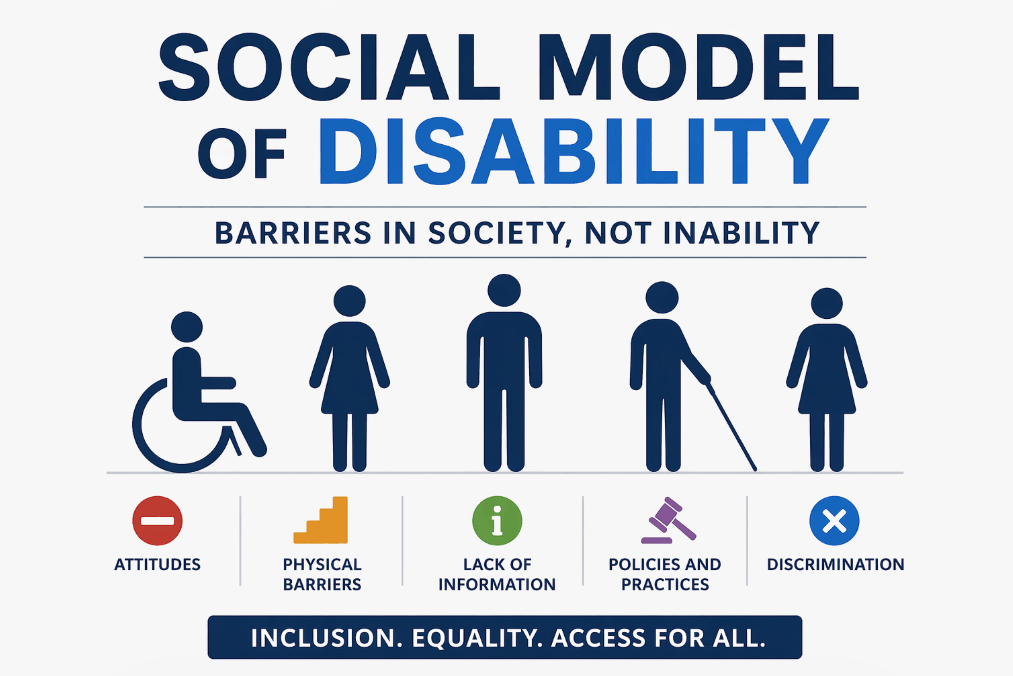
The social model of disability identifies systemic barriers, derogatory attitudes, and social exclusion as the primary factors that disable individuals with impairments.
By defining disability as a restriction of activity caused by social organisation, rather than a medical defect, this framework shifts the focus from curing the individual to fixing environments, policies, and public perceptions.
It asserts that society’s failure to account for physical, sensory, or cognitive impairments is what ultimately creates the disadvantage, making accessibility a matter of collective responsibility rather than personal tragedy.
Why is the social model of disability fundamental to UK equality?
The social model of disability represents a radical shift from viewing disability as a personal tragedy to recognising it as a human rights issue.
In the UK, this perspective gained momentum through the Union of the Physically Impaired Against Segregation (UPIAS) and was later formalised by academic Mike Oliver.
It serves as the philosophical foundation for the British disability rights movement, moving beyond the idea that people need to be fixed to fit into a rigid world.
A fundamental truth of this model is the distinction between impairment and disability. An impairment is a long-term characteristic of an individual’s body or mind, such as blindness or a mobility limitation. Disability, however, is the result of the world failing to accommodate that impairment.
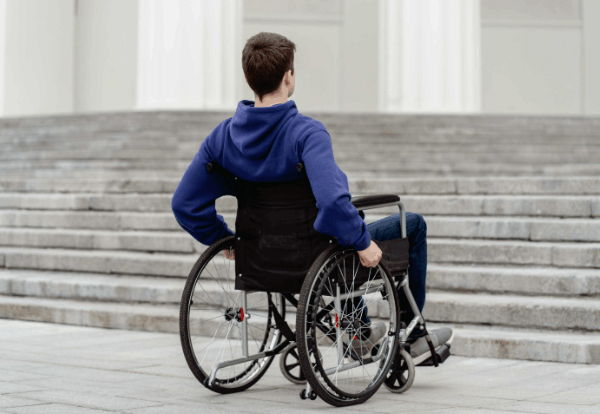
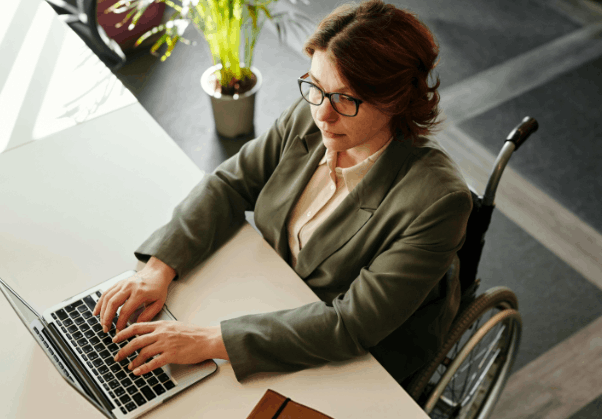
For example, a person who uses a wheelchair is not disabled by their inability to walk, but by a building that only has stairs. When a ramp is installed, the impairment remains, but the disability, the barrier to entry, is removed.
How does the social model differ from the medical model?
To understand the impact of the social model, it must be compared to the medical model, which historically dominated UK healthcare and social policy.
| Feature | Medical Model of Disability | Social Model of Disability |
| Core Focus | The individual’s impairment or defect. | The barriers created by society. |
| Goal | To cure, treat, or manage the condition. | To remove barriers and ensure access. |
| Identity | Viewed as a patient or someone to be helped. | Viewed as a citizen with rights and choices. |
| Power | Controlled by medical professionals. | Led by disabled people (Nothing About Us Without Us). |
| Social View | Disability is a personal burden/tragedy. | Disability is a result of social exclusion. |
In practice, a business following the medical model might suggest a neurodivergent employee tries harder to focus in a loud office. Comparing this approach to the medical model, which historically dominated UK healthcare and social policy, reveals a fundamental power shift.
While the medical model focuses on managing a condition, the social model prioritises civil rights and environmental adjustments.
This distinction is critical when navigating the UK welfare system; for example, using structured PIP review form example answers allows claimants to accurately frame their daily challenges as functional barriers rather than just medical symptoms.
What are the 4 main barriers identified by the social model?
Understanding the social model of disability requires identifying the specific obstacles that prevent inclusion. These are generally categorised into four areas:
- Attitudinal Barriers: These include stereotypes, pity, or the assumption that disabled people are less capable.
- Physical Barriers: Steps, narrow doorways, lack of accessible toilets, or poor lighting that restricts movement and safety.
- Systemic Barriers: Policies or the way we do things that exclude people, such as rigid 9-to-5 working hours or recruitment tests that aren’t screen-reader friendly. These systemic flaws are often mirrored in the benefits system, where strict compliance rules lead many to wonder can universal credit sanction all your money if a disability-related accessibility issue is misunderstood by assessors.
- Communication Barriers: Lack of British Sign Language (BSL) interpreters, absence of Braille, or overly complex language that excludes those with learning disabilities.
How do you apply the social model of disability in the workplace?
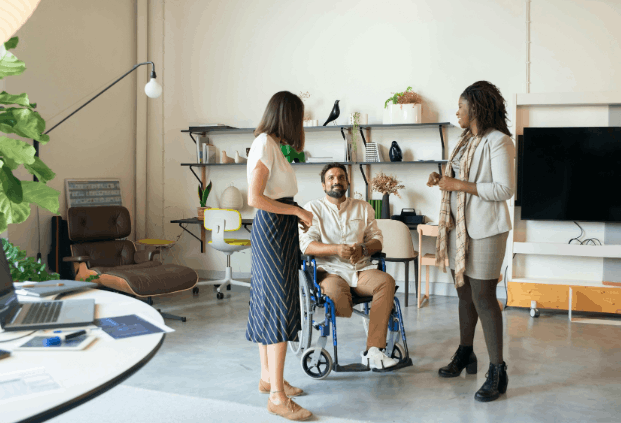
Modern UK organisations are increasingly adopting inclusive by design principles to meet their statutory obligations. Successfully applying the social model in a professional setting involves a proactive audit of both physical and digital environments.
This includes consulting directly with disabled staff to identify pain points, implementing flexible output-based policies, and formalising a non-bureaucratic process for reasonable adjustments.
- Conduct an Accessibility Audit: Evaluate physical premises and digital platforms for barriers.
- Consult Directly: Engage with disabled employees or customers to identify specific pain points.
- Implement Flexible Policies: Shift focus from hours at a desk to output and task completion.
- Provide Assistive Technology: Ensure all software is compatible with screen readers and offers text-to-speech.
- Train Staff on Unconscious Bias: Address the attitudinal barriers that lead to microaggressions.
- Formalise Reasonable Adjustments: Create a clear, non-bureaucratic process for requesting changes.
- Review Recruitment: Remove unnecessary requirements (e.g., must have a driving licence if the role is office-based).
How does the UK Equality Act 2010 incorporate this model?
The Equality Act 2010 is the primary piece of legislation protecting disabled people in the UK. While the Act uses a specific legal definition of disability, the duty to provide Reasonable Adjustments is a direct application of the social model.
| Adjustment Category | Definition | Example in Practice |
| Provisions & Practices | Changing the way things are done. | Allowing flexible start times for someone with chronic fatigue. |
| Physical Features | Altering the physical environment. | Installing a hearing loop in a reception area or boardroom. |
| Auxiliary Aids | Providing extra equipment or services. | Supplying specialised software for a dyslexic staff member. |
When reviewing decisions regarding accessibility, UK courts often look at whether a service provider has been proactive. The social model suggests that we should not wait for a disabled person to ask for access; access should be designed into the system from the start.
What are the limitations of the social model of disability?
While powerful, the model has faced critiques, primarily concerning the lived experience of impairment. Some advocates for people with chronic pain or debilitating conditions argue that the model occasionally overlooks the physical reality of symptoms that cannot be solved by a ramp or a change in attitude.
Practitioners now often favour a Biopsychosocial approach that respects the social model’s civil rights focus while acknowledging the physical reality of chronic pain or illness.
Moving toward this rights-based society also depends on robust financial safety nets. Support such as the Winter Fuel Payment remains vital, ensuring that those who face higher living costs due to their impairment are not further marginalised by seasonal economic pressures.
Summary and Next Steps
The social model of disability is a practical tool for building a more equitable UK by dismantling environmental barriers rather than attempting to correct individuals. Communities can finally unlock the full potential of a significant portion of the population.
True progress lies in treating accessibility as a continuous evolution of design and policy, ensuring that inclusion is the default setting for every British institution.
FAQ about social model of disability
Who created the social model of disability?
It was developed by disabled activists in the 1970s, notably the Union of the Physically Impaired Against Segregation (UPIAS), and later formalised as an academic concept by Professor Mike Oliver in 1983.
Is the social model of disability a law?
No, it is a conceptual framework. However, it heavily influences UK legislation like the Equality Act 2010 and international treaties like the UN Convention on the Rights of Persons with Disabilities.
Does the social model reject medical treatment?
No. The model acknowledges the value of medical care for impairments. It only rejects the idea that a person’s inability to participate in society is a medical problem rather than a social one.
What is a social model of disability example?
A person with a visual impairment wanting to read a restaurant menu is disabled if the menu is only in small print. They are included if the menu is available in Braille or via a QR code.
Why is the social model better than the medical model?
It empowers disabled people by placing the responsibility for change on society. This leads to independence and inclusion rather than institutionalisation, dependency, or a focus on normalization.
How does the social model view mental health?
It suggests that many mental health challenges are exacerbated by societal pressures, lack of support, and stigma. Inclusion involves creating low-stress environments and offering emotional flexibility.
What is the 2026 update for disability standards in the UK?
Recent updates focus on digital accessibility (WCAG 2.2) and the National Strategy for Disabled People, which emphasises data-driven barrier removal in housing and transport sectors.