HMRC Child Benefit Extension Guide: Deadlines, Eligibility Rules & How to Apply Online
HMRC child benefit extension procedures allow eligible UK parents and guardians to keep receiving financial support when teenagers turn 16 and remain in approved education or training. Because standard payments automatically terminate on fixed seasonal dates, mastering the correct renewal protocol prevents unnecessary gaps in household cash flow.
Key Takeaways
- Parents must report continued education to HM Revenue and Customs before August 31 after a child turns 16 to avoid interruptions.
- Qualifying training includes non-advanced full-time education like A levels, T levels or NVQ level 3 undertaken up to age 20.
- Applications can be submitted directly through the official digital government portal or by phone using official contact numbers.
- High earners with incomes crossing specific statutory thresholds must review potential tax charges linked to ongoing household benefit claims.
What is HMRC Child Benefit Extension?
The HMRC Child Benefit extension is an administrative continuation process that allows parents and guardians to keep receiving financial support past a child’s 16th birthday.
Normally, standard Child Benefit payments are automatically scheduled to terminate on specific seasonal dates following a teenager turning 16 (such as August 31).
By submitting an extension update, you inform HM Revenue and Customs that the young person is transitioning into approved post-compulsory education or training, ensuring that financial support continues seamlessly.

What Happens When Your Teen Turns 16?
When a young person reaches their 16th birthday, standard Child Benefit entitlement does not stop immediately, but the system triggers a review milestone.
Official statutory regulations dictate that payments stop permanently on specific annual dates unless the household officially updates HM Revenue and Customs regarding the teenager’s future plans.
The Post-Sixteen Administrative Bridge
The HMRC child benefit extension mechanism serves as a vital administrative bridge for families navigating post-sixteen educational transitions.
A common pattern is that families receive a pre-printed inquiry letter from the government administration office during the spring term of the academic year when the child reaches age 16.
Avoiding Automatic Payment Termination
Failing to respond or failing to submit a formal update leads to payments terminating automatically on August 31, November 30, or the end of February, depending on the exact birthday month.
Understanding these administrative boundaries ensures that financial support continues seamlessly without unexpected disruptions to household budgeting.
When Can You Extend Your Child Benefit?
Parents can initiate and submit a Child Benefit extension request as soon as their child reaches age 16 and confirms plans to stay in qualifying full-time education or approved training, keeping in mind the critical deadline of August 31.
- The Key Deadline: Parents must report and update their teenager’s educational status to HMRC before August 31 following their 16th birthday. Missing this deadline triggers an automatic termination of payments.
- Age Limits: Extended claims can remain active until the young person turns 20 years old, provided they stay continuously enrolled in an approved non-advanced course or training path and were accepted onto it before turning 19.
- Temporary 20-Week Extension: A separate extension window applies if a 16- or 17-year-old leaves education or training and registers with a local careers service (like Connexions) or the armed forces.
Who Can Claim HMRC Child Benefit Extension?
To claim the HMRC Child Benefit extension, the claimant must be the primary registered parent or legal guardian, and the teenager must be aged 16 to 20, undertaking full-time non-advanced education or approved training without receiving independent benefits like Universal Credit.
- The Claimant: Must be the primary registered parent or legal guardian already receiving or eligible for the active Child Benefit claim.
- The Young Person:
- Must be aged between 16 and 20.
- Must be undertaking full-time, non-advanced education (such as A-Levels, T-Levels, Scottish Highers, or vocational NVQ Level 3 courses) or approved training.
- Must not be studying on a higher education path (such as university degree courses or HNDs) or working under a standard employment contract apprenticeship.
- Must not be receiving independent benefits like Universal Credit.

Which UK Child Benefit Eligibility Rules Apply to 16 to 19 Year Olds?
UK child benefit eligibility rules state that qualifying young persons must be undertaking full-time, non-advanced education, such as A-Levels, T-Levels, or NVQ Level 3, up to age 20, while university degrees and advanced employment apprenticeships are excluded.
Understanding uk child benefit eligibility requires mapping out exact educational boundaries. Financial support does not extend to all post-sixteen activities.
| Education Type | Qualifying Status | Typical Age Limit |
| A Levels & T Levels | Yes | Up to age 20 |
| NVQ Level 3 | Yes | Up to age 20 |
| University Degrees (BA/BSc) | No | Not Eligible |
| Advanced Apprenticeships | No (Employed) | Not Eligible |
| Home Schooling (Registered) | Yes (Conditions Apply) | Up to age 20 |
When reviewing decisions regarding home-schooled teenagers, administrators require proof that education began before age 16 or that special educational needs apply.
The instruction hours must also equate to a full-time timetable defined by the relevant educational authority.
Truth About Post-Sixteen Entitlement Rules
Statutory legislation separates standard childhood support from post-compulsory educational funding. While universal eligibility applies automatically up to the statutory school leaving age, continued support functions as a conditional privilege tied directly to verifiable educational enrollment.
HM Revenue and Customs enforces these rules strictly to prevent administrative overpayments. When reviewing decisions on stopped claims, compliance officers examine whether the educational institution holds official government recognition as a provider of approved non-advanced courses.
What Documents Are Required to Claim?
When submitting your extension online via GOV.UK, digital workflows minimize paperwork, but you should have your National Insurance number, the child’s unique National Insurance number, and precise course details ready.
- Personal Identification: Your personal National Insurance number and current contact details.
- Child Details: The young person’s full legal name, date of birth, and unique National Insurance number (which is automatically generated around age 16).
- Educational Institution Records: Precise data concerning the school, college, or training provider, including the exact course title, study hours per week, and the official expected completion date.
- Supporting Documents (If requested by compliance officers): Proof of enrollment, or birth/adoption certificates if establishing a fresh or modified structural claim.
How to Submit Your HMRC Child Benefit Extension UK Form Online?
You can submit your HMRC Child Benefit extension form online by logging into your personal Government Gateway account via the official GOV.UK portal or mobile app and reporting a change of circumstances regarding your teenager’s education.
- Log in to your personal Government Gateway account via the official GOV.UK portal or open the dedicated mobile application.
- Navigate to the Child Benefit section within your digital dashboard to view active family claims.
- Select the option to report a change of circumstances concerning your teenager’s education or training.
- Input the name, date of birth, and unique National Insurance number of the qualifying young person.
- Provide precise details regarding the educational institution, course title, and expected completion date.
- Review all entered information for accuracy to prevent processing delays or administrative rejections.
- Submit the digital form and retain the official confirmation reference number for your personal records.
Where to Find the HMRC Child Benefit Extension UK Contact Number?
The primary official HMRC Child Benefit extension UK contact number is 0300 200 3100, available Monday to Friday between 8:00 AM and 6:00 PM for parents requiring direct telephone assistance.
When digital submissions hit roadblocks or complex personal circumstances require direct human intervention, speaking with an advisor at the central government department provides clarity.
Parents often need telephone assistance if their renewal letter never arrived or if an administrative error paused payments prematurely.
- Primary Helpline: 0300 200 3100 (Monday to Friday, 8:00 AM to 6:00 PM).
- Textphone Service (Hearing Impairments): 0300 200 3103.
- Postal Address: Child Benefit Office, Washington, UK (though digital routes resolve queries significantly faster).
How the High Income Child Benefit Charge Affects Extended Claims?
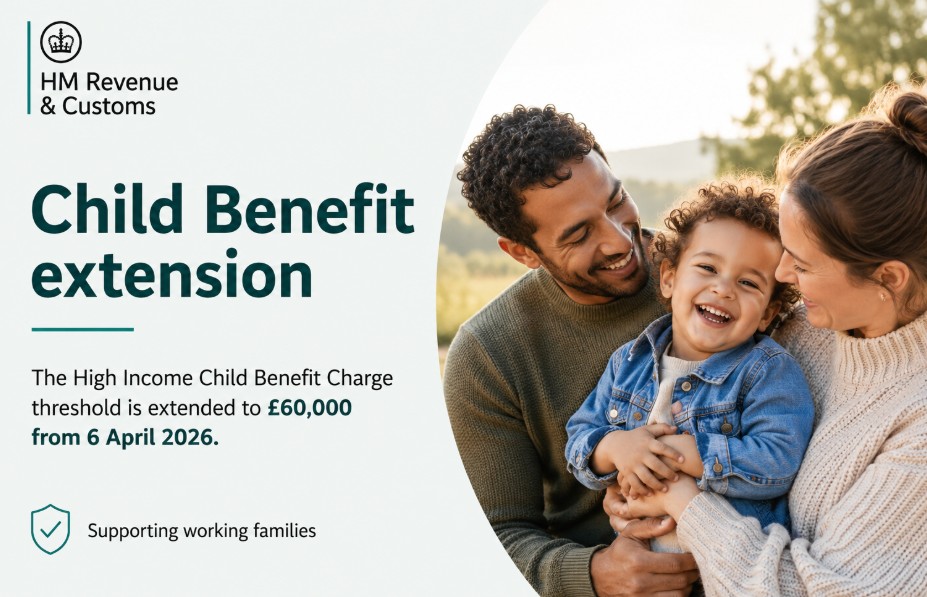
The High Income Child Benefit Charge applies when an adjusted net income exceeds £60,000 per year, requiring higher earners to decide whether to receive physical payments or opt out while keeping the administrative claim active for National Insurance credits.
A common pattern for growing families involves rising household earnings intersecting with statutory tax thresholds. Maintaining an active claim even when opting out of payments remains crucial for non-working partners.
This administrative link ensures that the claimant secures vital National Insurance credits toward their state pension until the child reaches age 19.
Families with incomes between £60,000 and £80,000 pay a tapered charge proportional to the amount earned over the lower threshold, meaning partial benefits are retained, especially following updates that HMRC Confirmed Child Benefit Will Increase Starting April 2026, unless the claimant elects to stop payments entirely.

Conclusion
HMRC child benefit extension means securing uninterrupted financial support for eligible UK families navigating post-16 educational transitions in 2026. By confirming full-time study details before the August 31 cutoff, households protect their entitlements.
Utilize GOV.UK portals for rapid processing and review income brackets against tax thresholds to maintain complete financial compliance.
Disclaimer: This article is for informational purposes only and does not constitute formal legal or financial advice. Please consult official GOV.UK resources or HM Revenue and Customs (HMRC) directly for specific guidance regarding your personal claim.
FAQ
When does child benefit stop in the UK?
Child benefit standard payments stop on August 31 following a child’s sixteenth birthday unless parents submit an extension notice confirming the teenager is continuing in approved full-time education or training.
Does Child Benefit stop at 18 in the UK?
Yes, support generally stops permanently when a young person turns 19, even if they remain in education. Payments also terminate immediately if the student leaves their course early or enters paid employment.
Can you backdate Child Benefit in the UK?
Claims can typically be backdated by a maximum of three months if all statutory eligibility criteria were met during that past window, provided applications are submitted within strict administrative limits.
What salary does child benefit stop in the UK?
Benefit payments do not strictly stop based on salary, but the High Income Child Benefit Charge recovers 100% of the value through taxation once an individual’s adjusted net income exceeds £80,000.
How long does Child Benefit take to process in the UK?
Digital updates submitted online usually process within a few working days, whereas paper forms sent by post can take several weeks during peak administrative renewal periods in late summer.
Does Child Benefit stop when a child goes to university in the UK?
Yes, standard support stops when a young person transitions to higher education, degree-level courses, or advanced apprenticeships operating under standard employment contracts.
How to cancel Child Benefit online in the UK?
Parents can cancel active claims securely by logging into their Government Gateway account, navigating to the Child Benefit service page, and selecting the closure option.