
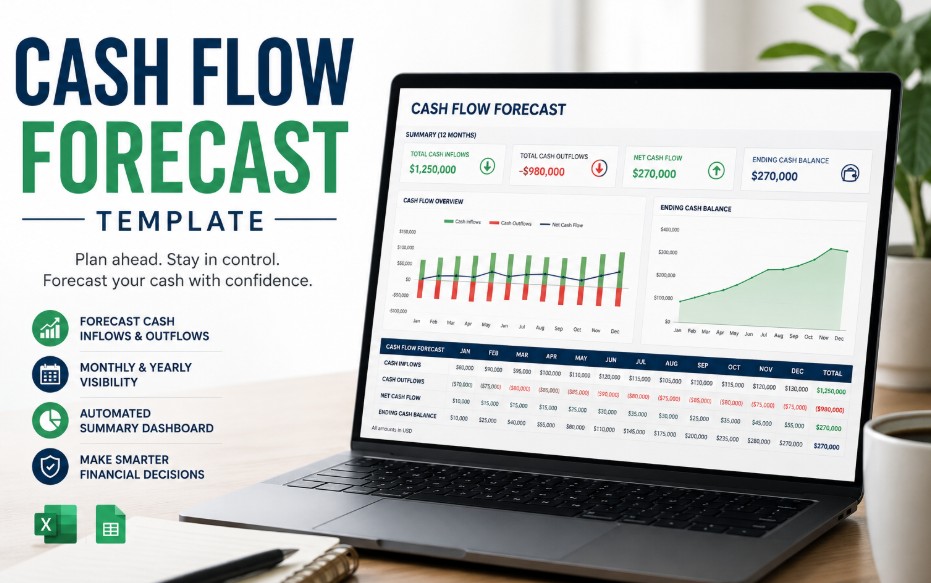
Cash Flow Forecast Template: The UK Business Guide
A cash flow forecast template is a financial tool used to project a business’s future bank receipts and payments over a specific period. By tracking actual cash movements rather than paper profits, this template helps small businesses monitor real-time liquidity, manage working capital, and prevent sudden insolvency.
What Is a Cash Flow Forecast?
A cash flow forecast is a forward-looking financial roadmap that estimates the exact amount of money expected to flow into and out of a business bank account over a specific timeframe. Unlike historical statements, its sole purpose is to predict future liquid survival.
In professional practice, a business can report strong accounting profits on its income statement while simultaneously sliding toward corporate insolvency due to severe timing mismatches between cash collections and operational liabilities.
Maintaining a rolling liquidity model provides management with a clear runway view, ensuring that short-term obligations like payroll, supplier invoices, and regulatory debts remain fully funded.
Why Is a Cash Flow Forecast Important for Business Survival?
A cash flow forecast is vital for business survival because it predicts upcoming cash crunches, protects company liquidity, and ensures that immediate liabilities, such as employee payroll and quarterly HMRC tax bills, can be paid on time regardless of paper profitability.
- Prevents Insolvency: It highlights upcoming cash crunches weeks or months before they happen, giving you time to secure financing, cut expenses, or accelerate collections.
- Informs Smart Decisions: It reveals exactly when you can afford to purchase new equipment, hire staff, or expand into new markets without risking your daily operations.
- Secures Funding: Lenders and investors rarely look at profits alone. They want to see a robust, realistic forecast that proves the business can comfortably service debt and generate free cash.
Profitability does not guarantee survival. A business can report record accounting profits on paper but still face structural liquidation if cash is locked in unpaid trade invoices when immediate debts like payroll and HMRC liabilities fall due.

Why Your Business Strategy Requires a Cash Flow Forecast Template?
Your business strategy requires a cash flow forecast template to standardize financial reporting, eliminate human formula errors, automate balance calculations across complex timelines, and enable rapid scenario stress-testing against sudden shifts in macroeconomic or supplier pricing.
- Standardized Matrix: It forces a disciplined categorization of every sterling or dollar increment entering and leaving your account.
- Automated Mathematical Engines: Built-in calculation blocks automatically update your net cash position and closing balances across complex chronological horizons.
- Scenario Testing: A template allows you to run instant what-if stress tests, such as simulating a 25% drop in collection speeds or a sudden spike in supplier pricing.
Is a Cash Flow Forecast the Same as a Profit and Loss Statement?
No, a cash flow forecast tracks real cash moving through a bank account, whereas a Profit and Loss statement records revenue and expenses when they are incurred under accrual accounting, regardless of whether any money has actually changed hands.
A Profit and Loss statement operates under the accrual accounting framework, recognizing revenues when an invoice is issued and expenses when a liability is incurred.
Conversely, a structural cash flow model strictly records transactions when money clears the business bank account.
When reviewing decisions under stress, organizations must recognize that non-cash items such as asset depreciation, amortization, and bad debt write-downs lower taxable net income on a P&L but have zero immediate impact on bank liquidity.
For example, a commercial logistics firm may record the depreciation of its fleet every month, but this bookkeeping adjustment does not drain funds from its day-to-day accounts.
Which Cash Flow Forecast Template Format Should You Select?
Selecting the correct structural medium directly impacts the accuracy, scalability, and collaborative utility of an organization’s financial projections.
| Template Format | Core Operational Advantage | Primary Functional Risk | Best Suited For |
| Microsoft Excel (.xlsx) | Advanced native computing formulas, macro modeling, robust offline security. | Version control confusion across multiple users. | Complex multi-variable forecasting, internal deep-dives. |
| Google Sheets | Real-time cross-departmental collaboration, automated cloud data integrations. | Performance degradation with exceptionally massive data arrays. | Agile teams requiring dynamic, simultaneous updating. |
| Static PDF Documents | Immutability ensures structural design and formatting remain locked. | Complete lack of active cell calculation or formula scaling. | Static layout blueprints or presentation handouts for lenders. |
Why Use a Cash Flow Forecast Template Excel Structure?
Desktop spreadsheet software provides unparalleled processing depth for businesses handling complex financial structures.
An Excel architecture allows finance managers to build intricate logic blocks, execute sensitivity analyses, and connect historical enterprise resource planning data directly via secure local links.
This format ensures complete data confidentiality, as the entire model resides within the organization’s local infrastructure.

When to Implement a Cash Flow Forecast Template Google Sheets Document?
Cloud-based sheets excel in fast-moving commercial environments where diverse team members, such as sales leads and procurement officers, must continuously feed live pipeline projections into a central document.
The inherent revision history tracking mitigates data corruption risks, allowing managers to audit formula edits instantly and maintain a single source of financial truth.
The Limitations of a Static Cash Flow Forecast Template PDF
A non-editable document format cannot function as a living operational tool. Its utility is strictly limited to serving as a visual reference guide or a formal printout for stakeholders during bank presentations.
Because it cannot dynamically calculate sums or automatically adjust to changing variables, using a PDF for continuous rolling updates is functionally inefficient.
What Key Components Must Be Included in a UK Cash Flow Forecast Template?
A UK cash flow forecast template must include three core sections: cash inflows (revenue, debtor collections), cash outflows (operating overheads, cost of sales, tax liabilities), and the automated net cash balance formulas that track closing cash liquidity.
1. Cash Inflows
Cash inflows track every single sterling payment clearing into the business bank account, categorized by point-of-sale cash receipts, credit debtor collections, and alternative finance infusions like loans or equity grants.
- Cash Sales Receipts: Immediate point-of-sale revenues that boost liquidation balances instantly.
- Debtor Collections: Invoiced amounts clearing after typical 30, 60, or 90-day credit intervals.
- Alternative Inflows: Infusions of equity, drawn commercial loans, director loans, and government grants.
2. Cash Outflows
Cash outflows record all capital disbursements leaving the business bank account, split into predictable fixed operating overheads, variable cost of sales, employment expenses, and critical capital or tax obligations.
- Direct Cost of Sales: Outlays for raw materials, inventory procurement, and direct subcontractor delivery fees.
- Fixed Operating Overheads: Commercial rent, local business rates, utilities, and insurance premiums.
- Employment Expenses: Gross staff salaries, National Insurance contributions, and workplace pension provisions.
- Capital Outlays & Debt: Financing repayments, equipment purchases, and corporate tax disbursements.
3. The Net Cash Flow Balance Formula
The net cash flow formula calculates the variance between income and expenditure, mathematically deriving the closing bank balance by adding the current period’s net cash flow to the opening balance.
Should a UK Cash Flow Forecast Template Include VAT?
A common pitfall when configuring a cash flow forecast template uk model is omitting Value Added Tax (VAT) under the assumption that it does not represent true corporate revenue. While this omission is correct on an income statement, it introduces significant errors into a real-time liquidity forecast.
Because a cash model must match the actual bank ledger, all projected collections and disbursements must be recorded on a VAT-inclusive basis.
Failing to do so distorts short-term liquidity, as the business will appear to have less available cash than what actually resides in its accounts during the trading cycle.
A common pattern among mismanaged firms is spending accumulated VAT inflows on operational expenses, only to face a severe cash crunch when the quarterly HM Revenue and Customs (HMRC) payment deadline arrives.
A robust forecasting layout solves this by capturing these funds on entry and scheduling a major cash outflow line item exactly when the electronic payment clears to HMRC, preventing unexpected deficits.

Which Forecast Frequency Fits Your Business?
Choosing the right time horizon depends heavily on a business’s current financial stability, capital structure, and overarching strategic goals.
The Daily and Weekly Model
High-frequency modeling is an essential defensive tool for businesses operating with tight working capital cushions or experiencing intense seasonal demand variations.
Retail operations, hospitality providers, and businesses emerging from restructuring use short-term projections to monitor immediate payroll deadlines and prevent sudden overdraft breaches.
The 13-Week Structure
The 13-week standard is the benchmark methodology favored by corporate treasurers, turnaround professionals, and institutional lenders.
Spanning a full calendar quarter, this format provides a clear view of medium-term obligations, making it highly effective for tracking trade credit cycles and managing quarterly tax liabilities.
The 12-Month for Strategic Planning
An annualized monthly view is the preferred asset for sound corporate planning and investment evaluation.
It smooths out short-term operational noise to reveal structural funding requirements, helping directors assess capital expenditure budgets and present a compelling financial case to commercial lenders.
Templates for Niche Business Models
Generic, one-size-fits-all financial sheets often fail to capture the unique operational dynamics and financial risks of specific industries.
Using a Construction Cash Flow Blueprint
The construction sector operates under highly volatile financial conditions characterized by upfront capital demands and delayed payment cycles. A dedicated build-sector layout must feature specialized line items to handle these structural anomalies safely.
- Project Retention Monies: Isolating the standard 5% to 10% cash deduction held by clients until formal practical completion, a commercial strain frequently cited in regional industry updates by the National Federation of Builders (NFB).
- Staged Milestone Inflows: Mapping cash injections precisely against certified clerk-of-works sign-offs rather than invoice dates.
- Sub-contractor Payables: Aligning flexible weekly labor outlays alongside rigid monthly material supplier invoices.
Selecting the Ideal Free Template Model
Evaluating structural archetypes against specific functional demands ensures that an organization implements a tool that fits its exact needs without adding unnecessary complexity.
| Operational Archetype | Embedded Calculations | Ideal Formatting Platform | Typical Review Period |
| Simple Cash Flow Forecast Template Excel Free Download | Basic sum vectors for immediate cash inflows and outflows. | Excel / Google Sheets | Weekly review cadence. |
| Monthly Cash Flow Forecast Template Excel | Multi-column layouts tracking standard annual operational lines. | Excel | Monthly rolling variance analysis. |
| Project Cash Flow Forecast Template Excel | Segregated phase cost allocations tied to specific contract timelines. | Google Sheets | Milestone-dependent review cycle. |
How to Create a Cash Flow Forecast Step by Step?
To create a reliable cash flow forecast, you must move methodically from verified, concrete financial figures to realistic future assumptions.
Approaching this process step-by-step ensures you do not accidentally omit major expenses or miscalculate when cash actually hits your bank account.
Here is the exact, systematic sequence required to construct a highly accurate cash flow forecast:
- Lock the Base Balance: Extract the verified closing balances across all current, savings, and clearing accounts to serve as the absolute starting point for the model.
- Project Revenue Milestones: Map out realistic future sales based on historical performance and confirmed pipelines, building in realistic payment delays for trade credit accounts.
- Schedule Non-Discretionary Debts: Hardcode all fixed, contractual outgoings, such as commercial leases, salaried payroll obligations, and business insurance premiums, directly into the schedule.
- Integrate Variable Operational Costs: Estimate flexible costs that scale alongside revenue, such as raw material procurement, shipping fees, and temporary labor resources.
- Factor In Regulatory and Tax Deadlines: Insert specific, scheduled outlays for corporation tax, pay-as-you-earn (PAYE) staff deductions, and quarterly VAT obligations.
- Run Continuous Variance Audits: At the close of every month, replace the projected estimates with actual bank figures to identify discrepancies and adjust future assumptions accordingly.

What Are the Primary Limitations of Cash Flow Templates?
While structured forecasting spreadsheets are essential corporate tools, they are models rather than perfect predictions. Recognizing their inherent limitations is vital for maintaining sound risk management.
A template is entirely dependent on the quality of its inputs. Overly optimistic sales pipelines, underestimated project delays, or missing operational costs can quickly invalidate a forecast, turning a helpful model into a compliance risk.
Furthermore, static models struggle to absorb sudden macroeconomic shifts, abrupt supply chain bottlenecks, or rapid interest rate changes without extensive manual restructuring.
To counter these limitations, forward-looking organizations do not rely on a single best-case scenario.
Instead, they run regular stress tests within their models, such as simulating a 25% drop in collection speeds, a baseline safety margin recommended in small business liquidity studies by the British Chambers of Commerce.
Securing Your Small Business Cash Runway
Developing a sound forecasting routine is one of the most effective ways to protect your business from sudden liquidity challenges.
Download a reliable base layout, establish a consistent weekly or monthly update schedule, and ensure your actual bank positions are reviewed regularly against your projections.
This discipline gives management the clarity needed to make confident growth decisions, secure commercial financing, and protect the business against unexpected economic shifts.
FAQ about Cash flow forecast Template
Where can I find a simple cash flow forecast template Excel free download asset?
Highly reliable, free layout structures are available directly from official UK business support portals, major commercial clearing banks, and the British Chambers of Commerce network.
Can I use a single template to manage multiple concurrent business projects?
Yes, provided the sheet includes a multi-tiered tracking matrix that isolates individual project inflows and expenses before consolidating them into a master bank balance overview.
How does inflation or shifting UK supplier pricing impact a 12-month model?
Rising supply chain costs erode cash balances faster than expected. Projections should include an adjustable expense multiplier line to account for changing supplier prices over time.
How frequently should a small business update its cash flow template?
Monthly at an absolute minimum. However, volatile or fast-growing operations operating with tight working capital reserves should move to a weekly update cycle to spot cash crunches early.
Should asset depreciation be included in a standard cash flow template?
No. Depreciation is a non-cash accounting adjustment used for asset valuation and tax calculations; it does not cause an actual withdrawal of funds from a business bank account.
What is the ideal working capital cushion a UK business should aim to maintain?
Generally, three to six months of fixed operating overheads. While exact liquidity needs vary by industry, maintaining this liquid cash reserve ensures a secure runway against unexpected macroeconomic shifts.
How should emergency loan drawdowns be treated in the layout?
A loan advance is recorded as a direct cash inflow under financing activities when it hits the bank, while subsequent principal and interest payments are tracked as regular monthly outflows.