What Is Postponed VAT Accounting And How To Set Up Your Customs Import Account
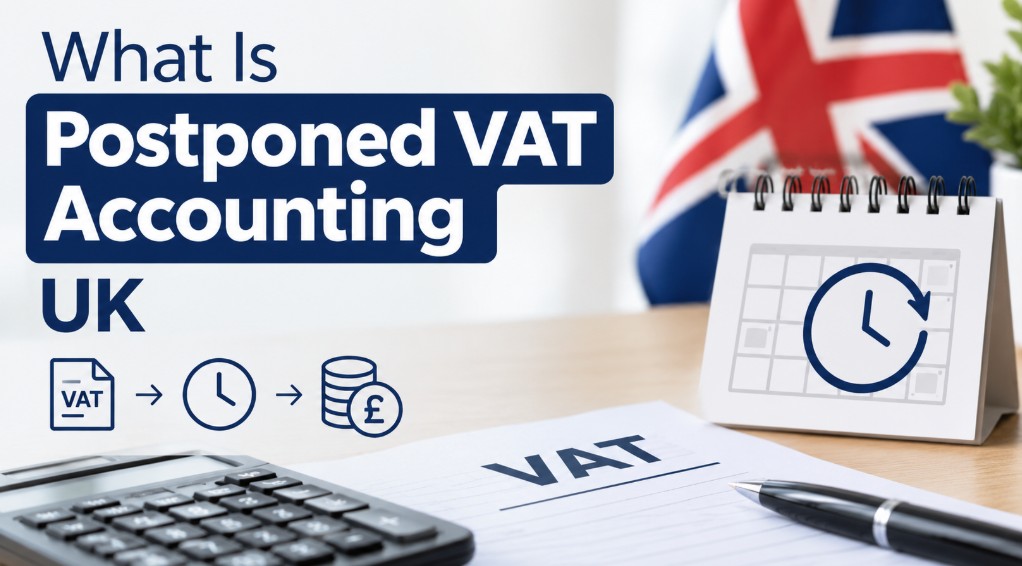
Postponed VAT accounting is a UK import-tax mechanism that lets VAT-registered businesses declare and recover import VAT on the same VAT return, rather than paying it upfront at the border.
Using the scheme is optional for standard imports, but if you delay your customs declaration, using postponed VAT accounting to account for import VAT is mandatory.
Key takeaways
- Postponed VAT accounting lets VAT-registered UK businesses declare and recover import VAT on the same VAT return, avoiding an upfront payment.
- HMRC’s June 2025 update confirmed the scheme is optional, even for delayed customs declarations.
- Monthly postponed import VAT statements, known as MPIVS, are archived after six months, so download them promptly.
What Is Postponed VAT Accounting?
Postponed VAT accounting, often shortened to PVA, is the standard method UK VAT-registered businesses use to account for import VAT since Brexit.HMRC introduced the scheme in January 2021 as part of HM Treasury’s wider post-Brexit customs reforms.
It replaced the previous system, where import VAT was paid upfront and reclaimed later using a C79 certificate.
PVA removes that upfront payment step entirely for eligible imports, keeping cash inside the business rather than tied up at the border. It applies to imports into Great Britain from anywhere outside the UK, and to Northern Ireland imports from outside the UK and the EU.
This scope covers the vast majority of UK businesses trading with any country outside the UK.
How Does Postponed VAT Accounting Work?
Postponed VAT accounting works by shifting import VAT off the customs declaration and onto the VAT return, so no cash changes hands at the point of import.
When a business imports goods, its customs agent selects postponed accounting on the declaration instead of paying VAT immediately.
HMRC records the VAT due against the business’s EORI (Economic Operator Registration and Identification) number. The same figure is later reclaimed on the VAT return.
The VAT recorded this way is treated as output tax at the point of declaration, and as input tax once reclaimed. This single step is what separates postponed VAT accounting from the old system, where VAT had to be paid before goods were released.
The business later declares that same VAT as both due and reclaimable on its VAT return. This cancels out the cash impact for most fully taxable importers, though partially exempt businesses reclaim only the portion their partial exemption calculation allows.
This distinction between output and input tax matters most for partially exempt businesses, who can only reclaim part of what they declare.
Businesses using a freight forwarder or customs agent must give that agent written instructions to use the scheme, which can often be set up as a standing authority rather than on a per-shipment basis.
Unlike a duty deferment account, postponed VAT accounting needs no guarantee or security deposit, which is why several older guides still describe a different process.
How does Postponed VAT Accounting Improve Business Cash Flow?
Postponed VAT accounting benefits small importers mainly through improved cash flow, since import VAT no longer needs to be paid before it can be reclaimed. Businesses that import regularly avoid tying up working capital at the border on every shipment, unlike a duty deferment account, which only delays the payment rather than removing it.
- No upfront VAT payment required at the point of import, keeping liquid funds free for operations.
- No separate C79 certificate to track and match against VAT paid at customs.
- Fewer manual VAT payments to reconcile across each accounting period.
Which Imports Qualify for Postponed VAT Accounting?
PVA applies to most international shipments, but route and consignment value determine eligibility:
- Great Britain: Applies to goods imported from anywhere outside the UK.
- Northern Ireland: Applies to goods from outside both the UK and EU. EU-to-NI goods are not imports, so PVA does not apply.
- £135 Limit: Shipments valued at £135 or less are exclude, these use supply VAT rules charged at point of sale rather than import VAT at the border.
Who Can Use Postponed VAT Accounting?
Any UK VAT-registered business that imports goods for use in the business can use postponed VAT accounting, with no application or approval needed from HMRC. Eligibility depends on:
- Being registered for VAT in the UK.
- Importing goods into Great Britain from anywhere outside the UK, or into Northern Ireland from outside the UK and the EU.
- Including a valid VAT registration number on the import declaration.
- Having the right to dispose of the goods, usually as their owner.
How to Apply for Postponed VAT Accounting on a Customs Declaration?
Applying for postponed VAT accounting means selecting it correctly at the point of import, since there is no separate registration process to complete beforehand.
- Tell the freight forwarder, courier, or customs agent, in writing, that postponed VAT accounting should be used for the shipment.
- Provide the business’s VAT registration number and EORI number for the customs declaration.
- Confirm the agent enters the VAT registration number at header level on the declaration.
- Keep a written record of the instructions given, since the declaration cannot be changed once submitted.
Missing any of these steps is one of the most common reasons import VAT gets recorded against the wrong EORI number, which then shows as a gap on the wrong business’s statement.

How to Set Up PVA Step-by-Step?
Getting started with PVA is straightforward, but setting up the administrative workflow correctly prevents cash flow delays and missing statements down the line.
- Register for the CDS: Log in to gov.uk and specifically register for the Customs Declaration Service (CDS). A standard Government Gateway account alone will not grant you access to your statements.
- Issue your standing authority: Send a formal email to all your current freight forwarders and couriers instructing them to use PVA, complete with your EORI and VAT numbers.
- Configure your software: Set up your accounting platform (like Xero or QuickBooks) to use the dedicated tax rates for postponed import VAT, ensuring it applies correctly to supplier bills.
- Set a monthly download reminder: Create a recurring calendar event to log into the CDS dashboard and download your Monthly Postponed Import VAT Statement (MPIVS) before HMRC archives it after six months.
- Brief your finance team: Ensure whoever files the VAT return knows to map the MPIVS figures to Boxes 1, 4, and 7, and knows they will no longer receive a C79 certificate for eligible shipments.
Which VAT Return Boxes Does Postponed VAT Accounting Affect?
Postponed VAT accounting affects three boxes on the VAT return: Box 1, Box 4 and Box 7, as HMRC’s return guidance sets out. Some search results reference a Box 6 adjustment, but HMRC’s current guidance does not use Box 6 for postponed import VAT at all.
| VAT Return Box | What to Include | Why It Matters |
|---|---|---|
| Box 1 | VAT due on imports for the period | Declares the import VAT owed to HMRC |
| Box 4 | VAT reclaimed on the same imports | Cancels out Box 1 for fully taxable businesses |
| Box 7 | Total import value excluding VAT | Records the net value of goods imported |
On a hypothetical £10,000 import at the standard 20% rate, £2,000 would be entered in both Box 1 and Box 4, and £10,000 in Box 7. No cash changes hands, because the two VAT entries cancel out for a fully taxable business.
A partially exempt business would only enter part of that £2,000 in Box 4, based on its own recovery rate.
For businesses using the VAT Flat Rate Scheme, postponed import VAT is accounted for outside the flat rate calculation. You must include the import VAT in Box 1 and Box 4, but you do not apply your flat rate percentage to the imported goods.
Where Do You Find Your Postponed VAT Statement?
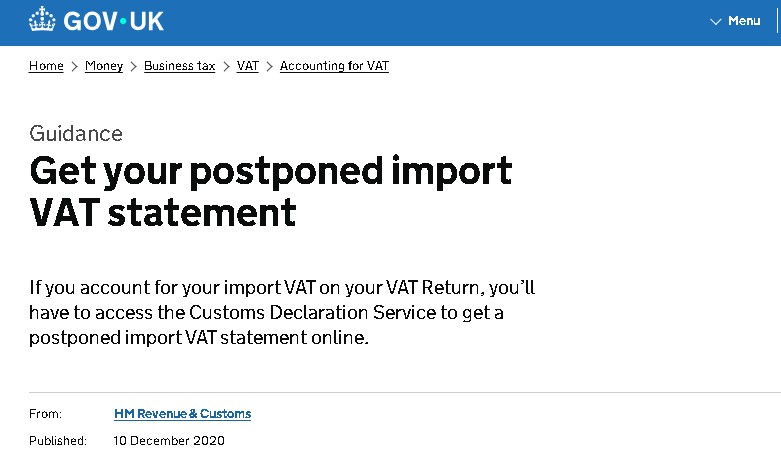
Businesses find their postponed VAT figures on the Monthly Postponed Import VAT Statement (MPIVS), downloaded through the Customs Declaration Service after logging in through the Government Gateway.
However, a standard Government Gateway account is not enough on its own; businesses must specifically register for the Customs Declaration Service (CDS) before they can access their statements.
How Long Is It Available?
Each MPIVS is only available to download for six months from publication before HMRC archives it. Businesses that miss this window lose direct access to the figures needed to support their VAT return.
Freight agents sometimes default to using postponed VAT accounting without being explicitly asked. This often happens when a business hasn’t given clear written instructions, so it may not notice a missing statement until months into the scheme.
Checking the Customs Declaration Service dashboard monthly, rather than waiting for a VAT return deadline, catches this early.
What Are the Benefits of Postponed VAT Accounting?
Postponed VAT accounting benefits small importers mainly through improved cash flow, since import VAT no longer needs to be paid before it can be reclaimed. Businesses that import regularly avoid tying up working capital at the border on every shipment, unlike a duty deferment account, which only delays the payment rather than removing it.
- No upfront VAT payment required at the point of import.
- No separate C79 certificate to track and match against VAT paid at customs.
- Fewer manual VAT payments to reconcile across each accounting period.
Does It Cover Customs Duty?
Postponed VAT accounting does not cover customs duty. Duty remains payable separately, though a duty deferment account can delay those payments by around 30 days rather than removing them. This distinction is one of the most common points of confusion for new importers.
What Deadlines, Mistakes and Risks Should You Watch For?
The main risks around postponed VAT accounting involve missed statements, mismatched VAT return periods and outdated assumptions about when the scheme is compulsory.
- Downloading MPIVS statements late, after the six-month archive window has already closed.
- Assuming postponed VAT accounting is still mandatory for delayed customs declarations, when HMRC removed this requirement in June 2025.
- Confusing postponed VAT accounting with the reverse charge, which applies to services rather than imported goods.
- Applying postponed VAT accounting to consignments valued at £135 or less. For these smaller consignments, supply VAT rules apply instead of import VAT, meaning the VAT is charged at the point of sale rather than at the border.
| Scheme | Cash Paid at Border? | How VAT Is Recovered |
|---|---|---|
| Postponed VAT accounting | No | Declared and reclaimed on the same VAT return |
| C79 certificate | Yes | Reclaimed on a later VAT return using the certificate |
| Duty deferment account | Yes, after a delay | Paid roughly 30 days later, then reclaimed as normal |
Conclusion
Postponed VAT accounting removes the upfront VAT bill that used to slow down UK importers at the border. Getting it right means matching MPIVS figures to the correct VAT return period and downloading statements before the six-month window closes.
Businesses unsure about eligibility, partial exemption, or how the scheme interacts with duty should check HMRC’s current guidance directly before filing. Reviewing that guidance periodically helps businesses catch further updates before they affect a VAT return.
Disclaimer: Import VAT rules and figures reflect HMRC guidance published as of September 2026; individual circumstances vary, and businesses should confirm current requirements directly with HMRC or a qualified adviser before filing.
FAQs
Is postponed VAT accounting the same as reverse charge?
No, they are different mechanisms. Postponed VAT accounting applies specifically to imported goods entering the UK, while the reverse charge typically applies to services and certain domestic or cross-border supplies instead, with separate return treatment.
How do you account for postponed VAT accounting on Xero?
Xero uses dedicated tax rates for postponed import VAT, applied when recording the supplier bill for the imported goods. The figures entered should still match the totals shown on the business’s own MPIVS each month, not an estimate.
How do I log in to my postponed VAT statement?
Businesses access their MPIVS through the Customs Declaration Service, reached via a Government Gateway login on gov.uk. A standard Government Gateway login alone will not display the statement without going through that specific route, so bookmark the correct service page.
Can Northern Ireland businesses use postponed VAT accounting?
Yes, for goods arriving from outside the UK and EU, or moving in from Great Britain. Goods moving from the EU into Northern Ireland are not treated as imports for VAT purposes, so the scheme does not apply to them at all. This distinction trips up several businesses moving goods for the first time.