
Check an EORI Number: How to Validate UK Customs IDs and Fix Failed EORI Checks
An EORI number is a unique customs identifier that HM Revenue and Customs (HMRC) issues to any UK business moving goods across a border, distinguishing it from a VAT number by tracking trade rather than tax.
Under 2026 UK customs rules, traders can verify an EORI number’s live validity on GOV.UK before shipping.
Key Takeaways
- An EORI number does not expire and does not require periodic renewal. However, HMRC automatically cancels an EORI number if a business deregisters from VAT, or if a non-VAT registered business subsequently registers for VAT (which requires applying for a new VAT-linked EORI).
- GB-prefixed numbers are checked on GOV.UK; XI and EU numbers go through the European Commission’s validation tool instead.
- There is no public register that finds an EORI number from a company name alone, only the reverse.
How to Check an EORI Number in the UK?
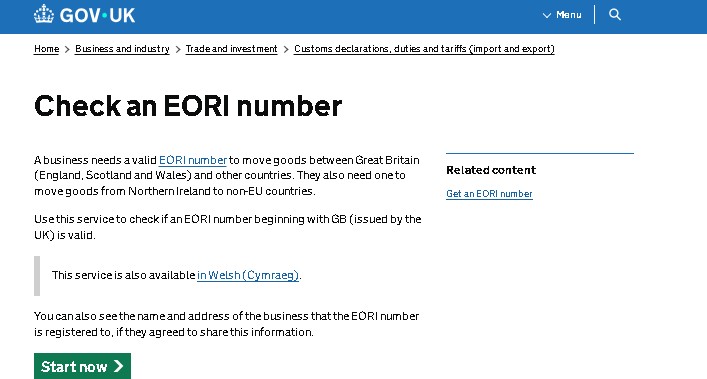
You can check a UK EORI number using GOV.UK’s free Check an EORI number service, which runs a live check against HMRC’s own database.
- Go to the GOV.UK EORI checker and enter the full number, including the GB prefix.
- Submit the number exactly as given, spacing or a missing digit will return a false invalid result.
- Read the result: it will show as valid, invalid, or valid with no business details shown.
A result showing valid with no business details displayed occurs when the trader did not opt into public disclosure during registration. HMRC and the European Commission suppress trader names and address records on public registers unless explicit consent is granted.
A valid result confirms the number is live and usable on a customs declaration today. An invalid result usually means a typo or a number still processing.
Which EORI Checker Do You Need?
| Number prefix | Who it covers | Where to check it |
|---|---|---|
| GB | Great Britain businesses | GOV.UK GB EORI checker |
| XI | Northern Ireland businesses | European Commission validation tool |
| EU country codes (DE, FR, NL, etc.) | EU member state businesses | European Commission validation tool |
For customs audit compliance, always save a PDF copy or screenshot of the live validation result. Freight forwarders and HMRC customs officials may request proof of verification prior to clearing shipments. The service is free, needs no login, and covers only GB-prefixed numbers, anything else needs a different tool.
What is an EORI Number?
An EORI number identifies a business to customs whenever goods cross a UK border. Customs authorities use it to link a shipment to the business responsible for it. Without a valid one attached to a declaration, a shipment can be delayed or refused entirely.
HMRC issues every GB-prefixed number, and the identifier stays tied to that business for as long as it trades internationally.
A freight forwarder or courier will usually ask for it before touching a shipment. Verifying a trading partner’s identifier before dispatch is as essential as securing your own registration.
Can you check an EORI Number by Company Name?
No, there is no public register that finds an EORI number from a company name alone. Both official checkers work in one direction only: enter a known EORI number, and they confirm whether it is valid.
Neither tool searches by business name, so the number must come from the trading partner first.
If a business is VAT-registered in the UK, its GB EORI number is typically its VAT number with GB in front and 000 at the end, confirmed by HMRC’s own guidance.
That gives a starting point to validate, rather than a guaranteed answer. Companies House holds a company’s registration number publicly, but not its EORI, so the simplest route for supplier checks is still to ask the business directly.
What If You Can’t Find or Lost Your Own EORI Number?
You can retrieve a lost EORI number through your original registration portal rather than applying again from scratch. Follow these steps to locate it:
- Sign in to the online EORI registration service using the exact Government Gateway user ID and password used when applying; your number will display on screen.
- Check if the number mirrors your VAT details, as a UK VAT-registered business’s GB EORI is typically GB followed by its 9-digit VAT number and 000.
- Contact HMRC’s EORI team directly if login details are lost or the online record fails to load.
Signing in through a standard personal tax account or general business tax portal will not display the number. Traders must sign into the digital EORI service using the exact Government Gateway credentials created during their original application.
Does an EORI Number Expire or Need a Renewal?
An EORI number does not have an expiry date, according to HMRC’s own guidance, and it does not need renewing. Once issued, it stays valid for as long as the business keeps trading internationally.
The one exception worth knowing: an EORI number is generally deregistered at the same time as the linked VAT registration, since most GB numbers are tied directly to a VAT number.
Similarly, if a non-VAT-registered trader holding an EORI later registers for VAT, HMRC invalidates the non-VAT number. The business must submit a new application to generate a GB EORI that incorporates its 9-digit VAT number.
A business that deregisters for VAT should check its EORI status rather than assume it still works. This matters for anyone restructuring, closing a VAT registration, or changing trading status.
What If an EORI Number Check Fails?
A failed EORI check almost always comes down to one of three fixable causes, not a genuine system fault.
- The number was typed incorrectly, including missing digits or extra spaces
- The application is still processing and has not yet appeared on the register
- The linked VAT registration has since been deregistered

Who Can Get an EORI Number, and What If a Business Is Not Eligible?
A business can usually get an EORI number only if it is established in the country it imports to or exports from. GOV.UK counts a registered office, a central headquarters or a permanent business establishment as being established.
The last means premises where customs-related activities take place, and HR and technical resources are permanently based.
A business outside that test can still get a number in specific cases, for example, when making a customs declaration for transit or temporary admission. Otherwise, it can appoint someone to deal with customs, and that person obtains the number instead.
Before applying, check that the business does not already hold one, because the application asks for:
- A Unique Taxpayer Reference
- The business start date and Standard Industrial Classification code
- Government Gateway sign-in details
How to Apply for an EORI number?
You can apply for a UK EORI number directly through the apply for an EORI number GOV.UK portal.
Documents required to apply for an EORI number
To submit an application, you will need to provide:
- Unique Taxpayer Reference
- Incorporation date or National Insurance number
- Standard Industrial Classification code
- VAT number and effective registration date if VAT-registered
- Government Gateway login details.
How Long Does an EORI Application Take?
Most applications are issued immediately. HMRC can take up to five working days if it needs to run further checks, particularly for businesses that are not VAT-registered, so applying well ahead of a first shipment avoids delay.
When does a small business Actually Need an EORI Number?
You need an EORI number the moment your business moves physical goods across a UK border, regardless of size or structure.
- Moving goods between Great Britain and any other country, including the EU
- Moving goods between Great Britain and Northern Ireland in some cases
- Trading as a sole trader, partnership, or limited company; the structure makes no difference
- Appointing a freight agent or courier to handle customs declarations on your behalf
Selling services alone does not require one, but the moment a service business starts shipping physical goods, that exemption disappears. This requirement applies uniformly under customs rules administered by HMRC.
Trading without one is not a paperwork technicality, goods can be held at the border until a valid number is checked and confirmed.

Conclusion
Checking an EORI number takes minutes once the right tool is matched to the right prefix: GOV.UK for GB numbers, the European Commission for XI and EU numbers.
There is no shortcut by company name and no renewal to remember. The detail worth flagging is VAT deregistration, since that is what most often breaks a number that used to work.
Disclaimer: EORI checking tools and customs requirements can change. Figures here reflect HMRC and European Commission guidance current at the time of writing; confirm live status directly with HMRC before relying on a check for an active shipment.
FAQs
Can I find an EORI number from a VAT number?
Yes, for VAT-registered UK businesses. A GB EORI number is typically the VAT number with GB added at the start and 000 at the end. Always confirm the result on GOV.UK’s checker rather than assuming the formula is correct for that business.
How can I find my EORI number on the GOV.UK website?
Log into GOV.UK using the specific Government Gateway credentials created during your original EORI application. The identifier displays directly on your registration dashboard. Standard personal tax accounts or general business portals will not show this custom record.
Is an EORI number the same as a VAT number?
No, they are separate identifiers issued by different systems. A VAT number relates to tax; an EORI number relates to customs movement. Many UK businesses check an EORI number and find it shares digits with their VAT number, but the two serve different purposes.
Do I need an EORI number as a sole trader?
Yes, company structure makes no difference. Any sole trader moving physical goods across a UK border needs a valid EORI number, exactly like a limited company. Only businesses that trade in services alone are exempt from this.