Complete Guide to Online Bookkeeping Services: UK Costs, Top Providers
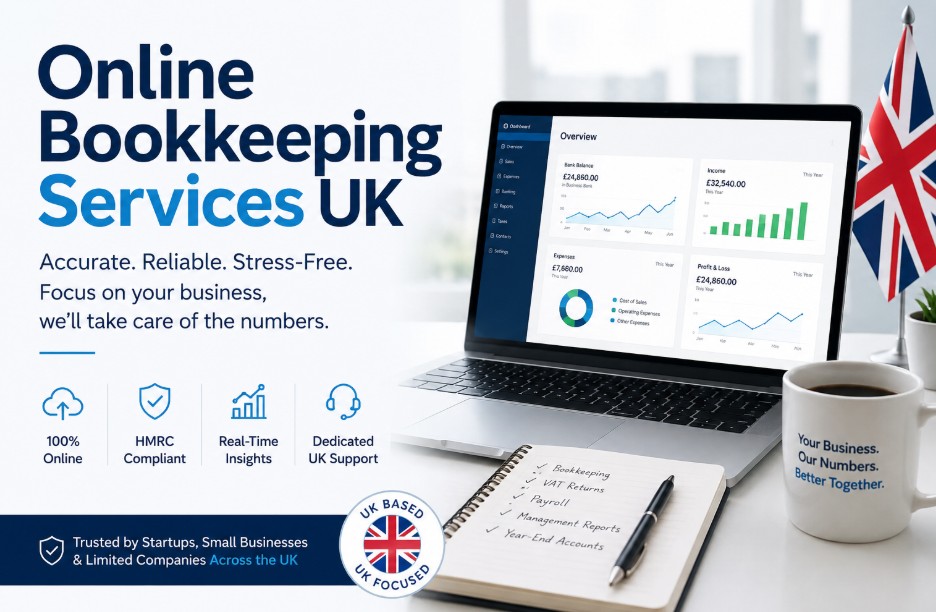
Online bookkeeping services handle everyday finances for UK businesses using cloud software, taking care of bank reconciliations, invoicing, and digital VAT updates without you having to pop into an office.
Key Takeaways
- UK digital bookkeeping typically costs between £50 and £800 a month, depending on your transaction volume and whether you run a sole trader or limited company setup.
- Under HMRC’s Making Tax Digital rules, self-employed individuals earning over £50,000 must keep digital records and submit quarterly updates online.
- Platforms like Xero and QuickBooks keep data structured, but you still need a qualified bookkeeper to catch tricky categorisation mistakes and fix reconciliation errors.
- Outsourcing your bookkeeping cuts overheads by removing the burden of full-time staff salaries, workplace pensions, and extra software licenses.
What Are Online Bookkeeping Services for UK Businesses?
Online bookkeeping services manage day-to-day financial transactions for UK businesses using cloud accounting software. They handle bank reconciliations, invoice logging, expense categorisation, and VAT updates remotely.
This ensures sole traders and limited companies keep accurate financial records that comply directly with HM Revenue and Customs (HMRC) regulations.
Certified specialists review your accounts regularly, so your ledgers stay clean and audit-ready without swallowing up your weekends.
The Modern Cloud Bookkeeping Ecosystem
- Data Ingestion Sources: Supplier invoices, paper receipts, e-commerce / Point-of-Sale (POS) feeds, and company bank account transactions.
- Optical Character Recognition (OCR) Capture: Tools like Dext or AutoEntry extract transaction metadata (date, supplier, VAT rate, total) from mobile photos or PDF documents.
- Cloud Engine: Software platforms such as Xero, QuickBooks Online, or FreeAgent centralize ledger records and open banking data feeds.
- Certified Virtual Bookkeeper Review: A qualified specialist reviews transactions, performs bank reconciliations, files VAT returns, and prepares Making Tax Digital (MTD) submissions to HMRC.

What Is the Difference Between a Bookkeeper, a Full-Charge Bookkeeper, and an Accountant?
A bookkeeper handles routine daily transaction entries, tracking debtors and creditors, and completing bank reconciliations; a full-charge bookkeeper manages end-to-end operational finance including payroll and trial balances; an accountant provides high-level tax strategy, year-end statutory accounts for Companies House, and HMRC audit representation.
Understanding these operational boundaries ensures you assign tasks cost-effectively without paying chartered accountancy rates for routine ledger maintenance.
| Role | Primary Responsibilities | Scope of Work | Strategic & Statutory Output |
| Bookkeeper | Daily transaction entry, logging receipts, issuing sales invoices, expense categorization, monthly bank reconciliations. | Administrative & Operational | Maintains clean, up-to-date ledgers for review. |
| Full-Charge Bookkeeper | End-to-end operational finance, Accounts Payable (AP) / Accounts Receivable (AR), payroll processing, quarterly VAT liabilities, trial balances. | Full Financial Operations | Produces internal management accounts and trial balances. |
| Accountant | Reviews trial balances, year-end accruals, tax optimization, statutory filings, and HMRC audit representation. | Strategic & Statutory Compliance | Prepares statutory accounts for Companies House & Corporation Tax returns. |
Is a Bookkeeper Cheaper Than an Accountant?
Yes, hiring an online bookkeeper is far more affordable than relying on a chartered accountant for day-to-day tasks. According to UK market pricing benchmarks, senior accounting firms typically bill between £100 and £250 an hour for routine admin work.
By comparison, dedicated virtual bookkeepers manage routine data processing at fixed monthly retainers or hourly rates of £18 to £45.
By delegating daily record-keeping to a virtual bookkeeper, small business owners keep monthly ledgers organized, allowing chartered accountants to focus strictly on high-value year-end tax strategy at lower overall cost.
How Much Do Online Bookkeeping Services Cost in the UK?
Online bookkeeping services in the UK cost between £50 and £800+ per month on fixed monthly retainers. Sole trader packages average £50 to £120/month, small limited companies pay £120 to £300/month, and growing SMEs or e-commerce businesses range from £300 to £800+/month.
UK Bookkeeping Cost Breakdown by Business Size (2026 Averages)
| Business Structure | Average Monthly Turnover | Typical Transaction Volume | Estimated Cost (Monthly Retainer) | Estimated Hourly Rate |
| Sole Trader / Freelancer | Under £50,000 | Under 50 items/mo | £50 – £120 / month | £18 – £30 / hour |
| Small Ltd Company (1–5 Staff) | £50,000 – £250,000 | 50 – 200 items/mo | £120 – £300 / month | £30 – £45 / hour |
| Growing SME / E-commerce | £250,000 – £1,000,000+ | 200 – 600+ items/mo | £300 – £800+ / month | £45 – £70 / hour |
Are There Free Online Bookkeeping Services in the UK?
There are no completely free managed online bookkeeping services with human bookkeepers in the UK. However, business owners can access free software subscriptions through business bank accounts like Mettle, NatWest, or RBS, which include complimentary FreeAgent cloud software.
While free tools eliminate subscription costs, business owners must still process data entry, receipt capture, and reconciliations themselves using small business accounting software unless they hire a professional bookkeeper to manage the ledger.
What Are the Main Service Delivery Models for UK Online Bookkeeping?
UK business owners can choose from three main online bookkeeping models: self-managed DIY cloud software, independent virtual bookkeepers, or fully managed digital accounting agencies. Each model varies by monthly cost, time commitment, and statutory compliance coverage.
| Feature / Metric | DIY Cloud Software | Independent Virtual Bookkeeper | Fully Managed Digital Agency |
| Average Monthly Cost | £12 – £45 | £100 – £350 | £150 – £600+ |
| Time Required from Owner | 3–6 hours/week | Under 1 hour/week | Under 30 mins/week |
| HMRC Compliance Coverage | Self-Managed Check | High (Individual ICB/AAT) | Verified (Multi-tier Review) |
| Software Management | User-operated | Managed by Specialist | Managed & Provided |
| Scale & Redundancy | Low (Single user) | Medium (Single point of failure) | High (Dedicated back-up team) |
Comparison of the 10 Best Online Bookkeeping Providers in the UK
The 10 best online bookkeeping providers in the UK include Mazuma, The Accountancy Partnership, Crunch, Osome, Sleek, TaxScouts, Countingup, Aone Outsourcing Solutions, TaxAssist Accountants, and Meru Accounting. Rates start from £5 to £100+ per month based on business scale.
| Provider | Starting Price | Primary Target Audience | Core Accounting Software | Highlight Features |
| Mazuma | £38/mo + VAT | Micro-businesses & Sole Traders | Proprietary MazApp / Paper | Paper receipt envelope service + digital uploads. |
| The Accountancy Partnership | £20/mo + VAT (Bookkeeping) | Sole Traders & Small Ltds | Pandle / Xero / QBO | Pay-only-for-what-you-need flexible retainer model. |
| Crunch | £24.50/mo + VAT | Freelancers & Contractors | Proprietary Crunch Software | All-in-one software and accountant access bundle. |
| Osome | £71/mo + VAT | E-commerce & Growing SMEs | Xero + Osome Platform | AI-driven daily reconciliations with live UK chat. |
| Sleek | £30/mo + VAT | Startups & Small Businesses | Xero / Sleek App | Automated paperless bookkeeping & VAT management. |
| TaxScouts | £14/mo + VAT | Freelancers & Side Hustlers | Cloud Agnostic | Combined tax prep and lightweight bookkeeping. |
| Countingup | £5/mo | Micro Sole Traders | Built-in Business Account | Built-in business bank account with automated logs. |
| Aone Outsourcing Solutions | Custom (£100+/mo) | Growing SMEs & Practices | Xero, QBO, Sage, FreeAgent | Fully outsourced ledger, AP/AR, and multi-tier QA. |
| TaxAssist Accountants | Custom (£100+/mo) | Established Local SMEs | Xero, QBO, Fathom | Local high-street presence combined with cloud tools. |
| Meru Accounting | Custom (£80+/mo) | E-commerce Businesses | Xero, QBO, A2X, Shopify | Specialist multi-currency e-commerce payout sync. |
1. Mazuma
Mazuma is an award-winning UK online accounting service known for its hassle-free purple envelope physical document collection alongside digital app uploads, starting from £38/month + VAT.
- Best For: Micro-business owners and sole traders who prefer sending physical paper receipts or simple digital photos.
- Pros:
- Accepts postal paperwork via pre-paid envelopes for non-tech-savvy users.
- Very affordable entry-level pricing for small entities.
- Full HMRC MTD compliance included in all tiers.
- Cons:
- Less tailored for complex multi-channel e-commerce operations.
- Bespoke custom reporting requires higher tier plans.
2. The Accountancy Partnership
The Accountancy Partnership offers modular, transparent bookkeeping services from £20/month + VAT, using their proprietary Pandle software or major third-party platforms.
- Best For: Small business owners who want a modular service where they only pay for exact transaction volumes.
- Pros:
- Highly customizable pricing with no hidden charges.
- Includes free access to Pandle cloud accounting software.
- Dedicated UK-based bookkeepers assigned to every account.
- Cons:
- Software integrations outside Pandle may incur higher monthly retainers.
- Payroll and specialized tax filings cost extra.
3. Crunch
Crunch combines intuitive cloud accounting software with accredited online bookkeepers and accountants, offering structured monthly plans starting at £24.50/month + VAT.
- Best For: Freelancers, contractors, and small limited companies looking for software and human advice under one roof.
- Pros:
- Seamless integration between proprietary software and in-house advice.
- Self-Assessment and year-end statutory account add-ons available.
- Real-time tax liability dashboard.
- Cons:
- Requires using the native Crunch software ecosystem.
- Higher tier required for dedicated account manager support.
4. Osome
Osome delivers tech-led online bookkeeping starting at £71/month + VAT, pairing AI automation with dedicated human bookkeepers to process documents and reconciliations daily.
- Best For: High-volume e-commerce sellers (Amazon, Shopify, Stripe) and tech-forward SMEs.
- Pros:
- Fast response times via live in-app chat.
- Daily transaction matching and multi-currency conversion handling.
- Integrates directly with major online sales channels via A2X.
- Cons:
- Higher starting price point compared to basic entry-level competitors.
- Fees auto-scale upward as annual revenue crosses statutory benchmarks.
5. Sleek
Sleek provides digital bookkeeping and tax services starting from £30/month + VAT, utilizing smart automation to process receipts, track VAT liabilities, and keep ledgers ready for filing.
- Best For: Early-stage UK startups and small limited companies looking for paperless management.
- Pros:
- Streamlined mobile receipt scanning and automated categorizations.
- Transparent fixed monthly subscription tiers.
- Includes corporate secretarial and registration add-ons.
- Cons:
- Specialized sector advisory requires separate consultations.
- Limited custom management reporting on standard packages.

6. TaxScouts
TaxScouts provides low-cost digital tax and bookkeeping guidance starting around £14/month + VAT, pairing sole traders directly with certified UK accountants.
- Best For: Sole traders, gig workers, and side hustlers who need simple income tracking and Self Assessment support.
- Pros:
- Extremely simple fixed-fee pricing structure.
- Fast turnarounds on tax queries and return submissions.
- Fully remote setup through web and mobile apps.
- Cons:
- Not designed for complex limited companies needing daily Accounts Payable/Receivable.
- Lacks inventory and stock tracking features.
7. Countingup
Countingup combines a UK business bank account and automated bookkeeping software into one app, with fees ranging from £5 to £20/month depending on monthly deposits.
- Best For: Sole traders and micro-entrepreneurs wanting an all-in-one business bank account with built-in bookkeeping.
- Pros:
- Automatic receipt matching directly linked to business debit card transactions.
- Real-time tax estimates calculated automatically upon spending.
- Instant setup with no separate software integration needed.
- Cons:
- Serves as software/banking only, does not include a dedicated human bookkeeper for complex queries.
- Transaction limits apply on lower-tier accounts.
8. Aone Outsourcing Solutions
Aone Outsourcing Solutions delivers fully managed outsourced bookkeeping and accounting services for UK businesses and practices, providing multi-layer quality control and complete HMRC compliance.
- Best For: Growing SMEs and accountancy practices needing dedicated full-time or part-time virtual finance teams.
- Pros:
- Comprehensive services including daily transaction posting, AP/AR, and payroll.
- Native operation across Xero, QuickBooks, Sage, and FreeAgent.
- Scalable structure with multi-tier quality checks.
- Cons:
- Requires custom discovery calls for precise quote generation.
- Best suited for structured businesses rather than micro sole traders.
9. TaxAssist Accountants
TaxAssist Accountants provides a hybrid online and high-street bookkeeping service, backed by a nationwide network of over 400 local offices across the UK.
- Best For: Small-to-medium businesses that want the convenience of cloud software paired with optional face-to-face local consultation.
- Pros:
- Hybrid delivery model (in-person storefronts or 100% virtual).
- Extensive network handling payroll, VAT, statutory accounts, and advisory.
- High client trust ratings across UK regional hubs.
- Cons:
- Monthly retainer pricing is generally higher than pure virtual providers.
- Rates vary slightly based on regional office locations.
10. Meru Accounting
Meru Accounting offers specialist outsourced e-commerce bookkeeping for UK online merchants using Xero, QuickBooks, and automated payout connectors like A2X.
- Best For: E-commerce startups and multi-channel retailers selling across Shopify, Amazon, and eBay.
- Pros:
- Expertise in complex e-commerce sales tax, payment gateway fees, and multi-currency reconciliations.
- Fixed, affordable monthly retainer packages.
- Integrates inventory software with core cloud accounting platforms.
- Cons:
- Remote-only delivery with no physical client meetings.
- Focuses heavily on digital and retail sectors rather than traditional trades.
How Do Online Bookkeeping Services Keep You HMRC and MTD-Compliant?
Online bookkeeping services maintain HMRC compliance by capturing digital audit trails, executing quarterly Making Tax Digital (MTD) updates, and ensuring digital links between software modules without manual data entry.
Under HM Revenue and Customs Making Tax Digital regulations, paper records are no longer compliant for VAT-registered entities or self-employed individuals crossing statutory income thresholds.
HMRC MTD ITSA Implementation Timeline & Income Thresholds
HMRC Making Tax Digital for Income Tax Self Assessment (MTD ITSA) mandates digital record-keeping starting April 2026 for income over £50,000, April 2027 for income over £30,000, and April 2028 for income over £20,000.
| Phase | Implementation Date | Qualifying Gross Income Threshold | Mandated MTD Compliance Actions |
| Phase 1 | April 2026 | Gross Income > £50,000 | Mandatory digital record-keeping & 4 quarterly updates to HMRC. |
| Phase 2 | April 2027 | Gross Income > £30,000 | Threshold lowers to include mid-tier sole traders and landlords. |
| Phase 3 | April 2028 | Gross Income > £20,000 | Expands digital reporting coverage across self-employed sole traders. |
Key MTD Requirements Handled by Virtual Bookkeepers
- Digital Record-Keeping: Securing a clear digital audit trail for every sales invoice and business purchase without manual transcription errors.
- Quarterly MTD Updates: Submitting summary figures for income and expenses directly to HMRC using compatible software every three months, replacing reliance on single end-of-year calculations.
- Digital Links: Ensuring data transfers between software modules without manual copy-pasting, preserving digital link continuity required during HMRC compliance reviews.
How to Choose the Best Virtual Bookkeeper for Your Small Business
To choose the best virtual bookkeeper in the UK, audit your monthly transaction volume, verify ICB or AAT professional certifications, confirm Anti-Money Laundering (AML) registration, and verify software compatibility with Xero, QuickBooks, or FreeAgent.
Step-by-Step Virtual Bookkeeper Selection
- Audit Internal Transaction Volume: Calculate your average monthly invoices, receipts, bills, and active bank accounts to request accurate fixed-fee quotes.
- Verify Professional Qualifications: Confirm that the primary account manager holds valid certification from recognized bodies such as the AAT or ICB, along with required AML registration.
- Confirm Software Compatibility: Ensure the provider specializes in your preferred software stack, such as Xero, QuickBooks Online, or FreeAgent.
- Establish Receipt Capture Workflows: Deploy dedicated capture applications like Dext or AutoEntry on team mobile devices to upload receipts electronically at the point of purchase.
- Grant Read-Only Bank Access: Connect secure, read-only digital open-banking feeds to allow automatic daily transaction imports into the ledger system.
- Define Clear SLA & Escalation Protocols: Set up regular reconciliation schedules and establish dedicated communication channels for handling unusual tax queries.
Conclusion
Transitioning to an online bookkeeping service helps streamline financial record-keeping, maintain continuous MTD compliance, and save valuable administrative time.
Rather than spending weekends reconciling bank feeds, digital bookkeeping gives business owners real-time financial visibility through structured cloud accounting systems.
To start, list your current monthly transaction totals and confirm whether your current software setup supports secure open-banking integrations.
Comparing quotes from certified virtual bookkeepers allows you to select a fixed-fee plan tailored to your operational scale, giving you clear oversight of your business finances.
FAQ
Do online bookkeeping services include annual tax returns?
No, Standard monthly bookkeeping covers day-to-day transaction logging, bank reconciliation, and quarterly VAT filings. Year-end statutory accounts and Corporation Tax or Self Assessment tax returns are typically added as separate annual service modules.
Can an online bookkeeper handle multi-currency accounts for e-commerce?
Yes. Professional online bookkeepers use multi-currency cloud accounting software like Xero or QuickBooks to track foreign currency sales feeds, Shopify or Amazon payouts, stripe processing fees, and real-time realized exchange gains or losses.
How do I send my physical receipts to a virtual bookkeeper?
Physical paperwork is digitized using mobile document capture tools like Dext or AutoEntry. Business owners take a photograph of paper invoices or receipts using a smartphone app, which instantly uploads legible digital copies to the cloud ledger.
What happens if my business transaction volume increases mid-year?
When transaction volumes grow, managed online bookkeeping providers update your monthly retainer plan based on transparent tier levels, ensuring fee adjustments reflect your updated volume requirements without service interruptions.
Is online bookkeeping cheaper than hiring in-house staff?
Yes, outsourced digital bookkeeping eliminates costs related to full-time salaries, National Insurance contributions, workplace pensions, hardware provisioning, and software user licensing fees, typically cutting routine financial administration overheads by over fifty percent.
How safe is cloud bookkeeping data in the UK?
Cloud providers secure data using bank-grade 256-bit SSL encryption, mandatory multi-factor authentication, and redundant backups in UK-based data centers compliant with ISO 27001 standards and UK GDPR regulatory requirements.
What documents do I need to supply to my online bookkeeper monthly?
You will need to provide digital access to cloud bank feeds, sales channel breakdown reports, point-of-sale summaries, supplier purchase invoices, expense receipts, and monthly payroll summary schedules.
Disclaimer: This article is for informational purposes only and does not constitute formal financial, tax, or legal advice; always consult a certified UK accountant for tailored compliance guidance.