Being VAT Registered is Killing my Business? How to Navigate the VAT Cliff Edge
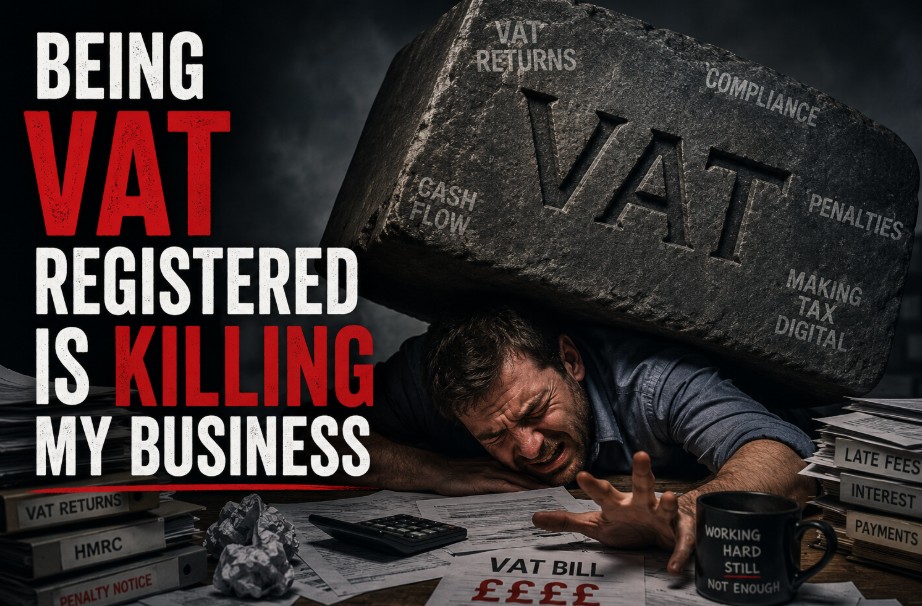
Many UK small business owners reach a point where they feel that being VAT registered is killing my business due to shrinking profit margins, administrative burdens, and cash flow strains. When a business crosses the compulsory registration threshold, it must suddenly account for a 20% tax on supplies.
For companies trading with non-VAT registered consumers or operating in low-margin sectors, absorbing this cost or passing it on to price-sensitive customers can severely damage competitiveness, stall growth, and reduce overall profitability.
Is being VAT registered killing your business right now?
When a company experiences severe cash flow blockages and margin erosion immediately after joining the UK Value Added Tax system, the owner frequently concludes that being VAT registered is killing my business from a structural perspective.
This commercial crisis typically occurs because the business must either raise prices by 20%, risking the loss of price-sensitive retail clients, or absorb the tax entirely within its existing pricing model, which instantly destroys net profitability.
The Economic Reality of the UK VAT Cliff Edge
In practice, the transition from an unregistered status to a fully compliant VAT entity introduces an immediate structural shift in how cash moves through a company. For a business operating just below the statutory threshold, every pound collected from a customer represents gross revenue.
The moment the business crosses that registration line, one-sixth of the total gross receipt from a standard-rated sale belongs directly to HM Revenue and Customs (HMRC).
Look at almost any micro-business hitting this transition phase, and you see the same pattern: working capital vanishes overnight. It gets even worse if you offer extended invoice terms.
If you hand a corporate client a standard-rated invoice on 60-day terms, the tax point rules dictate that you still owe that VAT to HMRC on time. You are stuck funding the tax bill out of your own pocket long before the client ever pays you.
What is the VAT threshold for UK small businesses?
The compulsory VAT registration threshold for UK small businesses is £90,000, calculated on a rolling 12-month basis. Conversely, the statutory threshold for voluntary deregistration is £88,000 or lower.
Meeting the £90,000 threshold immediately mandates automatic compliance with Making Tax Digital (MTD) regulations.
The Small Business VAT Rules Matrix
To determine compliance obligations, business owners must calculate their cumulative taxable turnover at the end of every single calendar month on a rolling 12-month basis, rather than a fixed calendar year or standard financial tax year.
| Tax Parameter | Statutory Limit | Assessment Calculation Window |
| Compulsory Registration Threshold | £90,000 | Rolling 12-month period (not a fixed tax year) |
| Voluntary Deregistration Threshold | £88,000 | Rolling 12-month look-forward or look-back |
| Making Tax Digital (MTD) Mandate | £90,000 | Automatic upon compulsory registration |
The statutory threshold requiring a UK business to register for VAT is £90,000. It is a common misconception that this figure applies to a fixed calendar year or a standard financial tax year.
Instead, business owners must calculate their cumulative taxable turnover at the end of every single calendar month on a rolling 12-month basis to determine compliance obligations.
Who Really Needs to Register for VAT?
You must register for VAT with HMRC if your total taxable turnover exceeds £90,000 in any rolling 12-month period, or if you realise that your turnover alone in the next 30 days will exceed £90,000.
It is required for both standard and zero-rated items, but businesses trading exclusively in exempt goods are completely barred from registering.
Before worrying about Value Added Tax rules, it is helpful to understand the baseline company structure milestones by reviewing when you need to register your business with HMRC. Once your operations grow, specific rules govern the compulsory transition into the VAT ecosystem.
- The Rolling 12-Month Rule: Your total taxable turnover goes over £90,000 in any rolling 12-month period (not a fixed tax or calendar year).
- The 30-Day Look-Ahead Rule: You realise at any point that your turnover alone in the next 30 days will exceed that £90,000 threshold.
Taxable vs. Exempt Turnover
Taxable turnover includes everything you sell that isn’t exempt from VAT. If your business sells zero-rated items (like most children’s clothing or books), you still must register if you cross the threshold, even though your actual VAT rate on sales will be 0%.
Conversely, if your business trades exclusively in exempt goods or services (such as certain financial services, insurance, or specific healthcare treatments), you cannot register for VAT at all, and you don’t need to track the threshold.
What are the disadvantages of being VAT registered?
The structural disadvantages of being VAT registered include an immediate 20% anti-competitive price jump for B2C consumers, critical cash flow gaps under standard invoice accounting, and heavy administrative overhead through Making Tax Digital (MTD) software and accounting fees.
- The Consumer Pricing Trap: If your target audience consists of standard retail consumers, uninsured individuals, or small unregistered businesses, they cannot reclaim the 20% VAT you append to invoices. Your services instantly become one-fifth more expensive than non-registered competitors.
- Administrative Surcharges and Software Costs: Compliance requires compatible, functional software to adhere to the strict statutory rules of Making Tax Digital (MTD). This demands extra bookkeeping hours, specialised tracking, and increased professional accountancy fees.
- Working Capital Exhaustion: Standard invoice accounting dictates that you owe output tax based on the invoice date. If a commercial customer defaults or delays payment, your company must still remit that VAT to HMRC on time, creating severe cash flow gaps.
What are the hidden benefits of being VAT registered?
While the financial pressure can feel overwhelming, maintaining a VAT registration offers distinct commercial advantages that can be leveraged to offset the underlying structural costs.
- Unlocking Input Tax Reclaims: Registered entities can fully claw back the input VAT paid on business expenses, stock, commercial rent, and sub-contractor fees. This directly lowers your everyday running costs.
- Elevating Corporate Reputation: Having a valid VAT number makes your business look established. It signals commercial scale, helping you land lucrative corporate contracts with larger firms that simply refuse to trade with unregistered setups.
- Historical Expense Recovery: When you first register, you can retrospectively claim back input VAT on goods still held in stock up to four years prior. You can also claim for services received up to six months before your effective registration date.
Is being VAT registered good or bad for your specific business model?
VAT registration is highly beneficial for corporate B2B environments with high capital expenses, as corporate clients can fully reclaim the 20% tax.
However, it is structurally damaging for B2C environments or low-overhead service models, where the 20% tax acts as a direct tariff on your gross margin.
Structural Framework Comparison
To determine whether registration serves or harms your business, you must look directly at your client base and your expense profile.
| Business Attribute | VAT Registered Environment | Non-VAT Registered Environment |
| Primary Target Market | Corporate entities (B2B) who fully reclaim VAT. | Retail consumers (B2C) or exempt organisations. |
| Expense Profile | High capital expenditure with heavy input VAT costs. | Low material expenses, mainly labour or digital services. |
| Pricing Strategy | Net-of-tax pricing; matches industry standard. | Gross pricing; highly competitive against larger firms. |
In a strict B2B environment, registration is highly efficient; your corporate clients simply reclaim the output tax you charge, rendering the 20% cost completely neutral to them while you enjoy full recovery of your input expenses.
Conversely, in a B2C environment, the tax acts as a direct tariff on your gross margin or an artificial inflation of your retail prices.
How can a business owner legally navigate the VAT burden?
To legally alleviate the VAT burden, business owners should consistently audit their trailing 12-month turnover, analyse sector-specific Flat Rate percentages, switch to the Cash Accounting Scheme to match liabilities with cash flow, and separate output tax receipts into a dedicated holding account weekly.
Actionable Financial Practices
To restructure your business operations and alleviate the severe cash flow pressures associated with standard VAT accounting, you can systematically implement specific statutory mechanisms approved by HMRC:
- Analyse your trailing 12-month turnover monthly: Constantly track your precise gross sales to identify exactly when you approach or drop below the statutory limits.
- Evaluate industry-specific Flat Rate Scheme percentages: Determine if your sector offers a low flat rate percentage that allows you to retain a portion of the VAT collected from customers.
- Switch immediately to the Cash Accounting Scheme: Align your tax liabilities directly with your actual bank account movements to eliminate the risk of funding unpaid invoices.
- Ring-fence all collected output tax weekly: Transfer a clean 20% slice of all weekly incoming revenues into a dedicated tax holding account to preserve operational liquidity.
- Audit your entire supply chain for hidden input VAT: Ensure your bookkeeping process captures every eligible penny of input tax on digital subscriptions, utility bills, and fuel.
- Submit a formal application for voluntary deregistration: If your rolling turnover safely drops below £88,000, submit a digital cancellation request via your secure HMRC online tax account.

Is the VAT Flat Rate Scheme a viable escape route?
The VAT Flat Rate Scheme is an alternative accounting method designed to simplify tax administration for small businesses by allowing them to pay a fixed percentage of their gross turnover to HMRC rather than calculating input and output tax individually.
Mechanics of the Flat Rate Structure
Under this regime, you simplify tax administration by paying a fixed percentage of your gross turnover to HMRC rather than calculating input and output tax individually.
You still invoice clients at the standard 20% rate but pay HMRC a lower, fixed percentage based on your sector. Your profit lies in the gap between what you charge and what you hand over.
The 16.5% Limited Cost Trader Trap
Watch out, though, if you spend less than 2% of your turnover (or under £1,000 a year) on physical goods, which is incredibly common for modern digital consultants, writers, and service providers, you hit the limited cost trader trap.
HMRC will automatically crank your flat rate to a brutal 16.5% of your gross sales, which completely wipes out your financial edge and can actually cost you more than standard VAT accounting.
Can you stop being VAT registered to save your profit margins?
Yes, a company can legally cancel its VAT registration through voluntary deregistration if it satisfies HMRC that its projected taxable turnover for the next 12 months will not exceed the deregistration threshold of £88,000 based on tangible business changes.
Navigating the Deregistration Framework
You don’t have to stay trapped in the system if your sales are cooling down. You can apply for voluntary deregistration the moment your rolling 12-month turnover drops below £88,000, or if you can prove to HMRC that your income over the next 12 months will not cross that threshold.
When calculating this forward-looking projection, you cannot simply hope for a drop in sales; you must provide tangible business evidence to support your application, such as:
- The verified loss of a major, recurring commercial contract.
- A structural alteration to your business model (e.g., permanently stopping a specific service line).
- A conscious, documented reduction in your operating hours or capacity.
If approved, HMRC will issue an official cancellation notice confirming your effective date of deregistration, after which you must immediately cease adding VAT to your commercial invoices.
The Remaining Asset Trap
Keep an eye on your stock and assets when exiting. When you deregister, if the VAT due on the business assets you still hold (like equipment, vehicles, or unsold stock) adds up to more than £1,000, you are legally required to pay that VAT back to HMRC on your final VAT return.
When to Get Expert Advice on VAT Registration and HMRC Rules?
VAT is widely considered one of the most complex areas of UK tax law. Trying to figure it out through trial and error can result in crippling back-tax bills and penalties. You should step away from Google and speak to a certified accountant or VAT specialist immediately if:
- You are tempted to split your business: If you are thinking about creating a second limited company just to keep both below the £90,000 line, stop. HMRC calls this artificial business splitting and will aggressively audit and merge the entities retroactively.
- You are facing an HMRC Failure to Notify penalty: If you accidentally crossed the threshold months ago and forgot to register, an expert can help minimise the potential financial penalties.
- Your pricing strategy needs a structural overhaul: If you are about to cross the threshold and don’t know how to transition your prices without losing your core B2C retail customers, a specialist can run the numbers to find the safest path forward.

How to Legally Stop Paying VAT?
If the system is suffocating your growth, there are legitimate, HMRC-approved strategies to reduce or entirely eliminate your VAT burden without breaking the law:
- Voluntary Deregistration: If your turnover slows down or you intentionally scale back, you can ask HMRC to cancel your registration (more on this below).
- The Cash Accounting Scheme: If cash flow is your main pain point, this scheme lets you account for VAT only when money actually changes hands. If a customer pays you late, or defaults entirely, you don’t owe HMRC a penny of VAT until the cash hits your bank.
- The Flat Rate Scheme: For businesses with low overheads, you pay a fixed, lower percentage of your gross turnover to HMRC based on your industry. You still charge 20% on invoices, but you keep the difference. Warning: Watch out for the 16.5% limited cost trader trap if you don’t buy many physical goods.
Summary of strategic options for small business owners
If the financial burden of tax compliance threatens the survival of your enterprise, you must take proactive steps to protect your margins. First, verify whether your rolling 12-month turnover allows for a legal, voluntary deregistration by falling below the £88,000 threshold.
If you must remain registered, analyse whether transitioning to the Cash Accounting Scheme will eliminate your working capital gaps by realigning tax payments with actual cash receipts.
Finally, review your service pricing structures alongside a qualified accountant to ensure you are accurately capturing every permissible input tax deduction on your operational expenses.
FAQ about Being VAT registered is killing my business
Is the first £90,000 of business turnover entirely VAT free?
Yes. A business is not required to charge or remit tax on its sales until its cumulative taxable turnover crosses the statutory £90,000 threshold within a rolling 12-month period, or if it registers voluntarily.
Can I claim back VAT as a sole trader working from home?
Sole traders can fully reclaim input tax on legitimate business expenses. This includes the exact business-use proportion of shared home utilities, internet connectivity, office equipment, computer software, and professional tools used to generate taxable revenue.
What is the financial penalty for failing to register for VAT on time?
HMRC calculates failure-to-notify penalties based on the Failure to Notify regime. The penalty is a direct percentage of the net potential lost revenue, which is the total output tax owed minus eligible input tax from the date registration was due.
Do I add VAT to my invoice if I am not VAT registered?
No. Legally, you must never include a VAT charge, display a VAT registration number, or imply tax collection on any invoice if your business is not actively registered with HMRC. Doing so constitutes serious tax fraud.
Is it better to be VAT registered or remain unregistered?
It depends entirely on your operational model. If your costs are low and you sell directly to the general public, remaining unregistered preserves your margins. If you sell B2B, registration is generally superior.
How much VAT do I pay on £100,000 of taxable turnover?
If your standard-rated gross turnover is £100,000 and you absorb the tax within that figure, your VAT liability is exactly one-sixth of the total, which equals £16,666.67, minus any allowable input tax reclaims.
Can I split my company into two businesses to avoid registration?
Artificially separating a single business into two distinct legal entities solely to stay below the £90,000 threshold is a breach of HMRC anti-avoidance rules. If discovered, HMRC will treat them as one entity and backdate tax liabilities.