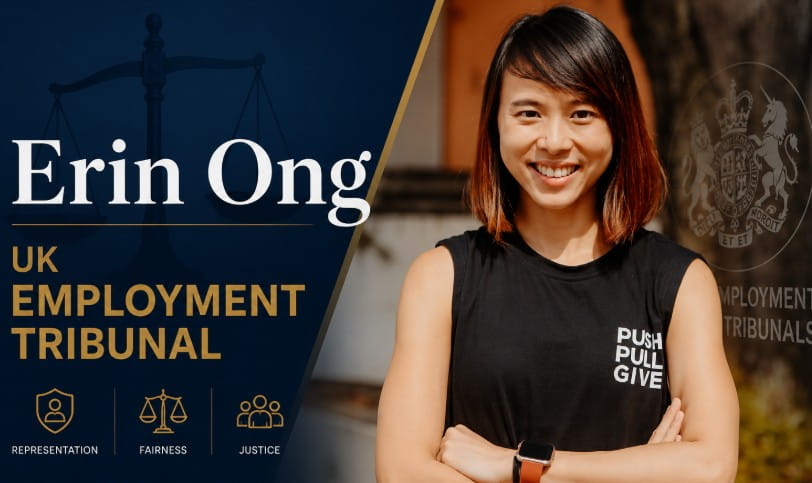
Erin Ong UK Employment Tribunal Case: Vital Equality Act for SMEs
The Erin Ong UK Employment Tribunal case (Ms E C L Ong v Yatson & Co Ltd, Case Number: 2411704/2023) is a landmark judgment by the Manchester Employment Tribunal.
It establishes that individuals lacking a valid visa or the legal right to work in the UK can still successfully bring claims against employers for statutory workplace discrimination under the Equality Act 2010, regardless of the validity of their employment contract.
What is the Erin Ong UK Employment Tribunal Ruling?
The Erin Ong ruling confirms that while an undocumented worker’s immigration status invalidates their employment contract under the common law doctrine of illegality, it does not strip them of statutory protections against discrimination, harassment, and victimisation.
The decision serves as a crucial legal warning for small and medium-sized businesses (SMEs) across the UK. It highlights that contractual invalidity does not grant immunity against substantial Equality Act 2010 financial penalties.
Contractual vs. Statutory Claims
The former relies on a valid employment agreement, while the latter is an independent right protected by law. The following table outlines how these two categories diverge in legal standing, financial liability, and eligibility when disputes arise.
| Legal Parameter | Contractual Claims | Statutory Discrimination Claims |
| Right to Work Required | Yes. Must possess a valid visa or work permit. | No. Statutory protections apply to all workers. |
| Impact of Contract Illegality | Entirely voids the claim, causing it to be dismissed. | None. The statutory tort remains fully actionable. |
| Applicable Legislation | Employment Rights Act 1996 | Equality Act 2010 |
| Statutory Financial Caps | Subject to strict upper limits and maximums. | No upper limit or statutory financial cap. |
| Core Examples | Unfair dismissal, notice pay, redundancy pay. | Disability, race, and sex discrimination. |
The Separation Between Contractual and Statutory Protection
Tribunals separate these categories to ensure the common law doctrine of illegality is not used by businesses to shield themselves from the financial consequences of discriminatory conduct.
When reviewing decisions involving migrant workers, tribunals seek to prevent the weaponisation of immigration status. While a breach of the Immigration Act 1971 voids contractual entitlements (like holiday pay) because courts cannot enforce an illegal contract, statutory claims function as independent torts.
The fundamental right to be free from harassment belongs to every individual meeting the statutory definition of a worker, detached from contractual validity.
Why Did the Tribunal Separate Immigration Status from the Equality Act 2010?
The separation is rooted in public policy and the expansive legislative intent of Section 83 of the Equality Act 2010, which protects anyone engaged to personally do work, regardless of their immigration status.
Employment Judge Susan Dennehy determined that the discrimination suffered by the claimant was not linked to her unlawful performance of work.
If the courts allowed an illegal contract to extinguish human rights protections, rogue employers would gain a financial incentive to recruit undocumented workers, exploit them with impunity, and rely on that status to escape accountability.

Which Specific Claims Were Upheld by the Judge?
The tribunal upheld three severe forms of statutory discrimination arising from the claimant’s brief 36-day tenure as a financial manager and receptionist at the Fisherbeck Hotel in Ambleside, Cumbria.
Disability Discrimination in the Erin Ong UK Employment Tribunal Case Under Sections 20 and 21
The claimant, a former PwC tax consultant, was a lifelong sufferer of severe childhood asthma. Despite notifying management of her physical limitations, she was forced to handle down-feather pillows, work in heavily dusty environments, and use aggressive cleaning chemicals without protective gear.
Consequently, the tribunal found that the respondent failed in its statutory duty to implement reasonable adjustments, directly worsening her medical condition.
Race and Sex Discrimination Under Section 13
The tribunal found that the hotel director, Zhiyong Zhou, subjected the claimant to hostile, degrading, and targeted text messages that were distinctly gendered and racially motivated.
Upon terminating her employment via WhatsApp, management withheld her accrued earnings. They explicitly demanded the physical surrender of her passport before any funds would be released, a coercive practice that was never applied to British or European staff members.
The Impact of the Witness Credibility Gap
When these disputes reach a hearing, the outcome frequently hinges on the relative credibility of the witnesses under cross-examination.
During cross-examination regarding the coercive WhatsApp messages and passport withholding, the hotel director repeatedly answered with I cannot remember or offered shifting, uncorroborated narratives.
Employment tribunals view evasive testimonies with severe skepticism. Because the respondent failed to provide clear, contemporaneous business records to counter the claimant’s meticulously documented logs, the judge drew adverse inferences, resulting in the total rejection of the employer’s defense.
How is Compensation Calculated in a UK Discrimination Case?
Discrimination claims are uncapped; tribunals aim to fully restore the claimant to the financial position they would have occupied had the discrimination not occurred, often leading to significant awards for SMEs.
Financial Loss vs. Injury to Feelings
Tribunal awards are divided into two distinct components:
- Financial Loss: This covers past and future loss of earnings, lost pension contributions, and expenses incurred due to the discrimination. If a highly qualified worker suffers psychological trauma that prevents them from returning to high-level corporate employment, an SME can be ordered to cover years of projected career losses, a financial strain that often forces UK business owners to plan job cuts to stay solvent. employment, an SME can be ordered to cover years of projected career losses.
- Injury to Feelings: This is a distinct, non-financial head of damage designed to compensate the claimant for the emotional distress, anxiety, humiliation, and psychological suffering caused by the employer’s actions.

The Vento Bands Framework
Judges determine injury to feelings awards by applying the formal Vento bands framework, which is updated annually to adjust for inflation. The bands assess severity across three tiers:
- The Lower Band: Applied to isolated, minor, or one-off incidents of discriminatory behavior.
- The Middle Band: Reserved for serious cases that do not merit inclusion in the highest band, such as prolonged campaigns of workplace harassment or discriminatory dismissals.
- The Highest Band: Triggered by exceptionally severe, systemic, and prolonged campaigns of discrimination, harassment, and victimisation. Cases involving physical intimidation, coercive passport retention, or malicious attempts to destroy a worker’s livelihood fall directly within this category, with top-tier awards exceeding tens of thousands of pounds.
The final financial liabilities for Yatson & Co Ltd will be formally determined at a designated remedy hearing. This hearing will mathematically aggregate the claimant’s calculated career disruption and severe injury to feelings.
How Can UK SMEs Protect Themselves from Severe Tribunal Risk?
Mitigating these severe litigation risks requires a shift away from informal, ad-hoc HR practices and implementing institutionalised compliance structures.
To fully protect your business from immigration penalties and discrimination claims, follow these critical compliance steps:
- Conduct formal Right to Work checks via the official Home Office online portal or using certified Identity Verification Technology before any individual performs a single hour of work.
- Issue an explicit, written statement of employment particulars on or before day one of employment to establish clear, lawful, and transparent terms.
- Establish a zero-tolerance workplace harassment policy that clearly defines protected characteristics and mandates formal reporting lines outside the direct chain of command.
- Implement mandatory equality, diversity, and inclusion training for all directors, line managers, and supervisors, documenting attendance to secure a statutory defense.
- Formally record and archive all reasonable adjustment requests made by staff with chronic health conditions or neurodivergent diagnoses, ensuring you apply the social model of disability to remove systemic barriers.
- Ban the use of casual text messaging, WhatsApp, or personal social media channels for formal disciplinary processes, performance management, or dismissals.
- Engage an independent, external HR auditor or employment law specialist to conduct an annual review of your recruitment pipelines, onboarding workflows, and payroll records.

The Danger of Failing Right-to-Work Inspections
Failing to perform proper verification checks exposes a company to dual legal liabilities. In addition to losing protection against discrimination claims, business owners face severe administrative enforcement from the Home Office.
The employer in the Ong case had previously been hit with a £10,000 civil penalty for immigration non-compliance.
Under current Home Office enforcement frameworks, civil penalties for employing illegal workers can reach up to £60,000 per undocumented individual for repeat offenses, alongside the potential revocation of sponsor licenses and criminal prosecution for directors.
Professionalising Digital Communications in Disciplinary Tracks
A recurring vulnerability for small firms is the reliance on informal messaging apps like WhatsApp to execute high-risk corporate actions, such as suspensions or dismissals. Casual, emotion-driven messages sent by managers late at night are fully discoverable in legal proceedings.
When a tribunal reviews a transcript filled with unprofessional language, aggressive demands, or dismissive remarks, it heavily damages the firm’s credibility.
All disciplinary actions must be managed through formal, written letters drafted on corporate letterhead, delivered via traceable methods, and executed following a structured, compliant process.
Final Summary and Next Steps
The Erin Ong v Yatson & Co Ltd case clarifies that contractual illegality offers no defense against Equality Act 2010 claims. For UK SMEs, the lesson is clear: immigration compliance and ironclad HR documentation are not optional.
Owners must audit their onboarding pipelines immediately to avoid the catastrophic financial risks highlighted by this 2026 tribunal decision.
FAQ about Erin Ong UK Employment Tribunal
Can an undocumented worker claim compensation for discrimination in the UK?
Yes. The tribunal confirms that while an undocumented worker’s illegal status invalidates an employment contract, it does not remove their absolute right to claim uncapped financial compensation for discrimination under the Equality Act 2010.
What was the case number for the Erin Ong tribunal?
The official case reference for this specific litigation is Ms E C L Ong v Yatson & Co Ltd, Case Number: 2411704/2023, heard at the Manchester Employment Tribunal.
When is the final remedy hearing for Ms E C L Ong v Yatson & Co Ltd?
The formal remedy hearing to calculate the exact financial compensation, loss of earnings, and injury to feelings payout is scheduled for June 1, 2026.
What are the 9 grounds for discrimination under the Equality Act 2010?
The nine protected characteristics are age, disability, gender reassignment, marriage and civil partnership, pregnancy and maternity, race, religion or belief, sex, and sexual orientation.
What are the statutory limits on unfair dismissal awards?
Standard unfair dismissal payouts are subject to strict statutory limits tied to length of service and weekly pay caps. Conversely, discrimination claims face no such restrictions, leaving small firms exposed to unlimited financial liability.
What is an example of disability discrimination at work?
An example is forcing an employee with a known, severe respiratory condition to clean rooms filled with heavy dust, down feathers, and harsh chemical fumes without adjustments, as seen in the Ms E C L Ong v Yatson & Co Ltd case.
Can a business face Home Office civil penalties and a tribunal claim at the same time?
Yes. Immigration enforcement and employment tribunals operate independently. An SME can be fined up to £60,000 per illegal worker by the Home Office while simultaneously facing uncapped financial damages at an employment tribunal.
Does contractual illegality block all types of workplace claims?
Yes, regarding standard contract-dependent claims. Contractual illegality will successfully block basic claims like notice pay, redundancy compensation, or unfair dismissal under 2 years, but it offers absolutely no defence against claims of discrimination, harassment, or human rights violations.